Posted by Mustafa Abbas on September 02, 2026 | Views: 350 | Ratings: 221
Download article from link below at the end
Contemplation in Islamic Thought: A Comprehensive Analysis of Reflecting on Creation and the Prohibition of Pondering the Divine Essence
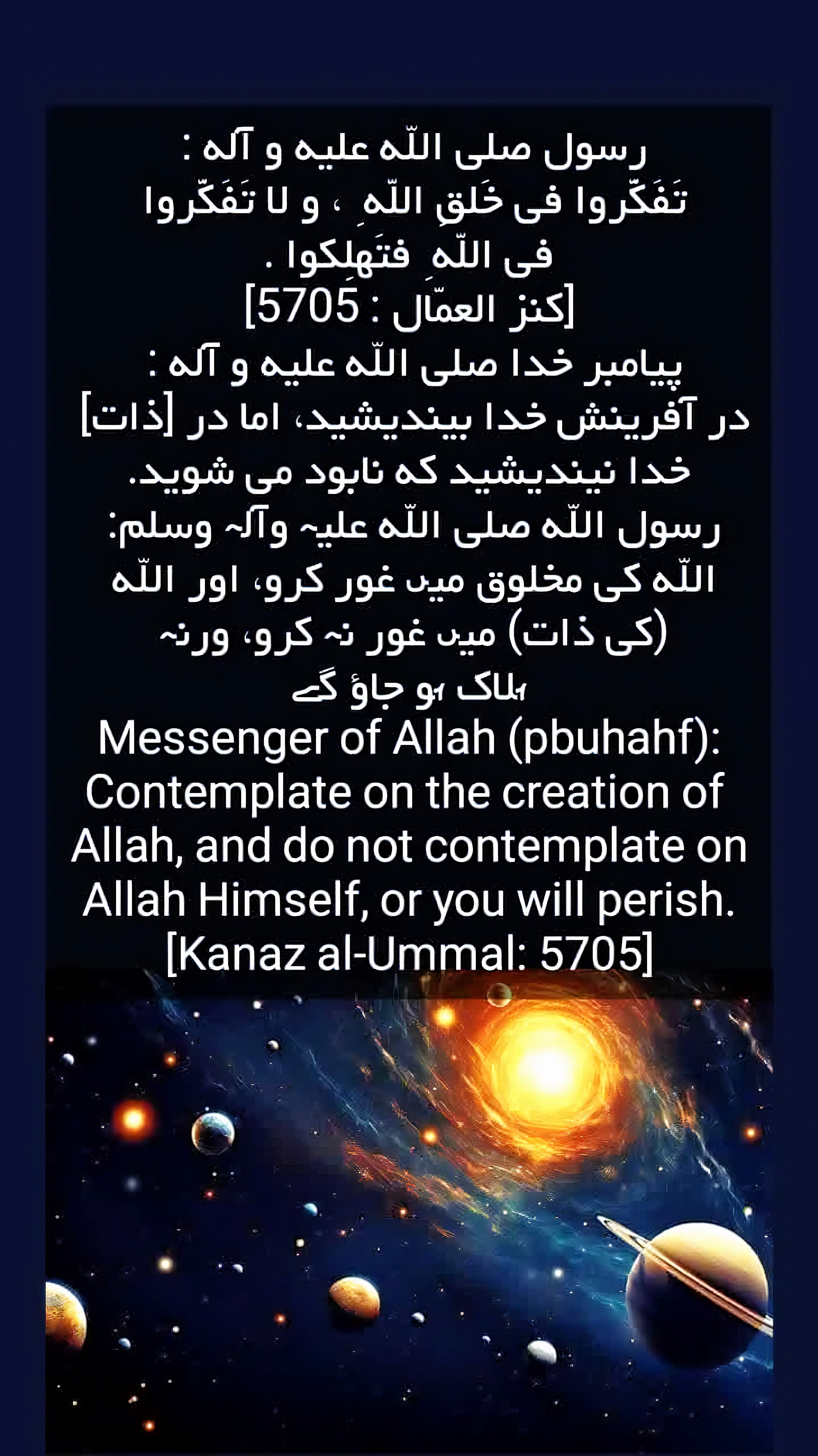
Islamic tradition presents a profound and nuanced approach to contemplation, establishing clear boundaries for human intellectual inquiry while simultaneously encouraging deep reflection on the created world. At the heart of this framework lies the prophetic saying: " ‘Ponder about the creation of Allah, but do not ponder about Allah Himself lest you be ruined." [Kanz al-Ummal, no. 5705]
This hadith, attributed to Prophet Muhammad (peace be upon him and his progeny), articulates a fundamental principle in Islamic theology that delineates the limits of human intellect in comprehending the Divine. It contains two essential directives: first, it encourages deep contemplation upon the vastness, complexity, order, and beauty of Allah's creation; second, it issues a stern prohibition against attempting to comprehend or speculate about the actual being or nature (dhat) of Allah Himself.
Part One: The Prohibition Against Contemplating Allah's Essence
The Inherent Limitations of Human Intellect
Islamic teachings unequivocally affirm that the human intellect is inherently finite and limited, incapable of grasping the infinite Essence of Allah. As the Quran states "There is nothing like Him" (Quran 42:11) and “Vision cannot grasp Him, but He grasps all vision.” (Quran 6:103) . The fundamental reason for this prohibition is that infinity cannot fit within a limited container.
Imam al-Sadiq (peace be upon him) issued a stern warning: "Beware of contemplating about Allah, for contemplating about Allah only increases one in confusion. Indeed vision cannot comprehend Allah [Quran 6:103], nor can He be described by measure."
[Wasa'il al-Shia Vol. 16, Section 2, Chapter 23, Hadith 21334]
Similarly, Imam al-Baqir (peace be upon him) advised: "Beware of contemplating about Allah, but if you want to look at His greatness, then look at the greatness of His creation."
[Wasa'il al-Shia Vol. 16, Section 2, Chapter 23, Hadith 21327]
Imam Zayn al-Abidin (peace be upon him) articulated this profound incapacity in his supplication: "The intellects are incapable of fathoming the essence of Your Beauty, the sights are restricted to looking at other than the splendour of Your Countenance, and You have not set aside any means for Your creation to get to know You except through their complete incapacity of knowing You."
[Bihar al-Anwar, v. 94, p. 150, no. 21]
The prohibition against contemplating Allah's essence is further reinforced by Imam Muhammad bin Ali al-Baqir (peace be upon him), who stated: “Beware of speculating about Allah. However, if you intend to see Allah’s magnificence, then look towards the magnificence of His Creation.
[Al-Taw??d by Shaykh Mu?ammad b. ?Al? al-?aduq, Book 2, Chapter 67, Hadith #20]
Imam Ja'far al-Sadiq (as) said: "Indeed, Allah has manifested Himself to His creation in His words, but they do not perceive." [Bihar al-Anwaar by Allamah Majlisi, Volume 89, Page 107]
Imam Ali Raza (peace be upon him) said: "We say God is All-subtle due to His creation of very fine, minute creatures; so small that we cannot see them and our hand does not feel them"
[Al-Kafi, volume one, page 106. Al-Tawheed, page 185. Uyoon Akhbar Ar-Ridha, vol 1, page 127]
Imam al-Hadi (a.s.) said, "Verily the Creator can only be described by that which He Himself has described Himself, and how can the Creator ever be described anyway, Whom the senses are incapable of perceiving and the imaginations unable to grasp and the ideas unable to confine and the sights unable to contain?! He is too exalted for the description of those who undertake to describe, and too high to be attributed by those who seek to attach attributes to Him."
[Kashf al-Ghamma, v. 3, p. 176]
The Consequences of Speculation
The warning "lest you perish" or "lest you be ruined" highlights the severe spiritual and intellectual consequences of attempting to grasp Allah's essence directly. The reasons for this prohibition are multifaceted:
- Limiting God and Creating an Invented Deity: Any attempt to think about God's essence inevitably leads to imposing limitations, definitions, or forms upon Him, thereby diminishing one's true knowledge of Him. Imam Ali (peace be upon him) explained: "The very first step in religion is acknowledging Him, and the perfect way to acknowledge Him is to testify to Him, and the perfect way to testify to Him is to believe in His divine unity, and the perfect way to believe in His divine unity is to regard Him as absolutely pure, and the perfect way to regard Him as absolutely pure is to negate all attributes from Him, for every attribute is a proof of its own distinction from the thing to which it is attributed, and everything that is attached and attributed is distinct from the attribute. Thus, whoever attaches attributes to Allah, Glory be to Him, associates Him with something else, and whoever associates Him regards Him as two, and whoever regards Him as two identifies parts to Him, and whoever identifies parts to Him has indeed misunderstood Him, and whoever misunderstands Him singles Him out, and whoever singles Him out has confined Him, and whoever confines Him has enumerated Him. Whoever asks ‘In what [is He]?’ holds that He is contained, and whoever asks ‘On what [is He]?’ has excluded Him. He is [a Being] but not through any phenomenon of coming into being, He exists but not from non-existence. He is with everything but not in physical proximity, and is separate from everything but not through physical separation. He acts but without need for movements and instruments. He sees without need for an object of sight from among His creation. He is One such that He has no need for a source of comfort that may keep Him company nor any whom He may miss in his absence."
[Nahj al-Balagha, Sermon 1]
Imam Ali Raza (peace be upon him) said, "The very first step to Allah’s worship is to attain inner knowledge of Him, and the origin of attaining inner knowledge of Allah, Exalted be His Praise, is through His divine Unity. The very basis of His divine Unity is to negate any kind of limitation from Him, since the intellects are able to witness that every limited being is created."
[Amali al-Tusi, p. 22, no. 28]
- Spiritual Destruction: Prophet Mohammad (peace be upon him and his family) said: "Ponder about the creation of Allah, but do not ponder about Allah Himself lest you be ruined."
[Kanz al-’Ummal, no. 5705]
Imam Jafar al-Sadiq (peace be upon him) explicitly stated that "Whoever contemplates about how Allah is (His essence), is ruined/destroyed." [Wasa'il al-Shia Vol. 16, Section 2, Chapter 23, Hadith 21328]
- Weakening Faith and Deviation: This kind of contemplation can weaken one's faith, lead to confusion, perplexity, deviation, and even polytheism. Imam Abu Abdullah (peace be upon him) warned: "Beware of contemplating about Allah, for contemplating about Allah only increases one in confusion." [Wasa'il al-Shia Vol. 16, Section 2, Chapter 23, Hadith 21334]
The Meaning of 'Allah' and the Impossibility of Knowing His Essence
The very name 'Allah' offers insight into this prohibition. One meaning of 'Allah' (Al-ilah) is "the God."
Imam Ali Raza (peace be upon him) said, "His essence is a partition between Himself and His creation."
[al-Tawhid, p. 36, no. 2]
This emphasizes that knowing the essence of Allah (SWT) is impossible for human beings.
Distinguishing Between Attributes of Essence and Attributes of Action
To facilitate proper understanding and worship without delving into the unknowable essence, Islamic theology categorizes Allah's attributes into two fundamental types:
Attributes of Essence (Sifat al-Dhat): These are inherent to the Divine Being, which the Essence must necessarily possess and which can never be separated from Him. They are affirmed for Allah without considering any relation to His creatures. Examples include:
- Ever Living (hayy): God is eternally Living
. Powerful (qadir): His omnipotence is an intrinsic perfection
- Omniscient (aalim): God's knowledge is essential, encompassing all things Hearing (sami') and
- Seeing (basir): Describing God's perfect awareness
Attributes of Action (Sifat al-Fel): These are attributed to Allah when the intellect considers His relation, agency, or effects with respect to creation. Examples include:
- Creator (khaliq): God is called Creator with respect to His act of bringing entities from non-existence to existence
- Sustainer (raziq): This denotes His act of providing sustenance
- Giver of life (muhyi) and Annihilator (mumit): These names refer to His acts in the created realm
A crucial principle is that Allah's attributes of Essence are not separate from His Essence but are identical to it. Unlike human attributes, which are distinct from our being, Allah's attributes are His Essence. Allah is Knowledge, Allah is Power, Allah is Life; it is not that He has these attributes as separate entities. Understanding this unity is essential for true Tawheed (Oneness of God).
Part Two: The Encouragement to Contemplate Allah's Creation
A Superior Form of Worship
In contrast to the prohibition on contemplating Allah's Essence, reflecting on His creation is not only permitted but highly encouraged and considered a superior form of worship.
Imam al-Sadiq (peace be upon him) is reported to have said that "The best worship is continuous/persistent contemplation about Allah and His power."
[Wasa'il al-Shia Vol. 15, Section 2, Chapter 5, Hadith 20260]
Imam Jafar al-Sadiq (peace be upon him) said: "The best of worship is addiction to the contemplation of Allah and His ability." [al-Kafi by Shaykh al-Kulayni, Volume 2, Page 55]
Imam Jafar al-Sadiq (peace be upon him) said, "Thinking for an hour is better than worshipping for a year, for “Only those who possess intellect take admonition”[Quran 39:9]."
[Bihar al-Anwar, v. 71, p. 327, no. 22]
Imam Hasan al-Askari (peace be upon him) said: "Worship is not the abundance of fasting and praying, rather worship is the abundance of contemplation in the matter of Allah."
[Tuhaf al-Uqul by Ibn Shu'ba al-Harrani, Volume 0, Page 488]
Imam Jafar al-Sadiq (peace be upon him) said: "The most frequent worship of Abu Dharr, may Allah have mercy on him, was contemplation and taking lessons."
[Wasa'il al-Shia Vol. 15, Section 2, Chapter 5, Hadith 20264]
The example of Abu Dharr (r.a.), whose greatest worship was his pondering and thinking, highlights the vital role of introspection in a Muslim's spiritual journey.
The Holy Quran is replete with exhortations to reflect on creation. Over 750 verses speak about knowing God through natural phenomena.
I swear by the Book that makes things clear:Surely We have made it an Arabic Quran that you may understand.And surely it is in the original of the Book with Us, truly elevated, full of wisdom.
(Quran 43:2-4)
Imam Jafar al-Sadiq (peace be upon him) said: "Indeed this Quran contains beacons of guidance and lamps for darkness, so let one who seeks polish his vision and open his sight to the light, for contemplation/reflection is life to the heart of the insightful one, just as one seeking light walks in darkness with illumination."
[Wasa'il al-Shia Vol. 6, Section 4, Chapter 3, Hadith 7655]
"Most surely in the creation of the heavens and the earth and the alternation of the night and the day there are signs for men who understand. Those who remember Allah standing and sitting and lying on their sides and reflect on the creation of the heavens and the earth: Our Lord! Thou hast not created this in vain! Glory be to Thee, save us then from the chastisement of the fire."
(Quran 3:190-191)
Upon the revelation of a series of verses, specifically Surah Al Imran (3:190-194), the Holy Prophet Muhammad (peace be upon him and his family) was deeply moved. Accounts state that one night, before his prayers, he recited these verses and wept profusely, so much so that his clothes and the ground became wet. Subsequently, he issued a solemn warning: "Woe unto him who reads this verse and does not contemplate it." This profound statement highlights that merely reciting the words of the Quran, especially these specific verses, without deep reflection and understanding, is a missed opportunity for spiritual growth and can even lead to spiritual detriment. The Prophet himself would recite these verses before his midnight prayers, indicating their immense significance.
Core lessons from these verses
Nature is a book of signs.
The universe is not disconnected from faith. In Islam, observing creation is a way of knowing God.
True understanding combines mind and heart.
Reason, reflection, and remembrance of God work together. A person of understanding uses both intellect and spirituality.
Life has meaning and purpose.
The universe is not created in vain. Human life also has purpose: to know and worship God.
Reflection should lead to humility.
Pondering God’s creation should make a person glorify God and seek His protection, not become arrogant.
Worship is not limited to ritual.
Remembering God while standing, sitting, and lying shows that a believer’s whole life can be lived in awareness of God.
This underscores the imperative for believers to ponder deeply on the signs of creation.
"Most surely in the heavens and the earth there are signs for the believers. And in your (own) creation and in what He spreads abroad of animals there are signs for a people that are sure, and (in) the variation of the night and the day, and (in) what Allah sends down of sustenance from the cloud, then gives life thereby to the earth after its death, and (in) the changing of the winds, there are signs for a people who understand." (Quran 45:3-5)
This verses meticulously enumerates various categories of divine signs:
- General Signs in the Heavens and the Earth (45:3): These signs are for "the believers," serving to reinforce and deepen their faith in Allah's overarching design and omnipotence. This encompasses celestial bodies, cosmic order, and the fundamental structure of the universe.
- Specific Signs in Human Creation and Animals (45:4): These are presented as signs for "a people that are sure," indicating that reflection upon one's own intricate creation (microcosm) and the vast diversity of animal life leads to a higher degree of certainty (yaqin) in the Creator. The text emphasizes that human creation is as enigmatic as a metropolitan city, with intricate systems of veins, nerves, and organs, and that countless animal species each bear testimony to Divine Signs.
- Dynamic Signs in Natural Phenomena (45:5): These signs, including the alternation of night and day, rain reviving dead earth, and the changing of winds, are for "a people who understand" (ya?qilun). These processes demonstrate Allah's continuous sustenance, renewal, and management of the world, appealing to the intellect to grasp the wisdom behind their calculated and astonishing order. For instance, the alternation of night and day prevents extreme temperatures, and rain is a life-bestowing element, while winds purify the air, pollinate plants, and facilitate navigation.
Important lessons
1. Nature is a book of signs
In Islam, the natural world is not separate from revelation. The Quran repeatedly calls the universe an open book pointing to God. But it requires spiritual and intellectual awakening to read it.
2. Faith, certainty, and reason work together
The verse mentions three qualities:
faith — the heart’s acceptance
certainty — deep, unshakable conviction
understanding — the use of reason
Islam does not separate belief from thinking. True faith is strengthened by reflection and knowledge.
3. Human beings should reflect on themselves
“And in your own creation…”
This is a call to self-reflection. The human being is a profound sign. Our bodies, minds, emotions, and development all testify to a Creator.
4. The cycles of nature point to resurrection
The revival of dead earth through rain is one of the Quran’s most repeated proofs for life after death. Just as dry, barren land comes alive after rainfall, so too will human beings be raised after death.
5. God’s mercy and providence
Rain is called “provision” (rizq). Winds are directed by God to carry clouds, pollinate plants, and bring relief. All of this shows that the universe is not random — it is cared for and governed by a Merciful Creator.
The Quran repeatedly urges humanity to engage in At-Tadabbur (Quranic contemplation) and At-Tafakkur (reflection on creation) to foster a deeper understanding of Allah's existence, power, and wisdom. This intellectual engagement is not merely an academic exercise but a fundamental aspect of faith and spiritual growth.
The verse "Do they not reflect within themselves: Allah did not create the heavens and the earth and what is between them two but with truth and (for) an appointed term? And most surely most of the people are deniers of the meeting of their Lord" (Quran, 30:8) directly calls for self-reflection ("within themselves") on the foundational truth of creation. It emphasizes several crucial aspects:
- Self-Reflection (Within Themselves): The verse begins by prompting individuals to look inward and consider their own understanding of existence. This internal inquiry is the starting point for recognizing universal truths.
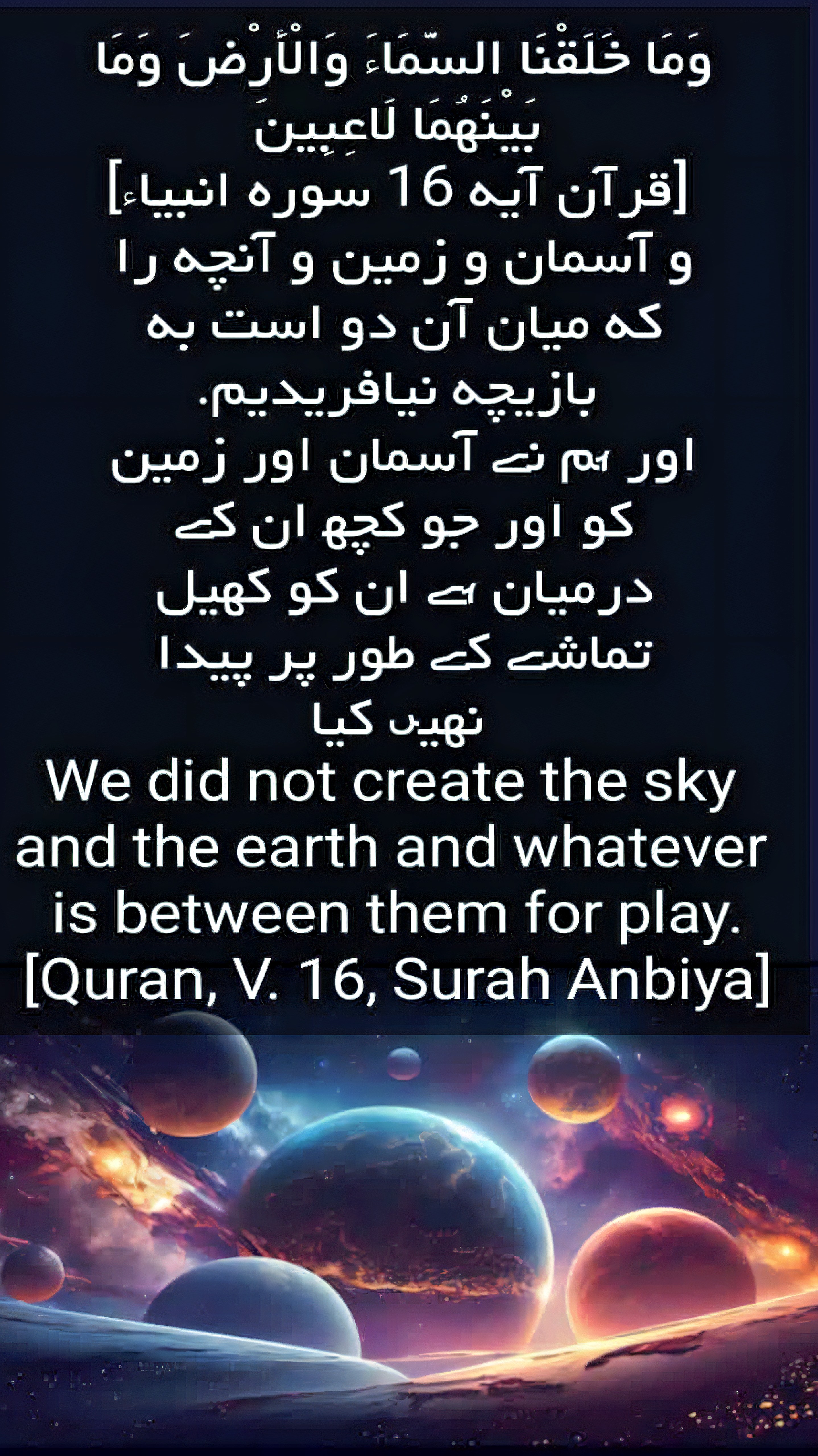
- Creation with Truth (bi al-haqq): The universe is not a product of chance or frivolity but is imbued with profound purpose and truth. This negates any notion of vain or meaningless existence. Those who reflect deeply affirm, "Our Lord, You have not created this in vain!" (Quran, 3:190-191). The creation is described as not being "in sport or play, but with a purpose and a truth," reflecting the sublimity of Divine actions and wisdom.
- Appointed Term (ajal musamma): Everything has a designated duration, pointing to the temporary nature of this world and the certainty of the Hereafter. This understanding counters heedlessness and denial of accountability. The existence of an " appointed term " for everything between the heavens and the earth reinforces the idea of a purposeful creation and a final reckoning.
- Consequence of Neglect: The verse highlights that " And most surely most of the people are deniers of the meeting of their Lord." This implies a direct correlation between a lack of reflection on creation's purpose and the denial of the afterlife. Failure to ponder these truths leads to being unaware of the purpose of creation and the consequences of one's actions, and ultimately, to denying a life after death.
Key lessons from the verse
- Creation has deep purpose.
The universe is not meaningless. It was created with truth, wisdom, and justice. - Human beings should reflect on themselves.
One of the clearest signs of God is the human self. Pondering our own existence leads to awareness of the Creator. - The world is temporary.
“An appointed term” teaches that neither the universe nor human life is eternal. This world will end. - There is accountability.
Because creation is purposeful and temporary, there must be a final judgment. Otherwise, justice and purpose would not be fulfilled. - Neglecting reflection leads to heedlessness.
The verse is a rebuke to those who live only for the visible world and do not think about the deeper reality of existence.
The verse "We will soon show them Our signs in the Universe and in their own souls, until it will become quite clear to them that it is the truth. Is it not sufficient as regards your Lord that He is a witness over all things?" (Quran, 41:53) promises a continuous revelation of divine signs, both in the external world and within the human being. This promise serves to clarify the ultimate truth:
- Signs in the Horizons: This refers to the external universe, the wonders of nature, celestial bodies, and the intricate order of existence. The Quran repeatedly calls for deliberation on "God's signs, and the beauties, wonders, rhythm, and coordination which is controlling them in order to discover the existence of a Learned, Wise and Omnipotent God." Contemplating the wonders of nature helps a person to recognize Allah as "the fundamental designer of the Universe," guiding them towards faith and away from disobedience.
- Signs in Themselves: This refers to introspection, reflection on one's own physical and spiritual composition, the complexities of the human body, mind, and soul, and the innate sense of accountability. Reflection on one's creation and nature helps to cultivate a deeper understanding of one's place in the world and relationship with Allah.
- Clarity of Truth: The ultimate purpose of showing these signs is for the truth ("that it is the truth") to become clear. This signifies that empirical observation and self-reflection are not divorced from faith but are integral to confirming and deepening it.
- Esoteric Interpretation: According to Imam Jafar Sadiq (asws), the sign "in the horizons" refers to the areas that people inhabit becoming smaller, and the sign "within themselves" refers to the disfigurement of people. The verse also refers to the reappearance of al Mahdi (atfs), indicating that He is the truth.
Key lessons
- Signs are everywhere.
God’s existence and the truth of His message are supported by signs in the universe and within human beings. - External and internal reflection both matter.
Islam encourages studying the world and knowing oneself. Both lead to God. - Truth will eventually become clear.
Sincere seekers will recognize the truth, while hardened rejecters will see it too late. - God is the greatest witness.
His knowledge is sufficient. We do not need God to prove Himself on our terms. His witness over all things is absolute. - Denial carries responsibility.
Since God witnesses everything, rejecting the truth after it becomes clear is a serious matter.
"Do they not then reflect on the Quran? Nay, on the hearts there are locks." (Quran 47:24)
The latter part of the verse, "Nay, on the hearts there are locks," identifies the core reason why some individuals fail to reflect on the Quran: a spiritual impediment that prevents them from accessing its guidance and wisdom. A locked heart is akin to an eye that has been sealed shut, rendering it unable to perceive light or anything visible in light. This signifies a profound spiritual blindness and deafness.
The "locks upon their hearts" refer to a state where the heart is closed off or blocked, making it unwilling to listen to or accept the guidance of the Quran. It is a spiritual barrier that hinders comprehension and understanding. The provided texts offer several insights into the nature and causes of these locks:
- Spiritual Insensitivity: The unfortunate state of having locked hearts can stem from carelessness toward divine guidance, a lack of perception, or an insensitivity of the heart.
- Following Vain Desires and Vicious Acts: Those who follow their vain desires and engage in vicious acts contribute to the locking of their hearts. Such evil deeds become like a "rust upon their hearts," as mentioned in Surah Mutaffifeen (Quran 83:14): "Nay! Rather, what they used to do has become like a rust upon their hearts." This rust overwhelms and covers the heart like thick coverings, similar to how an intoxicant confuses and blocks the mind, preventing understanding and feeling.
- Divine Consequence of Disbelief: The Quran also speaks of Allah setting a seal upon hearts as a consequence of disbelief and deviation. When individuals choose to deviate from the right path, Allah allows their hearts to become misguided and deviated from the truth. This "sealing" is a punishment for their disbelief, making it difficult for them to understand the message. This state is not necessarily a loss of sanity but a resistance to the truth, making it impossible for them to distinguish between right and wrong.
- Rejection and Heedlessness: Individuals who reject the Quran and pursue their own whims are described as having their hearts sealed by Allah, preventing them from truly listening and understanding the Prophet's message. These individuals are heedless and do not pay attention to the truth. Other verses elaborate on this, describing "Allah has set a seal upon their hearts and upon their hearing, and over their vision is a veil"(Quran 2:7) and "And We have placed coverings on their hearts and a heaviness in their ears lest they understand it" (Quran 17:46) to signify a spiritual inability to grasp the truth.
The Value and Benefits of Tafakkur
Tafakkur, or contemplation, is described as the "it is the life of the insightful's heart " seeking to understand the ultimate purpose and aim of life. Imam Hasan al-Mujtaba (peace be upon him) said: "You should contemplate, for it is the life of the insightful's heart and the keys to the doors of wisdom." [Bihar al-Anwaar by Allamah Majlisi, Volume 75, Page 115]
The practice holds immense spiritual significance:
- Guidance to Righteousness and Action: Tafakkur is not detached theorizing; it actively leads to righteousness and encourages its performance. It helps individuals grasp the true meaning of the Quran and live in accordance with its teachings, moving beyond the mere following of rituals.
- Essential for Meaningful Worship: Worship without insight and reflection is considered incomplete or even worthless. Imam Ali (peace be upon him) stated: "Be aware! Knowledge without thinking has no profit! Be aware! Recitation of the Quran without reflection is of little use! Be aware! Worship lacking reflection has no effect!"
[Al-Kafi, Volume One, Page 36 and Tuhaful Uqul, Maani Al-Akhbar, page 226; Bihar Al-Anwar Volume 2, page 48-49, Aalamu Addeen, page 100, Mishkat Al-Anwar 137-138, Muniat Almureed 162.]
- Purification of the Soul: Thinking about Allah's creatures and the universe can purify one's soul, leading to spiritual well-being and felicity. It helps individuals renounce misconceptions spread by nonbelievers and guides them towards understanding the truth.
- Deepening Connection with Allah: Contemplating Allah's qualities (as manifested in creation) deepens understanding and connection with Him, which is considered the true meaning of worship.
Specific Aspects of Creation for Contemplation
Islamic teachings urge reflection on numerous aspects of creation:
- The Heavens and the Earth: The Quran consistently highlights the creation of the heavens and the earth as primary signs of Allah's power and wisdom. The vastness and precision of the cosmos manifest Allah's knowledge, power, and mercy. The interdependence of elements like earth, water, air, and celestial bodies reveals a unified creative plan.
- The Alternation of Night and Day: The rhythmic succession of night and day is one of the most accessible signs for everyday contemplation. The Quran states: "Allah alternates the night and the day; verily there is a lesson in this for those with sight." (Quran 24:44). It demonstrates divine wisdom and care, providing balance between work and rest.
- Celestial Bodies: The sun, moon, and stars, with their precise orbits and functions, are presented as magnificent signs of Allah's power and design. The ordered movement of celestial bodies demonstrates an astonishing system that governs the universe.
- Humanity and Animal Life: The Quran explicitly invites reflection on "your (own) creation" as a sign for people who are sure. The intelligence, understanding, and complexity of human beings point to a Creator who is supremely intelligent. The human body with its intricate systems, the faculties of sight and hearing, and the capacity for thought are all creations pointing to a Creator who is supremely intelligent.
- The Natural World: Plants, rain, winds, mountains, and seas all serve as signs of Allah's power, knowledge, and wisdom. The sending down of sustenance from the clouds, giving life to the earth after its death, and the changing of the winds are all signs for people who understand.
The Concept of 'Signs on the Horizons' and 'Signs within the Soul'
The Quranic phrase "We will soon show them Our signs in the Universe and in their own souls, until it will become quite clear to them that it is the truth. Is it not sufficient as regards your Lord that He is a witness over all things?" (41:53) establishes a dual framework for contemplation:
Signs on the Horizons (ayat fi al-afaq): These refer to the vast external world—the heavens, earth, and all cosmic and natural phenomena. They manifest Allah's knowledge, wisdom, and power on a grand scale. This includes:
Celestial bodies and phenomena: The creation of the heavens, the stars, the sun, and the moon
Terrestrial features: The earth itself, its mountains, seas, rivers, and diverse terrains
Natural cycles and processes: The alternation of night and day, rainfall reviving the earth, the changing of the winds
Biological life: The constitutions of minerals, plants, and animals
Patterns and systems of nature: The overall coherence and compatibility of creation
Signs within the Soul (ayat f? anfusihim): These pertain to the inner dimension of the human being— the structure of the body, the faculties of the soul, consciousness, and spiritual experiences. These signs highlight the intricacy and miraculous nature of human existence as a testament to the Creator. This includes:
The fitrah (primordial disposition): The natural inclination towards truth, justice, and the worship of One God
- The conscience (wijdan): The inner voice that reproaches a person for evil and finds peace in goodness
The intellect ('aql): The faculty that can grasp universals and seek meaning beyond material appearances
The capacity for love, mercy, and self-sacrifice
The structure of the human body, the faculties of the soul, and inner states of consciousness
Deeper Interpretations of 'Signs on the Horizons'
Traditions of the Ahl al-Bayt (peace be upon them) offer deeper, sometimes eschatological, interpretations of Quran 41:53. These interpretations link "signs on the horizons" to societal and cosmic transformations that precede the rise of the Q?'im (Imam al-Mahdi, may Allah hasten his reappearance).
Imam Jafar al-Sadiq (peace be upon him) explained regarding the verse “[Quran 41:53] We will soon show them Our signs in the Universe and in their own souls, until it will become quite clear to them that it is the truth”, he (asws) said: ‘He (azwj) Showed them in their own selves, the metamorphosis, and Showed them in the horizon, the breakdowns in the horizons so they would see the Power of Allah (azwj) Mighty and Majestic within themselves and in the horizon’.
And about “until it will become quite clear to them that it is the truth”?’ He (asws) said: ‘The coming out of Al-Qaim (asws), it is the truth from the Presence of Allah (azwj) Mighty and Majestic which the creatures will see, it is inevitable’.
[Al-Kafi (Vol. 8) by Shaykh Muhammad b. Ya qub al-Kulayni, Book 1, Chapter 574, Hadith #1]
Another narration from Imam Jafar al-Sadiq (peace be upon him) specified "submerging (in the ground), and metamorphosis, and stoning" as these signs, clarifying that "that is the rising of the Rising One (Al- Qaim (asws))."
[Al-Kafi (Vol. 8) by Shaykh Muhammad b. Ya qub al-Kulayni, Book 1, Chapter 181, Hadith #1]
Part Three: The Relationship Between Tafakkur, Tadabbur, and Tadhakkur
Islamic spirituality distinguishes between related concepts of reflection:
Tafakkur is defined as the "inquisitive groping of the inner vision for attaining the coveted end," signifying an inward journey that moves from preliminary premises to higher goals and realities. It involves using the intellect to reorder known matters to reach new understanding.
[Al-Islam.org, Merits of the Soul: Contemplation - Tafakkur]
That is, reflection is a seeking by the “insight” [basirat], which is the eye of the heart, wanting to attain the aim and the result, which are the utmost perfection. It is quite clear that the destination [maqsad] and the aim [maqsud] are the absolute happiness, attainable through theoretical and practical perfection.
It is described as the insight's attempt to understand the purposehighlighting that it is a seeking by the "insight" (basirat)—the eye of the heart—to attain ultimate perfection and happiness through theoretical and practical understanding.
[Al-Islam.org, Adab-Salat-Disciplines-Prayer-Second-Revised-Edition-Sayyid-Ruhullah-Musawi-Khomeini/Section-Eight]
Tadabbur is a deeper, more nuanced form of reflection that considers the origin and consequences of a matter. It is particularly emphasized for understanding the Quran, unlocking hidden meanings. While Tafakkur is a more general term for deep thinking, Tadabbur involves deducing outcomes from the acquisition of information.
The Quran asks: "Do they not think over the Quran, or are their hearts locked?" (Quran 47:24), emphasizing that Tadabbur unlocks hidden meanings. It is crucial not merely to recite the Quran, but to delve into its depth, examining both its Zahir (exterior) and Batin (interior) aspects.
Tadhakkur is considered the result of Tafakkur; contemplation leads to remembrance of Allah and His truths. Tafakkur is the search for the Beloved, and Tadhakkur is the attainment. The strength and perfection of Tadhakkur are directly dependent on the strength and perfection of Tafakkur.
As long as a person is searching, they are separate from the object of their search. Upon finding the Beloved, the labor of search is relieved. A Tafakkur that results in a complete Tadhakkur of the Worshipped One holds immense merit, which is why an hour of Tafakkur is often considered better than years of other forms of worship.
Part Four: The Purpose of Creation
Worship and Servitude ('Ibadah)
The most explicit purpose for the creation of jinn and humankind is worship and servitude to Allah. The Quran states: "I have not created the jinn and the men except that they worship Me" (Quran 51:56).
Imam Jafar al-Sadiq (peace be upon him) explained that Allah created them for worship, specifying that this is a general command, not limited to particular instances.
[Wasa'il alShia Vol. 1, Section 2, Chapter 19, Hadith 196]
Another core purpose of creation, particularly life and death, is to test humanity. The Quran states: "He is the one who has created death and life so that He may test you to see who among you does good deeds" (Quran 67:2).
The world serves as a testing ground where individuals are tried through their obedience and service to Allah. This test is not because Allah needs to acquire knowledge—He is All-Knowing—but as a means for human beings to demonstrate their faith and develop their spiritual potential. Actions are crucial, and judgment will be based on deeds, not just belief.
The broader purpose of creation is for human beings to recognize Allah's oneness, power, wisdom, and blessings. The Quran states: "Allah is He Who created seven heavens, and of the earth the like of them; the decree continues to descend among them, that you may know that Allah has power over all things and that Allah indeed encompasses all things in (His) knowledge. " (Quran 65:12).
Imam al-Sadiq (peace be upon him), when asked about the purpose of creation, responded that Allah
"He created them to reveal [to them] His wisdom, to execute His knowledge, and to carry out His plan." [Mizan Al-Hikmah, Volume 1, Page 223]
Attaining Perfection and Everlasting Bliss
Human beings were created with the purpose of attaining the highest level of perfection, which leads to a blissful life in the hereafter. This journey is destined for eternity, and the goal is to reach everlasting bliss through constant servitude to God and navigating the tests and trials of this life.
The Quran states: "Did you then think that We had created you in vain and that you shall not be returned to Us?" (Quran 23:115). This rhetorical question emphasizes that human existence has profound meaning and purpose, culminating in the return to Allah.
Allah's Reasons for Creation: Wisdom and Absence of Need
Allah's creation of the world and all its inhabitants was not out of any need for Himself, nor to gain power or strengthen His authority. He created out of His boundless kindness and to manifest His wisdom, power, and glory.
Imam Ali (peace be upon him) stated: "World is created for another purpose, not for itself." [Safinat'ul-Bihar, Bihar Al-Anwar vol 70, page 133, Sharh Nahj Albalagha, vol 20, page 181, Nahj Albalagha page 557]
Imam Mahdi (may Allah hasten his reappearance) conveyed: "Allah has not created the creations as futile and in vain, and has not let them go aimless and purposeless." [Bihar ul-Anwar Vol. 53, P 194]
Specific Islamic Perspective: For the Sake of Holy Divine Guides
According to certain Islamic teachings, the existence of the holy divine guides, represented by Prophet Muhammad (SA) and his purified household, is considered a profound reason for creation's existence. It is believed that the entire universe was created for their sake, signifying their ultimate spiritual importance within the divine scheme.
Part Five: The Role of Tahayyur (Awe and Bewilderment)
A profound state of tahayyur—awe and reverent bewilderment—is a natural and positive outcome when one genuinely contemplates Allah's attributes and recognizes their limitless nature. This positive bewilderment is distinct from the destructive confusion arising from forbidden speculation about the Essence.
This arises from the forbidden attempt to speculate about "how" Allah's Essence is. It leads to confusion, doubt, and spiritual ruin, as warned in the hadith. It results from trying to fit the infinite Divine into finite mental categories, creating a limited and false image of God.
Constructive Tahayyur (Reverent Awe)
This is a spiritually beneficial state that emerges from the proper contemplation of
Allah's creation and His revealed Names and attributes. It is a bewildered awareness of
Allah's absolute transcendence and incomparability. When a believer internalizes that "There is nothing like Him" (Quran 42:11), and that all attributes are identical with His Essence, yet His Essence is beyond grasp, this produces a deep, reverent awe.
Hadiths suggest that "the higher one's belief and ma'rifah (knowledge of God), the more they experience this state of awe and profound questioning." This awe grows precisely because one refrains from limiting God in their mental image.
Benefits of Constructive Tahayyur
Deepens Humility: The servant recognizes the radical disparity between the finite self and the Infinite Lord
Purifies Tawhid: It strips away imagined likenesses and mental idols, affirming Allah's absolute uniqueness
Intensifies Worship: One stands before a Reality that cannot be circumscribed by thought, leading to greater reverence
Spiritual Maturity: It signifies a mature stage where the mind knows its limits, accepting that it cannot fully know the Essence, yet remains firm in belief in the Absolute Reality
Part Six: Practical Steps for Contemplating Creation
Islamic teachings provide practical guidance for integrating contemplation into daily life:
Calm the mind
Set a clear intention
Nature's Elements: A single leaf, flower, fruit, or seed; the movement of water, wind, or clouds; the sun, moon, or stars; an animal, bird, or insect
Humanity and Cycles: The structure of your own hand; the cycle of day and night, or the seasons
Note sensory details: color, shape, texture, size
Observe function and change
. Avoid preconceptions; allow details to surprise and engage you
Level 1 — What is it?: Provide an accurate description
Level 2 — How does it work?: Investigate the systems, laws, or processes that enable its existence
Level 3 — Where did it come from?: Trace its origin
Level 4 — What does it depend on?: Identify its dependencies
Level 5 — What does it point to?: Reflect on whether such precision, interdependence, and beauty could be accidental or if they indicate a Designer
5. Move from the Seen to the Unseen
Recognize divine attributes manifested in the world:
Order: Systematic arrangement in seasons, planetary orbits, and biological rhythms
Beauty: Colors, symmetry, and harmony in creation
Purpose: Everything has a function; nothing is wasted or created in vain
Mercy: Provisions like rain and plant growth sustain living beings
Recognize your interconnectedness with creation
Understand that your existence is not accidental but carries meaning and responsibility
Ask: "What is my purpose? How should I respond to the One who made all this?"
Express praise: "Glory be to the One who created this"
Engage in supplication
Allow the reflections to settle in your heart
8. Incorporate Regular Contemplation
Engage in self-dialogue, reviewing the previous day's actions and intentions
Amir al-Mu'minin Imam Ali (peace be upon him) said: "Awaken your heart with contemplation, keep your side away from bed at night, and fear Allah your Lord."
[Wasa'il al-Shia Vol. 15, Section 2, Chapter 5, Hadith 20258]
Prophet Muhammad (peace be upon him and his family) said: "You must get up for the night prayer, for verily it was the devoted practice of all righteous people before you, and verily the night vigil is a means of proximity to Allah and a prevention from sin." [Kanz al-’Ummal, no. 21428]
The prophetic directive "Ponder on the creation of Allah, and do not ponder on Allah (Himself) lest you perish" provides a vital safeguard for believers. It channels human curiosity and intellect towards a productive and spiritually enriching path—the contemplation of Allah's magnificent creation—while protecting them from an endeavor that is beyond their capacity and fraught with spiritual peril.
True knowledge and awe (ma'rifah and tahayyur) of Allah are attained not by dissecting His unknowable essence, but by recognizing His boundless power, wisdom, and beauty as manifested in everything around us, and acknowledging His absolute transcendence and uniqueness. Through deep reflection on the signs in the horizons and within ourselves, believers can strengthen their faith, purify their souls, and draw closer to their Creator, all while humbly recognizing the limits of human understanding before the infinite majesty of the Divine.
As Imam Zain-ul-Abideen (peace be upon him) advised: "contemplate, meditate, and practice for the (place, thing) that you have been created for, Allah did not at all create you in vain and useless." [Tuhaf al-Uqul, P 274]
Contemplation is not about thinking more but about thinking deeper and slower. It transforms the ordinary into the extraordinary, allowing one to see signs of the Creator everywhere. In the words of Imam Ali (peace be upon him), the human heart is like a house, and Tafakkur is the lamp that illuminates it; without this light, the heart remains steeped in darkness.
Quranic References
(Listed in numerical order by Surah and Verse)
- Quran 2:7 – "Allah has set a seal upon their hearts and upon their hearing, and over their vision is a veil."
- Quran 3:190-191 – "Most surely in the creation of the heavens and the earth and the alternation of the night and the day there are signs for men who understand. Those who remember Allah standing and sitting and lying on their sides and reflect on the creation of the heavens and the earth: Our Lord! Thou hast not created this in vain! Glory be to Thee, save us then from the chastisement of the fire."
- Quran 6:103 – "Vision cannot grasp Him, but He grasps all vision."
- Quran 17:46 – "And We have placed coverings on their hearts lest they should understand it (the Qur'an) and in their ears a heaviness."
- Quran 23:115 – "Did you then think that We had created you in vain and that you shall not be returned to Us?"
- Quran 24:44 – "Allah alternates the night and the day; verily there is a lesson in this for those with sight."
- Quran 30:8 – "Do they not reflect within themselves: Allah did not create the heavens and the earth and what is between them two but with truth and (for) an appointed term? And most surely most of the people are deniers of the meeting of their Lord."
- Quran 39:9 – "Only those who possess intellect take admonition."
- Quran 41:53 – "We will soon show them Our signs in the Universe and in their own souls, until it will become quite clear to them that it is the truth. Is it not sufficient as regards your Lord that He is a witness over all things?"
- Quran 42:11 – "There is nothing like Him."
- Quran 43:2-4 – "I swear by the Book that makes things clear: Surely We have made it an Arabic Quran that you may understand. And surely it is in the original of the Book with Us, truly elevated, full of wisdom."
- Quran 45:3-5 – "Most surely in the heavens and the earth there are signs for the believers. And in your (own) creation and in what He spreads abroad of animals there are signs for a people that are sure, and (in) the variation of the night and the day, and (in) what Allah sends down of sustenance from the cloud, then gives life thereby to the earth after its death, and (in) the changing of the winds, there are signs for a people who understand."
- Quran 47:24 – "Do they not then reflect on the Quran? Nay, on the hearts there are locks."
- Quran 51:56 – "I have not created the jinn and the men except that they worship Me."
- Quran 65:12 – "Allah is He Who created seven heavens, and of the earth the like of them; the decree continues to descend among them, that you may know that Allah has power over all things and that Allah indeed encompasses all things in (His) knowledge."
- Quran 67:2 – "He is the one who has created death and life so that He may test you to see who among you does good deeds."
- Quran 83:14 – "Nay! Rather, what they used to do has become like a rust upon their hearts."
HADITH & SECONDARY SOURCES
(Listed alphabetically by primary book title)
- Aalamu Addeen, p. 100
- Al-Kafi (Shaykh al-Kulayni)
o Volume 1, p. 36
o Volume 1, p. 106
o Volume 2, p. 55
o Volume 8, Book 1, Chapter 574, Hadith #1
o Volume 8, Book 1, Chapter 181, Hadith #1
- Al-Tawhid (Shaykh al-Saduq)
o Book 2, Chapter 67, Hadith #20
o p. 36, no. 2
o p. 185
- Amali al-Tusi, p. 22, no. 28
- Bihar al-Anwar (Allamah al-Majlisi)
o Volume 2, pp. 48-49
o Volume 53, p. 194
o Volume 70, p. 133
o Volume 71, p. 327, no. 22
o Volume 75, p. 115
o Volume 89, p. 107
o Volume 94, p. 150, no. 21
- Kanz al-Ummal
o no. 5705 (cited twice)
o no. 21428
- Kashf al-Ghamma, Volume 3, p. 176
- Maani Al-Akhbar, p. 226
- Mishkat Al-Anwar, pp. 137-138
- Mizan Al-Hikmah, Volume 1, p. 223
- Muniat Almureed, p. 162
- Nahj al-Balagha
o Sermon 1
o p. 557
- Safinat'ul-Bihar (cited alongside Bihar al-Anwar)
- Sharh Nahj al-Balagha, Volume 20, p. 181
- Tuhaf al-Uqul (Ibn Shu'ba al-Harrani)
o p. 274
o p. 488
- Uyoon Akhbar Ar-Ridha, Volume 1, p. 127
- Wasa'il al-Shia (Shaykh al-Hurr al-Amili)
o Volume 1, Section 2, Chapter 19, Hadith 196
o Volume 6, Section 4, Chapter 3, Hadith 7655
o Volume 15, Section 2, Chapter 5, Hadith 20258
o Volume 15, Section 2, Chapter 5, Hadith 20260
o Volume 15, Section 2, Chapter 5, Hadith 20264
o Volume 16, Section 2, Chapter 23, Hadith 21327
o Volume 16, Section 2, Chapter 23, Hadith 21328
o Volume 16, Section 2, Chapter 23, Hadith 21334
Online / Contemporary Sources
- Al-Islam.org, Merits of the Soul: Contemplation - Tafakkur
- Al-Islam.org, Adab al-Salat – Disciplines of Prayer – Second Revised Edition by Sayyid Ruhullah Musawi Khomeini (Section Eight)
Quranic verses and hadiths of Ahl al-Bayt (peace be upon them) and sayings in Arabic, Persian and English.
https://eitaa.com/noorunalanoor
https://www.youtube.com/@110Inspire
https://youtube.com/@mustafaabbas4668?si=EnSIkaIECMiOmarE