Posted by Mustafa Abbas on August 26, 2026 | Views: 279 | Ratings: 121
Download article from link below at the end
Human Development in Islam: A Comprehensive Study Based on Qur'anic Verses and Prophetic Traditions
Islam presents a holistic and integrated vision of human growth and development that encompasses physical, intellectual, moral, and spiritual dimensions. This vision is grounded in divine revelation and the teachings of Prophet Muhammad (peace be upon him and his family) and his purified progeny. Unlike secular models that often compartmentalise human development, the Islamic perspective views the human being as a unified whole—body and soul, material and spiritual—continuously progressing towards perfection and proximity to Allah.
The foundational principle is that human beings are "always in the process of becoming," in a perpetual state of development and change from the first day of life to the last. This dynamic understanding implies that self-improvement and transformation are always possible, and it is never too late to strive for betterment. The ultimate goal of human development is "movement towards truth and uniting with the Divine glory and beauty," elevating one's consciousness and developing one's personality within the framework of divine guidance.
Allah (SWT) is believed to be the One who determines a person's growth and helps them to reach the highest peaks of humanity and completion, both spiritually and in scientific knowledge. Human life is a sacred gift and a trust that must be regulated according to divine instructions and protected.
Part One: The Qur'anic Foundation of Human Develoment
The Stages of Embryonic Development
The Qur'an provides one of the most detailed and remarkable descriptions of human embryonic development, revealed over fourteen centuries before the advent of modern embryology. The stages of fetal development are described with precision, demonstrating the divine origin of human life and the systematic nature of its creation.
The Quran comprehensively describes various stages of human development, spanning from the initial creation of the first human, through embryonic and fetal development, to the different phases of life in this world and existence beyond. These descriptions serve as evidence of Allah's power, wisdom, and meticulous design in creation.
I. Creation of the First Human (Adam)
The Quran outlines the initial creation of the first human, Adam, using specific materials and processes:
Materials: Adam was created from "al-ar?" (earth), "tur?b" (dust), and "m??" (water).
Process: The combination of dust and water formed "?ama?," a dark, foul-smelling clay. This clay was then refined, processed through stages like straining, kneading, and drying, until it became "??n" (clay), ready to be fashioned into the human form. This initial stage is also described as being created from an "extract of clay" or a "quintessence of clay."
II. Stages of Embryonic and Fetal Development
The Quran meticulously details the transformation of human life within the womb, a process described as a "creation after a creation, in triple darkness" (referring to the darkness of the abdomen, the womb, and the placenta):
The Quran also states that humans are created in the wombs of their mothers "He creates you in the wombs of your mothers, creation after creation, within three darknesses." (Quran 39:6)
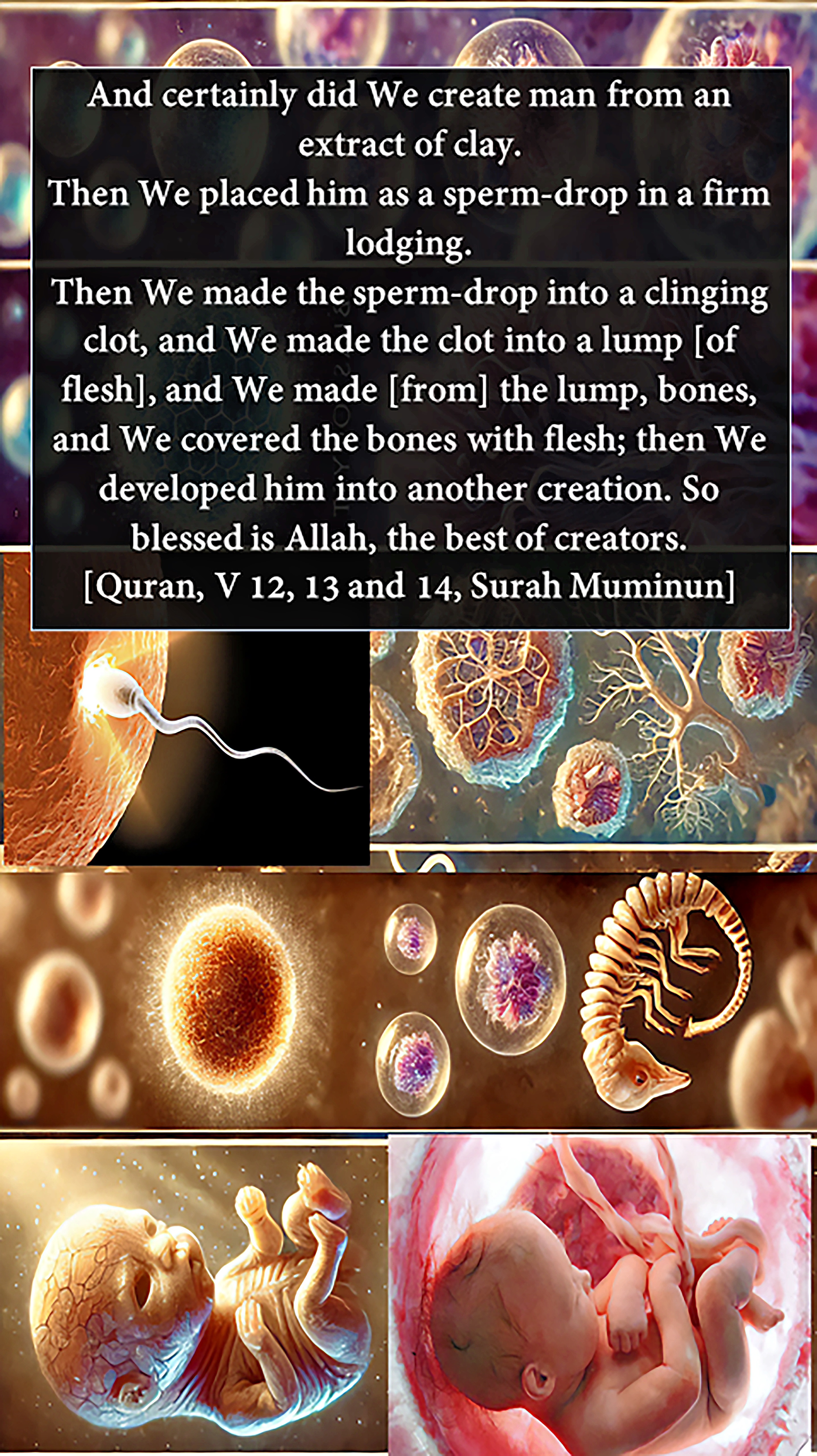
The primary verses outlining these stages are from Surah Al-Mu'minun (Qur'an 23:13-14):
"Then We made the sperm-drop into a clinging clot, and We made the clot into a lump [of flesh], and We made the lump [of flesh] into bones, and We clothed the bones with flesh; then We developed him into another creation. So blessed is Allah, the best of creators."
From this and other verses, the key stages are identified as:
Nutfah (Seed/Sperm/Life-Germ): Human beings are created from a "small seed," "sperm," or "life-germ," which is a mixture of male and female sexual discharge. This "drop of fluid" (nutfah) is placed in a "firm resting-place" (the womb). According to Islamic teachings, it remains in the womb as sperm for the first 40 nights 1.
Alaq (Clot of Blood/Leech-like Structure): The seed then develops into a "clot of blood" (alaq), which is described as a "leech-like structure" that clings or attaches to the endometrium of the uterus, drawing nutrition from it. This stage lasts for the next 40 nights.
Mudhghah (Lump of Flesh): Following the clot, it transforms into a "lump of flesh" (mudhghah), which resembles a "chewed lump." This appearance is due to the somites, which develop into the axial skeleton and musculature. This stage is further divided into:
Formed: Where differentiated tissues are present.
Unformed: Where undifferentiated tissues still exist, which may lead to miscarriage if the embryo does not pass this stage. This lump stage lasts for another 40 nights (or an "embryo" for the next 40 nights).
Formation of Bones and Clothing with Flesh: From the lump of flesh, "bones are formed," and then "We clothed the bones with flesh." The Quran highlights this precise order, where bone formation precedes muscle development.
Another Creation / Breathing of the Soul (Ruh): Finally, Allah "grows it as another creation." This stage often refers to the point when the embryo develops distinct human characteristics (typically after the eighth week or a total of four months of development), and the "spirit" (Ruh) is breathed into the fetus. At this point, two creative angels inquire about the fetus's creation, including its sex, fortune, and sustenance.
Sensory and Intellectual Development: The Quran also indicates the order of sensory development, stating that Allah gave humans "Then He proportioned him and breathed into him from His [created] soul and made for you hearing and vision and hearts; little are you grateful." (Quran 32:9). This sequence—hearing, then sight, then the brain (the site of understanding) differentiating last—is corroborated by embryological studies.
The detailed and accurate description of these embryonic stages, revealed in the 7th century CE, long before modern embryology, is presented as a profound sign of Allah's power and the divine origin of the Quran.
III. Stages of Life in This World and Beyond
Beyond fetal development, the Quran describes the progression of human life on Earth and the journey beyond:
Infancy to Maturity: Humans are "brought out... as infants," then given "growth that you may reach your age of full strength."
Aging and Death: Among humanity, some "die (young)," while others are "brought back to the miserable old age, so that he knows nothing after having known." This highlights the periods of early weakness (childhood), strength (maturity), and final weakness (old age).
Quranic View of Worldly Life: The life of this world is characterized as "[This] worldly life is only amusement and diversion. And if you believe and fear Allah, He will give you your rewards and not ask you for your properties." (Qur'an 47:36) It is likened to rain that brings forth growth, which then withers, yellows, dries, and crumbles, emphasizing its temporary and fleeting nature.
Three Major Periods on Earth: The Quran also divides man's life on earth into three broad stages:
The Nursing stage.
The Stage of Unity.
The Stage of Disunity and Disintegration.
The Qur'anic account traces human development from a drop of fluid, progressing through stages of being a clot (alaqah), a lump of flesh (mudghah), the formation of bones, and finally the clothing of bones with flesh. Each of these stages is understood to last approximately forty days, culminating in the ensoulment at roughly four months.
This systematic progression underscores that human development is not accidental but follows a divinely ordained order and law, occurring gradually. The Qur'an emphasises that after these material stages, "soul is breathed into the body," marking the "origination of a new existence" that is distinct from the prior material phases. At this point, two creative angels inquire from Allah about the fetus's sex, fortune, and sustenance.
The Innate Nature of Humanity (Fitra)
The Qur'an establishes that human beings are created with an innate disposition towards good and towards recognising the existence and unity of God. This primordial nature, known as fitra, forms the basis of human moral and spiritual capacity. Faith in God is ingrained in human nature, and human beings are endowed with the ability to rationally judge between good and bad.
Allah has granted human beings unique faculties to acquire knowledge, articulate thoughts, and communicate with others. The Qur'an highlights the gifts of hearing, sight, and hearts (intellect) for understanding and appreciating the world. This endowment establishes the foundation for intellectual and spiritual growth, distinguishing human beings from other creations.
Human Dignity and Divine Purpose
The Qur'an affirms that human life is sacred, a gift and a trust from Allah that must be regulated according to divine instructions, appreciated, respected, and protected. Human dignity extends to the body both before and after ensoulment. The ultimate goal of human creation is to become a perfected human being, with the virtues of Allah manifested in all aspects of life.
The Divine Warning on Hereditary Influence
The Qur'an provides a profound insight into the transmission of beliefs and tendencies through heredity. In the story of Prophet Noah (peace be upon him), we find a powerful supplication that reveals the connection between lineage and moral disposition:
"And Noah said, "My Lord, do not leave upon the earth from among the disbelievers an inhabitant." (Qur'an, 71:26).
This verse is interpreted to indicate that beliefs and tendencies can pass through heredity, demonstrating that the environment and lineage of parents significantly influence the moral and spiritual disposition of children.
Part Two: The Prophetic and Imamic Traditions on Growth and Development
The narrations from Prophet Muhammad (peace be upon him and his family) and the Imams from his progeny provide detailed guidance on the stages, characteristics, and principles of human development. These traditions offer practical frameworks for understanding and nurturing human growth.
The Three Seven-Year Stages of Childhood
One of the most comprehensive frameworks for childhood development is found in the tradition of Imam Ali ibn Abi Talib (peace be upon him): "A child should be nurtured for seven years, disciplined for seven years, and then employed (given responsibility) for seven years. His physical growth reaches its peak at twenty-three years, and his intellect matures at thirty-five years. Whatever comes after that is through experiences." (Man La Yahduruh al-Faqih (Vol. 3) by Shaykh Mu?ammad b. Ali al-Saduq, Book 3, Chapter 53, Hadith #4)
This tradition outlines three distinct phases of upbringing:
Prophet Muhammad (peace be upon him and his family) said: "The child is a master for seven years, a servant for seven years, and a minister for seven years. If you are satisfied with his character at twenty-one years, (good); if not, then strike his sides, for you have been excused before Allah." (Wasa'il al-Shia Vol. 21, Section 6, Chapter 83, Hadith 27627)
First Stage (Birth to 7 years) - "Master" Stage: The child is to be treated with affection and relative freedom. This is the time to let the child "be a child" and focus on character building (tarbiyyah) more than formal instruction. The child is to be nurtured, and play is considered essential for a child's intellectual growth. Prophet Muhammad (peace be upon him and his family) is quoted saying, "Chiding a boy in his childhood [as discipline] leads to an increase in his intellect as an adult." (Kanz al-’Ummal, no. 30747)
Second Stage (7 to 14 years) - "Servant" Stage: The child now needs more structured teaching, discipline, and responsibility, including religious education and moral training. During this period, the child should be disciplined and taught obedience, with a growing sense of duty.
Third Stage (14 to 21 years) – "Vizier" Stage: The young person should be treated like a partner and adviser, with respect and consultation, while still being guided by the parents' experience. This stage involves guiding a near-adult who is taking on responsibilities, making life choices, and preparing to manage their own affairs.
A detailed narration from Imam Ja far al-Sadiq (peace be upon him) specifies key physical developmental milestones:
"A boy's teeth fall out at seven years, he is commanded to pray at nine, they are separated in their sleeping places at ten, he reaches puberty at fourteen, reaches his full height at twenty-two, and reaches mental maturity at twenty-eight years except for experiences gained." (Wasa'il al-Shia Vol. 21, Section 6, Chapter 74, Hadith 27584)
A tradition also mentions that "A child grows every year by four finger-widths, measured by his own finger." (Man La Yahduruh al-Faqih (Vol. 3) by Shaykh Mu?ammad b. Ali al-Saduq, Book 3, Chapter 53, Hadith #5)
This indicates an awareness of proportional growth patterns.
The Hadith from Imam Ali (peace be upon him) further clarifies:
"A child is to be trained for seven years, to be disciplined for seven years and is employed for seven years. The end of his physical growth is when he is twenty three years old, and the end of the completion of his intellect is when he is thirty five years old, and after that, whatever comes forth is gained by means of experience." (Kitab Man la Yahdarhu al-Faqih, vol. 3, p. 493)
Spiritual and Moral Development
The tradition from Imam Ja far al-Sadiq (peace be upon him) emphasise that spiritual development begins from birth and continues throughout life. The narration regarding the recording of deeds states: "Indeed, the children of Muslims are marked by Allah as intercessors and those interceded for. When they reach twelve years of age, their good deeds are recorded for them, and when they reach puberty, their bad deeds are recorded against them." (Wasa'il al-Shia Vol. 1, Section 6, Chapter 1, Hadith 27280)
A tradition from Imam Muhammad Baqir (peace be upon him) establishes the progressive nature of moral responsibility, with complete legal obligations and punishments becoming applicable at the age of puberty:
"When he has a wet dream, or reaches fifteen years, or grows hair, or develops pubic hair before that, the complete legal punishments are implemented on him and applied to and for him."(Wasa'il al-Shia Vol. 1, Section 2, Chapter 4, Hadith 72)
For a girl, the tradition states:
"When the girl marries and is consummated with at nine years, her orphanhood ends, her property is handed to her, her transactions in buying and selling become valid, and complete legal punishments are implemented on her and applied for her."(Wasa'il al-Shia Vol. 1, Section 2, Chapter 4, Hadith 72)
The Role of Intellect in Development
The narrations place great emphasis on the development of intellect ('aql) as a fundamental aspect of human growth. A profound tradition from Imam Ja far al-Sadiq (peace be upon him) explains individual differences in intellectual capacity:
"The man who understands the whole (matter) on hearing a little is one whose intellect was kneaded with his (substance) at the spermatic stage. The one who hears the whole thing and responds in accordance with what you had told him, is one whose intellect developed in his mother's womb. And the man who requests you to repeat is one whose intellect developed after he grew up." (Usul Al-Kafi)
This tradition reveals that intellectual development can occur at different stages—before birth, during gestation, or after birth—and that understanding capacity is linked to the stage at which intellect was "kneaded" or developed.
Wisdom and Character Development
Imam Musa al-Kazim (peace be upon him) provided a beautiful analogy for the development of wisdom:"O, Hisham! Indeed cultivation and growth takes shape in a soft, even land and not in a rocky (barren) land. So similarly, wisdom grows and develops in a humble heart and does not grow in a proud, vain and arrogant heart" (Tuhaf al-Uqul P 396)
This tradition establishes that the development of wisdom is contingent upon humility and the cultivation of a receptive heart. Wisdom grows and develops in a humble heart, not a proud, vain, and arrogant heart.
Prophet Muhammad (peace be upon him and his family) also outlined the characteristics of a believer, which represent the goals of moral and spiritual development:"A (true) believer should have the following eight characteristics: soberness at hard times, patience in calamities, gratefulness in reliefs, contentment for whatever the Great and Glorified God has given, avoidance from oppressing enemies and hurting friends, and toleration of physical sufferings to make people feel safe from him" (Nahj Al-Fasahah)
The Sustenance of the Child in the Womb
A remarkable narration from Imam Ja far al-Sadiq (peace be upon him) provides insight into the divine provision for the developing child:
Imam Ali (peace be upon him) said about the sustenance of the child in the womb of its mother: "Indeed, Allah, the Blessed and Exalted, withholds menstruation from her and makes it the sustenance of the child in the womb of its mother." (Wasa'il al-Shia Vol. 2, Section 4, Chapter 30, Hadith 2289)
This tradition reveals the profound care and provision of Allah for the developing human being, even in the earliest stages of life.
Part Three: Heredity, Environment, and Free Will
The Role of Heredity
Islamic teachings acknowledge a significant role for heredity in shaping a person's personality and characteristics. Children are understood to inherit not only the physical features of their parents but also psychological and innate characteristics such as bravery, generosity, and good temper. Genetics is explicitly stated to play a "significant role in shaping a person's personality," with nobility of root leading to noble character.
Imam Ali (peace be upon him) advised: "Take into account who it is that suckles your children, for verily this is what a child grows on." (al-Kafi, v. 6, p. 44, no. 10)
Amir al-Muminin, Imam Ali (peace be upon him) said: "Be careful who nurses your children, for the child will grow up according to it." (Wasa'il al-Shia Vol. 21, Section 6, Chapter 78, Hadith 27600)
Imam Ali (peace be upon him) used to say: "Be selective in choosing wet nurses just as you are selective in choosing for marriage, for breastfeeding affects natural dispositions. Dislike Of Seeking Nursing From A Foolish Woman Or A Woman With Eye..." (Wasa'il al-Shia Vol. 21, Section 6, Chapter 78, Hadith 27605)
This indicates that moral and ethical traits can be transmitted through heredity. The "goodness of birth" is considered to create a special spiritual tendency in a child, whereas a child born from an illegitimate relationship may be more inclined towards forbidden actions.
Imam Ja far al-Sadiq (peace be upon him) explained the divine orchestration of inherited traits: "When Allah (swt), the Blessed and Exalted, wills to create a being, He (swt) gathers every form between him and Adam (as), then creates him in the image of one of them. Therefore, no one should say about his child, 'This one does not resemble me or any of my ancestors.'" (Man La Yahduruh al-Faqih (Vol. 3) by Shaykh Mu?ammad b. Ali al-Saduq, Book 3, Chapter 49, Hadith #22)
This tradition highlights the broad ancestral influence in heredity and cautions against denying a child's resemblance to ancestors. Human formation involves numerous races" or "veins," meaning a child can resemble any ancestor, not just immediate parents.
The Influence of Environment
While heredity provides the foundation, the environment plays a crucial role in actualising potential.
The Prophet (peace be upon him and his family) stood up to deliver a sermon and said: "O people, beware of the green growth in a dung heap." It was asked: O Messenger of Allah (swt), what is the green growth in a dung heap? He (sw) replied: "A beautiful woman raised in a bad environment." (Man La Yahduruh al-Faqih (Vol. 3) by Shaykh Mu?ammad b. Ali al-Saduq, Book 3, Chapter 12, Hadith #8)
The Prophet warned about a beautiful woman raised in a bad environment. This illustrates how a negative environment can overshadow inherent beauty or potential, emphasising the profound impact of upbringing and surroundings on development. The environment is identified as a prominent factor influencing human development, encompassing external factors such as material appearances, living conditions, and social and cultural patterns.
The Interaction of Heredity and Environment
Islam adopts a moderate position, recognising that genetics, environment, and upbringing all play specific roles in shaping a child's personality. It is explicitly stated that "Islam doesn't acknowledge the certain influence of only one element." While genetics lays a groundwork, "not all that is inherited by children from fathers and mothers is a necessary destiny and a certain fate. There still remains the human will and choice and other upbringing factors which can change the groundwork of genetics."
Free Will and Divine Guidance
Human beings are free creatures endowed with strength and durability by Allah, enabling them to make choices. They possess both intellect and desire, a unique combination that allows them to ascend beyond angels or descend lower than beasts based on their choices. The status of a human being with Allah depends on the type of actions they choose to commit.
Freedom is the source from which the tree of life grows, but it needs the light and guidance of Islam to flourish. Without freedom, human growth would be distorted and stunted.
Part Four: The Characteristics and Patterns of Growth
The Continuous Nature of Development
Islamic principles assert that human beings are "always in the process of becoming," constantly developing and changing from the first day of life to the last. This perspective highlights that self-improvement and transformation are always possible. Human life is understood as eternal, with death being a transition rather than an end.
The different stages of human existence include the sperm state, the womb, this world (from birth to death), Barzakh (the interval between death and Resurrection), Resurrection, and finally the Hereafter.
The Gradual Nature and Varying Rates of Development
Human development is characterised by distinct, gradual stages and varying rates across different aspects of life. Prophet Muhammad (peace be upon him) stated: "Islam increases and does not decrease." (Man La Yahduruh al-Faqih (Vol. 4) by Shaykh Mu?ammad b. Ali al-Saduq, Book 1, Chapter 170, Hadith #5717)
This indicates that the path of Islamic development is one of continuous growth and augmentation. Gradual progress is essential for intellectual and spiritual growth.
Physical and Psychological Interconnection
Islamic teachings consistently highlight the intricate link between the body and soul, asserting that the health of one intrinsically affects the other. The healthiness of the body is believed to be a result of mental healthiness, indicating a strong relationship between physical and psychological well-being.
True spiritual vigor is considered unattainable without physical well-being, and conversely, physical fitness cannot be fully realized without spiritual health. The body is regarded as a trust (amanah) from God, requiring proper care to enable individuals to better fulfill religious obligations.
Childhood as the Most Delicate Period
The early years of childhood are deemed the most important formative years for emotional growth and molding a proper social environment. The first three years are crucial for personality and character, and childhood is the most delicate period of life because the foundations of the future personality are laid then.
Part Five: The Ultimate Goals of Human Development
Movement Towards Truth and Divine Union
Real development in Islam is defined as movement towards truth and uniting with the Divine glory and beauty. This involves rejecting misleading temptations, whether they relate to "servitude to men, or submission to his own base lusts and desires." The ultimate goal is to elevate one's consciousness and develop one's personality within the framework of divine guidance.
Purification (Tazkiyah) and Spiritual Perfection
A crucial aspect of development is tazkiyah, which means "purification, or the removal of obstacles (such as sins and disobedience) that prevent a person from growing towards perfection and becoming a representative of God." This involves:
- Cultivating inner purity and taqwa (piety) through constant remembrance of Allah
(dhikr) self-accountability, and sincere supplication (du”).
- Embracing ilm-o-amal (knowledge and action) by seeking knowledge with sincerity and applying it diligently to manifest in righteous actions.
- Developing sabr (patience) and discipline.
- Cultivating virtues and rejecting vices.
Death is seen not as an end but as a transition from one stage of life to another The different stages of human existence include the sperm state, the womb, this world (from birth to death), Barzakh (the interval between death and Resurrection), Resurrection, and finally the Hereafter. This eternal perspective gives meaning and purpose to earthly development, as actions in this life have consequences in the next.
The Role of Knowledge and Action
Imam Ali (peace be upon him) said, "Verily knowledge is the life of the hearts, the light of the eyes from blindness and the strength of the bodies against weakness." (Amali al-Saduq, p. 493, no. 1).
Imam Ja far al-Sadiq (peace be upon him) said: "Knowledge is a light that Allah casts into the heart of whomever He wishes." (Misbah al-Shari'ah wa Miftah al-Hakikah by Attributed to Imam al-Sadiq (as), Volume 0, Page 16)
Imam Jaffar al-Sadiq (peace be upon him) said, "Knowledge is not acquired through learning. Rather it is a light that illuminates in the heart of one who wants Allah, Blessed and most High, to guide him. So if you want knowledge, first seek out within yourself true servitude [to Allah], and seek knowledge according to its use, and ask Allah to make you understand, and He will make you understand." (Bihar al-Anwar, v. 1, p. 225, no. 17)
This emphasises that knowledge is considered a source of enlightenment, guidance, and strength capable of enlivening the heart, strengthening the body, and promoting one's rank in the world and the Hereafter. However, knowledge must be accompanied by righteous action—ilm-o-amal—manifesting in virtuous conduct.Islamic teachings prioritize learning and intellectual development, with prophetic traditions valuing a scholar's sleep over some supererogatory worship.
Prophet Mohammad (peace be upon him and his family) said, "To sleep having knowledge is better than to pray in ignorance." (Munyat al-Murid, p. 104)
Prophet Mohammad (peace be upon him and his family) said: "A scholar who avails himself of his own knowledge is superior to a thousand simple worshipers (of God)" (Nahj Al-Fasahah)
Part Six: Social Development and Responsibility
The Family as the First School
The family is regarded as the primary institution for a child's upbringing—the "first school in life." It is here that a child learns language, values, norms of behavior, habits, and psychological and social tendencies. Parents are crucial role models, and their instructions are most effective when demonstrated through example.
A congenial family atmosphere, mutual respect between parents, and adherence to Islamic values are vital for a child's security and the flourishing of their potential. Conversely, a dysfunctional family or parents who do not model good behavior can negatively impact a child's development, leading to behavioral defects.
Parents are held accountable for their role in upbringing in the same way as the children are to be held to account for disregarding parents rights, parents are also accountable for not observing the childrens rights.
This mutual accountability establishes the seriousness of the parental responsibility in nurturing children's development.
Marriage is viewed as a sacred matter and a means of personal growth, allowing individuals to exit the shell of one's natural personal self and expand one's personality, thereby developing greater maturity and responsibility. It is a means of exiting the shell of one's natural personal self and expanding one's personality.
Achieving growth is a condition for participation in economic and social affairs, requiring intellectual and social ability for responsibilities like marriage and financial management. Human beings are grouped into six categories based on their level of development and acceptance of their roles, ranging from those who have not reached personal growth to those who have achieved piety (Taqwa).
Part Seven: Factors Contributing to Development and Perfection
A person's development and perfection depend on four key factors:
A believing father
A believing mother
A good and sympathetic teacher
Lawfully obtained food
A good and sympathetic teacher is listed among the crucial factors for a person's development and perfection. Teaching is highly valued for spreading knowledge and fostering moral and intellectual growth. The upbringing process is considered the most honourable responsibility and plays a fundamental role in the life of nations.
Knowledge is considered a source of enlightenment, guidance, and strength, capable of enlivening the heart, strengthening the body, and promoting one's rank in the world and the Hereafter. Islamic teachings prioritize learning and intellectual development.
Freedom is the source from which the tree of life grows, but it needs the light and guidance of Islam to flourish. Without freedom, human growth would be distorted and stunted. Freedom requires the light and guidance of Islam to flourish to prevent growth from being distorted and stunted.
Part Eight: Addressing Growth Difficulties and Challenges
Physical and Environmental Challenges
The Islamic perspective acknowledges that unsuitable environments can hinder development. Physical conditions during pregnancy, such as polluted air, smoking, late nights, and especially oxygen deficiency, are linked with serious defects in the child that would not necessarily occur if the environment were healthier. This illustrates that a poor environment can prevent the normal realization of hereditary potential for healthy growth.
Genetic Defects and Disabilities
Islam upholds the inherent dignity and worth of all human beings, regardless of their physical or mental abilities. It is strictly prohibited and considered a major sin to laugh at or ridicule the physical defects or disabilities of others. Muslims are required to show extra care and attention to people with physical defects or disabilities and to encourage them to lead as normal a life as possible.
Disabilities are not seen as deficiencies but as opportunities for spiritual growth and societal betterment, part of the divine test and design, meant to inspire empathy and mutual support.
Regarding those with deformities, prophet Mohammad (peace be upon him and his family) said: "Whoever has intercourse with his wife while She is menstruating, and if the child born from that union is afflicted with leprosy or vitiligo, he should blame only himself." (Man La Yahduruh al-Faqih (Vol. 1) by Shaykh Mu?ammad b. Ali al-Saduq, Book 1, Chapter 21, Hadith #201)
When imam Ja far al-Sadiq (peace be upon him) was asked about those who are deformed in their creation, he replied: "They are those whose fathers engaged in intercourse with their wives during menstruation." (Man La Yahduruh al-Faqih (Vol. 1) by Shaykh Mu?ammad b. Ali al-Saduq, Book 1, Chapter 21, Hadith #202)
These traditions link certain physical conditions to specific actions, though the broader Islamic principle remains one of compassion and dignity for all individuals regardless of their physical condition.
Part Nine: Practical Implications for Educators and Parents
Understanding Growth Patterns
Understanding growth patterns enables parents and educators to:
- Distinguish between proper and improper behavior and apply the correct approach towards a child's behavior at each stage of development
- Tailor their approach to the child's needs, leading to a more successful upbringing process
- Gain a better understanding of a child's emotional and psychological needs, fostering improved mutual interaction and a stronger relationship
- Predict a child's behavior, enabling preparation for and response to their needs
- Control a child's behavior in a positive way, creating a more favourable environment for training and development
Age-Appropriate Religious and Moral Expectations
Detailed guidance is given regarding when to introduce key religious concepts. For instance, at age 3 the child is taught "L? il?ha illall?h," at around 3 years 7 months "Muhammadun Ras?lull?h," and then later the salaw?t, followed gradually by more concepts as the child grows.
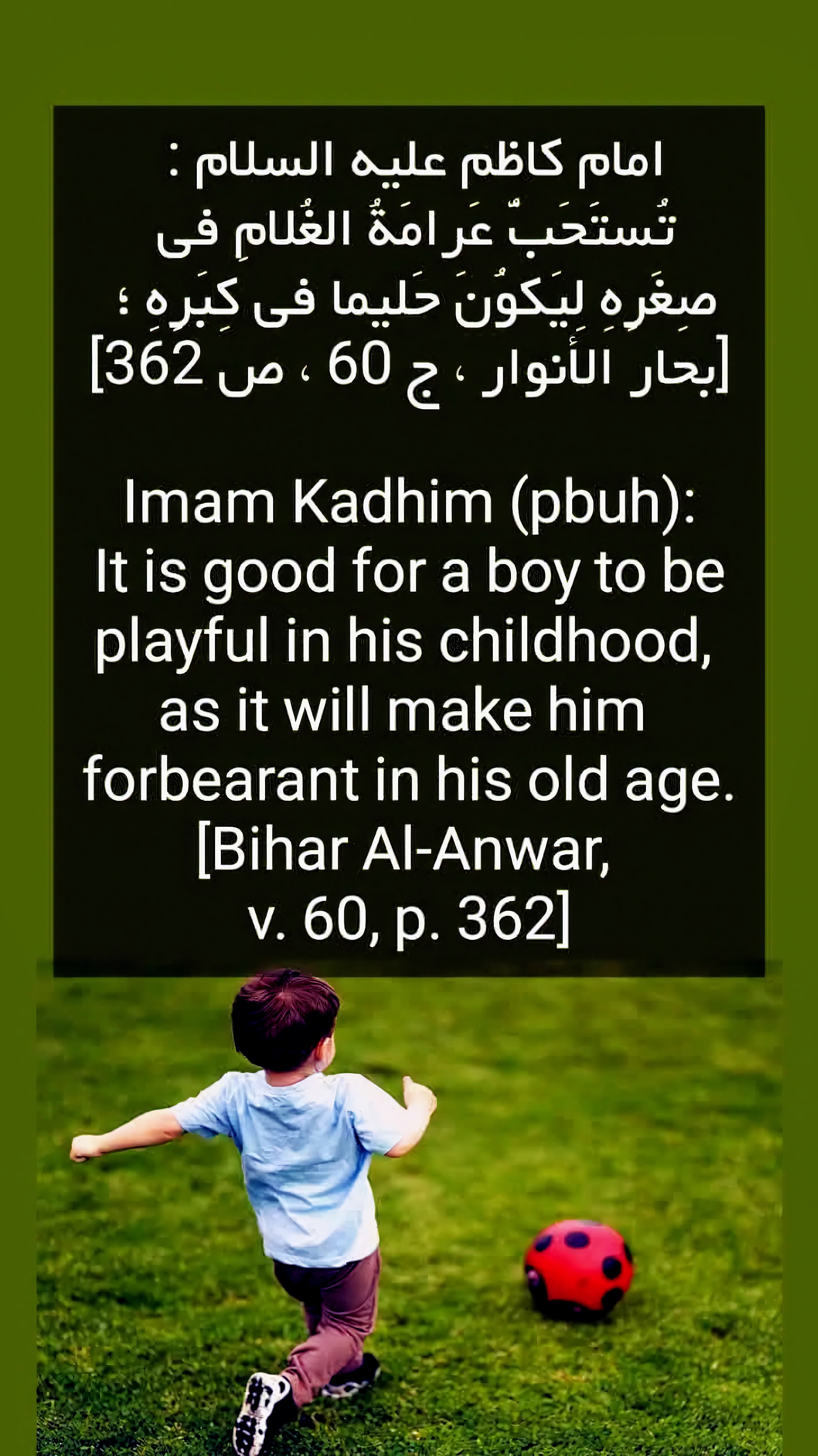
The Role of Play
Play is deemed essential for a child's growth and development, Imam Ja far al-Sadiq (peace be upon him) said: "Let your child play for seven years, then discipline him for seven years, and then keep him close to yourself for seven years. If he succeeds, then that is well; but if not, then he is among those in whom there is no good." (Man La Yahduruh al-Faqih (Vol. 3) by Shaykh Mu?ammad b. Ali al-Saduq, Book 3, Chapter 53, Hadith #1)
Imam Ja far al-Sadiq (peace be upon him) said: "Let your son play for seven years, and keep him close to yourself for seven years. If he succeeds (in learning), (good), and if not, then he is among those in whom there is no good." (Wasa'il al-Shia Vol. 21, Section 6, Chapter 82, Hadith 27618)
Play is vital for:
- Physical development: strengthening bones and limbs, sharpening senses, improving blood circulation
- Behavioral and social development: learning fairness, sharing, caring, alertness, problem-solving, and cooperation
The Role of Parents and Teachers
The role of parents and teachers is not merely to instruct but to provide an environment conducive to growth and development. This includes:
- Providing lawfully obtained food
- Ensuring physical health and well-being
- Nurturing spiritual and moral development
- Serving as role models for virtuous behaviour
- Protecting children from negative environmental influences
Conclusion: A Comprehensive Framework for Human Development
The Islamic vision of human development, as articulated in the Qur'an and the traditions of the Prophet and his progeny, provides a comprehensive and balanced framework for understanding and nurturing human growth. This framework recognises:
- The Divine Origin of Life: Human development begins with the formation of the embryo, progresses through divinely ordained stages, and culminates in the breathing of the soul—a sacred process that demands reverence and care.
- The Integration of Body and Soul: Development must address all dimensions of human existence—physical, intellectual, moral, and spiritual—in a balanced manner, ensuring that no aspect is neglected or overemphasised. Islam promotes balanced development of body, mind, and spirit, rather than prioritizing one over the others.
- The Role of Heredity and Environment: Both nature and nurture play significant roles in shaping human development, but neither is deterministic. Human will and choice remain central to the developmental process. Islam doesn't acknowledge the certain influence of only one element.
- The Stages of Growth: Human development follows predictable patterns and stages, each with its own characteristics, needs, and appropriate approaches to upbringing and education. The three seven-year stages provide a clear framework for understanding childhood development.
- The Interconnection of All Aspects: Physical, psychological, moral, and social development are deeply intertwined. A "healthy mind in a healthy body" is not merely a saying but a fundamental principle of Islamic anthropology.
- The Ultimate Purpose: The goal of human development is to achieve proximity to Allah, cultivate virtues, and fulfil humanity's destiny as the noblest of creatures, labouring towards the Lord and ultimately encountering Him. The ultimate goal is to become the "perfected human being, or 'insan-e kamil,' a state in which the individual is a polished mirror of God."
The Eternal Perspective
As the tradition of Imam Ali ibn Abi Talib (peace be upon him) reminds us, "Experiences are a beneficial knowledge." (Ghurar al-Hikam, no. 1036)
Imam Ali (peace be upon him) said, "A man who masters his experiences will be safe from harm, while a man who is devoid of experiences will be blind to consequences [of actions]." (Ghurar al-Hikam, no. 8040, 8680)
Whatever comes after that is through experiences—life itself is the continuous classroom in which human development unfolds, guided by divine principles and culminating in the eternal life to come. This perspective gives meaning to every stage of development and reminds us that growth is not limited to this world but continues in the hereafter, where the ultimate perfection awaits those who strive for it.
The traditions and verses examined in this article demonstrate that Islam provides not only spiritual guidance but also practical, developmental frameworks that are remarkably aligned with modern understandings of human growth. The three seven-year stages of childhood, the recognition of individual differences in intellectual development, the emphasis on balanced, holistic growth, and the understanding of the interplay between heredity and environment all reflect a profound understanding of human nature that remains relevant and instructive for parents, educators, and individuals seeking to understand the journey of human development.
In Islam, human beings are urged to develop their personality and elevate their consciousness within the framework proposed by Allah (SWT), the Creator, who is fully aware of human nature and needs. God is the One who determines a person's growth and helps them reach the highest peaks of humanity and completion, both spiritually and in scientific knowledge.
References:
Qur'anic References
1. Qur'an 39:6 – "He creates you in the wombs of your mothers, creation after creation, within three darknesses."
2. Qur'an 23:13-14 – "Then We made the sperm-drop into a clinging clot, and We made the clot into a lump [of flesh], and We made the lump [of flesh] into bones, and We clothed the bones with flesh; then We developed him into another creation. So blessed is Allah, the best of creators."
3. Qur'an 32:9 – "Then He proportioned him and breathed into him from His [created] soul and made for you hearing and vision and hearts; little are you grateful."
4. Qur'an 47:36 – "[This] worldly life is only amusement and diversion. And if you believe and fear Allah, He will give you your rewards and not ask you for your properties."
5. Qur'an 71:26 – "And Noah said, 'My Lord, do not leave upon the earth from among the disbelievers an inhabitant.'"
Hadith - Prophetic and Imamic Traditions
From Man La Yahduruh al-Faqih by Shaykh Mu?ammad b. Ali al-Saduq
6. Vol. 3, Book 3, Chapter 53, Hadith #4 – Imam Ali ibn Abi Talib (peace be upon him): "A child should be nurtured for seven years, disciplined for seven years, and then employed (given responsibility) for seven years. His physical growth reaches its peak at twenty-three years, and his intellect matures at thirty-five years. Whatever comes after that is through experiences."
7. Vol. 3, Book 3, Chapter 53, Hadith #5 – "A child grows every year by four finger-widths, measured by his own finger."
8. Vol. 3, Book 3, Chapter 49, Hadith #22 – Imam Ja?far al-Sadiq (peace be upon him): "When Allah (swt), the Blessed and Exalted, wills to create a being, He (swt) gathers every form between him and Adam (as), then creates him in the image of one of them. Therefore, no one should say about his child, 'This one does not resemble me or any of my ancestors.'"
9. Vol. 3, Book 3, Chapter 12, Hadith #8 – The Prophet (peace be upon him and his family): "O people, beware of the green growth in a dung heap... A beautiful woman raised in a bad environment."
10. Vol. 4, Book 1, Chapter 170, Hadith #5717 – Prophet Muhammad (peace be upon him): "Islam increases and does not decrease."
11. Vol. 1, Book 1, Chapter 21, Hadith #201 – Prophet Muhammad (peace be upon him and his family): "Whoever has intercourse with his wife while she is menstruating, and if the child born from that union is afflicted with leprosy or vitiligo, he should blame only himself."
12. Vol. 1, Book 1, Chapter 21, Hadith #202 – When Imam Ja?far al-Sadiq (peace be upon him) was asked about those who are deformed in their creation, he replied: "They are those whose fathers engaged in intercourse with their wives during menstruation."
13. Vol. 3, Book 3, Chapter 53, Hadith #1 – Imam Ja?far al-Sadiq (peace be upon him): "Let your child play for seven years, then discipline him for seven years, and then keep him close to yourself for seven years. If he succeeds, then that is well; but if not, then he is among those in whom there is no good."
From Wasa'il al-Shia
14. Vol. 21, Section 6, Chapter 83, Hadith 27627 – Prophet Muhammad (peace be upon him and his family): "The child is a master for seven years, a servant for seven years, and a minister for seven years. If you are satisfied with his character at twenty-one years, (good); if not, then strike his sides, for you have been excused before Allah."
15. Vol. 21, Section 6, Chapter 74, Hadith 27584 – Imam Ja?far al-Sadiq (peace be upon him): "A boy's teeth fall out at seven years, he is commanded to pray at nine, they are separated in their sleeping places at ten, he reaches puberty at fourteen, reaches his full height at twenty-two, and reaches mental maturity at twenty-eight years except for experiences gained."
16. Vol. 1, Section 6, Chapter 1, Hadith 27280 – Imam Ja?far al-Sadiq (peace be upon him): "Indeed, the children of Muslims are marked by Allah as intercessors and those interceded for. When they reach twelve years of age, their good deeds are recorded for them, and when they reach puberty, their bad deeds are recorded against them."
17. Vol. 1, Section 2, Chapter 4, Hadith 72 – Imam Muhammad Baqir (peace be upon him): "When he has a wet dream, or reaches fifteen years, or grows hair, or develops pubic hair before that, the complete legal punishments are implemented on him and applied to and for him." (For a girl): "When the girl marries and is consummated with at nine years, her orphanhood ends, her property is handed to her, her transactions in buying and selling become valid, and complete legal punishments are implemented on her and applied for her."
18. Vol. 2, Section 4, Chapter 30, Hadith 2289 – Imam Ali (peace be upon him) said about the sustenance of the child in the womb: "Indeed, Allah, the Blessed and Exalted, withholds menstruation from her and makes it the sustenance of the child in the womb of its mother."
19. Vol. 21, Section 6, Chapter 78, Hadith 27600 – Amir al-Muminin, Imam Ali (peace be upon him): "Be careful who nurses your children, for the child will grow up according to it."
20. Vol. 21, Section 6, Chapter 78, Hadith 27605 – Imam Ali (peace be upon him) used to say: "Be selective in choosing wet nurses just as you are selective in choosing for marriage, for breastfeeding affects natural dispositions. Dislike of seeking nursing from a foolish woman or a woman with eye..."
21. Vol. 21, Section 6, Chapter 82, Hadith 27618 – Imam Ja?far al-Sadiq (peace be upon him): "Let your son play for seven years, and keep him close to yourself for seven years. If he succeeds (in learning), (good), and if not, then he is among those in whom there is no good."
From Kanz al-?Ummal
22. No. 30747 – Prophet Muhammad (peace be upon him and his family): "Chiding a boy in his childhood [as discipline] leads to an increase in his intellect as an adult."
From Usul Al-Kafi
23. Imam Ja?far al-Sadiq (peace be upon him): "The man who understands the whole (matter) on hearing a little is one whose intellect was kneaded with his (substance) at the spermatic stage. The one who hears the whole thing and responds in accordance with what you had told him, is one whose intellect developed in his mother's womb. And the man who requests you to repeat is one whose intellect developed after he grew up."
24. Vol. 6, p. 44, no. 10 – Imam Ali (peace be upon him) advised: "Take into account who it is that suckles your children, for verily this is what a child grows on."
From Tuhaf al-?Uqul
25. p. 396 – Imam Musa al-Kazim (peace be upon him): "O, Hisham! Indeed cultivation and growth takes shape in a soft, even land and not in a rocky (barren) land. So similarly, wisdom grows and develops in a humble heart and does not grow in a proud, vain and arrogant heart."
From Nahj al-Fasahah
26. Prophet Muhammad (peace be upon him and his family): "A (true) believer should have the following eight characteristics: soberness at hard times, patience in calamities, gratefulness in reliefs, contentment for whatever the Great and Glorified God has given, avoidance from oppressing enemies and hurting friends, and toleration of physical sufferings to make people feel safe from him."
27. Prophet Muhammad (peace be upon him and his family): "A scholar who avails himself of his own knowledge is superior to a thousand simple worshipers (of God)."
From Bihar al-Anwar
28. Vol. 1, p. 225, no. 17 – Imam Ja?far al-Sadiq (peace be upon him): "Knowledge is not acquired through learning. Rather it is a light that illuminates in the heart of one who wants Allah, Blessed and most High, to guide him. So if you want knowledge, first seek out within yourself true servitude [to Allah], and seek knowledge according to its use, and ask Allah to make you understand, and He will make you understand."
From Misbah al-Shari'ah wa Miftah al-Haqiqah
29. p. 16 – Imam Ja?far al-Sadiq (peace be upon him): "Knowledge is a light that Allah casts into the heart of whomever He wishes."
From Amali al-Saduq
30. p. 493, no. 1 – Imam Ali (peace be upon him): "Verily knowledge is the life of the hearts, the light of the eyes from blindness and the strength of the bodies against weakness."
From Munyat al-Murid
31. p. 104 – Prophet Muhammad (peace be upon him and his family): "To sleep having knowledge is better than to pray in ignorance."
From Ghurar al-Hikam
32. No. 1036 – Imam Ali ibn Abi Talib (peace be upon him): "Experiences are a beneficial knowledge."
33. No. 8040, 8680 – Imam Ali (peace be upon him): "A man who masters his experiences will be safe from harm, while a man who is devoid of experiences will be blind to consequences [of actions]."
Qur'anic verses and hadiths of Ahl al-Bayt (peace be upon them) and sayings in Arabic, Persian and English.
https://eitaa.com/noorunalanoor
https://www.youtube.com/@110Inspire
https://youtube.com/@mustafaabbas4668?si=EnSIkaIECMiOmarE
https://youtube.com/@mustafaabbas8978?si=EMJylUW9_zruJx95