Posted by Mustafa Abbas on August 18, 2026 | Views: 220 | Ratings: 112
Download article from link below at the end
Loving Children and Their Development: A Comprehensive Islamic Perspective
The relationship between love and child development lies at the heart of Islamic teachings on parenting and upbringing. The Holy Prophet Mohammad (peace be upon him and his progeny) delivered a profound directive that serves as a foundational principle for raising children:
"Love children and be merciful to them, and when you promise them something, fulfill it for them, for they see none other than you as their providers." (Wasa'il al-Shia Vol. 21, Section 6, Chapter 88, Hadith 27650)
"Love the children and have mercy on them. When you promise them something, fulfill it for them, for they only perceive that you are the ones who provide for them." (Man La Yahduruh al-Faqih (Vol. 3) by Shaykh Mu?ammad b. Ali al-Saduq, Book 3, Chapter 49, Hadith #15)
This simple yet comprehensive instruction encapsulates a complete philosophy of child development—one that recognizes the intricate connection between emotional nurturing, spiritual growth, and holistic well-being. The Prophet further elaborated on this guidance by emphasizing the importance of fulfilling promises to children, recognizing their unique perception of their parents as their primary providers and protectors. This instruction is further elaborated by the Prophet, who added: 'When you promise them something, fulfill it for them, for they only perceive that you are the ones who provide for them. This hadith, recorded in major collections such as Man La Yahduruh al- Faqih, establishes that the Islamic approach to child development is rooted in love, mercy, and a deep understanding of children's emotional, psychological, and spiritual needs. This article explores the comprehensive Islamic perspective on loving children and their development, drawing from the rich teachings of the Qur'an, the Prophet Mohammad (peace be upon him), and the Ahl al-Bayt (peace be upon them).
Part One: The Theological Foundation – Understanding the Child's Innate Nature
The Concept of Fitrah
Central to the Islamic understanding of child development is the concept of fitrah—the innate, natural disposition with which every human being is created. The Holy Prophet (peace be upon him and his progeny) stated: “Every new born is born upon the Fitra” (Mujam al-Ahadith al-Mutabara by Shaykh Mu?ammad Asif Muhsini Book 4, Chapter 9, Hadith #8)
This profound teaching establishes that children are not born as blank slates or with inherent sin, but rather with a natural inclination toward goodness, truth, and recognition of their Creator. This hadith explicitly connects the fitra of the newborn with the Qur'anic verse: "And if you asked them, "Who created the heavens and earth?" they would surely say, "Allah." (Qur'an 31:25) indicating that even the general acknowledgement of Allah as Creator, described in the Qur'an, is rooted in an inner, innate knowledge placed in human beings."
Imam Ja'far al-Sadiq (peace be upon him) explained that fitrah denotes tawhid (monotheism)—that Allah created mankind upon the recognition of His Oneness. When asked about the verse "God's creation (fitrah) upon which He originated mankind" (Qur'an 30:30), the Imam explicitly stated: "He originated mankind upon tawhid."
al-Tawhid: Ibn al-Mutawakkil from Ali b. Ibrahim from al-Yaqtini from Yunus from Abdallah b. Sinan from Abi Abdillah. He (Abdallah) said: I asked him about the words of Allah Mighty and Majestic: “The Fitra of Allah which He created the people upon” (30:30) - what is that Fitra? He said: It is Islam (submission). Allah created them upon it when He took their Covenant upon Tawhid - He said: “Am I not your Lord?” (7:172), and among them were believers and disbelievers. (Mujam al-Ahadith al-Mutabara by Shaykh Mu?ammad Asif Muhsini Book 4, Chapter 9, Hadith #5)
The Qur'an reinforces this concept:
"So direct your face toward the religion, inclining to truth. [Adhere to] the fitrah of Allah upon which He has created [all] people. No change should there be in the creation of Allah. That is the correct religion, but most of the people do not know." (Qur'an 30:30)
The Child's Innate Recognition of God
From the very day a child enters the world, they are attracted toward the Power that will provide their needs, though their understanding is not yet developed enough to express this focus. This innate recognition manifests in various ways as the child grows.
Around the age of four, children raised in a religious family begin to recognize Allah and ask questions that reveal their awakening instinct of Godliness. These questions include:
"Who made the sun?"
"Who has created the moon and the stars?"
"Does Allah love me?"
"Where does Allah live?"
"Who brings the rain?"
"Who gave birth to Dad?"
"Is Allah listening to our talk?"
"Can we talk with Allah over the 'phone?"
It is evident from these questions that the instinct of Godliness is awakening in the child. By asking these questions he tries to quench his thirst for knowledge.
The Role of Parents in Nurturing Fitrah
While the inclination toward God is innate, it requires nurturing and guidance from parents and caregivers to develop properly. The Prophet stated:
""Every child is born on Fitrah, but later on the parents might make him a Jew or a Christian." (Bihar al-anwar, v 3, p.281)
This highlights that external influences, particularly from parents and the environment, can either nurture this innate disposition or cause it to deviate. Parents bear the sacred responsibility of:
- Cultivating their child's innate fitrah to love Allah
- Connecting worldly experiences to divine truths
- Creating a supportive home environment where the child's religious instinct is properly nourished
- Serving as living role models of God-consciousness
The foremost responsibility of parents is to 'cultivate their child's innate fitrah (natural inclination) to love Allah, and to nurture it amidst the various external influences of the world.
The Primordial Covenant and Fitrah
The concept of fitrah is closely linked to the primordial covenant described in the Qur'an:
"And [mention] when your Lord took from the children of Adam - from their loins - their descendants and made them testify of themselves, [saying to them], "Am I not your Lord?" They said, "Yes, we have testified.'" (Qur'an 7:172)
Imam al-Baqir (peace be upon him) explained that Allah removed Adam's descendants, showed them His creation, and that without this, no one would recognize their Lord.
al-Tawhid: My father from Sa’d from Ibn Hashim, Ibn Abi al-Khattab and Ibn Yazid from Ibn Abi Umayr from Ibn Udhayna from Zurara from Abi Ja’far. He (Zurara) said: I asked him about the words of Allah Mighty and Majestic: “Hunafa for Allah, not associating with Him (anything)” (Qur'an 22:31) and about the Hanifiyya (what is it)? He said: It is the Fitra which He created the people upon, there is no change in the creation of Allah. He (also) said: Allah created them upon the Ma’rifa (Recognition). Zurara said: and I asked him about the words of Allah: “and when your Lord took from the children of Adam from their backs …” (7:172). He said: He removed from the back of Adam his descendants up to the Day of Judgment, they came out like particles, then he made known to them and showed them His creation, and if it were not for that then no one would recognize (know) his Lord. He (the Imam) also said: The Prophet Mohammad (peace be upon him and his family) said: “Every new born is born upon the Fitra”, that is, with the Ma’rifa (Recognition) that Allah Mighty and Majestic is his Creator. This then is His (Allah’s) words: “and if you were to ask them - who created the heavens and the earth - they will say Allah” (Qur'an 39:38) (Mujam al-Ahadith al-Mutabara by Shaykh Mu?ammad Asif Muhsini Book 4, Chapter 9, Hadith #8)
Part Two: The Developmental Significance of Love and Affection
Love as a Foundation for Healthy Development
Islamic teachings recognize that love and affection are not optional extras in childrearing but essential components of healthy development. The Prophet Mohammad (peace be upon him and his progeny) emphasized to love children and be kind to them.
He also advised:
"Whoever kisses his child, Allah Azzawajal will record for him a hasanah, and whoever delights him, Allah will delight him on the Day of Resurrection, and whoever teaches him the Qur’an , the parents will be called upon and they will be dressed in two suits from whose light the faces of the people of Paradise will illuminate." (al-Kafi by Shaykh al-Kulayni, Volume 6, Page 49)
Prophet Mohammad (peace be upon him and his family) said: "Whoever kisses his child, Allah will record for him a good deed, and whoever makes his child happy, Allah will make him happy on the Day of Resurrection, and whoever teaches him the Qur’an , both parents will be called and clothed in two garments whose light will illuminate the faces of the people of Paradise." (Wasa'il al-Shia Vol. 21, Section 6, Chapter 83, Hadith 27623)
Prophet Mohammad (peace be upon him and his family) said: "Allah The Exalted loves that you maintain justice among your children, even in kisses." (Mizan al-Hikmah by Muhammad al-Rayshahri, Volume 4, Page 3673)
These teachings highlight that physical expressions of love are not only emotionally beneficial but spiritually significant.
Prophet Mohammad (peace be upon him and his family) said: "Kiss your children often, for with every kiss you will have a degree in Paradise, and the distance between each degree is five hundred years."(Bihar al-Anwar, Vol. 104, Page 92)
Prophet Mohammad (peace be upon him and his family) said: "Whoever kisses his child, Allah Azzawajal will record for him a hasanah, and whoever delights him, Allah will delight him on the Day of Resurrection, and whoever teaches him the Qur’an , the parents will be called upon and they will be dressed in two suits from whose light the faces of the people of Paradise will illuminate." (al-Kafi by Shaykh al-Kulayni, Volume 6, Page 49)
Imam Ja'far al-Sadiq (peace be upon him) who said: "Indeed Allah shows mercy to a man due to the intensity of his love for his child. Recommendation Of Honoring, Seeking, And Loving The Righteous Child" (Wasa'il al-Shia Vol. 21, Section 6, Chapter 2, Hadith 27300)
The Psychological Impact of Love
When children receive love and affection from their parents, they develop:
- Emotional Security
Children who feel loved and valued develop a strong sense of security that enables them to explore the world with confidence. The single most important cause of the happiness of the child is the kindness of the parents.
- Self-Esteem
Being shown respect and affection helps children develop a positive self-image and healthy self-worth. When a child is respected, he 'feels proud and thinks that he has been praised,' so respectful treatment directly builds dignity and a positive sense of self.
- Trust
Consistent love and fulfillment of promises builds trust in caregivers, which forms the foundation for trust in others and, ultimately, trust in Allah. Respect and good interaction between parent and child are the foundations for forming the child's character.
- Resilience
Children who experience unconditional love are better equipped to handle life's challenges and disappointments. Children who grow up with ample love and affection develop confident personalities resilient to life's hardships.
The Consequences of Withholding Love
The Prophet (peace and blessings be upon him and his family) saw a man with two sons who kissed one and not the other. The Prophet (peace and blessings be upon him and his family) said: “Why didn’t you treat them equally?” (Bihar al-Anwar, Vol. 104, Page 92)
Prophet Mohammad (peace and blessings be upon him and his family) kissed al-Hasan and al-Husayn (peace be upon them). Al-Aqra' ibn Habis said, "I have ten children, and I have never kissed any of them." The Prophet replied, "It is not my concern if God has removed mercy from your heart," or words to that effect. (Bihar al-Anwar, Vol. 104, Page 92)
Prophet Mohammad (peace be upon him and his family) used to kiss (al-Hasan and al- Husayn) (peace be upon them). Al-Aqra' bin Habis said: I have ten children and I have never kissed any of them. The Prophet Mohammad (peace be upon him and his family) replied: "Whoever does not show mercy will not receive mercy." (Wasa'il al-Shia Vol. 21, Section 6, Chapter 89, Hadith 27657)
Imam Ja'far al-Sadiq (peace be upon him) said: A man came to the Prophet (peace be upon him and his family) and said: I have never kissed any of my children. When he turned away, the Prophet Mohammad (peace be upon him and his family) said: This is a man who, in my view, is from the people of Hell. (Wasa'il al-Shia Vol. 21, Section 6, Chapter 89, Hadith 27654)
Prophet Mohammad (peace be upon him and his progeny) strongly condemned the lack of affection towards children, viewing it as a severe deficiency in one's character and faith.
Imam Ja'far al-Sadiq (peace be upon him) said: "One who does not respect the elders and does not show affection to the children, does not belong to us" (Usool al-Kafi, , page 253)
Imam Ja'far al-Sadiq (peace be upon him) warned that not showing affection to children and being harsh and strict with them can deprive a person of God's Mercy.
Part Three: The Role of Play in Child Development
Play as a Natural Right and Need
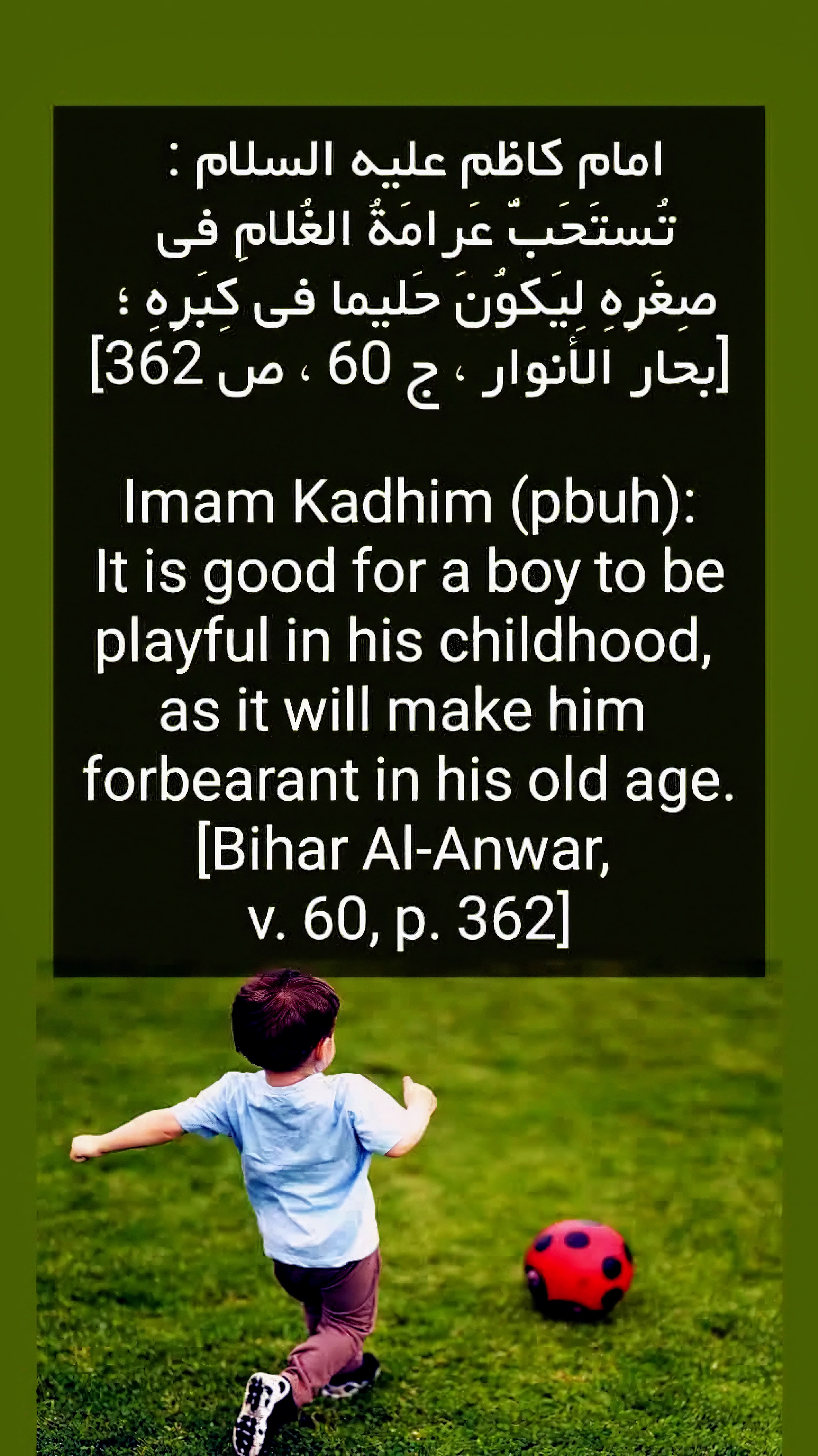
Islamic teachings recognize play as a natural and essential part of a child's growth and development. Imam Ja'far al-Sadiq (peace be upon him) said: "Let your son play for seven years, and keep him close to yourself for seven years. If he succeeds (in learning), (good), and if not, then he is among those in whom there is no good." (Wasa'il al-Shia Vol. 21, Section 6, Chapter 82, Hadith 27618)
Childhood play is a cause of intellectual, emotional, and personality growth. Play is an important part of growing up and is vital for the physical and emotional development of the child. It is the first source of learning basic social skills.
Benefits of Play for Development
Play provides comprehensive benefits across various aspects of a child's growth:
Physical Development
Physical play helps a child's body develop through:
Strengthening muscles and bones
Sharpening senses and refining reactions
Improving coordination and balance
Enhancing blood circulation and overall health
A child's body develops through physical play. His senses sharpen, his reactions become refined, and he learns the use of appropriate limbs to achieve his goals.
Cognitive Development
Play fosters intellectual growth by:
Developing problem-solving and thinking skills
Encouraging curiosity, imagination, and creativity
Building focus, memory, and planning abilities
Teaching foundational academic skills
Through play, children learn colors, shapes, sizes, and functions of things, helping them to recognize the world in which they live.
Social Development
Through play with others, children learn:
Sharing and taking turns
Cooperation and teamwork
Negotiation and conflict resolution
Understanding rules and fairness
Making and maintaining friendships
In play, a child learns how to socially communicate with others who are outside his family unit.
Emotional Development
Play assists children in:
Expressing and managing emotions
Reducing stress and anxiety
Building confidence and self-esteem
Processing difficult experiences through pretend play
Play is "soul-food" that helps children develop confident personalities.
Prophet (peace and blessings be upon him and his family) said: "Whoever has a child with them should act childlike with them." (Wasa'il al-Shia Vol. 21, Section 6, Chapter 90, Hadith 27659)
In another narration, the Prophet (peace and blessings be upon him and his family) said: "Whoever has a child should act childishly with him." (Man La Yahduruh al-Faqih (Vol. 3) by Shaykh Mu?ammad b. Ali al-Saduq, Book 3, Chapter 49, Hadith #20)
The Prophet encouraged adults to engage with children on their level.
Parents should approach playing by 'shrinking themselves' to the child's level, playing according to their age and abilities. This means setting aside parental superiority and being willing to be 'childish' and playful.
The Three Stages of Childhood Development
Islamic teachings outline a framework for child development in three seven-year stages, as narrated from the Prophet: "A child is a master for seven years, a slave for the next seven years, and a minister for another seven years. By the age of twenty one, you must either approve of his manners or cut him loose, for [by then] you would have fulfilled your obligation toward Allah, most High." (Makarim al-Akhlaq, v. 1, p. 478, no. 1649)
Imam Ja'far al-Sadiq (peace be upon him) explained this guidance: "Let your child play for seven years, then discipline him for seven years, and then keep him close to yourself for seven years. If he succeeds, then that is well; but if not, then he is among those in whom there is no good." (Man La Yahduruh al-Faqih (Vol. 3) by Shaykh Mu?ammad b. Ali al-Saduq, Book 3, Chapter 53, Hadith #1)
First Seven Years (0-7): The Age of Play
Children should be allowed complete freedom to play
Parents should focus on care, affection, and allowing natural development
This stage is essential for building character and emotional foundations
Formal academic pressure should be avoided
Second Seven Years (7-14): The Age of Study and Discipline
Children should be guided toward education and discipline
Parents act as trainers, gently directing the child's nature
Discipline should be introduced through love rather than fear
Children should be taught to read, write, and understand religious duties
Third Seven Years (14-21): The Age of Learning and Responsibility
Focus shifts to learning about what is permissible and impermissible
Children should learn about religion and religious law
Parents act as advisors, allowing the child to make decisions based on divine principles
Part Four: Nurturing the Child's Spiritual Development
Teaching Faith from an Early Age
The most important thing to teach children is Islamic beliefs, particularly monotheism (the oneness of God). Imam Ja'far al-Sadiq (peace be upon him) provided detailed guidance on introducing core beliefs at specific ages:
Zurarah and Ubaidullah ibn Ali Al-Halabi narrated from Imam Jafar ibn Muhammad Al-Sadiq (peace be upon him) that He was asked about when the funeral prayer should be offered for a child.
Imam (peace be upon him) replied: When the child understands the concept of prayer.
I asked: At what age does prayer become obligatory for the child?
Imam (peace be upon him) replied: When the child reaches six years old, and fasting becomes obligatory when they are capable of it.
(Footnote: Hadith.486 – Zurarah and Ubaidullah ibn Ali Al-Halabi narrated from Imam Jafar ibn Muhammad Al-Sadiq (peace be upon him) that He was asked about when the funeral prayer should be offered for a child.
Imam (peace be upon him) replied: When the child reaches six years old, and fasting becomes obligatory when they are capable of it.) (Man La Yahduruh al-Faqih (Vol. 1) by Shaykh Mu?ammad b. Ali al-Saduq, Book 1, Chapter 26, Hadith #486)
Cultivating Love for Allah
Parents are encouraged to teach children about Allah's mercy, love, and generosity rather than focusing primarily on punishment. Teach them instead about God's infinite mercy and love; teach them about His protection and forgiveness.
Children should be taught to:
Love Allah and trust in Him
Ask Allah for their needs
Remember Allah and invoke His blessings in daily activities
Thank Allah on all occasions, especially when achieving their aims
This positive, loving relationship with Allah strengthens the child's God-consciousness and makes faith something beloved and natural, rather than burdensome or frightening.
Love for the Prophet and His Household
The Prophet Mohammad (peace be upon him and his progeny) advised:
"Discipline your children on three traits: love for your Prophet, love for his household, and reading the Qur’an ." (Mizan al-Hikmah by Muhammad al-Rayshahri, Volume 4, Page 3680)
Instilling love for the Prophet and his pure household (Ahl al-Bayt) is essential because:
They are the inheritors of prophetic knowledge and wisdom
Their lives serve as exemplars of piety, justice, and truth
This love guides children toward the true understanding of Islam
When children repeatedly experience honour, kindness, and fairness, their experiential sense of self-worth and of others' value becomes aligned with theological principles such as human dignity and accountability before Allah.
Encouraging Qur'an Recitation
Regular engagement with the Qur'an helps in shaping a child's character, instilling faith, and providing a moral compass for life. Parents who teach their children the Qur'an will be honored with special crowns and garments of light on the Day of Judgment.
Prophet Mohammad (peace be upon him and his family) said: "There is no man who teaches his child the Qur’an except that Allah will crown his parents on the Day of Resurrection with the crown of kingship and clothe them with two garments that people have never seen the like of." (Wasa'il al-Shia Vol. 6, Section 4, Chapter 1, Hadith 7643)
Part Five: Building Character Through Good Manners and Ethics
The Importance of Good Manners
Islamic teachings emphasize that the foundation of belief is adopting good character and adorning oneself with truth. The Prophet Mohammad (peace be upon him and his progeny) stated: "The best of people in faith is the best of them in character." (Amali al-Saduq by Shaykh al-Saduq, Volume 0, Page 73)
Prophet Mohammad (peace be upon him and his family) said: "The most complete of believers in faith are those who have the best character." (Wasa'il al-Shia Vol. 12, Section 1, Chapter 104, Hadith 15937)
Imam Ali (peace be upon him) said, "The most perfect in faith from among you is the one with the best character." (Bihar al-Anwar - Volume: 71, Page: 387)
Imam Muhammad Baqir (peace be upon him) who said: "The most complete of believers in faith are those who have the best character." (Wasa'il al-Shia Vol. 12, Section 1, Chapter 104, Hadith 15904)
This establishes that character development is not secondary to faith but central to it.
Key Virtues to Cultivate in Children
Islamic teachings identify numerous virtues that parents should cultivate in their children:
Truthfulness and Honesty
Prophet Mohammad (peace be upon him and his family) said, "There are three things that on being found in a person prove him to be a hypocrite, even though he may fast, pray and think that he is a Muslim: Violation of trust when he is thought of as trustworthy, lying in one’s words and disregard of one’s promises. Allah, the Most Majestic, the Most Holy, has said in His book, ‘. . . Allah does not love the treacherous ones’, (Qur'an 8:58) also in His words, ‘. . . let Allah’s condemnation be upon him if he lies’ (Qur'an 24:7), and in the words of Allah, the Most Majestic, the Most Holy, ‘Mention in the Book (the Qur’an ) the story of Ishmael; he was true to his promise, a Messenger and a Prophet.’” (Qur'an 19:54) (Al-Kafi (Vol. 2) by Shaykh Mu?ammad b. Yaqub al-Kulayni, Book 1, Chapter 115, Hadith #8)
Fulfilling promises is a crucial aspect of truthfulness.
Kindness and Compassion
Children should be taught to show mercy to all of Allah's creation. The Prophet's teaching: : "Whoever does not show mercy will not receive mercy." (Wasa'il al-Shia Vol. 21, Section 6, Chapter 89, Hadith 27657)
Patience and Forbearance
Imam Ja'far al-Sadiq (peace be upon him) said: "Patience is to faith what the head is to the body. If the head goes, the body goes, and likewise, if patience goes, faith goes." (al-Kafi by Shaykh al-Kulayni, Volume 2, Page 89)
Patience is described as being to faith as the head is to the body. Forbearance involves controlling anger and suppressing rage.
Generosity and Hospitality
Prophet Mohammad (peace be upon him and his family) said: "The best of people is one whom people benefit from." (Amali al-Saduq by Shaykh al-Saduq, Volume 0, Page 73)
Imam al-Ridha (peace be upon him) said, "Instruct the child to give charity with his own hand, be it a piece of bread or a handful of [food] or any other small thing, for everything – no matter how little it is – if done for the sake of Allah and with an honest intention is very great." (al-Kafi, v. 4, p. 4, no. 10)
Children should learn to give freely and not be stingy.
Justice and Fairness
Prophet Mohammad (peace be upon him and his family) said: "Allah, The Exalted loves that you maintain justice among your children, even in kisses." (Mizan al-Hikmah by Muhammad al-Rayshahri, Volume 4, Page 3673)
Children should be taught to treat others equitably. The Prophet's emphasis on fairness among siblings even in showing affection.
Humility
Prophet Mohammad (peace be upon him and his family) said, "The most disgraceful of people is he who humiliates others." (Bihar al-Anwar, v. 44, p. 142, no. 2)
The meanest person is one who shows disrespect to others. Children should learn to respect elders and those in authority.
Imam Ja'far al-Sadiq (peace be upon him) said: "Invite people to the path (of truth) without using your tongues; let them see in you piety, effort, prayer, and goodness, for this is the true invitation." (Al-Kafi, Volume 2, Page 78, Hadith 14)
The most powerful factor in character building is parents' own example. Children don't listen to what you say, they see what you do.Parents must provide themselves as good role models for character building, demonstrating Islamic values and practices through their own actions. Children learn etiquette, good behaviour, and noble character primarily through how their parents interact with them.
Part Six: The Importance of Fulfilling Promises
Building Trust Through Reliability
A critical aspect of loving children and supporting their development is fulfilling promises made to them. The Prophet explicitly linked love and mercy to promise-keeping: "Love children and be merciful to them, and when you promise them something, fulfill it for them, for they see none other than you as their providers." (Wasa'il al-Shia Vol. 21, Section 6, Chapter 88, Hadith 27650)
The Child's Perception of Parents
Children, in their innocence and dependency, perceive their parents as their primary providers and means of survival. They do not yet fully grasp the concept of Allah as the ultimate Provider. When a parent makes a promise, the child implicitly trusts that this promise will be fulfilled, linking it to their fundamental sense of provision and security.
Imam Abu al-Hassan (peace be upon him) reinforced this teaching: "When you make promises to children, fulfill them, for they see you as their providers. Indeed Allah, the Mighty and Majestic, does not become angry for anything as He becomes angry for women and children." (Wasa'il al-Shia Vol. 21, Section 6, Chapter 88, Hadith 27652)
Consequences of Breaking Promises
Failing to fulfill promises to children has several detrimental effects:
- Damage to trust: It severely damages a child's trust in their parents and authority figures
- Negative impact on relationship with Allah: Children may become pessimistic toward Allah if their primary "providers" are untruthful
- Allah's wrath: Allah is most wrathful when women and children are disheartened
- Setting a bad example: Parents who make false promises train their children in dishonesty
- Weakening spiritual perception: Broken promises damage the child's perception of dependence, provision, and gratitude
When parents fulfil even small promises, the child is trained in this important aspect of life; if parents neglect or trivialize their promises, children learn the opposite habit of breaking their word.
Practical Guidance for Parents
Based on these teachings, parents are advised to:
Avoid making promises they are unsure they can keep
Consistently fulfill commitments to strengthen the child's trust
Explain honestly when circumstances prevent fulfillment
Recognize that promise-keeping is part of religious training that shapes a child's character
Part Seven: The Role of Nutrition in Child Development
Nutrition as a Foundation for Development
Islamic teachings emphasize that nutrition is fundamental for a child's overall health and development. A well-fed child is more likely to be healthy and happy, while malnutrition can lead to illnesses and behavioral issues.
Maternal Nutrition During Pregnancy
The nutrition of a pregnant woman is considered of prime importance due to its definite effect on the character and development of her child. The child's brain responds to the quality of nutrition provided by the mother during fetal growth.
Islamic traditions recommend specific foods for pregnant women:
Behdana (Quince) Seeds
He (the Imam) (peace be upon him), has said, "A pregnant woman should eat quince because the child grows up of fine smell and clear color.’”(Al-Kafi (Vol. 6) by Shaykh Mu?ammad b. Yaqub al-Kulayni, Book 1, Chapter 12, Hadith #1)
Melons
The Prophet Mohammad (peace and blessings be upon him and his family) said: “No pregnant woman eats watermelon with cheese except that her child will be beautiful in face and character.” (Bihar al-Anwar, vol. 62, p. 299.)
Dates
A number of our people have narrated from Ahmad ibn Muhammad from ibn Khalid from A number of his people from Ali ibn Asbat from his uncle Ya‘qub ibn Salim in a marfu‘ manner from ’Amir al-Mu’minin (peace be upon him), who has said the following: “The Prophet Mohammad (peace be upon him and his family) has said, ‘The first thing that women should eat is fresh dates; Allah, most High, said to Maryam, ‘...shake the twig of the palm tree; fresh dates will fall on you to be picked up.’ (Qur’an 19:24) It then was asked, ‘O Prophet Mohammad (peace be upon him and his family), what happens if it is not the season of fresh dates?’ He (the Prophet Mohammad (peace be upon him and his family)) said, ‘If this is not available then it is seven pieces of dates of the dates of al-Medina, and if that is not available then even pieces of dates of the dates of other cities. Allah, most Majestic, most Glorious, says, “I swear by My majesty, Glory, greatness and the height of My place that if a woman during her childbirth eats fresh dates, her child, a boy or girl, will grow up forbearing and tolerant.' (Al-Kafi (Vol. 6) by Shaykh Mu?ammad b. Yaqub al-Kulayni, Book 1, Chapter 12, Hadith #4)
The Importance of Avoiding Unlawful Food
A crucial warning in Islamic teachings concerns the destructive role of consuming unlawful (haram) food. A fetus originating from the consumption of unlawful food can lead to the deviation and aberration of the child. Families who desire happiness for their children must avoid prohibited food.
Imam al-Baqir (peace be upon him) mentioned: “All sins are intense and severe. The most severe is that which increases flesh and blood (consumption of unlawful foods). Sins are either forgiven or one is punished for and paradise is only for the clean ones to enter.” (Al-Kafi (Vol. 2) by Shaykh Mu?ammad b. Yaqub al-Kulayni, Book 1, Chapter 111, Hadith #7)
All sins are grave, and the gravest of them is that of which blood and meat grows on (i.e. ?aram intake.
Breastfeeding: The Best Nutrition
Islamic teachings consistently present mother's milk as "the best and most complete food" for the child. The Prophet stated: “There is no milk better than the mother’s milk for a baby.” (Uyun akhbar al-Rida (Vol. 2) by Shaykh Mu?ammad b. Ali al-Saduq, Book 1, Chapter 1, Hadith #69)
Breast milk contains all necessary ingredients for the child in the first 4-6 months of life, including suitable proteins and fats tailored to the infant's natural needs.
The Qur'an instructs that mothers should suckle their children for two full years "Mothers may breastfeed their children two complete years for whoever wishes to complete the nursing [period]." (Qur'an 2:233).
Imam Ja'far al-Sadiq (peace be upon him) said: "Breastfeeding is for twenty-one months, and anything less than that is an injustice to the child." (Man La Yahduruh al-Faqih (Vol. 3) by Shaykh Mu?ammad b. Ali al-Saduq, Book 3, Chapter 47, Hadith #1)
Imam Ja'far al-Sadiq (peace be upon him), has said, "Breastfeeding is for twenty-one months. Breastfeeding for less than this is injustice to the child.’” (Al-Kafi (Vol. 6) by Shaykh Mu?ammad b. Yaqub al-Kulayni, Book 1, Chapter 28, Hadith #3)
Narrations from the Imams set a minimum of twenty-one months, describing anything less as a hardship or injustice to the child.
The Influence of the Wet Nurse
Islamic traditions highlight the importance of who nurses a child, even if it is not the biological mother.
Prophet Mohammad (peace be upon him and his family) said, "Do not employ wet-nurses that are stupid or bleary-eyed for verily the milk has an effect [on the child]." (Bihar al-Anwar, v. 103, p. 323, no. 13)
Imam Muhammad Al-Baqir (peace be upon him) said that the Prophet Mohammad (peace be upon him and his family) said: "Do not choose a foolish woman as a wet nurse, for milk can transmit traits. A child is influenced by the milk, meaning by the wet nurse, in foolishness and ignorance." (Man La Yahduruh al-Faqih (Vol. 3) by Shaykh Mu?ammad b. Ali al-Saduq, Book 3, Chapter 47, Hadith #19)
This indicates that the characteristics and physical state of the wet nurse can influence the child's development.
Part Eight: Justice and Fairness in Child Development
The Principle of Equal Treatment
The Prophet emphasized that parents must be just and equal in their treatment of children: "Observe justice among your children just as you would like that they render justice among you" (Bihar al-Anwar, volume 23, Makarim AlAkhlaq, page 220)
Prophet Mohammad (peace be upon him and his family) said: "Allah The Exalted loves that you maintain justice among your children, even in kisses." (Mizan al-Hikmah by Muhammad al-Rayshahri, Volume 4, Page 3673)
Justice among children:
Promotes unity and harmony
Prevents envy and vengeance
Fosters a spirit of fairness that extends to society
Ensures children feel equally valued and loved
The just behavior within a family, starting from childhood, lays the groundwork for social justice, raising individuals with a spirit of fairness.
Injustice and discriminatory treatment:
Deprive parents of their children's love
Endanger the children's future well-being
Create lasting psychological damage
Contradict the prophetic example
Part Nine: The Spiritual Rewards of Loving Children
Divine Mercy for Those Who Love Children
Imam Ja'far al-Sadiq (peace be upon him) explicitly connects a parent's love for their child with Allah's mercy: "Allah will have mercy on a servant because of his intense love for his child." (al-Kafi by Shaykh al-Kulayni, Volume 6, Page 50)
In another narration, he said: "Indeed Allah shows mercy to a man due to the intensity of his love for his child. Recommendation Of Honoring, Seeking, And Loving The Righteous Child." (Wasa'il al-Shia Vol. 21, Section 6, Chapter 2, Hadith 27300)
Loving Children as the Best Act
In a profound narration, Imam Ja'far al-Sadiq (peace be upon him) said: "Musa bin Imran (peace be upon him) said: O Lord, which deeds are the best in Your sight? And He said: Loving children, for I have formed their fitrah upon My tawheed, and if I cause them to die young, I will admit them into My Paradise by My mercy." (al-Mahasin by Ahmad bin Muhammad bin Khalid al-Barqi, Volume 1, Page 293)
This teaching from Imam Sadiq indicates that loving children is not just an emotional act but one aligned with Allah's divine creation and purpose for humanity.
The Reward for Making Children Happy
The Prophet stated that:
Whoever kisses his child receives a recorded reward
Whoever makes his child happy will be made happy by Allah on the Day of Judgment
Whoever pleases a crying child until they become quiet receives abundant heavenly bounties
The Connection Between Love and Divine Mercy
Islamic teachings establish a direct link between a person's compassion towards others and the reception of divine mercy:
"One who shows no mercy will be shown no mercy."
The Prophet's statement that "God is not merciful to those who are not kind to His creation and to their own children."
Part Ten: Parental Responsibilities and Accountability
The Comprehensive Duty of Parents
Imam Zayn al-'Abidin (peace be upon him) elucidated the extensive rights of a child over their parents:
"The right of your child is that you know that he has emerged from you and in this world, his right and wrong are attributed to you. You are responsible of his fine teaching and training, guiding him to his Lord, Almighty and Glorious, and assisting him to obey Him."
This establishes that parents are entrusted with the complete upbringing of their child—from moral guidance to fostering obedience to Allah.
The rights of children over their parents:
A good name
Sound upbringing and moral training
Religious and ethical education
Love, respect, and dignity
Justice and fairness among siblings
Fulfillment of promises
Proper nutrition and physical care
Spiritual guidance and teaching of faith
Disregarding safe and healthy nutrition for the body and soul can lead to uncontrollable and dangerous consequences. A small fault in this regard may cause a significant problem that continues to influence a child throughout their life.
The Holy Prophet Mohammad (peace be upon him and his family) told Amir Al-Mu’minin ‘Ali (‘a): “O' ‘Ali! Allah has cursed the parents who would cause their child to be disobedient of them by cursing them.” (Wasa’il ash-Shi’a, vol. 21, p. 390)
The beneficence shown to children yields spiritual rewards, mirroring the blessings one receives for honoring parents.
The Islamic perspective on loving children and their development presents a comprehensive, holistic approach that integrates emotional, physical, spiritual, and moral dimensions. The prophetic instruction to "love the children and have mercy on them" establishes a foundation for raising children that recognizes:
Key Principles of Islamic Child Development
- Innate Goodness
Every child is born upon fitrah—a natural disposition toward recognizing and worshipping Allah—and this innate goodness must be nurtured and protected. To love a child is, in effect, to show reverence for the divine imprint placed within them.
- Love as Foundation
Love and affection are not optional extras but essential components of healthy development. Children who receive love develop emotional security, self-esteem, trust, and resilience. The single most important cause of the happiness of the child is the kindness of the parents.
- Play as Essential
Play is recognized as a natural and vital part of child development, supporting physical, cognitive, social, and emotional growth. The period of playing is not a cease in progress; rather, it is a period of flourishing of talents through playing.
- Spiritual Nurturing
Teaching faith, monotheism, and love for the Prophet and his household from an early age cultivates a strong spiritual foundation. Parents are instructed to begin theological education gently and in simple forms.
- Character Development
Good manners and moral character are central to Islamic upbringing, with parents serving as primary role models. The best of people in faith is the best of them in character.
- Promise-Keeping
Fulfilling promises to children builds trust and teaches honesty and reliability. Keeping promises to children is a specific application of the wider Islamic obligation to honor covenants and promises.
- Proper Nutrition
Nutritious, lawful food is essential for physical, cognitive, and spiritual development, beginning from pregnancy. A fetus originating from unlawful food can lead to the deviation and aberration of the child.
- Justice and Fairness
Equitable treatment of all children promotes harmony and prevents psychological damage. Allah The Exalted loves that you maintain justice among your children, even in kisses.
- The Influence of the Nurturer
The character and conduct of those who raise children profoundly affect their development. Be careful who nurses your children, for the child will grow up according to it.
- Divine Reward
Loving and caring for children is not only a duty but a path to Allah's mercy and eternal reward. Allah will be merciful to His servant for his intense love to his child.
The Enduring Relevance of Prophetic Guidance
In an era where children face unprecedented challenges—from digital distractions to social pressures—the timeless wisdom of the Prophet's guidance offers a clear path forward. By grounding child-rearing in love, mercy, and spiritual awareness, parents can raise confident, compassionate, and God-conscious individuals who are equipped to navigate the complexities of modern life while remaining rooted in their faith.
References
- Wasa'il al-Shia
Compiler: Al-Shaykh al-Hurr al-'Amili
Citations:
Vol. 21, Section 6, Chapter 88, Hadith 27650
Vol. 21, Section 6, Chapter 83, Hadith 27623
Vol. 21, Section 6, Chapter 89, Hadith 27657
Vol. 21, Section 6, Chapter 89, Hadith 27654
Vol. 21, Section 6, Chapter 82, Hadith 27618
Vol. 21, Section 6, Chapter 90, Hadith 27659
Vol. 6, Section 4, Chapter 1, Hadith 7643
Vol. 12, Section 1, Chapter 104, Hadith 15937
Vol. 21, Section 6, Chapter 2, Hadith 27300
- Man La Yahduruh al-Faqih
Compiler: Shaykh Mu?ammad b. Ali al-Saduq
Citations:
Vol. 3, Book 3, Chapter 49, Hadith #15
Vol. 3, Book 3, Chapter 49, Hadith #20
Vol. 3, Book 3, Chapter 53, Hadith #1
Vol. 1, Book 1, Chapter 26, Hadith #486
Vol. 3, Book 3, Chapter 47, Hadith #1
Vol. 3, Book 3, Chapter 47, Hadith #19
- Mujam al-Ahadith al-Mutabara
Compiler: Shaykh Mu?ammad Asif Muhsini
Citations:
Book 4, Chapter 9, Hadith #8
Book 4, Chapter 9, Hadith #5
- Al-Kafi
Compiler: Shaykh Mu?ammad b. Yaqub al-Kulayni
Citations:
Volume 6, Page 49
Volume 2, Page 89
Volume 2, Page 78, Hadith 14
Volume 6, Page 50
Vol. 6, Book 1, Chapter 12, Hadith #1
Vol. 6, Book 1, Chapter 12, Hadith #4
Vol. 2, Book 1, Chapter 111, Hadith #7
Vol. 6, Book 1, Chapter 28, Hadith #3
Vol. 2, Book 1, Chapter 115, Hadith #8
- Bihar al-Anwar
Compiler: Allama al-Majlisi
Citations:
v 3, p. 281
Vol. 104, Page 92
Vol. 23, Page 220 (Makarim AlAkhlaq)
Vol. 71, Page 387
Vol. 44, Page 142, no. 2
Vol. 103, Page 323, no. 13
- Mizan al-Hikmah
Compiler: Muhammad al-Rayshahri
Citations:
Volume 4, Page 3673
Volume 4, Page 3680
- Usool al-Kafi (Page 253)
- Makarim al-Akhlaq
Citation: v. 1, p. 478, no. 1649
- Amali al-Saduq
Citation: Volume 0, Page 73
10. Uyun akhbar al-Rida
Compiler: Shaykh Mu?ammad b. Ali al-Saduq
Citation: Vol. 2, Book 1, Chapter 1, Hadith #69
11. Al-Mahasin
Compiler: Ahmad bin Muhammad bin Khalid al-Barqi
Citation: Volume 1, Page 293
12. Wasail ash-Shia
Citation: vol. 21, p. 390
Based on the text you provided, here are all the Quranic references extracted:
13. Quran
Qur'an 31:25:
"And if you asked them, 'Who created the heavens and earth?' they would surely say, 'Allah.'"
Qur'an 30:30:
"So direct your face toward the religion, inclining to truth. [Adhere to] the fitrah of Allah upon which He has created [all] people. No change should there be in the creation of Allah. That is the correct religion, but most of the people do not know."
Qur'an 7:172:
"And [mention] when your Lord took from the children of Adam - from their loins - their descendants and made them testify of themselves, [saying to them], 'Am I not your Lord?' They said, 'Yes, we have testified.'"
Qur'an 39:38:
"And if you asked them, 'Who created the heavens and the earth?' they would surely say, 'Allah.'"
Qur'an 19:24:
"...shake the twig of the palm tree; fresh dates will fall on you to be picked up."
Qur'an 2:233:
"Mothers may breastfeed their children two complete years for whoever wishes to complete the nursing [period]."
Qur'an 8:58:
"...Allah does not love the treacherous ones"
Qur'an 24:7:
"...let Allah's condemnation be upon him if he lies"
Qur'an 19:54:
"Mention in the Book (the Qur'an) the story of Ishmael; he was true to his promise, a Messenger and a Prophet."
Qur'an 22:31:
"Hunafa for Allah, not associating with Him (anything)"
Qur'anic verses and hadiths of Ahl al-Bayt (peace be upon them) and sayings in Arabic, Persian and English.
https://eitaa.com/noorunalanoor
https://www.youtube.com/@110Inspire
https://youtube.com/@mustafaabbas4668?si=EnSIkaIECMiOmarE
https://youtube.com/@mustafaabbas8978?si=EMJylUW9_zruJx95