Posted by Mustafa Abbas on August 16, 2026 | Views: 191 | Ratings: 119
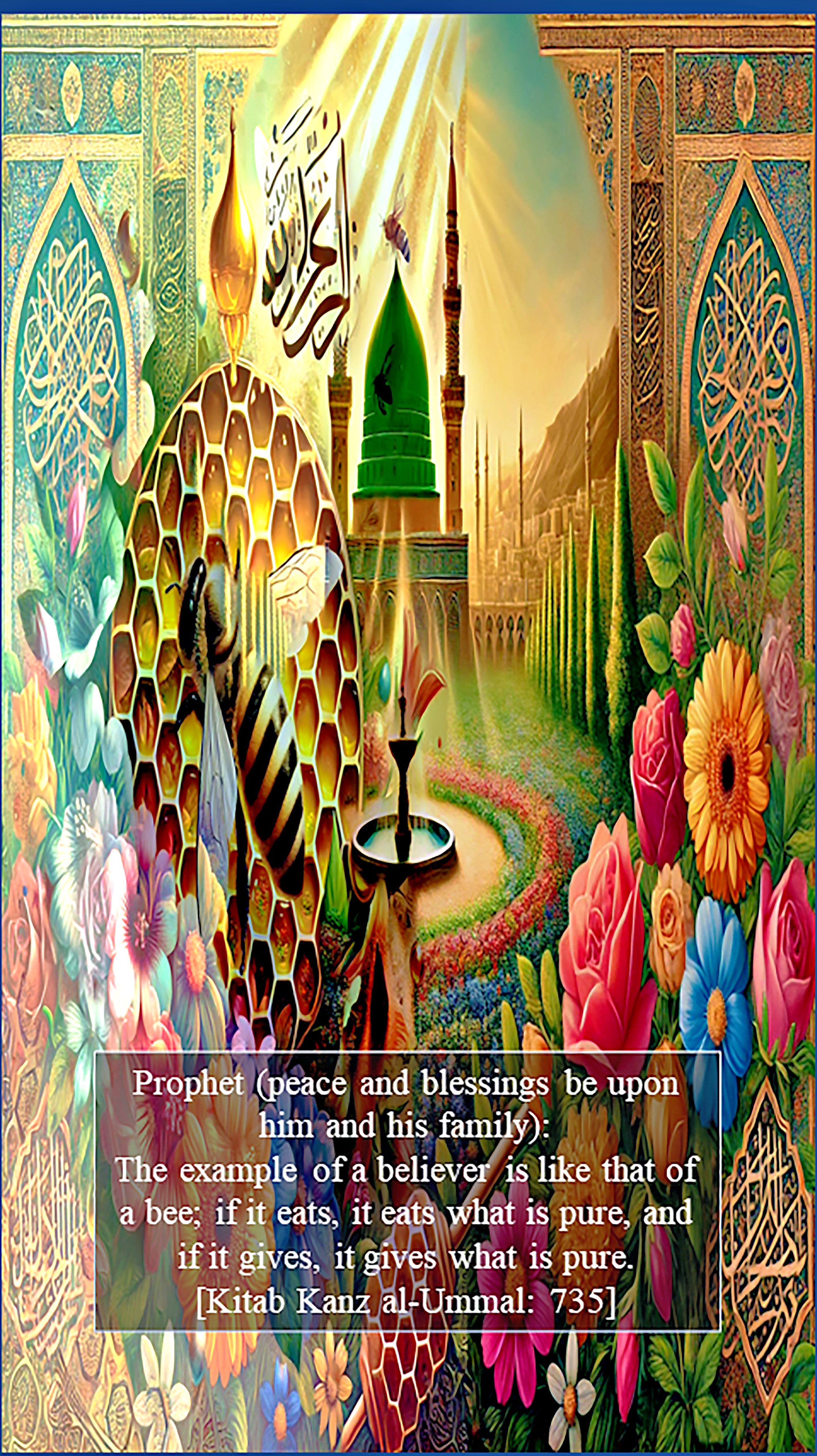
Download article from link below at the end
The Believer, the Bee and the Date-Palm: A Comprehensive Study of Divine Wisdom in Creation and Sustenance
This article explores the profound relationship between Islamic teachings on the nature of the believer, the wisdom embedded in creation, and the divine system of sustenance. Drawing from the rich tradition of prophetic hadith, Qur'anic exegesis, and Islamic ethics, we examine how the believer is likened to the bee and the date-palm—creatures of
immense benefit whose entire existence serves as a testament to divine wisdom. The article traces the spiritual and practical dimensions of lawful consumption, the etiquette of eating, the wisdom in natural cycles, and how reflection on food and creation leads to certainty in resurrection and accountability.
Part One: The Believer as the Bee
The Prophetic Analogy
Prophet Mohammad (peace be upon him and his family) said:
"Verily, the example of the believer is like that of the bee. If you accompany him, he benefits you; if you consult him, he benefits you; if you sit with him, he benefits you; and all of his affairs are full of benefits."(Bihar al-Anwar, Vol. 64, p. 238)
This profound analogy captures the essence of a true believer's character and impact on society. Just as the bee is a creature of immense benefit—producing honey, pollinating plants, and contributing to the ecosystem without causing harm—the believer is a source of goodness in all circumstances.
The Qur'an dedicates an entire chapter, Surat an-Nahl (The Bee), to this remarkable creature. Allah describes how He inspired the bee:
"And your Lord inspired the bee, saying: 'Take for yourself among the mountains, houses, and among the trees and that which they construct. Then eat of all the fruits and follow the ways of your Lord made easy.' There emerges from their bellies a drink of varying colors, in which there is healing for people. Indeed in that is a sign for a people who give thought." (Qur'an 16:68-69)
The bee's existence exemplifies divine wisdom. It consumes pure substances—nectar from flowers—and produces something even more beneficial: honey. The believer
similarly consumes what is lawful and good, and produces righteous deeds that benefit others.
Three Dimensions of the Believer-Bee Analogy
Prophet Mohammad (peace be upon him and his family) said: "The believer is just as a bee, if it eats, it eats what is good, and if it produces, it produces what is good, and if it falls on a decaying stick, it does not break it." (Mizan al-Hikmah by Muhammad al-Rayshahri, Volume 4, Page 2825)
- "If it eats, it eats what is good"
Just as the bee selects only pure nectar from the finest flowers, the believer partakes only in what is lawful, pure, and wholesome—both physically and spiritually. Prophet Muhammad (saww) (peace be upon him and his family) is reported to have said:
This signifies that the believer's knowledge, sustenance, and experiences are sought from virtuous sources. They are careful about what they consume, ensuring it is permissible and beneficial, reflecting their inner purity and adherence to divine guidance.
- "If it produces, it produces what is good"
The bee transforms nectar into honey—a substance described in the Qur'an as having healing for people. Similarly, the believer generates good deeds, wisdom, beneficial advice, and positive impact in society. Their words are constructive, their actions righteous, and their influence wholesome.
- "If it falls on a decaying stick, it does not break it"
This illustrates the believer's gentle, merciful, and discerning nature. Even in difficult, fragile, or seemingly insignificant situations, a believer acts with wisdom, care, and compassion, avoiding harm or destruction. They do not exacerbate problems but rather seek to mend and heal.
Comprehensive Benefit in Association
The tradition of the believer as a bee emphasizes three specific forms of interaction:
Companionship: Keeping company with a believer is beneficial. Their piety and good character naturally influence those around them.
Prophet Mohammad (peace be upon him and his family) said: "A believer is like unto a perfumer who will benefit you, should you keep company with him, or move along with him, or be a partner to him" (Nahj al-Fasahah, Tradition No. 9)
Consultation: Consulting a believer brings benefit. Their wisdom, discernment, and adherence to Islamic principles make their advice valuable.
Prophet Mohammad (peace be upon him and his family) said: "Consulting the wise and sincere advisor is guidance, blessing, and success from Allah, so when a sincere and wise person advises you, beware of opposition for in that lies destruction." (Wasa'il al-Shia Vol. 12, Section 1, Chapter 22, Hadith 15595)
Imam Jafar al-Sadiq (peace be upon him) said: "Seek counsel from the wise, pious men, for they only advise what is good. And beware of opposition, for opposing the wise and pious person causes corruption in religion and worldly affairs." (Wasa'il al-Shia Vol. 12, Section 1, Chapter 22, Hadith 15594)
Imam Jafar al-Sadiq (peace be upon him) said: "Consultation is only beneficial within its proper limits. Whoever understands its proper limits [benefits from it], otherwise its harm to the one seeking consultation is greater than its benefit to him. The first condition is that the one whom you consult should be intelligent, the second is that he should be free and religious, the third is that he should be a friend and a companion, and the fourth is that you inform him of your secret so that his knowledge of it is like your own knowledge of yourself, then he keeps it confidential and conceals it. For if they are intelligent, you will benefit from their consultation; if they are free and religious, they will strive to give you sincere advice; if they are a close friend and brother, they will keep your secret when you reveal it to them; and if you reveal your secret to them and their knowledge of it becomes like your own knowledge, the consultation becomes complete and the advice becomes perfect. Recommendation Of Consulting The God-Fearing, Wise, Devout, And Sin..." (Wasa'il al-Shia Vol. 12, Section 1, Chapter 22, Hadith 15597)
Sitting Together: Even casual interaction or spending time with a believer can impart positive influence, knowledge, or comfort.
Prophet Mohammad (SAWW): "A believer is the source of benefit. He will avail you, should you keep his company, counsel with him and become his partner. He is the cause of benefit in all affairs." (Nahj al-Fasahah, Tradition No. 22)
Part Two: The Believer and the Date-Palm
The Prophetic Comparison
Prophet Mohammad (peace be upon him and his family) also compared the believer to a date-palm:
"A believer is like unto a date palm; whatever you take from it will be to your benefit" (Nahj al-Fasahah, Tradition No. 8)
The Multifaceted Benefits of the Date-Palm
The date-palm is a tree of immense utility, and its comprehensive benefit serves as a powerful analogy for the believer:
Fruit: Its fruit is consumed as one of the best and most nutritious foods
Stone: Even its stone can be burnt, suggesting its use for fuel
Leaves: The leaves are versatile, used for weaving items such as mats, hats, and table-cloths
Wood: Its wood is utilized in construction and as bridges
Blossom: A fragrant and useful essence is extracted from its blossom
The commentary on this tradition notes: "No part of it is useless and shall be discarded." Every component serves a purpose and provides benefit.
Qualities of the Believer Analogous to the Date-Palm
Just as every part of a date-palm is beneficial, so too are the various aspects of a believer's existence and interaction:
Thoughts: Their thoughts are useful, leading to constructive ideas and intentions
Speeches: Their speeches are profitable, offering wisdom, guidance, and positive communication
Meetings: Their meetings give lesson, meaning interaction with them is always enlightening and educational
Religion: Their adherence to religion is reforming, indicating a positive impact on society
Character: They are loyal in friendship and strong in decision
Everything of them is worthy.
The Steadfastness of the Believer
Another narration further underscores the steadfastness of a believer:
Prophet Mohammad (peace be upon him and his family) said the following: “A believer is like the tree whose leaves do not fall off in summer or in winter. They asked, ‘O Prophet, what tree is it?’ He said, ‘It is the palm-tree.’” (Al-Kafi (Vol. 2) by Shaykh Muhammad b. Yaqub al-Kulayni, Book 1, Chapter 99, Hadith #16)
Hazrat Mohammad (SAWW): "A strong believer is like unto a palm tree, and a weak one resembles a stalk" (Nahj al-Fasahah, Tradition No. 131)
Hazrat Mohammad (SAWW): "A believer is like unto a date palm; whatever you take from it will be to your benefit" (Nahj al-Fasahah, Tradition No. 8)
This highlights the believer's unwavering faith and resilience, much like the date tree that remains steady and unchanged despite changing seasons.
Part Three: The Believer's Consumption - Lawful and Pure Sustenance
The Qur'an establishes the principle of consuming what is both lawful (halal) and good/pure (tayyib):
"O mankind! Eat of what is in the earth lawful and good; and do not follow the footsteps of Satan. Surely he is a manifest foe for you." (Qur'an 2:168)
"O you who have faith! Eat of the good things We have provided you with, and be grateful to Allah, if Him it is you worship."(Qur'an 2:172)
These verses establish two conditions for what a believer consumes: it must be legally permissible according to Islamic law, and it must be pure, wholesome, and beneficial.
The Meaning of "Lawful" (Halal)
"Lawful" primarily refers to food that is religiously permissible according to Islamic law. The general principle is that everything in the earth is permissible unless explicitly forbidden by Allah. Lawfulness is defined by adhering to Allah's explicit prohibitions and ensuring proper acquisition through legitimate means.
The Meaning of "Good" (Tayyib)
"Tayyib" encompasses multiple dimensions relating to purity, wholesomeness, and beneficial nature. It means the food should be:
Clean and pure: Free from impurity and contamination
Wholesome: Beneficial to the body and mind
Lawfully acquired: Obtained through legitimate and ethical means
Not harmful: Free from substances that would cause harm
The Spiritual Significance of Lawful Consumption
The consumption of lawful and pure sustenance is not merely a dietary restriction but a comprehensive Islamic principle that underpins a believer's piety, health, spiritual development, and relationship with Allah:
Reflection of Inner Purity: The act of eating only what is good directly reflects a believer's inner purity. Their external actions, including what they consume, align with their internal state of devotion.
Preparation for the Hereafter: Eating lawful food is a way to prepare for the good and pure sustenance of Heaven. If one wishes to be capable of receiving the blessings of Heaven, they should accustom themselves to eating lawful and good foods.
Part Four: The Etiquette of Eating and Moderation
The Qur'anic Command of Moderation
"Eat and drink, but do not waste; surely He does not love the extravagant."(Qur'an 7:31)
This verse affirms that lawful eating and drinking are encouraged within Islam, but they must be governed by moderation and the avoidance of extravagance.
Amir al-Mu'minin Imam Ali (peace be upon him) said, "Eating little is a sign of self-restraint, and eating a lot is a sign of wastefulness." (Mustadrak al-Wasa’il, v. 16, p. 213, no. 19634)
Imam Jafar al Sadiq (peace be upon him) said: "Do you think Allah gave to those He gave out of honoring them, and withheld from those He withheld from out of degrading them? No, rather wealth is Allah's wealth which He places with people as deposits. He permitted them to eat moderately, drink moderately, dress moderately, marry moderately, ride moderately, and return what exceeds that to the poor believers and help those in distress. Whoever does this, what they eat, drink, ride, and marry is permissible. Whoever exceeds that, it becomes forbidden for them. Then he said: "Do not be excessive; indeed, He does not like those who commit excess" [Al-A'raf: 31]. Do you think Allah would entrust a man with wealth and tell him to buy a horse for ten thousand dirhams when a horse worth twenty dirhams would suffice him, or buy a slave girl for a thousand when one worth twenty dinars would suffice him? Then he said: "Do not be excessive; indeed, Allah does not like those who commit excess" [Al-A'raf: 31]. (Wasa'il al-Shia Vol. 11, Section 6, Chapter 23, Hadith 15370)
Imam Jafar a Sadiq (peace be upon him) said, "Allah, most Majestic, most Glorious, hates overeating.’ Abu ‘Abd Allah (a.s.), has said, ‘Children of Adam must eat to keep their backs straight. When one of you eats keep one-third of your stomach for food one-third for water and one-third for breathing and never become fat like pigs to be slaughtered.’” (Al-Kafi (Vol. 6) by Shaykh Muhammad b. Yaqub al-Kulayni, Book 5, Chapter 21, Hadith #9)
The Prophetic Guidance on Eating
Prophet Mohammad (peace be upon him and his family) provided practical advice on eating habits:
"Eat when you desire and stop while you still desire." (Bihar al-Anwar, v. 62, p. 290)
Imam Ali's Advice on Health and Moderation
Imam Ali (peace be upon him) advised:"A man who eats excessively, his health declines and his burden becomes heavier than he can endure." (Ghurar al-Hikam, no. 8903)
Imam Ali (a.s.) said, "Eating little is a sign of self-restraint, and eating a lot is a sign of wastefulness." (Mustadrak al-Wasa’il, v. 16, p. 213, no. 19634)
This advice establishes practical criteria for relative moderation in eating that keeps one away from greed and overfilling.
The Harms of Excessive Eating
Islamic traditions warn extensively against overeating and its detrimental effects:
Physical Harms:
Imam Jafar al Sadiq (a.s.) said, "Every illness is because of overeating except, fever (infection) which enters the body.” (Al-Kafi (Vol. 6) by Shaykh Muhammad b. Yaqub al-Kulayni, Book 5, Chapter 21, Hadith #8)
Spiritual Harms:
Prophet Mohammad (peace be upon him and his family) said, "Be warned against excessive food, for it poisons the heart with hardness, slows the limbs in performing acts of obedience, and blocks the souls from hearing counsel." (Bihar al-Anwar, v. 77, p. 182, no. 10)
Prophet Mohammad (peace be upon him and his family) said, "Nothing is more despised by Allah than a full stomach." (Uyoun Akhbar al-Ridha (a.s.), v. 2, p. 36, no. 89)
Imam Ali (a.s.) said, "Overeating is the greatest aid to acts of disobedience." (Ghurar al-Hikam, no. 9922)
Imam Ali (a.s.) said, "Overeating spoils piety." (Ghurar al-Hikam, no. 659)
The Spiritual Benefits of Moderation
Conversely, moderation in eating brings numerous spiritual and physical benefits:
Prophet Mohammad (peace be upon him and his family) said, "A man whose [consumption of] food is little has a healthy stomach and a pure heart, and a man whose food is plenty has a sickly stomach and a hard heart." (Tanbih al-Khawatir, v. 1, p. 46)
Sound Body and Pure Heart: Whoever eats little, will have a sound body and a pure heart
Spiritual Activity: Moderation results in feeling active and zealous for worship
Soul's Purification: It leads to soul's purification, illumination, and enjoyment
Clarity of Thought: Whoever eats less, their thought will be more purified
Part Five: The Wisdom in Creation and the Signs of Resurrection
"Then Let Man Look to His Food"
The Qur'anic verse "Then let man look to his food" found in Surah Abasa (Qur'an 80:24) carries profound meaning. It is an invitation to deep reflection on our physical sustenance.
The verses immediately following detail the miraculous process through which food is produced:
[80:25] That We pour down the water, pouring it in abundance,
[80:26] And We split the earth into fragments,
[80:27] And We produce therein corn,
[80:28] And grapes and grasses,
[80:29] And the olive and the palm,
[80:30] And gardens, dense with trees,
[80:31] And fruits and fodder,
[80:32] Provision for you and for your cattle.
Spiritual Interpretation: Food as Knowledge
Imam al-Baqir (peace be upon him) provided a profound spiritual interpretation: “It is his knowledge that he acquires from whoever he acquires.” This he said in answer to the question ‘What is his food’ in the words of Allah, “Let the human being think about (how We produce) his food.” (80:24)?’ (Al-Kafi (Vol. 1) by Shaykh Muhammad b. Yaqub al-Kulayni, Book 2, Chapter 16, Hadith #8)
This interpretation elevates the meaning of "food" from mere bodily nourishment to the sustenance of the soul. Just as the body requires physical food for its survival and function, the soul requires knowledge, and the source of this knowledge is of paramount importance.
The Connection to Resurrection
The deeper purpose of reflecting is to recognize the power of Allah and the certainty of resurrection. The question embedded in the verse is:
"Is not He who created the heavens and the earth Able to create the likes of them? Yes, [it is so]; and He is the Knowing Creator."(Qur'an 36:81)
The Signs of Resurrection in Nature
The Qur'an repeatedly uses natural phenomena as evidence for resurrection:
Revival of Dead Land:
"And of His signs is that you see the earth still, but when We send down water upon it, it stirs and grows. Indeed, He who gives it life is the Giver of Life to the dead. Indeed, He is over all things competent." (Qur'an 41:39)
"And it is Allah who sends the winds, and they stir the clouds, and We drive them to a dead land and give life thereby to the earth after its death. Thus is the resurrection."(Qur'an 35:9)
Creation from Nothing:
"Does man not remember that We created him before, while he was nothing?" (Qur'an 19:67)
Imam Ali's Wonder at the Deniers
Imam Ali (peace be upon him) expressed amazement at those who deny the resurrection: "How I wonder at the one who entertains doubts about Allah whilst beholding the very creation of Allah." (Nahjul Balaghah, Saying 126)
Part Six: The Most Beloved Servants of Allah
The Prophetic and Imams Description
Imam Jafar al Sadiq (peace be upon him) said: "The Prophet Mohammad (peace be upon him and his family) (peace be upon him and his family) was asked: Who are the most beloved people to Allah? He said: The most beneficial of people to people." (Wasa'il al-Shia Vol. 16, Section 3, Chapter 22, Hadith 21713)
This profound hadith identifies three core attributes of individuals who attain the highest degree of Allah's love:
- Most Beneficial to His Servants
This emphasizes an active and selfless approach to life, where a believer's existence is a source of good for others. It encompasses all forms of assistance, kindness, support, and positive impact on fellow human beings.
Prophet Mohammad (peace be upon him and his family) said:
"Creatures are the dependents of Allah, so the most beloved creation to Allah is the one who benefits the dependents of Allah and brings joy to a household." (Wasa'il al-Shia by al-Hurr al-Amili, Volume 16, Page 341)
Prophet Mohammad (peace be upon him and his family) (peace be upon him and his family) said: "All creation are the dependents of Allah, and the most beloved to Allah, the Mighty and Majestic, are those who benefit His dependents most." (Wasa'il al-Shia Vol. 16, Section 3, Chapter 22, Hadith 21720)
Imam Jafar al Sadiq (peace be upon him) said: "Allah the Mighty and Majestic says: The creation is My dependents, so the most beloved of them to Me are those who are most kind to them and those who strive the most in fulfilling their needs." (Wasa'il al-Shia Vol. 16, Section 3, Chapter 27, Hadith 21781)
- Most Upright in Fulfilling His Rights
This refers to steadfast adherence to Allah's commands, laws, and ethical principles. It signifies a deep sense of accountability and devotion, ensuring that one's duties towards the Creator are meticulously observed.
Prophet Mohammad (peace be upon him and his family) said: "The most beloved of Allah’s servants to Him are those that are the most useful to His servants, and the most persistent of them in establishing His right, those who endear virtue and its practices." (Tuhaf al-’Uqul, no. 49)
- To Whom Good is Made Beloved
This attribute goes beyond merely performing good deeds; it signifies an intrinsic love and inclination towards goodness. Such individuals are not just externally compliant but possess an inner disposition that delights in virtue.
Imam Mohammad Baqir (peace be upon him) said: "Indeed among the most beloved servants of Allah to Allah are those whom He has made to love good deeds and made them love doing them." (Wasa'il al-Shia Vol. 16, Section 3, Chapter 1, Hadith 21560)
These characteristics are perfectly embodied by the Ahl al-Bayt (the purified Household of the Prophet). They are described as the ultimate guides and benefactors of humanity, the epitome of devotion to Allah's rights, and those who inherently love and perform all forms of goodness.
Part Seven: Generosity - The Path to Nearness to Allah
Imam Ali's Statement
"Generosity is a means of nearness [to Allah]." (Mizan al-Hikmah, Bihar al-Anwar, Vol. 72, p. 193)
Imam Ali (a.s.) said, "Generosity is the fruit of the intellect, and contentment is the proof of magnanimity." (Ghurar al-Hikam, no. 2145)
Imam Ali (a.s.) said, "The intellect is a tree the fruit of which is generosity and modesty." (Ghurar al-Hikam, no. 1254)
The Nature of Generosity
In Islamic teachings, generosity is defined as:
Comprehensive Giving: Giving what one has, including wealth, knowledge, strength, time, a smile, or a prayer
Recognition of Allah's Ownership: Recognizing that all possessions are trusts from Allah
Fulfilling Obligations: As Imam al-Sadiq (peace be upon him) defined it: "It is to give from your wealth the rightful dues that Allah has obligated upon you"
Selfless Giving: True generosity is giving without expectation of return
The Prophetic Teachings on Generosity
Prophet Mohammad (peace be upon him and his family) extensively emphasized generosity:
"The generous person is close to Allah, close to people and close to Paradise." (Bihar al-Anwar, v. 73, p. 308, no. 37)
Prophet Mohammad (may Allah bless him and his family) said: "The generous person is beloved in the heavens, beloved on earth, created from pure clay, and the water of his eyes is created from al-Kawthar. The miser is despised in the heavens and despised on the earths, created from brackish clay, and the water of his eyes is created from the water of thorns." (Wasa'il al-Shia Vol. 21, Section 7, Chapter 22, Hadith 27819)
The Benefits of Generosity
Generosity brings numerous benefits to a believer:
Spiritual Benefits:
Nearness to Allah
Entry into Paradise
Divine protection and guidance
Forgiveness of sins
Worldly Benefits:
Love and respect from people
Protection from calamities
Lengthening of life
Increase in sustenance
Imam Ali (peace be upon him) linked generosity to the intellect: "Generosity is the fruit of the intellect, and contentment is the proof of magnanimity." (Ghurar al-Hikam, no. 2145)
The intellect is described as a tree the fruit of which is generosity and modesty. This indicates that true generosity stems from wisdom and sound understanding.
Part Eight: The Divine Attribute of Generosity and Its Reflection in Believers
Allah as Al-Karim (The Generous)
The discussion of the divine name Al-Karim explains that anything good, precious, and of great importance is described as karim, and a person who is "outgiving" is also called generous. Allah's generosity is absolute and without limit.
"Recite, and your Lord is the most Generous" (Quran 96:3)
"O mankind, what has deceived you concerning your Lord, the Generous" (Quran 82:6)
The Friends of Allah and Generosity
Prophet Mohammad (peace be upon him and his family) said:
"Allah has created every single vicegerent of His with generosity as their natural disposition." (Kanz al-’Ummal, no. 16204)
These teachings establish that being among the friends of Allah entails generosity as a defining, intrinsic trait. Generosity is not merely an occasional act for those close to Allah; it is part of their very nature.
The ethical teachings encourage believers to endeavour hard to be munificent and generous towards relatives, deserving ones and the like, for the pleasure of Allah.Imam Zaynul Abideen (peace be upon him) said: "The most pleasing of you to Allah is the most generous of you to his family." (Wasa'il al-Shia Vol. 21, Section 7, Chapter 20, Hadith 27806)
This shows that generosity is both a distinctive mark of the awliya' and an attribute believers must consciously cultivate to approach the station of Allah's friends.
Part Nine: The Good Tree - A Symbol of the Believer
The Qur'anic Parable
"Do you not see how Allah presents an example: a good word is like a good tree, whose root is firmly fixed and its branches are in heaven, producing its fruit at all times by permission of its Lord."
(Qur'an 14:24-25)
The Interpretation of the Good Tree
A number of our people has narrated from Ahmad ibn Muhammad from Ali ibn Sayf from his father from ‘Amr ibn Harith who has said the following. “I asked abu ‘Abdallah (a.s.) about the words of Allah. “. . a blessed tree which has firm roots and branches rising up into the sky.” (14:24) The Imam (a.s.) said that the The Holy Prophet (s.a) said, “The root is Amir al-Mu’minin Ali (a.s.) and the branches are the Imams from their (Amir al-Mu’minin (a.s.) and The Holy Prophet (s.a) descendants and the knowledge of Imams stand for the fruits. Their faithful followers represent the leaves of such tree.” The Imam (a.s.) asked, “Is there anything else in the tree?” I said, “No, there is nothing else there. The Imam (a.s.) then said, “By Allah, when a faithful is given a child a leave grows in the tree and when a faithful dies a leave falls off the tree.” (Al-Kafi (Vol. 1) by Shaykh Muhammad b. Yaqub al-Kulayni, Book 4, Chapter 108, Hadith #78)
According to the same documentation on the authority of Ali ibn Abi Talib (a.s.), God’s Prophet (S) said, “O Ali! People have been created from different trees, but you and I have been created from the same tree. I am the root and you are the trunk. Al-Hassan and Al-Husayn are its branches. The Shiites are the leafs. God will take to Paradise whoever grabs onto any of the branches!” (Uyun akhbar al-Rida (Vol. 2) by Shaykh Muhammad b. Ali al-Saduq, Book 1, Chapter 1, Hadith #342)
This tradition interprets this "good tree" in a profound way:
The Holy Prophet is the origin (root)
Imam Ali is its stem or trunk
The Imams are its branches
The true believers are its leaves
The Qur'an mentions the olive tree in Surat an-Nur (24:35):
"Allah is the Light of the heavens and the earth. The Parable of His Light is as if there were a Niche and within it a Lamp... Lit from a blessed Tree, an Olive, neither of the east nor of the west."
My father, may Allah have mercy on him, said: Sa`d ibn `Abd Allah on the authority of Ya`qub ibn Yazid on the authority of al-`Abbas ibn Hilal that I asked al-Rida about the Word of Allah, the Mighty and High: “Allah is the Light of the Heavens and the Earth.” So he replied: “He is the Guide of the Inhabitants of Heaven and the Guide of the Inhabitants of the Earth.” While the narration of al-Barqi states: “He guides whatever is in the Heavens, and He guides whatever is in the Earth.” The Compiler of this book says: The anthropomorphist interpret this verse as He is the Light of the Heavens and the Earth. If that were correct, how is it possible to find darkness on the Earth at any time, be it day or night? If Allah was the Light of the Heavens, and the Earth, according to their interpretation, He would have to be perpetually present, and could not be non-existent at times. Therefore, when we find the Earth dark at night, and when we find the inside of the Earth dark (even) during the day, then this indicates that the interpretation of : “Allah is the Light of heaves, and the Earth,” is what al-Ridahas said and not that the anthropomorphist have given. So, verily, He, the Mighty and High, is the Guide of the Inhabitants in the Heavens and the Earth, and the Indicator [Mubayyin] for the Inhabitants of the Heavens and the Earth in their religious and worldly affairs. In the same way that the inhabitants of the Heavens and the Earth are guided by Allah in their religious affairs, they are guided by the Light that Allah has created for them in the Heavens and the Earth in their worldly affairs. This is what He meant when He said that He was the Light of the Heaves and the Earth. The attribute He applied to Himself is metaphorical since, intellectually – speaking, it is not logical for Allah, the Mighty and High, to be light or to glow, or to belong to the realm of lights, for the simple fact that He is the Creator of Light. His Statement also applies to the verse: “A likeness of His Light.” Verily, He intended by it the description of His Light. Evidently, this Light is other than Him since He anthropomorphized it with the lamp and its glow, as He mentioned and described in this verse. It is not permissible to anthropomorphize His Being with the lamp, because there is no likeness and no equivalent to Allah. Therefore, it is correct to say that His Light, which He anthropomorphized with a lamp, refers to His Guidance. It refers to the fact that He guides the inhabitants of the Heaves and the Earth towards His Religion, towards divine Unity, toward His Wisdom, and towards His Justice. After explaining the Clearness of His Guidance and naming it “Light,” as He guides with it His Servants to His Religion and what is in their best interests, He said: A likeness of it is a niche in which is a lamp, the lamp is in a clear glass that resembles a brightly shining star in its clearness. The brightly shining star is a star that resembles a pearl in its color. This lamp, which is in a clear glass, light from a blessed olive oil. He has intended by this Syrian oil, because it is said: It is blessed for its inhabitants. By “Neither eastern nor western,” the Mighty and High means that this oil is neither eastern, so that he sun does not shine on it at the time of sunset, nor western so that the sun does not shine on it at the time of sunrise. Rather, it is from the upper part of the tree and the sun shines on it throughout the day. This is what makes it the best, and makes its oil light. He then emphasized the clearness of its oil; that “the oil whereof almost gives light through fire touches it not” to describe its clarity. He explains that the religious guidance that Allah gives His Servants in the Heavens and the Earth, is clear, and its explanation, which is the clear glass, is equally clear. The fire ignites the clear oil as He described. The glow of the fire combines with the glow of glass and the glow of oil in it. This is the meaning of His Word: “light upon light,” and this is what He, the Mighty and High, meant: “Allah guides to His light whom He pleases.” That is, from His Servants who have reached the age of maturity so that they may recognize by that and be guided through it, and reason with it, regarding the unity of their Lord, and all religious matters. Allah, the Mighty and High, has indicated by this verse what He has mentioned of His Clear Indications and Signs with which He guides His Servants in their religion. In other words, none of them have been left in ignorance. If any of them neglect their religion, it is not due to vagueness or ambiguity on behalf of Allah, the Mighty and High, since Allah, the Mighty and High, has explained to them His Indications and Signs. Verily, they come to make mistake, due to forgetting about Allah’s sings and failing to derive through these signs the existence of Allah, the Mighty and High, and what is in their best religious interest. He has also explained that He Is All-Knowing when it comes to the interest of His Servants." (Al-Tawhid by Shaykh Muhammad b. Ali al-Saduq, Book 2, Chapter 15, Hadith #1)
It had been related on the authority of al-Sadiq (AS) that he (AS) was asked about the Word of Allah, the Mighty and High: “Allah is the Light of the Heavens and the Earth; a likeness of His Light is as a niche in which is a lamp.” So he (AS) replied: "Allah has given an example for us. The Prophet (SA) and the Imams, may Allah bless them all, are the Signs of Allah through which He guides people towards Divine Unity, towards His Religion, towards Islamic law, and towards (religious) obligations and recommendations. There is no power except Allah, the Most High and Most Great." (Al-Tawhid by Shaykh Muhammad b. Ali al-Saduq, Book 2, Chapter 15, Hadith #2)
This verse is interpreted as referring to the Imams of the Ahl al-Bayt:
"Light upon light" refers to the Imams arriving one after another, each increasing knowledge and wisdom.
Part Ten: Reflection on Creation as a Path to Divine Knowledge
The Qur'an repeatedly commands reflection on creation:
"Indeed, in the creation of the heavens and the earth and the alternation of the night and the day are signs for those of understanding - who remember Allah while standing or sitting or lying on their sides and give thought to the creation of the heavens and the earth."(Qur'an 3:190-191)
The universe is not created in vain:
"And We did not create the heaven and earth and that between them aimlessly. That is the assumption of those who disbelieve."(Qur'an 38:27)
Imam al-Baqir (peace be upon him) advised:
"Beware of contemplating about Allah, but if you want to look at His greatness, then look at the greatness of His creation." (Wasa'il al-Shia Vol. 16, Section 2, Chapter 23, Hadith 21327)
This teaching emphasizes that the path to knowing Allah is through contemplation of His signs in the universe, not through futile attempts to comprehend His essence.
The ultimate purpose of creation is clarified in the Qur'an:
"And I did not create the jinn and mankind except to worship Me." (Qur'an 51:56)
This worship encompasses all aspects of life lived in obedience to Allah—not merely ritual prayers but every action done with the intention of pleasing Him.
The comprehensive teachings presented in this study reveal a profound unity in Islamic thought—connecting the nature of the believer to the wisdom of creation, and both to the ultimate reality of resurrection and accountability.
The Believer's Place in Creation
The believer, likened to the bee and the date-palm, is a creature of immense benefit whose entire existence serves as a testament to divine wisdom. Through lawful
consumption, moderation, generosity, and reflection, the believer embodies the qualities of these remarkable creatures.
The Wisdom in Sustenance
The system of sustenance—from the descent of rain to the growth of diverse plants—is not merely a biological process but a sign of Allah's power, wisdom, and mercy. It serves both to sustain life and to provide evidence for the resurrection.
The Call to Reflection
The Qur'anic command to "look to one's food" is an invitation to deep reflection that leads to three essential realizations:
- The Power of Allah in creating such a complex and perfect system from simple elements
- The Wisdom of Allah in the diversity, order, and benefit of creation
- The Certainty of Resurrection demonstrated by the constant cycle of life from death
The Path to Divine Love
The most beloved servants of Allah are those who:
Benefit His creation
Uphold His rights
Love goodness and act upon it
Practice generosity as a natural disposition
Reflect on His signs and grow in knowledge and certainty
The Ultimate Reality
All of creation points to its Creator. The physical world, with all its intricate systems and cycles, serves as a book of signs for those who reflect. And this reflection leads inexorably to the certainty that:
""He who gave life to the dead earth will surely give life to the dead."(Qur'an 41:39)
Thus, the believer's journey is one of continuous reflection, lawful consumption, moderation, generosity, and service to creation—all of which lead to nearness to Allah, certainty in His promise, and the hope of eternal felicity in Paradise.
References
Primary Sources
Qur'anic References
1. Qur'an 2:168 - "O mankind! Eat of what is in the earth lawful and good..."
2. Qur'an 2:172 - "O you who have faith! Eat of the good things We have provided you with..."
3. Qur'an 7:31 - "Eat and drink, but do not waste..."
4. Qur'an 14:24-25 - "Do you not see how Allah presents an example: a good word is like a good tree..."
5. Qur'an 16:68-69 - Surat an-Nahl (The Bee)
6. Qur'an 19:67 - "Does man not remember that We created him before, while he was nothing?"
7. Qur'an 24:35 - Surat an-Nur (The Light Verse)
8. Qur'an 35:9 - "And it is Allah who sends the winds..."
9. Qur'an 36:81 - "Is not He who created the heavens and the earth Able to create the likes of them?"
10. Qur'an 38:27 - "And We did not create the heaven and earth and that between them aimlessly..."
11. Qur'an 41:39 - "And of His signs is that you see the earth still..."
12. Qur'an 51:56 - "And I did not create the jinn and mankind except to worship Me."
13. Qur'an 80:24-32 - "Then let man look to his food..."
14. Qur'an 82:6 - "O mankind, what has deceived you concerning your Lord, the Generous"
15. Qur'an 96:3 - "Recite, and your Lord is the most Generous"
Hadith Collections
Al-Kafi by Shaykh Muhammad b. Yaqub al-Kulayni
1. Al-Kafi (Vol. 1), Book 2, Chapter 16, Hadith #8 - Imam al-Baqir's interpretation of food as knowledge
2. Al-Kafi (Vol. 1), Book 4, Chapter 108, Hadith #78 - Interpretation of the good tree
3. Al-Kafi (Vol. 2), Book 1, Chapter 99, Hadith #16 - Believer like the palm-tree
4. Al-Kafi (Vol. 6), Book 5, Chapter 21, Hadith #8 - Illness from overeating
5. Al-Kafi (Vol. 6), Book 5, Chapter 21, Hadith #9 - Moderation in eating
Wasa'il al-Shia by al-Hurr al-Amili
1. Wasa'il al-Shia Vol. 11, Section 6, Chapter 23, Hadith 15370 - Moderation and extravagance
2. Wasa'il al-Shia Vol. 12, Section 1, Chapter 22, Hadith 15594 - Consultation with wise and pious men
3. Wasa'il al-Shia Vol. 12, Section 1, Chapter 22, Hadith 15595 - Consulting the wise and sincere advisor
4. Wasa'il al-Shia Vol. 12, Section 1, Chapter 22, Hadith 15597 - Conditions for effective consultation
5. Wasa'il al-Shia Vol. 16, Section 2, Chapter 23, Hadith 21327 - Contemplating creation
6. Wasa'il al-Shia Vol. 16, Section 3, Chapter 1, Hadith 21560 - Love of good deeds
7. Wasa'il al-Shia Vol. 16, Section 3, Chapter 22, Hadith 21713 - Most beloved people to Allah
8. Wasa'il al-Shia Vol. 16, Section 3, Chapter 22, Hadith 21720 - Benefiting Allah's dependents
9. Wasa'il al-Shia Vol. 16, Section 3, Chapter 27, Hadith 21781 - Kindness to creation
10. Wasa'il al-Shia Vol. 21, Section 7, Chapter 20, Hadith 27806 - Generosity to family
11. Wasa'il al-Shia Vol. 21, Section 7, Chapter 22, Hadith 27819 - The generous and the miser
Bihar al-Anwar
1. Bihar al-Anwar, Vol. 64, p. 238 - The believer as the bee
2. Bihar al-Anwar, v. 62, p. 290 - Eat when you desire
3. Bihar al-Anwar, v. 72, p. 193 - Generosity as nearness to Allah
4. Bihar al-Anwar, v. 73, p. 308, no. 37 - The generous person
5. Bihar al-Anwar, v. 77, p. 182, no. 10 - Warning against excessive food
Nahj al-Fasahah
1. Tradition No. 8 - Believer like unto a date palm
2. Tradition No. 9 - Believer like unto a perfumer
3. Tradition No. 22 - Believer is the source of benefit
4. Tradition No. 131 - Strong believer like unto a palm tree
Other Primary Hadith Sources
1. Al-Tawhid by Shaykh Muhammad b. Ali al-Saduq, Book 2, Chapter 15, Hadith #1 - Commentary on the Light Verse
2. Al-Tawhid by Shaykh Muhammad b. Ali al-Saduq, Book 2, Chapter 15, Hadith #2 - Sadiq's interpretation of the Light Verse
3. Ghurar al-Hikam, no. 659 - Overeating spoils piety
4. Ghurar al-Hikam, no. 1254 - Intellect as a tree
5. Ghurar al-Hikam, no. 2145 - Generosity is the fruit of intellect
6. Ghurar al-Hikam, no. 8903 - Excessive eating harms health
7. Ghurar al-Hikam, no. 9922 - Overeating aids disobedience
8. Kanz al-’Ummal, no. 16204 - Generosity as natural disposition
9. Mustadrak al-Wasa'il, v. 16, p. 213, no. 19634 - Eating little and eating much
10. Mizan al-Hikmah by Muhammad al-Rayshahri, Volume 4, Page 2825 - The believer as a bee
11. Nahjul Balaghah, Saying 126 - Imam Ali's wonder at deniers of resurrection
12. Tanbih al-Khawatir, v. 1, p. 46 - Little food benefits
13. Tuhaf al-’Uqul, no. 49 - Most beloved servants of Allah
14. Uyoun Akhbar al-Ridha (a.s.), v. 2, p. 36, no. 89 - Full stomach despised by Allah
15. Uyun akhbar al-Rida (Vol. 2) by Shaykh Muhammad b. Ali al-Saduq, Book 1, Chapter 1, Hadith #342 - Creation from trees
Secondary Sources
1. Mizan al-Hikmah by Muhammad al-Rayshahri - Believer-bee analogy
2. Al-Kafi commentary - Various hadith interpretations
3. Nahjul Balaghah - Imam Ali's sayings and wisdom
General References
Islamic ethical teachings on consumption and moderation
Prophetic traditions on generosity and benevolence
Note: The article draws extensively from both primary Islamic sources (Qur'an and Hadith) as well as major Shi'a hadith compilations including Al-Kafi, Wasa'il al-Shia, Bihar al-Anwar, and various other collections of prophetic traditions and sayings of the Imams.
Qur'anic verses and hadiths of Ahl al-Bayt (peace be upon them) and sayings in Arabic, Persian and English.
https://eitaa.com/noorunalanoor
https://www.youtube.com/@110Inspire
https://youtube.com/@mustafaabbas4668?si=EnSIkaIECMiOmarE
https://youtube.com/@mustafaabbas8978?si=EMJylUW9_zruJx95