Posted by Mustafa Abbas on August 29, 2026 | Views: 253 | Ratings: 167
Download article from link below at the end
The Pursuit of Beneficial Knowledge in Islam: A Comprehensive Study
Introduction: The Prophetic Foundation
The teachings of Islam place extraordinary emphasis on knowledge, elevating it to a status that is simultaneously a religious obligation, a spiritual pursuit, and a path to divine nearness. One of the most profound statements attributed to the Holy Prophet Muhammad (peace be upon him and his family) encapsulates this emphasis:
"If a day comes upon me in which I do not increase in knowledge that brings me closer to Allah the Almighty, then there is no blessing for me in the rising of the sun of that day." (Nahj al Fasahah)
This declaration establishes a fundamental principle: the acquisition of beneficial, divinely-oriented knowledge is not merely recommended but is essential for a blessed life. The Prophet's words convey that a day without spiritual and intellectual growth is a day devoid of true blessing, emphasizing the dynamic and ongoing nature of a believer's journey toward Allah.
The Prophet's statement serves as a powerful motivator for introspection and selfimprovement, urging one to make every day count in the pursuit of greater understanding and closeness to Allah. It highlights a strong desire for constant progress and a sense of dissatisfaction with spiritual or intellectual stagnation.
Part One: The Obligation of Seeking Knowledge
Islamic teachings unequivocally establish seeking knowledge as a mandatory duty for every Muslim, without exception. The Prophet Muhammad (peace be upon him and his family) repeatedly emphasized this fundamental obligation:
"Seeking knowledge is an obligation on every Muslim. Indeed how Allah loves those who strive in their quest for knowledge." (al-Kafi, v. 1, p. 30, no. 1)
This obligation is universal, extending to every Muslim man and Muslim woman. The explicit inclusion of women alongside men underscores that the pursuit of knowledge is not restricted by gender, social status, or any other worldly distinction. Islam makes no distinction between men and women when it comes to the pursuit of knowledge.
Imam Amir ul Mu'mineen Ali (peace be upon him) said, "The one who seeks for knowledge is like a warrior in the cause of religion for the way of Allah." (Mizan al-Hikma, volume: 8, page: 31)
This saying highlights the high status of seeking knowledge in Islam. Imam Ali (peace be upon him) compares a sincere seeker of knowledge to a warrior fighting in the path of Allah because both strive against ignorance, falsehood, and the lower self, and both serve the cause of truth and religion. The wording is close to the well-known prophetic tradition: "He who goes out to seek knowledge is indeed on the path of Allah until he returns." ( Kanz al-’Ummal, no. 28702)
This typically refers to Jihad (holy struggle). By equating the journey of seeking knowledge with being "in the path of Allah," Islam elevates this pursuit to the highest forms of devotion and struggle. It signifies that every effort in acquiring knowledge is recognized and rewarded by Allah as if one were engaged in a divine campaign. The seeker of knowledge is "a warrior in the cause of religion for the way of Allah" and "a holy warrior in the way of Allah."
In this view, the pursuit of sacred knowledge is not merely an intellectual activity—it is a form of spiritual struggle and worship.
The Messenger of Allah (peace be upon him and his family) further emphasized this by stating:
"Seeking knowledge is obligatory for every Muslim. Let it be known that Allah loves those who seek knowledge." (Al-Kafi, Volume 1, Book 2, Chapter 1, Hadith #5)
This narration highlights that the obligation to seek knowledge is not merely a legal requirement but a means of earning divine love and companionship.
This reflects the spirit of the Quran. Allah says: "Allah will exalt those of you who believe, and those who are given knowledge, to high ranks." (Quran 58:11)
1.2 The Scope of Obligatory Knowledge
While the obligation encompasses knowledge in general, the primary focus, according to the teachings of the Ahl al-Bayt, is knowledge that preserves and transmits the words and guidance of the Prophet and his family. This includes:
- Understanding Divine Laws: Knowledge that enables one to distinguish "the lawful from the prohibited" and to correctly observe acts of worship and obedience to Allah.
- Core Islamic Principles: Knowledge of Tawhid (Unity of God), Nubuwwat (Prophethood), and Ma'ad (Eschatology). These three principles are specifically identified as the meaning of "knowledge" in certain established hadiths.
- Knowledge of Hadith Literature: The preservation and understanding of the narrations that transmit the teachings of the Ahlulbayt.
- Knowledge that Enables Worship: The understanding necessary for performing acts of worship correctly and meaningfully.
1.3 The Continuous Nature of Seeking Knowledge
The obligation to seek knowledge is not confined to a specific period but is a lifelong endeavor.
The Qur'an commands believers to constantly seek more knowledge:
"And say: O my Lord! Increase me in knowledge." (Quran 20:114)
This verse is a direct command from Allah to the Prophet Muhammad (peace be upon him and his family) to ask for increase in knowledge.
It shows that knowledge has no end, and even the Prophet was told to seek more continously.
This continuity is essential because:
Knowledge is not static; it requires constant renewal and deepening.
Stagnation in knowledge leads to spiritual and intellectual decline.
Each day presents new opportunities for growth and understanding.
The Prophet's statement about a day without growth underscores this lifelong commitment.
The Prophet (peace be upon him and his family) further emphasized this by saying:
"Be an early bird in seeking knowledge, for early-rising brings you blessing and prosperity." (Nahj Al-Fasahah)
This encourages Muslims to dedicate the best, most blessed time of the day—the early morning—to reading, study, reflection, or attending lessons.
1.4 Individual vs. Communal Obligation
There is a distinction between individual obligation (wajib 'ayni) and communal obligation (wajib kifa'i):
Individual Obligation: Every Muslim must seek the knowledge necessary for their own faith and practice. It is not permissible for people to neglect seeking knowledge about what they need to know.
Communal Obligation: The community as a whole must acquire all knowledge necessary for its spiritual and material development and well-being. This includes fields like medical sciences, physics, chemistry, engineering, and education, ensuring that a group of Muslims devotes themselves to such research for the benefit of all.
Part Two: The Virtues and Merits of Seeking Knowledge
2.1 A Path to Paradise
Prophetic traditions extensively highlight the immense rewards associated with seeking knowledge. The Prophet (peace be upon him and his family) stated: "He who goes out to seek knowledge is himself sought after by Paradise." (Kanz al-’Ummal, no. 28842)
This hadith establishes that the very act of undertaking a journey—whether physical, intellectual, or spiritual—for the purpose of acquiring knowledge is regarded as a meritorious deed that paves the way to Paradise. This imagery of Paradise actively seeking the knowledge seeker conveys the profound spiritual reward awaiting those dedicated to learning. The seekers of knowledge are described as:
"The seeker of knowledge is the seeker of mercy; the seeker of knowledge is the pillar of Islam and is given his recompense with the prophets." (Kanz al-Ummal, no. 28729)
Those who seek knowledge their reward is connected to the prophets. The prophets came to teach and guide. Those who sincerely carry that knowledge and guide others share in the prophetic mission and its reward, without reaching the rank of prophethood itself. This elevated status—being rewarded alongside the prophets—indicates the immense spiritual merit of sincere knowledge-seeking. The seeker's dedication is so profound and beneficial that it merits a recompense akin to the unparalleled status of the prophets.
2.2 Divine Love and Companionship
Allah loves those who strive in their quest for knowledge. The Prophet (peace be upon him and his family) stated:
"Indeed how Allah loves those who strive in their quest for knowledge." (al-Kafi, v. 1, p. 30, no. 1)
This statement reflects a deeply rooted Quranic and prophetic principle.
Allah says: “Indeed, Allah loves those who fight in His cause in ranks as if they were a solid structure.”
(Quran 61:4)
In the same spirit, those who strive hard to seek knowledge for the sake of Allah are engaged in a form of struggle against ignorance and falsehood. This indicates a special divine favor for those who embark on this path. The seeker of knowledge is described as someone whom "Allah loves" and "Allah befriends," indicating a deep spiritual connection and divine companionship.
2.3 Angelic Support and Universal Intercession
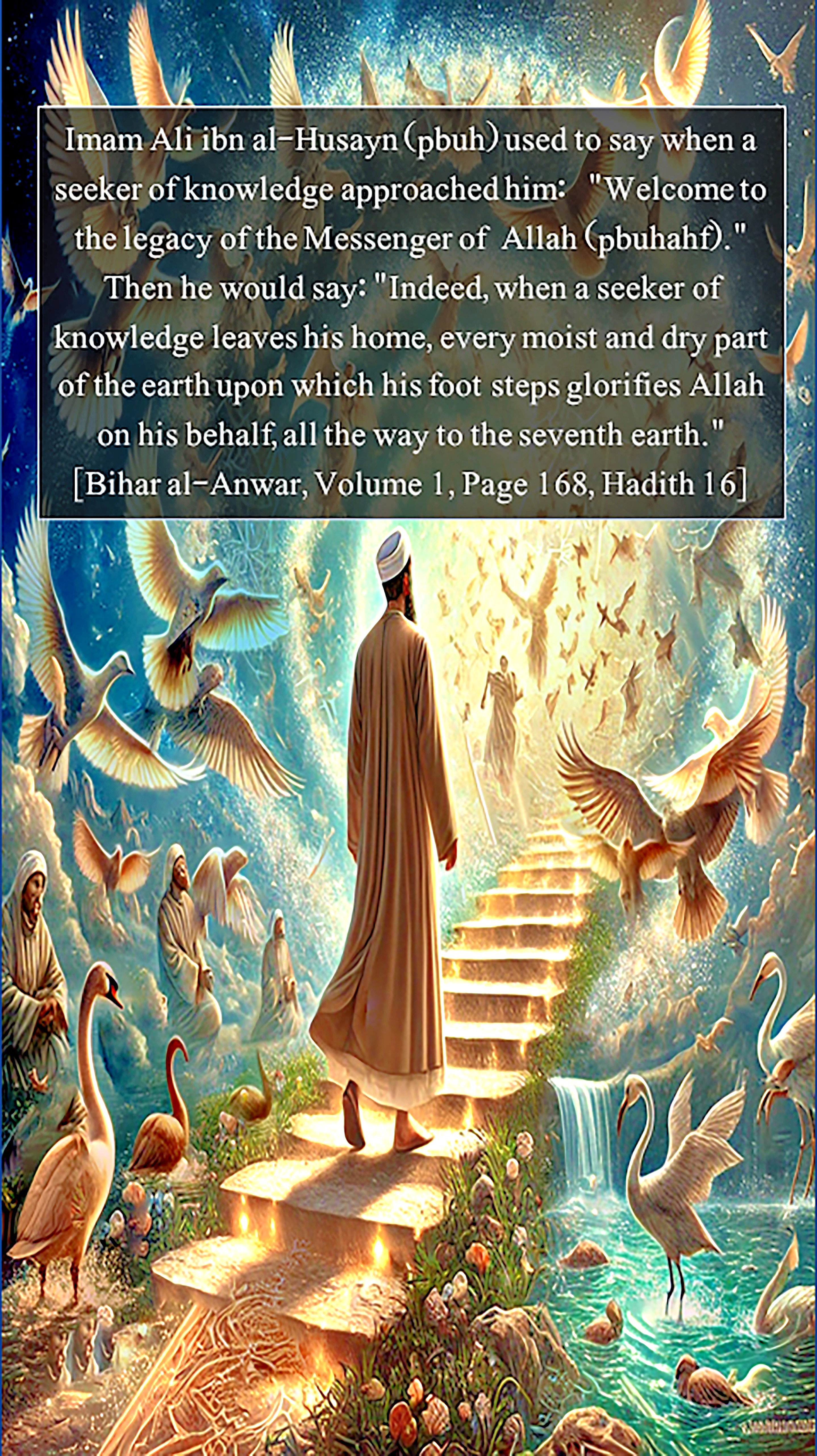
The narration of Prophet Muhammad (peace be upon him and his family) who said: "Whoever treads a path seeking knowledge Allah makes him tread a path to Paradise, and the angels lay down their wings for the seeker of knowledge in satisfaction with him, and whoever is in heaven and whoever is on earth seeks forgiveness for the seeker of knowledge even the fish in the sea, and the fadl of the scholar over the worshiper is like the fadl of the moon over the rest of the stars on the night of a full moon, and the scholars are the inheritors of the prophets; the prophets did not leave behind dinar or dirham, rather they left behind knowledge and whoever takes from it has taken an abundant share." (al-Kafi by Shaykh al-Kulayni, Volume 1, Page 34)
Key meanings from the hadith:
Path to Paradise
Sincerely seeking sacred knowledge is a means of salvation and nearness to Allah.
The angels lay down their wings
This indicates the angels’ humility, respect, and pleasure with the seeker of knowledge.
The inhabitants of the heavens and the earth seek forgiveness for him—even the fish in the sea
This shows the immense spiritual rank of the sincere student of knowledge in creation.
The scholar is superior to the worshipper like the full moon is superior to the stars
The scholar’s light benefits others, while the worshipper’s worship mainly benefits himself. Both are good, but knowledge carries a wider benefit.
The scholars are the heirs of the prophets
The prophets did not leave behind gold or silver. Their true inheritance is sacred knowledge. Whoever takes from that inheritance has taken a great and abundant share.
This hadith beautifully gathers the main virtues mentioned earlier: seeking knowledge is an act of worship, a path to Paradise, a means of mercy, and a prophetic inheritance.
Moreover, the universal intercession—from celestial beings to the smallest creatures of the sea—highlights the profound spiritual impact of seeking knowledge and the collective recognition of its value.
The superiority of the knowledgeable person over the mere worshipper is emphasized through powerful comparisons:"the fadl of the scholar over the worshiper is like the fadl of the moon over the rest of the stars on the night of a full moon." (al-Kafi by Shaykh al-Kulayni, Volume 1, Page 34)
The comparison here is powerful:
The worshipper is like a star—bright, but his light mostly benefits himself.
The scholar is like the full moon—his light spreads and benefits everyone.
The scholar who learns, acts, and teaches is guiding others to Allah. His knowledge removes ignorance, clarifies truth, and continues to benefit people even after his death. That is why his rank is greater.
This does not mean worship is unimportant. Rather, the best is to combine knowledge with worship, but Islam elevates the one who has beneficial knowledge because his benefit extends to the entire community.
This analogy conveys the vast difference between a scholar who guides others through knowledge and a devotee who may be sincere but lacks understanding. The scholar's light is far-reaching, illuminating the path for many, while the worshipper's devotion, though valuable, remains relatively contained.
The Prophet (peace be upon him and his family) also stated: "A scholar who avails himself of his own knowledge is superior to a thousand simple worshipers (of God)" (Nahj Al-Fasahah)
This superiority stems from several factors:
Societal Benefit and Guidance: A worshipper's acts of devotion primarily benefit themselves. However, a scholar's knowledge, when acted upon and shared, extends to guiding and illuminating an entire community.
Protection Against Misguidance: Scholars possess the intellectual and spiritual insight to discern and counteract innovations (bid'ah) that can corrupt religious practice and belief.
Inheritors of the Prophets: Scholars continue the prophetic mission of preserving and disseminating divine knowledge and guiding humanity.
Intrinsic Value of Knowledge: Islamic teachings consistently emphasize the inherent superiority of knowledge over mere acts of worship.
Imam al-Baqir (peace be upon him) said: “A scholar whose knowledge benefits others is better than seventy thousand worshippers.” [Al-Da?awat, p. 62, no. 153]
This hadith emphasizes the immense superiority of beneficial knowledge over mere personal worship. However, this does not mean worship is insignificant—rather, it highlights that a scholar who acts on his knowledge and teaches it brings far greater benefit to humanity than a person who only worships privately.
Why is the scholar so superior?
- His reward multiplies:
Every person who learns from him and acts on that knowledge is a source of continuous reward for him.
- His benefit is widespread:
A worshipper benefits himself, but a scholar benefits the entire community, guiding them to truth and correcting errors.
- He carries the prophetic mission:
The prophets came to teach, not just to perform personal devotions. The scholar inherits that role.
- He removes ignorance:
Ignorance is the root of misguidance and sin. One knowledgeable teacher can save many souls.
So the superiority of the scholar is not automatic—it is tied to sincerity, action, and benefit to others.
The profound impact of knowledge is powerfully illustrated in the hadith of prophet Mohammad (peace be upon him and his family):
"On the Day of Resurrection, the ink of the scholars will be weighed up against the blood of the martyrs, and the ink of the scholars will preponderate over the blood of the martyrs." (Tafsir al-Durr al-Manthur, v. 3, no. 423)
It highlights the immense value of sacred knowledge:
The martyr sacrifices his life for the sake of Allah.
The scholar preserves, practices, and spreads the religion of Allah.
Knowledge continues to guide people for generations, so its benefit and reward may continue long after the scholar’s death. This is one reason the ink of scholars is described as so weighty.
This comparison does not diminish the immense virtue of martyrdom but highlights the lasting, continuous benefit of knowledge.
The ripple effect of a scholar's teachings can lead countless individuals to righteousness, deepen their understanding of faith, and improve their lives, thereby accruing continuous rewards for the scholar. This concept of sadaqah jariyah (ongoing charity) is central to understanding why knowledge is so highly valued.
2.6 Continuous Reward After Death
Imam Jafar al-Sadiq (peace be upon him) stated that among the actions that continue to benefit a believer after death
From Abu Basir who said: I heard Abu Abdullah (peace be upon him) saying: Whoever teaches something good will have a reward similar to the one who acts upon it. I asked: If someone else teaches it, will that reward continue for him? He said: If all people teach it, the reward will continue for him. I asked: What if he dies? He said: Even if he dies. (Wasa'il al-Shia Vol. 16, Section 2, Chapter 16, Hadith 21270)
Knowledge that is benefited from teaching refers to knowledge that a person taught, spread, wrote, or left behind, and from which others continue to benefit after his death. This includes:
Teaching students
Writing beneficial books or articles
Spreading authentic religious knowledge
Recording lectures or lessons that continue to guide people
The reward for such knowledge continues as long as people benefit from it and act upon it.
This hadith is one of the strongest proofs in Islam that beneficial knowledge is a form of ongoing charity, and it continues even after the teacher's death, making it an everlasting legacy.
Part Three: The Link Between Knowledge and Action
3.1 The Inseparability of Knowledge and Practice
Islamic teachings consistently emphasize that knowledge and action are inseparable.
Imam Jafar al-Sadiq (peace be upon him) stated:
"Whoever teaches something good he will receive a reward for each time his student would practice such knowledge.” Abu Basir has said, “I asked the Imam, ‘Would this apply to the student if he would teach other people?’ The Imam replied, “Yes, it will apply to him even if all people would teach it.” I then asked, ‘Would it apply to him if he would already be dead?’ The Imam responded, “Yes, even if he would be dead.”’ (Al-Kafi, Volume 1, Book 2, Chapter 4, Hadith # 3)
This narration teaches that beneficial knowledge is a form of ongoing charity. The reward of a teacher does not stop with his direct student. Rather:
Every time someone acts upon that knowledge, the teacher receives reward.
If the student teaches others, the original teacher still receives reward because he was the original cause of that chain of good.
Death does not cut off this reward.
This underscores that knowledge is not merely an intellectual pursuit but a practical guide for life. Knowledge that does not translate into righteous deeds is considered incomplete and potentially detrimental.
3.2 The Consequences of Knowledge Without Action
Allah says: “O you who believe, why do you say what you do not do?
Greatly hateful is it in the sight of Allah that you say what you do not do.”
(Quran 61:2–3)
This verse is the strongest Quranic proof for everything we have reflected on:
“Knowledge calls for action.”
Allah first asks: “Why do you say what you do not do?”
Then He declares that this contradiction is “greatly hateful” to Him.
So this verse is both a warning and a call to sincerity. In Islam, knowledge and action are not separate. The one who truly knows is the one whose heart, tongue, and limbs are aligned in obedience to Allah.
Allah says: “Do you order righteousness to the people and forget yourselves?” (Quran 2:44)
This verse condemns a dangerous spiritual contradiction:
Calling others to good while neglecting one's own soul.
Knowing the Book and reciting it, yet not acting upon it.
Being outwardly learned while inwardly distant from Allah.
The verse ends with a powerful rebuke: “Then will you not reason?”—as if to say: does not your own intellect tell you that such behavior is hypocrisy?
This directly connects to Knowledge calls for action.
The Prophet (peace be upon him and his family) further warned:"The most severely punished in the Day of Judgment is a scholar who does not avail himself of his own knowledge." (Nahj al Fasahah)
A scholar is not like an ignorant person. He knows:
What Allah has commanded
What Allah has forbidden
The purpose of life
The reality of the Hereafter
If he still does not act, his sin is greater because he disobeyed with knowledge. His knowledge becomes a proof against him.
It is meant to purify the intention of the seeker. Knowledge in Islam is a trust:
It must be sought sincerely for Allah.
It must be acted upon.
It must be used to benefit others.
It must bring humility, not arrogance.
Prophet Mohammad (peace be upon him and his family) said: "A scholar who does not act upon his knowledge is like unto a niche providing people with light but burning itself" (Nahj Al-Fasahah)
The image is powerful and sobering:
The lamp gives light to others.
People benefit from its brightness and guidance.
But at the same time, the lamp burns itself—its oil is consumed, its wick is destroyed.
Likewise, a scholar who teaches and guides others but does not act on his own knowledge may benefit people outwardly, but he is destroying his own soul.
His knowledge becomes:
a light for others
but a fire for himself
Amir al-mu'minin, Imam Ali (peace be upon him), said: "Knowledge is associated with action. Therefore, he who knows should act, because knowledge calls for action; if there is a response well and good, otherwise it (i.e., knowledge) departs from him." (Nahj al-Balagha, Saying 366)
This saying teaches a central Quranic and prophetic principle: true knowledge naturally produces action.
Knowledge is not an end in itself; it is a trust and a means to nearness to Allah.
If a person learns something but does not act upon it, that knowledge becomes a burden and a proof against him.
Knowledge that is not acted upon loses its blessing and light, and may gradually be taken away.
Acting on knowledge makes it firm in the heart and causes it to increase.
Knowledge is linked to action… knowledge calls for action.
So the true scholar is not just one who knows—but one who knows, acts, and draws closer to Allah.
Imam Ali (peace be upon him) stated: "Knowledge without action is a curse, and action without knowledge is straying in error." (Ghurar al-Hikam, no. 1587)
Knowledge by itself is not automatically a blessing. It becomes a blessing only when it leads to:
humility
obedience
improved character
sincerity with Allah
If a person learns but does not act, that knowledge turns into a curse or burden because:
It becomes a proof against him on the Day of Judgment.
It may lead to arrogance and self-deception.
It distances him from Allah instead of bringing him closer.
A scholar is not like an ordinary person. He knows the proofs, the commands, and the prohibitions. If he does not act on his knowledge, his sin is greater because he disobeyed with knowledge, and his bad example may lead others astray.
The Prophet (peace be upon him and his family) outlined a clear sequence of steps for acquiring and effectively utilizing knowledge:
A man asked the Prophet (S): “O Prophet of God! What is (the requirement of) knowledge?” The Prophet (S) replied: “Silence.” The man asked: “What is next?” The Prophet (S) replied: “Listening to knowledge (i.e. those who are knowledgeable).” The man asked: “And what is next?” The Prophet (S) replied: “Remembering it.” The man asked: “And what is next?” The Prophet (S) replied: “Acting upon it.” The man asked: “And what is next?” The Prophet (S) said: “Spreading and sharing it with others.”
(Al-Khisal, volume: 1, page: 287)
This narration—often quoted in Islamic ethical and educational literature—presents knowledge as a process with clear stages of proper conduct, not merely as information. It is sometimes cited with slight variations, and while its chain may not be rigorously established as an authentic prophetic hadith, its meaning is fully consistent with the Quran.
The stages mentioned are:
1. Silence
2. Listening to knowledge
3. Remembering it
4. Acting upon it
5. Spreading and sharing it
1. Silence
The Prophet (peace be upon him and his family) reportedly said that the first requirement of knowledge is silence.
This means:
- The seeker of knowledge must learn to control the tongue.
- He should not speak about things he does not know.
- He should quiet the noise of the heart and mind to receive knowledge.
- Humility begins with listening, not with talking.
Imam Ali (peace be upon him) said:
"The tongue of the wise man is behind his heart, and the heart of the fool is behind his tongue."
(Nahj al-Balagha, Saying 40)
So silence is not empty quietness—it is the beginning of receptivity. A person who talks too much hears little.
2. Listening to knowledge
After silence comes listening.
This means:
- Paying full attention to scholars, teachers, and the Quran.
- Listening with the heart, not just the ears.
- Not interrupting, arguing prematurely, or showing off.
Allah says: “So give good tidings to My servants who listen to speech and follow the best of it.”
(Quran 39:17–18)
True learning requires deep listening, because knowledge is received before it is expressed.
3. Remembering it
After listening, the knowledge must be preserved and remembered.
This includes:
- Memorization where appropriate.
- Reflection and review.
- Internalizing the knowledge so that it becomes part of one’s mind and soul.
The Prophet (peace be upon him and his family) said: “May Allah bless the person who hears something from us and conveys it exactly as he heard it.” (Sunan al-Tirmidhi -, 2657)
Knowledge that is not retained is easily lost. So the seeker must guard it carefully.
4. Acting upon it
This is the central stage and the purpose of all knowledge.
Prophet Mohammad (peace be upon him and his family) said: "One who knows something and does not observe it, and does not use his knowledge, his punishment in the hereafter would be the most severe (Bihar al-Anwar, volume 2, page 38)
5. Spreading and sharing it with others
Only after acting upon knowledge does the narration mention spreading it.
This is important: teaching comes after practice, not before. If someone teaches before acting, he is like the lamp that gives light to people while burning itself.
But when knowledge is acted upon, teaching becomes:
- a form of charity
- a continuation of the prophetic mission
- a source of ongoing reward after death
Sharing knowledge with others, completing the cycle of benefit and fulfilling the social responsibility of those who possess knowledge.
3.4 Knowledge and the Divine Trust
The Holy Prophet (peace be upon him and his family) stated: "The scholars are Allah’s trustees over His creation." (Kanz al-’Ummal, no. 28675)
Knowledge is a divine trust
Knowledge is not personal property to be used for fame, power, or worldly gain. It is a deposit from Allah placed on earth through revelation, prophets, and scholars.
Allah says: “Indeed, We offered the Trust to the heavens and the earth and the mountains, but they declined to bear it and feared it; but man undertook it.” (Quran 33:72)
Sacred knowledge is one of the greatest trusts given to human beings.
Scholars are trustees
A scholar is not an owner of knowledge; he is a trustee. A trustee must:
- Preserve the knowledge without distortion
- Act upon it
- Teach it sincerely
- Not conceal what people need
- Not use it for worldly benefit at the expense of truth
Allah says: “Indeed, Allah commands you to render trusts to whom they are due.” (Quran 4:58)
Acting on knowledge is delivering the trust
A scholar delivers the trust when:
- He learns sincerely
- He practices what he knows
- He teaches others correctly
- He uses knowledge to draw closer to Allah
Then knowledge becomes a light, a mercy, and a means of salvation.
Not acting on knowledge is betrayal
If a scholar knows the truth but does not act, he betrays the trust. His knowledge becomes a proof against him.
This is the same message found in earlier sayings:
Knowledge calls for action; if one answers the call, it remains, and if not, it departs.
The most severely punished on the Day of Judgment is a scholar who does not avail himself of his own knowledge.
Knowledge without action is a curse.
So the true scholar is not the one who merely knows, but the one who carries knowledge honestly, acts upon it, and passes it on faithfully.
This highlights that knowledge is a sacred trust from Allah, and acting upon it is a fulfillment of this trust. When a scholar acts according to their knowledge, they are fulfilling their role as a trustee of divine knowledge.
3.5 The Quranic Metaphor of Knowledge Without Action
The Qur'an provides a vivid analogy:
"The example of those who were charged with the Torah, then failed to carry it… is that of an ass carrying books." (62:5)
This illustrates that merely possessing knowledge without applying it is futile. Knowledge and learning should be for the purpose of acting in accordance with what one has learned, and not just for the sake of narrating or sharing it with others.
Part Four: The Intention Behind Seeking Knowledge
4.1 Knowledge for Allah's Sake
The Prophet (peace be upon him and his family) provided clear guidance on the intention behind seeking knowledge: "He who seeks knowledge for Allah, no sooner does he learn even a chapter of it than it increases him in humility within himself, in humbleness in front of people, it increases his fear of Allah and his striving in religion, and that is the one who benefits from the knowledge that he gains." (Rawzat al-Wa’aiuin, p. 16)
When knowledge is sought with a pure intention—for the sake of Allah, for His pleasure, and to serve His creatures—it leads to:
Increased Humility: Recognition of one's limitations and the vastness of divine knowledge, leading to genuine humbleness before others. The more one learns, the more they become aware of what they do not know, fostering genuine humility.
Fear of Allah: A profound reverence, awe, and awareness of Allah's majesty and justice, leading to heightened piety and God-consciousness. The knowledge acquired should make one love and fear God more as they progress.
Striving in Religion: Enhanced dedication to righteous actions and diligent observance of religious duties. Knowledge acts as a catalyst for righteous actions.
True Benefit: Knowledge that genuinely improves the individual, leading to spiritual growth and deeper understanding.
4.2 Knowledge for Worldly Gain
Conversely, seeking knowledge for worldly motives leads to spiritual detriment:
" And he who seeks knowledge for this world and for status amongst people and for a favoured position with the ruler, no sooner does he learn even a chapter of it than it only increases his arrogance within himself, his presumptuousness with people, his self-delusion about Allah and his estrangement from religion. That is the one who does not benefit from his knowledge, and must subsequently refrain from it and stop furnishing proof for the case against himself in order not to feel regret and shame on the Day of Resurrection." (Rawzat al-Wa'izin, p. 16)
Such knowledge does not benefit the individual and leads to:
Increased Arrogance: Learning with the wrong intention inflates the ego rather than humbling it. Knowledge, like property and social status, is a field in which the danger of arrogance is especially strong.
Presumptuousness: Arrogance extends to interactions with others, leading to condescension and haughtiness.
Self-Delusion: A false sense of security and status, disconnected from true spiritual reality. The person becomes complacent with Allah and disobeys their religion.
Estrangement from Religion: A gradual distance from the essence of faith, as knowledge becomes a means of worldly advancement rather than spiritual growth.
Imam al-Sadiq (peace be upon him) categorized seekers of knowledge into three types:
"There are three types of seekers of knowledge, so recognize them by their characteristics and attributes. One type seeks it for ignorance and argument, another for arrogance and deceit, and a third for jurisprudence and intellect. The one who seeks it for ignorance and argument is a troublesome, argumentative person who exposes himself to discussion in men's gatherings, discussing knowledge and the attribute of forbearance. He has wrapped himself in humility and abandoned piety. So God has broken his nose and cut off his throat. The one who seeks arrogance and deceit is a hidden one who is arrogant towards his peers and humbles himself before the rich who are beneath him. He is a glutton for their sweets and a destroyer of his religion. So God has blinded his news and cut off his trace from the traces of scholars. The one who seeks jurisprudence and intellect is a man of gloom, sadness, and sleeplessness. He has become accustomed to his cloak and has stood up at night in its darkness, working and fearing with apprehension, calling out with compassion, attending to his affairs, knowing the people of his time, and feeling alienated from his closest brothers. So God has strengthened his pillars and given him security on the Day of Resurrection." (Al'usul Al'asliat Wa Alqawaeid Alshareiat, Volume 1, Page 297)
Seeking for Ignorance and Dispute: This type is injurious and quarrelsome. He contests opinions in the gatherings of men, speaking of knowledge and describing forbearance. He puts on the garb of humility, though he is devoid of piety. As a result, God crushes his nose and severs his waist.
Seeking for Domination and Deceit: This type is an imposter and a sycophant. He is domineering with those who are his likes but is humble in front of the rich, whose sweetmeats he ingests while he demolishes his own faith. As a result, God blinds his vision and wipes out his traces from the legacy of the learned.
Seeking for Understanding and Intellect: This type is grief-stricken and awake at nights. Having tied his cap with the loose end of his turban, he stands up in the dark of nights. He acts and is in trepidation. A caller overawed, engaged in his work, and acquainted with the people of his times, he is apprehensive of his most trusted brother. As a result, God strengthens his supports and grants him amnesty on the Day of Resurrection.
4.4 The Prohibition of Worldly Motives
The Prophet (peace be upon him and his family) also warned: "He who desires knowledge in order that he may beguile people will never even smell the fragrance of Paradise." (Makarim al-Akhlaq, v. 2, p. 364, no. 2661)
Imam Ali (peace be upon him) explicitly warned: "Take of knowledge whatever seems good to you, but beware of seeking knowledge for four reasons in order that you may contend with the scholars, or in order to wrangle with foolish people, or that you may show off with it in gatherings, or in order that people may look up to you to lead them." (al-Irshad, v. 1, p. 230)
Knowledge itself is good, but the intention behind seeking it can either make it a means of nearness to Allah or a cause of ruin.
The four forbidden motives are:
1. To contend with the scholars
“in order that you may contend with the scholars”
This means seeking knowledge to:
- defeat scholars in argument
- prove oneself superior
- gain reputation as more learned than others
This is a disease of the ego. Knowledge then becomes a tool of arrogance, not guidance.
2. To wrangle with foolish people
“or in order to wrangle with foolish people”
This refers to using knowledge for useless debates, arguments, quarrels, and trying to defeat ignorant or stubborn people.
Such arguing:
- wastes time
- hardens the heart
- leads to showing off and bad character
Knowledge is meant to guide, not to be used as a weapon for useless disputes.
3. To show off with it in gatherings
“or that you may show off with it in gatherings”
This is riya’—showing off.
A person seeks knowledge so that people will:
- praise him
- consider him eloquent
- sit around him in circles
- call him a scholar
This destroys sincerity. Allah says: “So whoever hopes for the meeting with his Lord, let him work righteousness and not associate anyone in the worship of his Lord.” (Quran 18:110)
Knowledge sought for reputation brings no reward from Allah.
4. That people may look up to you to lead them
“or in order that people may look up to you to lead them”
This is the love of status, leadership, and influence.
A person may seek knowledge to:
- become a leader
- be followed by people
- gain authority, titles, or positions
If leadership is given sincerely for the sake of Allah, it can be a trust. But if it is sought for the ego, it becomes a cause of downfall.
The correct intention
Knowledge should be sought:
- sincerely for Allah
- to act upon it
- to remove ignorance from oneself
- to benefit others
- to draw closer to Allah
4.5 The Importance of Sincerity
Sincerity is crucial when learning and practicing knowledge. Prophet Mohammad (peace be upon him and his family) said "Whoever gains knowledge for the sake of anything other than Allah, most High, should take himself a seat in the Fire." (Kanz al-’Ummal, no. 29035)
The warning is not against knowledge itself, but against corrupt intention.
A person may outwardly seek sacred knowledge, but if his real goal is:
- fame
- status
- winning debates
- being admired
- power or leadership
- worldly gain
then his knowledge is not worship—it is a means of self-serving and will bring loss in the Hereafter.
The Prophet (peace be upon him and his family) said: "Deeds are judged by intentions." (Wasa'il al-Shia Vol. 1, Section 2, Chapter 5, Hadith 88)
So the same act of studying can be a path to Paradise or a path to Hell, depending on the intention.
Because if knowledge is sought for other than Allah, it becomes a form of hidden idolatry of the ego.
The correct intention
The sincere seeker studies:
- for Allah alone
- to remove ignorance from himself
- to act upon what he learns
- to benefit the ummah
- to draw closer to Allah
Allah says:
“And they were not commanded except to worship Allah, being sincere to Him in religion.” (Quran 98:5)
So the seeker must constantly purify his heart and ask Allah for sincerity in every step of learning.
A scholar who seeks knowledge for worldly gain will be awed by everything, unlike the scholar who seeks it for God, who will receive reverence from everything.
Part Five: Beneficial vs. Useless Knowledge
5.1 The Definition of Beneficial Knowledge
The Prophet (peace be upon him and his family) taught: "The best type of knowledge is that which benefits." (Amali al-Saduq, p. 394, no. 1)
Beneficial knowledge, in Islamic perspective, is defined by its practical application, spiritual impact, and alignment with divine guidance. Imam Ali (peace be upon him) further clarified:
"The best type of knowledge is that which improves you." (Ghurar al-Hikam, no. 4962)
This improvement encompasses spiritual, moral, and intellectual development, leading to a deeper relationship with Allah and righteous conduct.
5.2 The Characteristics of Beneficial Knowledge
Leads to Action: The true value of knowledge lies in its application. Prophet Mohammad (peace be upon him and his family) said, "A scholar who does not act upon his knowledge is like unto a niche providing people with light but burning itself" (Nahj Al-Fasahah)
Brings Closeness to Allah: Knowledge that fosters a deeper connection with the Creator, increasing awareness of Allah, His attributes, and His commands.
Improves Character: Knowledge that cultivates humility, patience, sincerity, and other virtuous qualities.
Benefits Others: Knowledge that is shared and applied for the betterment of the community and humanity.
Reinforces Faith: Knowledge that strengthens conviction and certainty in the truth of Islamic teachings.
Open to Research: Valuable knowledge is often described as that which is open to research and investigation.
5.3 The Danger of Useless Knowledge
The Prophet (peace be upon him and his family) taught Muslims to seek refuge from useless knowledge. Prophet Muhammad (peace be upon him and his family) said:"Ask God (to give you) useful knowledge, and take refuge with Him from useless knowledge" (Nahj Al-Fasahah)
The Prophet (peace be upon him and his family) frequently made similar supplications: "O Allah, I seek refuge in You from knowledge that does not benefit, from a heart that is not fearful, from a supplication that is unheard, and from a soul that is never sated." (Kanz al-’Ummal, no. 3609)
Amir al-Mu’minin , Imam`Ali b. Abi Talib said: "The seekers of knowledge are of three types. You can distinguish them from each other by their characteristics and signs. (1) One group are those who learn for insincere argumentation. (2) One group are those who learn for stonewalling and deception. (3) One group are those who learn for understanding and for acting by it. As for those of insincere argumentation, they bring harm and doubt to groups of men. They gown themselves in reverence, but they are void of piety. May Allah knock their chests and cut their noses. As for those who learn for stonewalling and deception, they obstruct those like them, and they humble themselves for the rich. Thus, they consume those for their sweetness, and they destroy their religion. May Allah blind them from their sight and sever their affect on the legacy of the scholars. As for the group who learn for understanding and for acting by it, they are seen melancholy and grieving. They stand in prayer in the darkness of the night, and they bow in their evening robes. They work [in good deeds], and they are cautious and afraid of everyone except their trusted brethren. May Allah strengthen their foundations and grant them safety on the Day of Resurrection." (Al-Amali by Shaykh Mu?ammad b. Ali al-Saduq, Book 1, Chapter 91, Hadith #1)
Useless knowledge includes:
Knowledge without Benefit: Knowledge that neither harms the ignorant nor benefits the one who knows it.
Knowledge without Sincerity: Knowledge pursued for status, wealth, or other worldly motives.
Knowledge that Contradicts Action: Knowledge that remains theoretical and does not translate into righteous conduct.
Knowledge that Leads to Arrogance: Knowledge that inflates the ego and distances one from Allah.
5.4 The Three Kinds of True Knowledge
The Prophet (peace be upon him and his family) specified: "Knowledge consists of three kinds: A clear verse (of the Qur'an), a just obligation (i.e. a legal ruling) or an established sunnah (i.e. a hadith). Anything else is of the extra achievements.” (Al-K?fi (Vol. 1) by Shaykh Mu?ammad b. Ya?q?b al-Kulayn?, Book 2, Chapter 2, Hadith #1)
Scholars explain that this prophetic classification gathers all beneficial sciences into three overarching domains:
Knowledge of Divine Signs and Beliefs: The "firm sign" denotes knowledge of God, His attributes, His acts, His signs in creation, and the realities of Prophethood, Imamate, angels, the Hereafter, and the unseen world.
Knowledge of Ethical Duties and Self-Purification: The "just duty" refers to knowledge that governs the education of the heart: moral virtues such as sincerity, humility, courage, gratitude, and generosity, and knowledge of moral vices like pride, jealousy, hypocrisy, and love of status.
Knowledge of Law, Social Life, and Outward Conduct: The "established sunnah" comprises knowledge of jurisprudence, obligations and prohibitions, etiquettes and manners, family management, social interactions, and political and civic administration.
Knowledge of Religion and Knowledge of Bodies
Prophetic traditions distinguish between two broad types:
"There are two types of knowledge: the knowledge of ideologies, and the knowledge of physical bodies." (Bihar al-Anwar, v. 1, p. 220, no. 52)
Knowledge is of two types: The knowledge of religions (or creeds) and the knowledge of bodies.
The word translated here as “ideologies” is likely “ady?n” (religions, creeds, or belief systems), and “physical bodies” refers to “abd?n” (bodies), meaning medicine, anatomy, natural sciences, and everything related to the physical well-being of human beings.
Prophet Mohammad (peace be upon him and his family) is pointing out that true knowledge is not limited to religious sciences alone. Rather, it encompasses two broad areas:
1. Knowledge of Religions (Creeds, Ideologies)
This includes:
- Theology and belief in Allah
- Revelation, prophethood, and the Hereafter
- Islamic law (fiqh)
- Ethics and spirituality
- Knowledge of the soul and its purification
This knowledge is for the health of the soul, for guidance, and for nearness to Allah.
2. Knowledge of Bodies (Physical Sciences)
This includes:
- Medicine
- Anatomy
- Biology
- Physics, chemistry, astronomy
- Any science that benefits the physical human body and the material world
This knowledge is for the health of the body, for the benefit of society, and for the development of human life.
Why this division is important
Islam encourages both types
Many people mistakenly think religious knowledge is the only praiseworthy knowledge in Islam. But the hadith shows that the sciences of the body and the world are also part of knowledge and are needed.
The soul and body are connected
Human beings are both soul and body. Just as the soul needs guidance, the body needs healing and care. Neglecting one leads to imbalance.
The Quran says: “And seek, through that which Allah has given you, the home of the Hereafter; but do not forget your share of the world.” (Quran 28:77)
Both can be acts of worship
If a person studies medicine to treat the sick for the sake of Allah, that is worship. If a person studies physics to benefit humanity and please Allah, that is also worship. The key is intention.
So this reminds us:
- Do not limit knowledge to only religious sciences.
- Do not belittle worldly sciences.
- Seek both with sincerity and for the benefit of humanity.
- The best is to combine sound faith with sound knowledge of the world, so that both soul and body are cared for.
Part Six: Knowledge and Divine Nearness
6.1 The Path to Proximity to Allah
Knowledge that brings one closer to Allah is described as:
A Light in the Heart: Imam al-Sadiq (peace be upon him) said, "Knowledge cannot be acquired by (mere) learning; it is a light which appears in the heart of whom Allah, the Blessed and Sublime, wills to guide." This emphasizes that while learning is important, true, transformative knowledge originates from divine grace.
Complete Knowledge: This is knowledge that "cannot be acquired through learning or studying," but is a divine bestowal granted to those who strive for closeness to Allah. It is a deeper realization, a direct and unmediated knowledge of Allah at the level of the heart.
Knowing God by God: True knowledge of Allah means coming to know Him by Allah Himself. Any knowledge of God derived through anything other than God is considered incomplete. All knowledge about God ultimately comes from God Himself, as He is the source of intellect, prophets, and souls.
Instrument for Divine Pleasure: Knowledge is beneficial only if it serves as an "instrument for obtaining knowledge of God, His good pleasure and nearness." Without this purpose, knowledge, whether religious or natural science, can become "an iron curtain, a great inscrutable veil."
6.2 The Fruits of Divinely-Oriented Knowledge
Prophet Mohammad (peace be upon him and his family) said, "He who seeks knowledge for Allah, no sooner does he learn even a chapter of it than it increases him in humility within himself, in humbleness in front of people, it increases his fear of Allah and his striving in religion, and that is the one who benefits from the knowledge that he gains. And he who seeks knowledge for this world and for status amongst people and for a favoured position with the ruler, no sooner does he learn even a chapter of it than it only increases his arrogance within himself, his presumptuousness with people, his self-delusion about Allah and his estrangement from religion. That is the one who does not benefit from his knowledge, and must subsequently refrain from it and stop furnishing proof for the case against himself in order not to feel regret and shame on the Day of Resurrection." (Rawzat al-Wa’aiuin, p. 16)
Knowledge that brings one closer to Allah manifests in:
Humility and Humbleness: A person seeking knowledge for the sake of Allah finds that it increases their humility, humbleness before people, their fear of Allah, and their striving in religion.
Fear of Allah: The Qur'an states, "Be wary of Allah, and Allah will teach you" (2:282). Taqwa (piety and reverence) is the best way to approach knowledge and understanding, and thus gain closeness to Allah.
Obedience and Worship: Knowledge enables one to obey and worship Allah properly, strengthening relationship ties, and guiding individuals to lead a righteous life. It helps distinguish what is permissible and what is forbidden.
Spiritual Growth: Knowledge provides comfort in terror, companionship in solitude, light in darkness, energy in weakness, and is a cure for all diseases. It strengthens love for Allah, especially when coupled with reflection and divine grace.
Knowing the Imam: For the people of each era, "knowing Allah means that the people of each era must know their Imam, to whom obedience is mandatory." True knowledge of God includes believing in God and His Messenger, adhering to the Imam and the Imams of guidance, and disassociating from their enemies.
6.3 Inner Knowledge (Ma'rifah)
A central concept in Islamic teachings is that real knowledge is not merely intellectual acquisition but a divine light cast into the heart by Allah. Imam Ali (peace be upon him) stated: "Inner knowledge is the light of the heart." (Ghurar al-Hikam, no. 538)
The path to closeness with Allah is profoundly linked to the concept of inner knowledge (ma'rifah). This form of knowledge is not merely academic or acquired through study; rather, it is described as a divine light in the heart, considered the highest and most perfect form of understanding, leading directly to proximity with the Divine.
Characteristics of Inner Knowledge:
Highest Truth:
Imam Ali (peace be upon him) stated, "The inner knowledge of Allah, Glory be to Him, is the highest of knowable truths." (Ghurar al-Hikam, no. 9864)
Light of the Heart: . Imam Ali (peace be upon him) stated: "Inner knowledge is the light of the heart." (Ghurar al-Hikam, no. 538)
Perfection of Knowledge: Imam Ali (peace be upon him and his family) said, "He who attains inner knowledge of Allah has achieved perfection in his knowledge indeed." (Ghurar al-Hikam, no. 7999)
Fruit of Knowledge:
Imam Ali (peace be upon him) taught, "The fruit of knowledge is attaining inner knowledge of Allah."
(Ghurar al-Hikam, no. 4586)
Divine Gift: True knowledge cannot be acquired through learning or studying. It is just a light which appears in the heart of he, whom Allah, the Blessed and Sublime, wills to guide."
Imam Jafar al-Sadiq (peace be upon him) said, "Knowledge is not acquired through learning. Rather it is a light that illuminates in the heart of one who wants Allah, Blessed and most High, to guide him. So if you want knowledge, first seek out within yourself true servitude [to Allah], and seek knowledge according to its use, and ask Allah to make you understand, and He will make you understand." (Bihar al-Anwar, v. 1, p. 225, no. 17)
The Fruits of Inner Knowledge:
Indifference to Worldly Possessions: He whose heart finds peace in knowing Allah, finds peace in being needless of Allah's creatures.
Fear of Allah: The peak of inner knowledge of Allah is fear [of Him].
Asceticism and Devotion: The least knowledge of Allah leads one to abstain from the vanities of this world.
Transformation of Life: He who attains inner knowledge of Allah leads a life of unity; he who attains inner knowledge of his self strips himself; he who attains inner knowledge about this world abstains from it; and he who attains inner knowledge about people prefers solitude.
Spiritual Comfort: The inner knowledge of Allah is an intimate companion in every type of desolation, a friend in every type of loneliness, a light in every darkness, a source of strength from all weakness, and a cure for all ailments.
6.4 Self-Knowledge and Divine Knowledge
A fundamental step on the path to ma'rifah of Allah is the attainment of self-knowledge. Imam Ali (peace be upon him) repeatedly emphasized this interconnectedness:
"He who attains inner knowledge of his self attains inner knowledge of his Lord." (Ghurar al-Hikam, no. 7946)
This explains that self-knowledge—awareness of one's origin, nature, present, and ultimate goal—attains inner knowledge of his Lord because knowing oneself leads to knowing Allah and to self-improvement and closeness to Him.
6.5 The Connection Between Knowledge and Taqwa
The Qur'an establishes a direct link between knowledge and the fear of Allah:
"Only those fear Allah, from among His servants, who have knowledge." (Qur'an, 35:28)
This verse underscores that a deep, true fear of Allah (khashyat) is characteristic of those who possess knowledge. This fear is not mere anxiety but a reverential awe born
from:
Understanding Creation: Contemplating the signs of Allah in the universe.
Knowing Allah's Attributes: Deep awareness of Allah's knowledge, power, and majesty.
Understanding Divine Purpose: Awareness of the purpose of creation and one's responsibilities.
The Prophet's statement, "It is the duty of every Muslim, man and woman, to seek knowledge," is explained as referring to "the knowledge of precaution (taqwa) and certainty." This indicates that the primary intended knowledge is that which nurtures God-consciousness and firm faith, not mere information.
Part Seven: The Intellect as the Foundation
7.1 The Primacy of Intellect
The intellect ('aql) holds a central position in Islamic teachings, as expressed in the hadith:
"The first thing that Allah created was the intellect." (Bihar al-Anwar, v. 1, p. 97, no. 8)
This statement establishes the intellect as the foundation of human existence and spiritual understanding. The Prophet (peace be upon him and his family) further emphasized:
"The very basis of man is his intellect, and the man devoid of intellect has no religion." (Rawdhat al-Wa'izin, p. 9)
This direct connection between intellect and religion signifies that:
Religion Requires Understanding: True faith is not blind adherence but requires comprehension, reflection, and discernment. The intellect enables individuals to understand divine commandments and the proofs of God's existence.
Intellect Enables Worship: Meaningful worship stems from understanding God and His commands.
Accountability is Based on Intellect: Religious obligations, rewards, and punishments are predicated on the ability to understand and choose.
The Prophet (peace be upon him and his family) described the intellect as:
"The intellect is a light that Allah has created for mankind and which He has ordained to illuminate the heart, in order that with it, he may know the difference between the visually manifest things and the unseen things." (Awali al-La'ali, v. 1, p. 248, no. 4)
This divine light enables humanity to:
Discern Truth from Falsehood: The intellect provides the capacity to analyze, reflect, and understand the realities of existence.
Distinguish Right from Wrong: It enables moral judgment and ethical decisionmaking, guiding individuals toward good and away from evil.
Understand Metaphysical Realities: Beyond sensory perception, the intellect facilitates understanding of Allah's existence, the purpose of creation, and divine laws.
One narration from Imam al-Sadiq (peace be upon him) highlights the intellect's unique status by contrasting it with ignorance:
The Creation of Intellect: Imam Jafar al-Sadiq (peace be upon him) said: "When Allah created the intellect, He said to it: "Come forward," and it came forward. Then He said to it: "Go back," and it went back. Then He said: "By My Honor and Majesty, I have not created any creation more beloved to Me than you. Through you I take, through you I give, and upon you I bestow reward." (Wasa'il al-Shia Vol. 1, Section 2, Chapter 3, Hadith 67)
The intellect obeyed both commands immediately, demonstrating its complete submission and understanding.
Allah's Exaltation of Intellect: Allah declared, "By My Honor and Majesty, I have not created any creation more beloved to Me than you." There is no creation more beloved to Allh than intellect and Allah punishes or rewards on the basis of intellect.
7.4 The Comprehensive Role of the Intellect
The intellect encompasses a broad range of cognitive and spiritual functions:
Source of Knowledge and Wisdom: Imam Ali (peace be upon him) said, "Knowledge is the lamp of the intellect." (Ghurar al-Hikam, no. 536)
Imam Ali (peace be upon him) said: "The intellect is an intrinsic thing that increases with knowledge and experiences." (Ghurar al-Hikam, no. 1717)
Moral Compass and Friend: Imam Ali (peace be upon him) described the intellect as "The intellect is the friend of the believer." (Tuhaf al-’Uqul, no. 203)
Imam Ali (peace be upon him) said: "The intellect is the strongest foundation." (Ghurar al-Hikam, no. 475)
Imam Jafar al-Sadiq (peace be upon him) said: "Intellect is the guide of the believer." (Wasa'il al-Shia Vol. 15, Section 2, Chapter 8, Hadith 20293)
Prerequisite for Religion: The Prophet Muhammad (peace be upon him and his family) said, "The very basis of man is his intellect, and the man devoid of intellect has no religion." (Rawdhat al-Wa'izin, p. 9)
Means to Know Allah: The intellect is the primary tool for recognizing the Creator. With intelligence people come to know their creator and that they are created and that He is the one who has designed them.
Path to Salvation: Allah has only assigned man with an intellect so that it may one day deliver him.
7.5 The Intellect as the Criterion of Human Value
In discussions on ethics and spirituality, scholars emphasize that the intellect is the primary measure of a human being's dignity and rank, because it is through the intellect that one recognizes God, pursues knowledge, and distinguishes good from evil.
Allah says: “And We have certainly honored the children of Adam and carried them on the land and sea and provided for them of the good things and preferred them over much of what We have created, with [definite] preference.” (Quran 17:70)
This “preference” includes the gift of aql—the intellect by which a person can know Allah, distinguish right from wrong, and be held accountable.
The Quran says “Indeed, the worst of living creatures in the sight of Allah are the deaf and the dumb who do not use their intellect.” (Quran 8:22)
A person who does not use his intellect to recognize truth and obey Allah becomes spiritually deaf, dumb, and blind.
He is not merely like an animal—he is more astray, because he had the tools of guidance and rejected them.
Imam Ali (peace be upon him) said, "Allah, the Exalted, gave the angels intellect without desire, He gave the beasts desire without intellect, and He gave both to the sons of Adam. So a man whose intellect prevails over his desire is better than the angels whilst a man whose desire prevails over his intellect is worse that the beasts." (Bihar al-Anwar, v. 60, p. 299, no. 5)
1. Angels: intellect without desire
Angels were created with reason and obedience, but they do not have human-like desires, temptations, or bodily inclinations. They worship Allah continuously and do not disobey.
The Quran says: “They do not disobey Allah in what He commands them but do what they are commanded.” (Quran 66:6)
So the angels’ obedience is natural and unchallenged.
2. Beasts: desire without intellect
Animals follow their instincts and desires—eating, drinking, mating, sleeping—without moral reasoning, accountability, or spiritual responsibility.
They are not blamed because they have no intellect or revelation.
3. Human beings: intellect and desire
Allah gave human beings both:
- Intellect to recognize truth, know Allah, and choose right.
- Desire to be tested, just as one is drawn toward food, wealth, power, lust, anger, and comfort.
This combination makes human life a test.
Allah says: “Indeed, We created man from a mixed drop to test him, and We made him hearing and seeing.” (Quran 76:2)
Why a human can be “better than the angels”
When a person’s intellect—guided by revelation—controls his desires, he obeys Allah through struggle.
The angels obey without struggle because they have no opposing desire.
But a human being who:
- feels the pull of sin
- battles his own ego
- restrains unlawful desires
- chooses Allah despite temptation
has achieved something greater in terms of effort and sincerity.
So the human struggle against desire is a form of jihad, and success in it elevates a person to a very high rank.
Why a human can be “worse than the beasts”
If a person lets desire overpower his intellect, he falls below the animal because:
- An animal follows its nature without moral responsibility.
- A human being has intellect, revelation, and the knowledge of right and wrong.
- If he still chooses to follow lust, greed, arrogance, and sin, he has abused his greatest gift and denied his purpose.
The Quran says: “Have you seen the one who takes his own desire as his god? Then would you be responsible for him?” (Quran 25:43)
“They have hearts with which they do not understand, eyes with which they do not see, and ears with which they do not hear. They are like cattle—rather, they are more astray.” (Quran 7:179)
So the person who follows desire despite having intellect is not equal to an animal—he is more misguided, because he had the tools to know better and ignored them.
The balance
The ideal is not to kill desire entirely, but to govern it by intellect and revelation.
Desire itself is not evil if directed lawfully:
- Hunger for halal food
- Love for a lawful spouse
- Desire for provision and success
But when desire becomes the leader, the human being falls. When intellect leads and desire is controlled, the human being rises.
Allah created the angels from intellect without lust, animals with lust but without intellect, and human beings with both; thus whoever's intellect overcomes lust is higher than angels, and whoever's lust overcomes his intellect is lower than animals.
Part Eight: Contemplation and Reflection
8.1 The Virtue of Reflection
Islamic teachings elevate contemplation (tafakkur) to a high spiritual station. The Prophet (peace be upon him and his family) stated:
"An hour of thinking is better than sixty years of praying." (Nahj al-Fasahah, Tradition No. 207)
Similarly, Imam Jafar al-Sadiq (peace be upon him) said:
"Thinking for an hour is better than worshipping for a year, for 'Only those who possess intellect take admonition' (Quran 39:9)." (Bihar al-Anwar, v. 71, p. 327, no. 22)
This emphasis on contemplation underscores that:
Quality over Quantity: Meaningful reflection engages the heart and intellect, leading to genuine understanding and transformation.
Knowledge Enables Reflection: It is knowledge that provides the framework for meaningful contemplation.
Contemplation Leads to Action: Deep reflection invites goodness and motivates righteous deeds.
8.2 The Fruits of Contemplation
Contemplation is not idle thought but purposeful reflection that:
Deepens Faith: Reflecting on creation leads to recognition of Allah's power and wisdom. Prophet Mohammad (peace be upon him and his family) said, "An hour spent by a knowledgeable man lying on his bed thinking about his deeds is better than seventy years spent by the worshipper performing acts of worship." (Rawdhat al-Wa’aizin, no. 16)
Promotes Self-Awareness: Introspection on one's deeds leads to self-improvement for example when passing a house or the ruins of an old building, one should ask: "Where are the residents? Where are those who constructed this building? And why do they not speak?"
Protects from Error: Contemplation helps discern truth from falsehood and innovation from authentic practice.
Illuminates the Heart: As Imam Ali (peace be upon him) said, "Thinking is a transparent mirror," allowing one to perceive truths and instigate goodness.
Awakens the Individual: Islam views thinking and pondering as a form of worship that is considered far superior to many years of physical worship if it leads to the awakening of an individual.
8.3 The Boundaries of Contemplation
The Prophet (peace be upon him and his family) provided guidance on the limits of contemplation:
"Ponder about the creation of Allah, but do not ponder about Allah Himself lest you be ruined." (Kanz al-Ummal, no. 5705)
This draws a crucial distinction between permissible and prohibited forms of contemplation regarding Allah:
Pondering About the Creation of Allah: The Qur'an encourages to reflect: "Indeed, in the creation of the heavens and the earth and the alternation of the night and the day are signs for those of understanding." (Quran 3:190).
Reflect on the universe, its intricate design, and natural phenomena. These serve as
Not Pondering About Allah Himself: Strictly prohibited. Attempting to comprehend or imagine Allah's Essence (Dhat) or Being directly is futile and dangerous. Human minds are inherently limited, and Allah is Unlimited in all His Virtues. Trying to grasp Allah's Essence "only increases one's bewilderment" because Allah "cannot be perceived by the sights or described by any type of criteria."
Part Nine: The Danger of Stagnation
9.1 Spiritual Decline Through Stagnation
Imam Musa Kazim (peace be upon him) said: "The one whose two days are equal is a looser. And the one whose last one of the two days is the evil one of those (two days) is a cursed person. And the person who does not observe any progress & development in himself is a looser & the one who is looser; death is better for him than life" (Bihar ul-Anwar Vol. 78, P .327)
This highlights that merely maintaining the status quo is a form of spiritual detriment. The believer must continually strive for growth and development, as stagnation leads to:
Regression: Stagnation in faith naturally leads to spiritual decline.
Complacency: Lack of progress makes one susceptible to complacency and doubt.
Distance from Allah: Increased knowledge without corresponding spiritual growth can lead to greater distance from the Divine.
The Prophet (peace be upon him and his family) explicitly connected the increase in knowledge with the necessity for spiritual growth: "He who does not increase in guidance in spite of an increase in his knowledge only gets further away from Allah." (Tanbih al-Khawatir, v. 2, p. 21)
"he who seeks knowledge for this world and for status amongst people and for a favoured position with the ruler, no sooner does he learn even a chapter of it than it only increases his arrogance within himself, his presumptuousness with people, his self-delusion about Allah and his estrangement from religion. That is the one who does not benefit from his knowledge, and must subsequently refrain from it and stop furnishing proof for the case against himself in order not to feel regret and shame on the Day of Resurrection.’ " (Rawzat al-Wa’aiuin, p. 16)
This underscores that knowledge without spiritual growth and righteous action can lead to remoteness from Allah rather than closeness.
If a person increases their knowledge but experiences no spiritual growth, they only add to their distance from Allah.
Several critical factors that prevent knowledge from drawing one closer to Allah and, conversely, cause increased distance:
Lack of Action: Knowledge that is not translated into righteous deeds is considered detrimental. Knowledge does not increase one's closeness to Allah if it is not acted upon. In fact, it may even lead to greater remoteness from Allah.
Worldly Desires and Lack of Asceticism: According to a prophetic saying, a servant would not increase in knowledge and then increase in desire for the world, except that they would increase in remoteness from Allah.
Improper Intentions and Arrogance: If knowledge is pursued for worldly recognition, status, or to impress people rather than for the sake of Allah, it becomes a source of spiritual decay.
Absence of the Fear of Allah: True, beneficial knowledge is intrinsically linked to a reverential fear of Allah. Knowledge without this inner reverence fails to bring closeness.
Part Ten: The Role of Scholars
10.1 Scholars as Trustees
Scholars hold a distinguished position in Islam as prophet Mohammad (peace be upon him and his family) said: "The scholars are Allah's trustees over His creation." (Kanz al-Ummal, no. 28675)
This trusteeship involves:
Preserving Divine Knowledge: Safeguarding authentic teachings and preventing distortion.
Disseminating Guidance: Teaching and conveying divine knowledge to the community.
Interpreting Religious Law: Applying Islamic principles to new circumstances.
Protecting the Community: Preventing misguidance and innovation.
10.2 The Responsibilities of Scholars
The status of scholars carries immense responsibility. The Prophet (peace be upon him and his family) warned:
"The most severely punished in the Day of Judgment is a scholar who does not avail himself of his own knowledge." (Nahj al Fasahah)
Scholars are expected to:
Act Upon Their Knowledge: Transform understanding into righteous conduct.
Teach Sincerely: Share knowledge for Allah's sake, not for worldly recognition.
Protect Authentic Teachings: Distinguish truth from error and preserve prophetic guidance.
Guide the Community: Lead by example and provide sound religious instruction.
The rights of scholars are that, as trustees, scholars should guide people to the recognition and obedience of Allah, and their main concern is to serve the religion, publicize Islamic enlightenment, and guide Muslims towards high moral standards.
Believers are obligated to:
Respect scholars.
Support their livelihoods (through Shari'i dues and charity) so that they can focus on their religious tasks.
Refer to scholars in religious matters, imitating their rulings.
10.4 The Character of a True Scholar
The Prophet (peace be upon him and his family) stated:
"He who seeks knowledge for Allah, no sooner does he learn even a chapter of it than it increases him in humility within himself, in humbleness in front of people, it increases his fear of Allah and his striving in religion, and that is the one who benefits from the knowledge that he gains." (Rawzat al-Wa’aiuin, p. 16)
A true scholar is characterized by:
Humility and humbleness.
Fear of Allah (taqwa).
Striving in religion.
Benefit to others.
Sincerity in intention.
Part Eleven: The Quranic Foundation
11.1 The First Revelation
The very first divine revelation received by the Holy Prophet Muhammad (peace be upon him and his family) in the Cave of Hira laid a foundational emphasis on knowledge:
"Read in the Name of your Lord Who created... Who taught by the pen, taught man what he did not know." (Quran 96:1-5)
These verses convey several fundamental messages:
The Paramount Importance of Reading: The command to "Read" establishes the foundational importance of seeking knowledge and literacy in Islam.
Divine Source of Knowledge: All reading, learning, and seeking of knowledge must be undertaken with the acknowledgment of Allah as the ultimate Creator.
The Pen as a Divine Gift: The pen is presented as a fundamental instrument for recording, disseminating, and preserving knowledge.
Human Dependence on Divine Guidance: All knowledge ultimately originates from Allah, who bestows understanding upon humanity that they could not acquire independently.
11.2 The Prayer for Increased Knowledge
The Qur'an commands believers to constantly seek more knowledge:
"And say: O my Lord! Increase me in knowledge." (Quran 20:114)
This verse is a profound supplication and a pivotal instruction:
Universal Importance of Knowledge: This prayer highlights the critical importance of seeking knowledge and wisdom in Islam.
Lifelong Pursuit: If the Prophet (peace be upon him and his family), with his abundant knowledge, is enjoined to seek an increase in knowledge, then the duty of all other individuals to pursue knowledge is even clearer.
Divine Source of Knowledge: This prayer reaffirms that all knowledge ultimately comes from Allah, the All-knowing.
Continuous Guidance: The prayer signifies that seeking knowledge is a continuous process and a means for spiritual growth.
11.3 The Superiority of the Knowledgeable
The Qur'an establishes the superiority of those who know:
"Say: Are those who know equal to those who do not know? Only they will remember who are people of understanding." (Quran 39:9)
This rhetorical question underscores that the knowledgeable and the ignorant are not equal—neither at the Divine Threshold nor in the eyes of the discerning. The knowledge referred to in this verse is not merely "formal sciences" but a specific awareness and realization that leads a person to:
Obedience to God Almighty.
Fear of the Day of Judgment.
Setting hopes on Divine Mercy.
11.4 Divine Exaltation of the Knowledgeable
"Allah will exalt those of you who believe, and those who are given knowledge, to high ranks." (Quran 58:11)
This verse signifies that God will elevate individuals who combine faith with knowledge, referring to a higher status or rank in the eyes of Allah, both in this world and the Hereafter.
11.5 Knowledge and the Fear of Allah
"Only those of His servants who have knowledge fear Allah." (Quran 35:28)
This verse establishes a direct link between knowledge and the fear of Allah (khashyat). Having knowledge and awareness of the secrets of existence, as observed in the diversity of creation, prepares one to reach the position of fearing Allah. The term khashyat is defined as a fear mixed with veneration, often originating from knowledge and awareness.
"So ask the people of Dhikr if you do not know." (Quran 16:43)
This verse establishes a fundamental principle: the necessity of seeking knowledge and guidance from those who possess it, especially when one is uncertain or lacks understanding. According to numerous traditions, "Ahl al-Dhikr" refers specifically to the Ahl al-Bayt (the Household of the Prophet Muhammad), who are the ultimate authoritative source for religious knowledge and guidance.
Part Twelve: The Purpose and Ultimate Goal
12.1 Knowledge as a Means to Allah
The ultimate purpose of seeking knowledge in Islam is to draw closer to Allah. Knowledge is not an independent goal; its worth lies in how it leads to nearness to Allah.
Imam al-Sadiq (peace be upon him) described real knowledge as a "light" which Allah places in the heart of the person He wishes to guide, clarifying that "all people are asked to learn and acquire ordinary knowledge, but it is not enough; the real knowledge which revives our hearts and guarantees our happiness is what comes through faith and being close to Allah."
12.2 The Ultimate Goal of Human Life
In Islamic teachings, every value is tied to the servant's relationship with Allah, and true happiness comes through closeness to Allah. Nearness to Allah results in "complete knowledge," and this is a light placed in the heart of the one whom Allah guides.
12.3 The Three Realms of Improvement
Creeds (Beliefs): Correct beliefs form the foundation of faith.
Deeds (Actions): Beliefs must be embodied in righteous actions.
Virtues (Character Traits): Actions must lead to the refinement of character so that the heart becomes capable of receiving "divine illuminations."
Knowledge belongs first to the realm of creeds, but it must be embodied in deeds and virtues to truly function as a means of nearness.
Imam Jafar al-Sadiq (peace be upon him) said: "He who gains knowledge for the sake of Allah, acts upon it for the sake of Allah and teaches it for the sake of Allah is called great in the kingdom of the heavens, and it is exclaimed about him ‘Indeed he gains knowledge for Allah, acts for Allah and teaches for Allah!" (Amali al-Tusi, p. 167, no. 280)
This comprehensive statement illustrates how the pursuit of knowledge is interwoven with worship and devotion, strengthening one's bond with the Creator.
Conclusion: The Lifelong Pursuit
The comprehensive teachings on knowledge in Islam establish it as a sacred pursuit that is simultaneously an obligation, a form of worship, and a path to divine nearness. The Prophet's statement about a day without growth in beneficial knowledge serves as a powerful reminder that:
Every Day Matters: Each new day is an opportunity for spiritual and intellectual growth. The blessing of the sunrise is tied to how the servant uses that day in pursuit of knowledge that increases nearness to God.
Growth is Essential: Stagnation leads to regression, while progress leads to divine nearness. The believer must continually strive for growth and development.
Intention is Paramount: The purpose behind seeking knowledge determines its true benefit. Knowledge sought for Allah's sake leads to humility, fear of Allah, and striving in religion, while knowledge sought for worldly gain leads to arrogance and estrangement from religion.
Knowledge Demands Action: Understanding must translate into righteous conduct. Knowledge without action is incomplete and can even be detrimental.
Knowledge Serves Others: Beneficial knowledge is meant to be shared for the benefit of the community. The best form of charity is to gain knowledge and then teach it to others.
Knowledge is a Divine Light: True knowledge is a light that Allah casts into the heart, illuminating the path to divine nearness. This inner knowledge cannot be acquired through mere learning but is a divine bestowal granted to those who strive for closeness to Allah.
The Intellect is the Foundation: Intellect is the first creation of Allah and the basis of human dignity and religion. It is through the intellect that one can distinguish truth from falsehood, right from wrong, and ultimately recognize Allah.
Contemplation is Worship: An hour of meaningful reflection is better than years of unthinking worship. Contemplation deepens faith, promotes self-awareness, and leads to righteous action.
Scholars Bear Great Responsibility: As inheritors of the prophets and trustees of divine knowledge, scholars must act upon their knowledge, teach sincerely, and guide the community with wisdom and humility.
The Ultimate Goal is Divine Nearness: The ultimate purpose of seeking knowledge is to draw closer to Allah and to live a life that is pleasing to Him.
The pursuit of knowledge in Islam is not a one-time endeavor but a continuous journey requiring commitment, sincerity, and constant supplication:
"O my Lord, increase me in knowledge." (Quran 20:114)
|
Principle |
Description |
|
Obligation |
Seeking knowledge is a mandatory duty for every Muslim, male and female. |
|
Continuity |
The pursuit of knowledge is lifelong, from cradle to grave. |
|
Intention |
Knowledge must be sought for Allah's sake, not for worldly status. |
|
Action |
Knowledge must lead to righteous action; knowledge without action is incomplete. |
|
Benefit |
The best knowledge is that which benefits and improves the individual. |
|
Humility |
True knowledge increases humility, not arrogance. |
|
Fear of Allah |
Knowledge leads to increased God-consciousness and piety. |
|
Sharing |
Knowledge must be disseminated and taught to others. |
|
Contemplation |
Deep reflection is a form of worship superior to unthinking devotion. |
|
Divine Light |
True knowledge is a light from Allah that illuminates the heart. |
|
Proximity to Allah |
The ultimate purpose of knowledge is to draw closer to Allah. |
May Allah grant us beneficial knowledge, sincere intention, and the ability to act upon what we learn, drawing us closer to Him and making us of those who are truly successful in this life and the Hereafter.
"And say: O my Lord! Increase me in knowledge." (Quran 20:114)
References
Quranic References
1. Quran 58:11 - "Allah will exalt those of you who believe, and those who are given knowledge, to high ranks."
2. Quran 20:114 - "And say: O my Lord! Increase me in knowledge."
3. Quran 61:4 - "Indeed, Allah loves those who fight in His cause in ranks as if they were a solid structure."
4. Quran 61:2–3 - "O you who believe, why do you say what you do not do? Greatly hateful is it in the sight of Allah that you say what you do not do."
5. Quran 2:44 - "Do you order righteousness to the people and forget yourselves?"
6. Quran 39:17–18 - "So give good tidings to My servants who listen to speech and follow the best of it."
7. Quran 33:72 - "Indeed, We offered the Trust to the heavens and the earth and the mountains, but they declined to bear it and feared it; but man undertook it."
8. Quran 4:58 - "Indeed, Allah commands you to render trusts to whom they are due."
9. Quran 62:5 - "The example of those who were charged with the Torah, then failed to carry it… is that of an ass carrying books."
10. Quran 18:110 - "So whoever hopes for the meeting with his Lord, let him work righteousness and not associate anyone in the worship of his Lord."
11. Quran 98:5 - "And they were not commanded except to worship Allah, being sincere to Him in religion."
12. Quran 28:77 - "And seek, through that which Allah has given you, the home of the Hereafter; but do not forget your share of the world."
13. Quran 2:282 - "Be wary of Allah, and Allah will teach you."
14. Quran 35:28 - "Only those fear Allah, from among His servants, who have knowledge."
15. Quran 17:70 - "And We have certainly honored the children of Adam and carried them on the land and sea and provided for them of the good things and preferred them over much of what We have created, with [definite] preference."
16. Quran 8:22 - "Indeed, the worst of living creatures in the sight of Allah are the deaf and the dumb who do not use their intellect."
17. Quran 66:6 - "They do not disobey Allah in what He commands them but do what they are commanded."
18. Quran 76:2 - "Indeed, We created man from a mixed drop to test him, and We made him hearing and seeing."
19. Quran 25:43 - "Have you seen the one who takes his own desire as his god? Then would you be responsible for him?"
20. Quran 7:179 - "They have hearts with which they do not understand, eyes with which they do not see, and ears with which they do not hear. They are like cattle—rather, they are more astray."
21. Quran 39:9 - "Only those who possess intellect take admonition."
22. Quran 3:190 - "Indeed, in the creation of the heavens and the earth and the alternation of the night and the day are signs for those of understanding."
23. Quran 96:1-5 - "Read in the Name of your Lord Who created... Who taught by the pen, taught man what he did not know."
24. Quran 16:43 - "So ask the people of Dhikr if you do not know."
Non-Quranic Sources
Primary Hadith Collections
1. al-Kafi by Shaykh al-Kulayni
- Volume 1, p. 30, no. 1
- Volume 1, Book 2, Chapter 1, Hadith #5
- Volume 1, p. 34
- Volume 1, Book 2, Chapter 4, Hadith #3
- Book 2, Chapter 2, Hadith #1
2. Kanz al-’Ummal
- no. 28702
- no. 28842
- no. 28729
- no. 28675
- no. 29035
- no. 3609
- no. 5705
3. Nahj al-Fasahah
- Entry on "If a day comes upon me..."
- Entry on "Be an early bird in seeking knowledge..."
- Entry on "A scholar who avails himself..."
- Entry on "The most severely punished..."
- Entry on "A scholar who does not act upon his knowledge..."
- Entry on "Ask God (to give you) useful knowledge..."
- Tradition No. 207 ("An hour of thinking is better than sixty years of praying")
- Entry on "The most severely punished in the Day of Judgment is a scholar..."
4. Nahj al-Balagha
- Saying 366 - "Knowledge is associated with action..."
- Saying 40 - "The tongue of the wise man is behind his heart..."
5. Bihar al-Anwar
- Volume 2, p. 38
- Volume 1, p. 220, no. 52
- Volume 1, p. 225, no. 17
- Volume 1, p. 97, no. 8
- Volume 60, p. 299, no. 5
- Volume 71, p. 327, no. 22
- Volume 78, p. 327
Other Hadith and Ethical Works
6. Tafsir al-Durr al-Manthur
- Volume 3, no. 423
7. Wasa'il al-Shia
- Volume 16, Section 2, Chapter 16, Hadith 21270
- Volume 1, Section 2, Chapter 5, Hadith 88
- Volume 1, Section 2, Chapter 3, Hadith 67
- Volume 15, Section 2, Chapter 8, Hadith 20293
8. Rawzat al-Wa'izin
- p. 16
- no. 16
9. Makarim al-Akhlaq
- Volume 2, p. 364, no. 2661
10. al-Irshad
- Volume 1, p. 230
11. Amali al-Saduq
- p. 394, no. 1
12. Amali al-Tusi
- p. 167, no. 280
13. Ghurar al-Hikam
- no. 1587
- no. 4962
- no. 538
- no. 9864
- no. 7999
- no. 4586
- no. 536
- no. 1717
- no. 475
- no. 7946
14. Al-Da'awat
- p. 62, no. 153
15. Al-Khisal
- Volume 1, p. 287
16. Sunan al-Tirmidhi
- 2657
17. Tuhaf al-'Uqul
- no. 203
18. Awali al-La'ali
- Volume 1, p. 248, no. 4
19. Tanbih al-Khawatir
- Volume 2, p. 21
20. Al'usul Al'asliat Wa Alqawaeid Alshareiat
- Volume 1, p. 297
21. Al-Amali by Shaykh Mu?ammad b. Ali al-Saduq
- Book 1, Chapter 91, Hadith #1
22. Mizan al-Hikma
- volume: 8, page: 31
Quranic verses and hadiths of Ahl al-Bayt (peace be upon them) and sayings in Arabic, Persian and English.
https://eitaa.com/noorunalanoor
https://www.youtube.com/@110Inspire
https://youtube.com/@mustafaabbas4668?si=EnSIkaIECMiOmarE