Posted by Mustafa Abbas on August 15, 2026 | Views: 200 | Ratings: 139
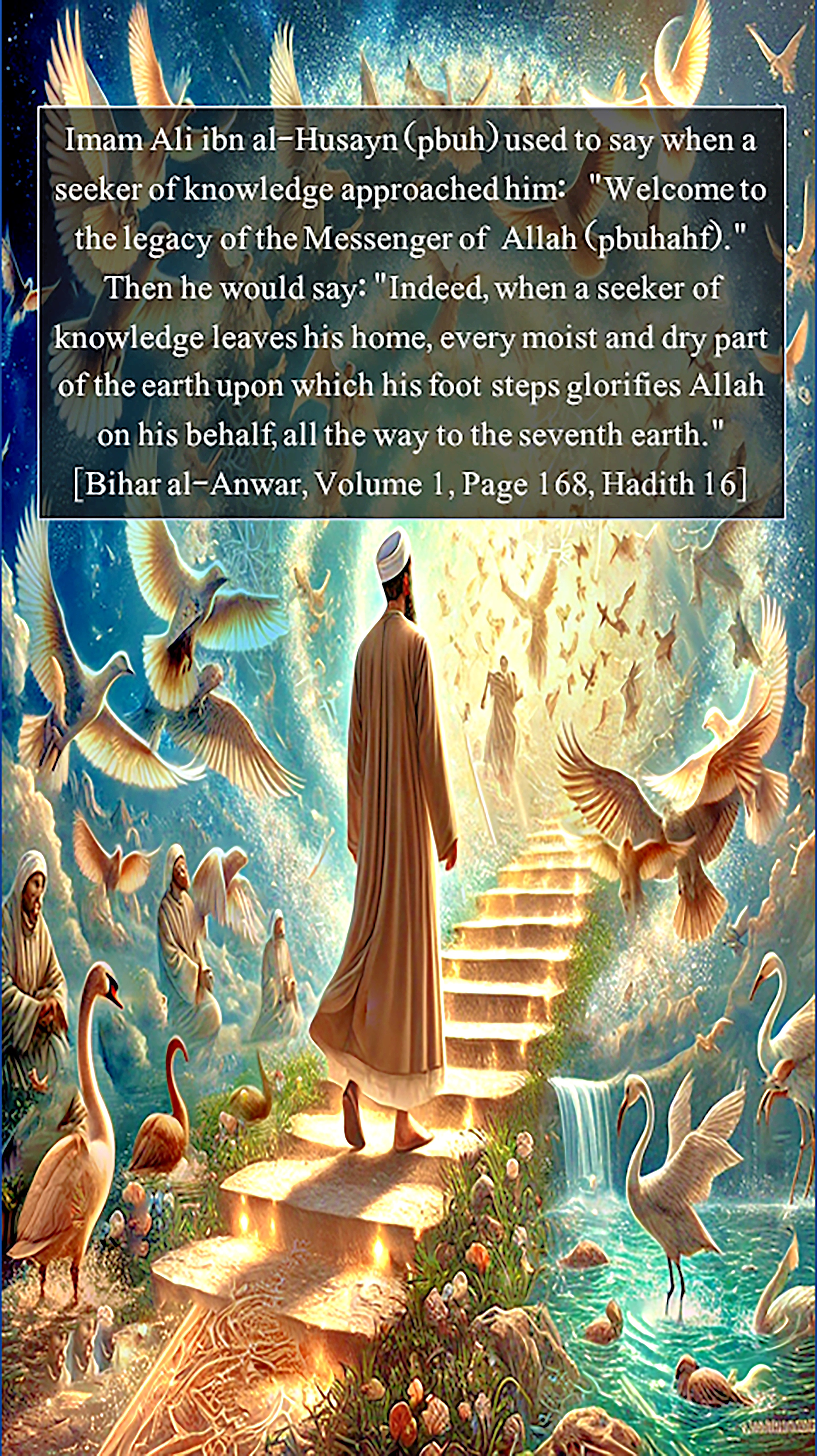
Download article from link below at the end
The Pursuit of Knowledge in Islam: Divine Promise, Spiritual Struggle, and Eternal Reward
A Comprehensive Exposition Based on the Teachings of the Prophet Muhammad (peace be upon him and his family) and the Ahl al-Bayt (peace be upon them)
This article presents a comprehensive examination of the Islamic teachings on the pursuit of knowledge, drawing from the rich traditions preserved in the corpus of Shia Islamic scholarship. It explores the multifaceted dimensions of seeking knowledge as an act of worship, the divine guarantee of sustenance for knowledge seekers, the connection between knowledge and jihad (spiritual struggle), the threefold duty of learning, acting upon, and teaching knowledge, the superiority of knowledge over mere ritual worship, and the profound rewards awaiting those who dedicate themselves to this noble path. The article synthesizes teachings from the Holy Prophet Muhammad (peace be upon him and his family) and the Imams of the Ahl al-Bayt (peace be upon them), presenting a holistic vision of knowledge as the foundation of faith, the path to Paradise, and the means of drawing closer to Allah.
Introduction
The Centrality of Knowledge in Islam
The Prophetic Tradition on Guaranteed Sustenance
Part One: The Status of Seeking Knowledge in Islam
1.1 An Obligation and Act of Worship
1.2 Knowledge as a Path to Paradise
1.3 The Comprehensive Reward of Knowledge Seekers
1.4 The Purpose and Intention Behind Seeking Knowledge
Part Two: The Divine Guarantee of Sustenance
2.1 The Prophetic Promise
2.2 Understanding Rizq (Sustenance)
2.3 The Broadened Meaning of Rizq
2.4 Two Types of Rizq
2.5 The Quranic Foundation
2.6 The Example of Maryam (peace be upon her)
2.7 Divine Apportionment and Moderation
Part Three: The Connection Between Knowledge and Sustenance
3.1 Knowledge as a Form of Sustenance
3.2 The Importance of Intention
3.3 The Prophetic Counsel on Sustenance
Part Four: Seeking Knowledge as Jihad
4.1 Knowledge and Struggle in the Way of God
4.2 Research as Intellectual Jihad
4.3 Jihad al-Nafs (The Greater Jihad)
4.4 The Broadening of Jihad
4.5 The Four Branches of Jihad
Part Five: The Threefold Duty of Knowledge Seekers
5.1 Imam al-Sadiq's Teaching
5.2 The Reward of Such a Person
5.3 The Inseparability of Knowledge and Action
5.4 The Consequences of Knowledge Without Action
Part Six: The Superiority of Knowledge Over Worship
6.1 Prophetic Teachings
6.2 The Sleep and Prayer of the Scholar
6.3 The Explanation for This Superiority
6.4 Imam al-Sadiq on Knowledge and Prayer
6.5 The Qualitative Superiority of Knowledge
Part Seven: The Reward of Knowledge Seekers
7.1 Prophetic Traditions on Recompense
7.2 The Ink of the Scholar and the Blood of the Martyr
7.3 The Support of Angels
Part Eight: Conditions for Receiving the Divine Guarantee
8.1 Pure Intention and Sincerity
8.2 Spiritual Purification and Taqwa
8.3 Action and Application
8.4 Avoiding Worldly Motives
Part Nine: Practical Implications for Knowledge Seekers
9.1 Balancing Effort and Trust
9.2 Moderation in Seeking
9.3 Spiritual Means for Sustenance
9.4 The Role of Gratitude
9.5 The Ethics of Teaching and Learning
Part Ten: The Rank of People of Knowledge in Society
10.1 Leaders and Guides
10.2 Closest to Prophethood
10.3 The Responsibility of Scholars
10.4 Warnings Against Corrupt Scholars
10.5 The Legacy of Scholars
Part Eleven: Knowledge as Light and Ignorance as Darkness
11.1 The Quranic Contrast
11.2 Ignorance as Spiritual Death
11.3 The Characteristics of the Ignorant Person
11.4 Knowledge as Divine Light
Part Twelve: The Comprehensive Vision of Beneficial Knowledge
12.1 The Best Knowledge Is That Which Benefits
12.2 Knowledge Must Lead to Action
12.3 The Stages of Knowledge Acquisition
12.4 Reflection and Contemplation as Worship
Conclusion
Summary of Key Themes
The Enduring Promise for Knowledge Seekers
Final Reflections and Call to Action
References
In the rich tapestry of Islamic teachings, the pursuit of knowledge occupies a position of unparalleled significance. The tradition of the Holy Prophet Muhammad (peace be upon him and his family) declares: "He who goes out to seek knowledge, Allah guarantees his sustenance for him." (Kanz al-Ummal, no. 28701). This profound statement encapsulates a fundamental principle in Islamic theology—that the Creator Himself guarantees the provision for those who dedicate themselves to the noble quest for understanding and wisdom.
The teachings of the Prophet Muhammad (peace be upon him and his family) and the Imams of the Ahl al-Bayt (peace be upon them) present a comprehensive vision of knowledge as the foundation of faith, the path to Paradise, and the means of drawing closer to Allah. This article explores the multifaceted dimensions of this divine promise, examining its theological foundations, the conditions attached to it, its connection to the broader concept of jihad, and its practical implications for seekers of knowledge throughout the ages.
Part One: The Status of Seeking Knowledge in Islam
1.1 An Obligation and Act of Worship
Islam elevates the pursuit of knowledge to the level of a sacred duty. Prophet Muhammad (peace be upon him and his family) emphatically stated: "Seeking knowledge is incumbent upon every Muslim, male and female" (Bihar al-Anwar, vol. 1, p. 177). This obligation is not limited by age, gender, or social status—or place, as reflected in the famous instruction to "Acquire knowledge, even if it be in China." (Bihar al-Anwar, vol. 1, p. 177)
The act of seeking knowledge is itself considered a form of worship. The Messenger of Allah (peace be upon him and his family) elaborated on this comprehensive vision:
"Seeking knowledge is an obligation on every Muslim. Indeed how Allah loves those who strive in their quest for knowledge." (al-Kafi, v. 1, p. 30, no. 1)
This profound teaching reveals that every stage of engagement with knowledge—from its initial pursuit to its dissemination—is infused with spiritual significance and divine reward.
Imam Muhammad al-Baqir (peace be upon him) reinforced this understanding, stating: “Try to learn knowledge because learning it is a good action and study is itself a worship.” (Bihar al-Anwar, vol. 78, p. 189)
This direct affirmation establishes that the very act of studying is classified as worship when oriented to Allah.
1.2 Knowledge as a Path to Paradise
The Prophet (peace be upon him and his family) further emphasized the salvific nature of knowledge: "He who traverses a path in order to gain knowledge thereupon, Allah makes him traverse the path to Paradise." ( Amali al-Saduq, p. 58, no. 9)
This connection between knowledge and salvation is reinforced by numerous traditions that describe the seeker of knowledge as being "sought after by Paradise" itself.
1.3 The Comprehensive Reward of Knowledge Seekers
The blessings and elevated status conferred upon those who seek knowledge are numerous and encompass both worldly and spiritual benefits:
Pathway to Paradise and Divine Proximity: Prophet Mohammad (peace be upon him and his family) said, "He who goes out to seek knowledge is himself sought after by Paradise." (Kanz al-’Ummal, no. 28842)
Prophet Mohammad (peace be upon him and his family) said, "He who goes out to seek knowledge is indeed on the path of Allah until he returns." (Kanz al-’Ummal, no. 28702)
Forgiveness and Mercy: Knowledge seekers will be granted forgiveness and every creature in the heavens and on the earth seeks Allah's forgiveness for the seekers of knowledge.
Prophet Mohammad (peace be upon him and his family) said, "Verily everything seeks forgiveness for the seeker of knowledge, including the fishes in the sea, the reptiles on the land, and the predators and livestock of the earth." (Amali al-Mufid, p. 29, no. 1)
Support and Reverence from Angels: Angels will happily spread their wings under the feet of one who stirs out in search of knowledge and like to accompany, wipe with their wings, and bless such people with the prayers.
Prophet Mohammad (peace be upon him and his family) said: "Whoever treads a path seeking knowledge Allah makes him tread a path to Paradise, and the angels lay down their wings for the seeker of knowledge in satisfaction with him, and whoever is in heaven and whoever is on earth seeks forgiveness for the seeker of knowledge even the fish in the sea, and the fadl of the scholar over the worshiper is like the fadl of the moon over the rest of the stars on the night of a full moon, and the scholars are the inheritors of the prophets; the prophets did not leave behind dinar or dirham, rather they left behind knowledge and whoever takes from it has taken an abundant share." (al-Kafi by Shaykh al-Kulayni, Volume 1, Page 34)
Elevated Status: Knowledge is the root of all good whereas ignorance is the root of all evil, and also attributes to Imam Ali that the fountainhead of all virtues is knowledge.
Prophet Mohammad (peace be upon him and his family) said, "Knowledge is the root of all good whereas ignorance is the root of all evil." (Bihar al-Anwar, v. 77, p. 177)
Imam Ali (peace be upon him) said, ‘The fountainhead of all virtues is knowledge and the peak of all virtues is knowledge.’ [Ghurar al-Hikam, no. 5234]
Equivalence to Worship and Jihad: Through knowledge, God is obeyed, worshipped, acknowledged, and confessed as being One.
Prophet Mohammad (peace be upon him and his family) said, ‘The quest for knowledge is incumbent upon every Muslim… by virtue of it the Lord is obeyed and worshipped, consanguinal relations are maintained, and the lawful is distinguished from the prohibited. Knowledge leads to action and action follows it. The fortunate ones are inspired by it whereas the wretched ones are deprived of it.’ ( Amali al-Tusi, p. 488, no. 1069)
The ink of the scholar is more holy than the blood of the martyr.
Prophet Mohammad (peace be upon him and his family) said, ‘On the Day of Resurrection, the ink of the scholars will be weighed up against the blood of the martyrs, and the ink of the scholars will preponderate over the blood of the martyrs.’ (Tafsir al-Durr al-Manthur, v. 3, no. 423)
1.4 The Purpose and Intention Behind Seeking Knowledge
The purpose and intention behind seeking knowledge are of paramount importance. Imam Ali al-Sajjad (peace be upon him) said: "If people knew what is involved in seeking knowledge, they would seek it even by shedding blood and wading through deep depths. Allah, Blessed and Exalted, revealed to Daniel: the most abhorred of my servants to me is the ignorant who disdains the right of people of knowledge and abandons following their example, and the most beloved of my servants to me is the one with taqwa who seeks the great reward, sticks to scholars, follows the forbearing, and accepts from the wise." (al-Kafi by Shaykh al-Kulayni, Volume 1, Page 35)
Prophet Mohammad (peace be upon him and his family) declared seeking knowledge to be a duty for all believers, urging them to pursue it even if it meant going to China. Prophet Mohammad (peace be upon him and his family) said, "Seek knowledge even in China, for verily to seek knowledge is an obligation on every Muslim." (Kanz al-’Ummal, no. 28697)
Imam Ali (peace be upon him) said, “Those who seek knowledge can be classified into three groups. You can distinguish them from each other by their characteristics and signs. There are those who seek knowledge due to their haughtiness and ignorance. There are those who seek knowledge so that they may rebel and deceive others. There are also those who seek knowledge to learn and become intelligent. Those who seek knowledge due to their haughtiness and ignorance disturb the people with their acts when they are in a group. They have a God-fearing outer look, while they are void of any piety. May God break their backs and cut off their noses! Those who seek knowledge due to their haughtiness and ignorance always rush ahead of their colleagues and make a lot of noise. They bow down to those who are lower themselves but are wealthy. They always feed on them and sell their religion. May God make them blind and uproot them. Those who seek knowledge to learn and become intelligent do not look so well and are sad. They wake up during the darkness of the night to pray. They will bend down while wearing their nightwear. They act with fear and avoid everyone except their brethren to whom they are accustomed. May God strengthen them and save them on the Resurrection Day.” (Al-Khisal by Shaykh Mu?ammad b. Ali al-Saduq, Book 4, Chapter 212, Hadith #3)
Part Two: The Divine Guarantee of Sustenance
2.1 The Prophetic Promise
The specific tradition concerning sustenance for knowledge seekers appears in multiple authoritative collections. The Prophet (peace be upon him and his family) declared:
"He who goes out to seek knowledge, Allah guarantees his sustenance for him." (Kanz al-Ummal, no. 28701)
This promise signifies God's special care for those who embark on the path of learning. The tradition clarifies that:
God is especially careful about the sustenance of a person who is in pursuit of knowledge.
He provides it in a special and different way, without requiring them to struggle for their income.
This divine assurance serves as a profound encouragement for Muslims to dedicate themselves to learning, freeing them from undue worldly anxieties about livelihood.
2.2 Understanding Rizq (Sustenance)
To fully appreciate this promise, it is essential to understand the Islamic concept of rizq (sustenance). In its comprehensive sense, rizq extends far beyond mere food and material provisions.
Initially, the term rizq was restricted primarily to "foodstuff." The Quranic verse (2:233) illustrates this original meaning, where clothing was explicitly not counted as part of "maintenance" or rizq. Over time, however, the meaning underwent a process of generalization, expanding to encompass "every useful thing that comes to someone."
This broadened definition includes:
- Material Provisions: Food, drink, shelter, means of income, livelihood, money, and wealth
- Social Goods: Wealth, prestige, family, supporters, and beauty
- Spiritual and Intellectual Gains: Knowledge, true inspiration, understanding, and divine manifestations
The Arabic word rizq carries a significant connotation of "bestowal by someone to someone else," emphasizing that sustenance is a gift granted by Allah rather than something earned solely through human effort.
Islamic teachings identify two primary types of sustenance:
Physical Sustenance: This sustains the body and includes material necessities such as food, drink, and shelter.
Spiritual Sustenance: This nurtures the soul and faith, encompassing knowledge, true inspiration, and understanding.
Significantly, spiritual sustenance is deemed superior because what sustains the soul lasts forever, while what sustains the body has a temporary duration. The best form of spiritual sustenance is identified as the knowledge of Deen and knowledge (Ma'rifat) about Mohammad-o-Aal-e-Mohammad (peace be upon him) .
Imam Ali (peace be upon him) further categorized rizq into two kinds based on its attainment:
Sustenance that you seek: This requires active effort and striving. Imam Ali (peace be upon him) said, "Go out and seek your livelihood for it is guaranteed to the one who goes in search of it." (al-Irshad, v. 1, p. 303)
Sustenance that seeks you: This will come to an individual even if they do not actively pursue it. As Imam Ali (peace be upon him) said: "O son of Adam! There are two types of sustenance: the sustenance that you seek and the sustenance that seeks you. So do not impose the anxieties for the year ahead on the anxiety of today. What each day holds is sufficient for you. If the following year is part of your life, then Allah will give you in every new tomorrow what is apportioned for you. But if the following year is not part of your life, then what will you do with worrying about what is not yours? No seeker will precede you to your sustenance nor will anyone take it from you, and what has been destined for you will not held back from you." (Nahj al-Balaghah, Hikmah 379.)
The Quran firmly establishes that every creature's sustenance is upon Allah:
"And there is no moving creature on the earth but its sustenance is on Allah, and He knows its resting place and its depository. All is (recorded) in a clear Book." (Quran 11:6)
This verse confirms that Allah has guaranteed the provision for every living creature. The Quran also states: "Allah provides means of subsistence to whomsoever He pleases without a measure" (Quran 2:212).
Quran 51:22 states: "And in the heaven is your sustenance and what you are promised." This verse highlights the divine origin of all sustenance and promises, serving as a reminder of humanity's dependence on Allah's provision and care.
2.4 The Example of Maryam (peace be upon her)
The narrative of Maryam (peace be upon her) during the birth of Prophet Isa (peace be upon him) provides a profound illustration of the relationship between divine provision and human effort. The Qur'an narrates:
"And shake towards you the trunk of the palm tree, it will drop on you fresh ripe dates." (Quran 19:25)
Despite being under God's direct care and experiencing a miraculous conception, Maryam (peace be upon her) was still required to perform an action—shaking the palm tree—to receive the blessing of the dates. This teaches that even divine blessings are often contingent upon human effort, however minimal. It demonstrates that reliance on Allah is not passive idleness but active striving coupled with trust in divine outcome.
2.5 Divine Apportionment and Moderation
Imam Ali (peace be upon him) taught that rizq is divinely apportioned and not increased or decreased by human shrewdness: "Know that even if a servant was devoid of shrewdness and was feeble in his schemes, it would not reduce the amount of sustenance that Allah has apportioned for him, and even if a servant were to be skilfully shrewd and crafty, it would not do anything to increase the sustenance that Allah has apportioned for him." [Amali al-Mufid, p. 207, no. 39]
Part Three: The Connection Between Knowledge and Sustenance
3.1 Knowledge as a Form of Sustenance
Since knowledge itself is counted among the "useful things" that Allah bestows, it is part of one's rizq. The commentary on Allah's name Al-Razzaq (The All-Provider) explicitly classifies knowledge as sustenance that nourishes the soul and is superior to material sustenance.
When a person seeks knowledge sincerely for Allah, they are already engaging in receiving the highest type of rizq. This spiritual sustenance shapes character, intentions, and reliance upon Allah, which then influences how material sustenance reaches them.
3.2 The Importance of Intention
The divine guarantee of sustenance is contingent upon the sincerity of one's purpose.
Holy Prophet (peace be upon him and his family) said, “One who walks on the way to seek knowledge, Allah will make him walk on the way to Paradise. Angels spread their wings for the pleasure of a student and every thing in the earth and the heaven including the fishes of oceans repent for him. A scholar is better than a worshipper much in the same way as a full moon is compared to stars. The scholars are inheritors of the prophets and the value of inheritance of prophets is measured in terms of knowledge instead of wealth. Whoever got a little of their inheritance has achieved a lot.” (Thawab al-Amal wa iqab al-Amal by Shaykh Mu?ammad b. Ali al-Saduq, Book 2, Chapter 269, Hadith #1)
Thus, the purity of intention is crucial for receiving the full benefit of the divine promise.
Prophet Mohammad (peace be upon him and his family) said, "He who seeks knowledge for Allah, no sooner does he learn even a chapter of it than it increases him in humility within himself, in humbleness in front of people, it increases his fear of Allah and his striving in religion, and that is the one who benefits from the knowledge that he gains. And he who seeks knowledge for this world and for status amongst people and for a favoured position with the ruler, no sooner does he learn even a chapter of it than it only increases his arrogance within himself, his presumptuousness with people, his self-delusion about Allah and his estrangement from religion. That is the one who does not benefit from his knowledge, and must subsequently refrain from it and stop furnishing proof for the case against himself in order not to feel regret and shame on the Day of Resurrection." (Rawzat al-Waizin, p. 16)
3.3 The Prophetic Counsel on Sustenance
In the advice on sustenance, the Prophet (peace be upon him and his family) mentions against being preoccupied with rizq. He advises:
"Do not preoccupy yourself away from the duties incumbent upon you in your bid to secure that which is guaranteed to you, for indeed neither will you miss out on that which has been apportioned for you, nor will you attain that which has been placed beyond your reach." (Bihar al-Anwar, v. 77, p. 187, no. 10)
Imam Hasan Askari (peace be upon him) said:
"The sustenance which has become guaranteed (by Allah) must not refrain and make you so busy so that you do not perform the obligatory practices." (Bihar ul-Anwar Vol. 78, P 374)
This is directly relevant to the student of knowledge: fear of poverty or excessive anxiety about income must not prevent him from obligations such as learning, worship, and moral duties, because a certain portion of rizq is guaranteed by Allah.
Part Four: Seeking Knowledge as Jihad
4.1 Knowledge and Struggle in the Way of God
The pursuit of knowledge is explicitly likened to jihad (struggle in the way of Allah). Imam Ali (peace be upon him) stated:
"A person setting forth for the acquisition of knowledge is like the one who struggles in the way of God." (Bihar al-Anwar, vol. 1, p. 179)
This comparison highlights that intellectual and spiritual striving for knowledge is as meritorious as physical struggle in defense of faith. Various aspects of engagement with knowledge are described as forms of jihad:
Working in knowledge is a fight for the sake of Allah.
Researching it is a form of jihad.
The traveler seeking knowledge is like a holy warrior in the way of Allah.
The Prophet (peace be upon him and his family) further emphasized: "He who goes out to seek knowledge is indeed on the path of Allah until he returns." (Kanz al-’Ummal, no. 28702)
4.2 Research as Intellectual Jihad
The text explicitly states that "researching it is a form of jihad," underscoring the importance of intellectual effort and investigation in the pursuit of knowledge. This is further reinforced by the teaching that "working in knowledge is a fight for the sake of Allah."
The importance of research and investigation is fundamental in the context of accepting Islamic teachings: According to Shia Jurists, accepting the teachings of Islam and entering into it, as well as acquiring its teachings and acting according to them, is all based on research, investigation, pondering, and thought.
4.3 Jihad al-Nafs (The Greater Jihad)
The Imams of the Ahl al-Bayt (peace be upon them) provided profound insights into the concept of jihad, identifying the struggle against one's own self as its highest and most significant form.
Imam Ali (peace be upon him) narrated the Prophet's famous distinction:
"The Messenger of Allah (peace be upon him and his family) sent a military expedition. When they returned he said: Welcome to people who have completed the lesser jihad, but the greater jihad remains for them. It was said: O Messenger of Allah, what is the greater jihad? He said: The jihad against one's self (nafs). And he (peace be upon him and his family) said: The best jihad is one's struggle against their own self that lies between their sides." (Wasa'il al-Shia Vol. 15, Section 2, Chapter 1, Hadith 20216)
Imam Ali (peace be upon him) stated: "The best jihad is combatting one’s self against its desires, and weaning it from the pleasures of this world." (Ghurar al-Hikam, no. 3232)
Imam Husayn ibn Ali (peace be upon him) further elaborated that Prophet Mohammad (peace be upon him and his family) has said, "Whoever establishes a good habitual practice, he will get his own reward for it as well as the reward of whoever performs it after him until the Day of Resurrection, without any decrease in their reward thereof." (Tuhaf al-’Uqul, no. 243)
Imam Muhammad ibn Ali al-Baqir (peace be upon him) reinforced this, stating: "There is no greater distinction than jihad, and no jihad like combatting one’s self." (Tuhaf al-’Uqul, no. 286)
This internal struggle—jihad al-nafs—relates directly to the discipline and effort required in seeking knowledge. The dedication, perseverance, and challenges involved in acquiring knowledge are comparable to the struggles faced by a warrior defending and promoting God's cause.
Imam Ali (peace be upon him) outlined different types of jihad, stating, the first kind of jihad that will overpower you is the jihad of your hands, then of your tongues, then of your hearts.
Amir al-mu'minin, Imam Ali (peace be upon him) said: "The first fighting with which you will be overpowered is the fighting with hands, thereafter with your tongues and then with your hearts. Consequently, he who does not recognize virtue with his heart or does not disapprove evil will be turned upside down. Thus, his upside will be turned downwards and his lowside will be turned upwards." (Nahjul Balagha Hadith 375)
This signifies that physical actions and verbal advocacy are preceded and underpinned by the purity and strength of the heart, which is cultivated through jihad al- nafs.
4.5 The Four Branches of Jihad
Imam Ali ibn Abi Talib (peace be upon him) stated, "Jihad has four branches: enjoining the good, forbidding the wrong, fortitude in the battlefield, and detesting the wicked." (al-Khisal, p. 232, no. 74)
These four branches collectively define jihad as a dynamic and comprehensive endeavor:
- Enjoining the Good: Actively inviting, persuading, and encouraging people to perform their duties towards Allah and to embrace virtuous actions.
- Forbidding the Wrong: Actively discouraging, preventing, and stopping others from engaging in sins, vices, and prohibited actions.
- Fortitude in the Battlefield: Encompassing perseverance, steadfastness, and sincere striving in all situations—physical, moral, and spiritual.
- Detesting the Wicked: Signifying a strong moral stance and an internal repulsion towards evil, sin, and those who perpetrate mischief.
Part Five: The Threefold Duty of Knowledge Seekers
5.1 Imam al-Sadiq's Teaching
Imam Ja'far al-Sadiq (peace be upon him) articulated a comprehensive vision of the knowledge seeker's responsibility:
"The one who learns knowledge and acts accordingly, and teaches it for Allah, will be called magnificently in heavens." (Al-Kafi, vol. 1, p. 35)
This hadith establishes three essential stages:
Learning for the Sake of Allah: Acquiring knowledge with the proper intention—seeking knowledge for Allah's pleasure, not for status or worldly gain.
Teaching for the Sake of Allah: Sharing knowledge with others. Imam al-Sadiq (peace be upon him) said, ‘Verily upon everything is its zakat, and the zakat of knowledge is to teach it to those who are worthy of it.’ (Tuhaf al-’Uqul, no. 364)
5.2 The Reward of Such a Person
The promise for those who fulfill this threefold duty is extraordinary: Imam Ja’far al-Sadiq (peace be upon him) said: “Whoever acquires knowledge, acts upon it and teaches it for the sake of God, he is known in the realm of hidden heavens as “Great”. For him it is said that he acquired knowledge for the sake of God, acted upon it for the sake of God and taught it for the sake of God.” (Al?Kulayni, Al-Kafi, vol.1, p. 35, hadith # 6)
He will be called magnificently in heavens
He is known in the realm of hidden heavens as 'Great'
It will be said there: 'He learned for the sake of Allah, practiced for the sake of Allah and taught it for the sake of Allah'
He will be glorified in the earth and the sky
5.3 The Inseparability of Knowledge and Action
The teachings emphasize that knowledge and action are deeply intertwined, like two wings of a bird. Imam Ali (peace be upon him) stated:
"Knowledge is associated with action. Therefore, he who knows should act, because knowledge calls for action; if there is a response well and good, otherwise it (i.e., knowledge) departs from him."(Nahjul Balagha Hadith 366)
The purpose of knowledge is to incite action. Knowledge is not considered valuable unless it is acted upon and internalized to become part of the knower's being. This internalization is demonstrated through one's behavior and attitudes.
5.4 The Consequences of Knowledge Without Action
Acquiring knowledge without acting upon it carries severe spiritual, ethical, and eschatological consequences:
Remoteness from Allah: If knowledge is not applied in practice, it can lead to remoteness from Allah. Prophet Mohammad (peace be upon him and his family) said, "He who does not increase in guidance in spite of an increase in his knowledge only gets further away from Allah." (Tanbih al-Khawatir, v. 2, p. 21)
Worthlessness and Futility: Knowledge without action is considered worthless and will be "frittered away" if not acted upon. It is akin to a "curse" rather than a blessing.
Prophet Mohammad (peace be upon him and his family) said, "He who seeks knowledge for Allah, no sooner does he learn even a chapter of it than it increases him in humility within himself, in humbleness in front of people, it increases his fear of Allah and his striving in religion, and that is the one who benefits from the knowledge that he gains. And he who seeks knowledge for this world and for status amongst people and for a favoured position with the ruler, no sooner does he learn even a chapter of it than it only increases his arrogance within himself, his presumptuousness with people, his self-delusion about Allah and his estrangement from religion. That is the one who does not benefit from his knowledge, and must subsequently refrain from it and stop furnishing proof for the case against himself in order not to feel regret and shame on the Day of Resurrection." (Rawzat al-Waizin, p. 16)
Prophet Mohammad (peace be upon him and his family), "A scholar who does not act upon his knowledge is like unto a niche providing people with light but burning itself." (Nahj Al-Fasahah)
Imam Ali (peace be upon him) said, "Knowledge without action is a curse, and action without knowledge is straying in error." (Ghurar al-Hikam, no. 1587)
Loss of Knowledge: Knowledge itself may depart from an individual who fails to act upon it. As Imam Ali conveyed, knowledge calls for action, and if that call is not answered, "it departs from him."
Imam Ali (peace be upon him) said, "Knowledge is linked to action, so he who knows acts. And knowledge calls for action, so if one answers [the call] it remains, and if not it departs from him." (Nahj a-Balagha, Saying 366)
Divine Punishment: Those who do not act on their knowledge will face punishment in the afterlife. A scholar who learns knowledge but does not act upon it will be resurrected on the Day of Judgment as blind.
Prophet Mohammad (peace be upon him and his family) said: "Whoever learns knowledge and does not act upon it, Allah will resurrect him on the Day of Resurrection as blind. And whoever learns knowledge for the sake of showing off and seeking reputation, desiring Dunya with it, Allah will remove its barakah and constrict his livelihood, and He will leave him to himself. And whoever Allah has left to himself, has perished. Allah, the Exalted, said: { Whoever hopes to meet his Lord, let him work righteousness, and never associate anyone with the service of his Lord }. (Makarim al-Akhlaq by Hasan bin al-Fadl al-Tabrisi, Volume 0, Page 451)
Imam Ja’far al Sadiq (peace be upon him) narrates from his ancestors that the Holy Prophet (peace be upon him and his family) said, “If knowledge is visible in a person and he does not act on it i.e. his words and actions do not match and if he breaks relations, Allah makes him deaf and blind.” (Thawab al-Amal wa iqab al-Amal by Shaykh Mu?ammad b. Ali al-Saduq, Book 3, Chapter 69, Hadith #1)
Part Six: The Superiority of Knowledge Over Worship
6.1 Prophetic Teachings
The Prophet Muhammad (peace be upon him and his family) provided numerous teachings that underscore the superior value of knowledge in comparison to mere worship: “Acquire knowledge since learning is a good deed, teaching equals saying God’s glorifications, and discussing about knowledge equals participating in a holy war. Teaching knowledge to the one who doesn’t know it is giving charity. Granting knowledge to the proper persons brings God’s pleasure, since one knows the lawful and the unlawful using knowledge and knowledge would lead its seeker to Paradise. Knowledge is a guide in case of fear; it is a companion in case of loneliness; it is a guide in case of hardships; it is a weapon against the enemies; and an ornament in the presence of friends. God promotes some people by means of knowledge to such a high rank that they are the leaders of goodness and must be obeyed. Their deeds must be taken into consideration and their works must be followed. The angels are inclined to be their friends and they anoint them with their own wings while they pray. Everything including the fish in the sea, the beasts in the desert and the quadrupeds ask for forgiveness for them since knowledge brings life to the hearts and light to the eyes and power against sluggishness. God opens the doors to the homes of the good people for the learned men. He grants them association with the good ones in this world and in the Hereafter. God is obeyed and served by means of knowledge. God is recognized as One by means of knowledge. The bonds of relationship are fastened by means of knowledge. What is lawful and unlawful is recognized by means of knowledge. Knowledge is the prelude to action. Any action follows knowledge. God inspires it to the blessed ones and deprives the miserable ones from it." (Al-Khisal by Shaykh Mu?ammad b. Ali al-Saduq, Book 21, Chapter 8, Hadith #20)
6.2 The Sleep and Prayer of the Scholar
A particularly striking tradition, transmitted by the Prophet who states: "An hour spent by a knowledgeable man lying on his bed thinking about his deeds is better than seventy years spent by the worshipper performing acts of worship." (Rawzat al-Waizin, page no. 12)
This emphasizes that the contemplation and understanding derived from knowledge far surpass the mere quantity of ritualistic worship performed without profound insight.
6.3 The Explanation for This Superiority
The Prophet (peace be upon him and his family) explained why the knowledgeable person is superior:
"Verily the knowledgeable man is superior to the [mere] worshipper as the sun is to the stars, and the worshipper is superior to the one who does not worship as the superiority of the moon to the stars." (Bihar al-Anwar, v. 2, p. 19, no. 49)
Prophet Mohammad (peace be upon him and his family) said: "A scholar who avails himself of his own knowledge is superior to a thousand simple worshipers (of God)" (Nahj Al-Fasahah)
Prophet Mohammad (peace be upon him and his family) said: "The knowledgeable man is superior to the [mere] worshipper by seventy degrees, the distance between two degrees spanning the gallop of a horse for seventy years; and this is because Satan plants an innovation amongst people which the knowledgeable man notices and prohibits, whilst the worshipper attends to his worship neither taking any notice of it nor recognising it." (Rawzat al-Waizin, no. 17)
This indicates that a scholar's understanding provides protection and guidance, which an unknowledgeable worshipper lacks.
6.4 Imam al-Sadiq on Knowledge and Prayer
Imam al-Sadiq (peace be upon him) said that Rasulullah (sw) said: “Seeking knowledge is obligatory.” In another hadith, Abu 'Abdillah (peace be upon him) narrated that Rasulullah (sw) said, “Seeking knowledge is obligatory for every Muslim. Let it be known that Allah loves those who seek knowledge.” (Al-Kafi (Vol. 1) by Shaykh Mu?ammad b. Yaqub al-Kulayni, Book 2, Chapter 1, Hadith #5)
6.5 The Qualitative Superiority of Knowledge
The teachings present a broad doctrinal framework in which knowledge has a higher qualitative value than worship when worship is uninformed or ignorant. The Prophet is quoted: “The virtue of knowledge is more beloved with Allah than the virtue of worship.” (Bihar al-Anwar, vol. 1, p. 167)
This superiority is based on several factors:
- Knowledge guides worship: Knowledge is the light and criterion by which worship acquires value; therefore, even "a little knowledge" invested in sincere action can outweigh "a lot of worship" performed in ignorance.
- Knowledge protects from innovation: The scholar sees and blocks misguiding innovations, while the worshipper absorbed only in ritual acts may not even notice such deviations.
- Knowledge continues to benefit: The ink of scholars continues to guide generations, whereas worship without understanding benefits primarily the individual performer.
Part Seven: The Reward of Knowledge Seekers
7.1 Prophetic Traditions on Recompense
The Prophet Muhammad (peace be upon him and his family) described the elevated reward awaiting knowledge seekers:
"The seeker of knowledge is the seeker of mercy; the seeker of knowledge is the pillar of Islam and is given his recompense with the prophets." (Kanz al-’Ummal, no. 28729)
The Prophet Mohammad (peace be upon him and his family) said, ‘Verily the angels spread their wings over the seeker of knowledge and seek forgiveness on his behalf.’ (Kanz al-’Ummal, no. 28745)
Prophet Mohammad (peace be upon him and his family) said: "Whoever treads a path seeking knowledge Allah makes him tread a path to Paradise, and the angels lay down their wings for the seeker of knowledge in satisfaction with him, and whoever is in heaven and whoever is on earth seeks forgiveness for the seeker of knowledge even the fish in the sea, and the fadl of the scholar over the worshiper is like the fadl of the moon over the rest of the stars on the night of a full moon, and the scholars are the inheritors of the prophets; the prophets did not leave behind dinar or dirham, rather they left behind knowledge and whoever takes from it has taken an abundant share." (al-Kafi by Shaykh al-Kulayni, Volume 1, Page 34)
7.2 The Ink of the Scholar and the Blood of the Martyr
A profound tradition emphasizes the superior value of scholarly endeavor:
Prophet Mohammad (peace be upon him and his family) said, ‘On the Day of Resurrection, the ink of the scholars will be weighed up against the blood of the martyrs, and the ink of the scholars will preponderate over the blood of the martyrs.’ (Tafsir al-Durr al-Manthur, v. 3, no. 423)
The knowledge recorded, taught, and disseminated by scholars continues to illuminate minds, guide actions, and rectify beliefs for generations, making its impact far-reaching and enduring.
Seekers of knowledge receive extraordinary celestial support:
Prophet Mohammad (peace be upon him and his family) said: "Whoever treads a path seeking knowledge Allah makes him tread a path to Paradise, and the angels lay down their wings for the seeker of knowledge in satisfaction with him, and whoever is in heaven and whoever is on earth seeks forgiveness for the seeker of knowledge even the fish in the sea, and the fadl of the scholar over the worshiper is like the fadl of the moon over the rest of the stars on the night of a full moon, and the scholars are the inheritors of the prophets; the prophets did not leave behind dinar or dirham, rather they left behind knowledge and whoever takes from it has taken an abundant share." (al-Kafi by Shaykh al-Kulayni, Volume 1, Page 34)
Part Eight: Conditions for Receiving the Divine Guarantee
8.1 Pure Intention and Sincerity
The divine guarantee of sustenance for knowledge seekers is contingent upon several conditions, the foremost being pure intention.
The aim behind seeking knowledge is more important than the knowledge itself.
Seeking knowledge with a divine aim, for the pleasure of God and serving His creatures, leads to Paradise.
8.2 Spiritual Purification and Taqwa
Seekers of knowledge are urged to:
Undergo spiritual purification
Instill taqwa (God-consciousness) in their hearts
Free themselves from bad intentions and worldly motives
Regularly assess their intentions in acquiring knowledge
The guarantee is for those who not only seek knowledge but also apply it. Knowledge without action is considered worthless.
Prophet Mohammad (peace be upon him and his family) said, "The quest for knowledge is incumbent upon every Muslim… by virtue of it the Lord is obeyed and worshipped, consanguinal relations are maintained, and the lawful is distinguished from the prohibited. Knowledge leads to action and action follows it. The fortunate ones are inspired by it whereas the wretched ones are deprived of it." (Amali al-Tusi, p. 488, no. 1069)
Imam Ali (peace be upon him) said: "Knowledge is a [means of] right guidance for the one who acts upon it."(Ghurar al-Hikam)
Imam Ali (peace be upon him) said: All of knowledge is a proof [against its possessor] except what is acted upon.(Ghurar al-Hikam)
Imam Ali (peace be upon him) said: "The bane of knowledge is to forsake acting upon it." (Ghurar al-Hikam)
Seeking knowledge for worldly or selfish aims is forbidden and leads to spiritual ruin rather than elevation. Knowledge sought for status, pride, worldly dominance, or sinful aims no longer serves as a path to Paradise but can instead become a cause of spiritual ruin.
Prophet Mohammad (peace be upon him and his family) said, "He who seeks knowledge for this world and for status amongst people and for a favoured position with the ruler, no sooner does he learn even a chapter of it than it only increases his arrogance within himself, his presumptuousness with people, his self-delusion about Allah and his estrangement from religion. That is the one who does not benefit from his knowledge, and must subsequently refrain from it and stop furnishing proof for the case against himself in order not to feel regret and shame on the Day of Resurrection." (Rawzat al-Waizin, p. 16)
Seeking knowledge for worldly motives can lead to spiritual ruin.
Imam Ali (peace be upon him) warned against seeking knowledge for inappropriate reasons: "Take of knowledge whatever seems good to you, but beware of seeking knowledge for four reasons in order that you may contend with the scholars, or in order to wrangle with foolish people, or that you may show off with it in gatherings, or in order that people may look up to you to lead them." (al-Irshad, v. 1, p. 230)
Part Nine: Practical Implications for Knowledge Seekers
9.1 Balancing Effort and Trust
Islamic teachings provide a balanced approach to sustenance:
Effort is required: Imam Ali (peace be upon him) advised, "Go out and seek your livelihood for it is guaranteed to the one who goes in search of it." (al-Irshad, v. 1, p. 303)
Trust in Allah: While actively seeking, one should maintain trust in Allah's provision.
From Ali bin Abdul Aziz who said: Abu Abdullah (peace be upon him) said: What happened to Umar bin Muslim? I said: May I be sacrificed for you, he turned to worship and left trading. He said: Woe to him! Doesn't he know that one who abandons seeking provision will not have his prayers answered? When the verse "And whoever fears Allah, He will make for him a way out and provide for him from where he does not expect" [Quran 65:2-3] was revealed, some companions of the Messenger of Allah (peace be upon him and his family) closed their doors and turned to worship, saying "We have been sufficed." This reached the Prophet (peace be upon him) so he sent for them and said: What made you do what you did? They said: O Messenger of Allah, our provision has been guaranteed so we turned to worship. He said: Whoever does this will not have his prayers answered - you must seek provision." (Wasa'il al-Shia Vol. 17, Section 1, Chapter 5, Hadith 21894)
Prophet Muhammad (peace be upon him and his family) emphasized: "Verily the archangel Gabriel blew into my mind that no soul shall pass away before the depletion of his sustenance in this world, so be wary of your duty to Allah and seek your livelihood through decent means, and let not a delay in your provision cause any of you to seek it through unlawful means, for verily what is with Allah is only acquired through His obedience." (al-Kafi, v. 2, p. 74, no. 2)
Prophet Mohammad (peace be upon him and his family) advised moderation:
" A believer is satisfied with little" (Nahj Al-Fasahah)
Prophet Mohammad (peace be upon him and his family) said, "The best livelihood is that which suffices." (Bihar al-Anwar, v. 77, p. 168, no. 4)
Imam Ali (peace be upon him) advised moderation:
"Be content with little from your worldly possessions for the safety of your religion, for indeed the believer is satisfied with the little that he gets of this world." (Ghurar al-Hikam)
Imam Sadiq (peace be upon him) clarified the priority of obligations over the pursuit of sustenance:
"Let your pursuit of livelihood be above the earning of the wasteful, but below the seeking of the greedy one who is content with his worldly life and at peace with it. Rather, place yourself at the level of the fair and virtuous - raising yourself above the level of the feeble and weak, earning what is necessary. Indeed, those who were given wealth and did not show gratitude have no wealth." (Wasa'il al-Shia Vol. 17, Section 1, Chapter 13, Hadith 21950
)
9.3 Spiritual Means for Sustenance
Prophet Mohammad (peace be upon him and his family) said, "Increase your seeking of forgiveness, for verily Allah, Mighty and Exalted, has only taught you to seek forgiveness because He wants to forgive you." (Tanbih al-Khawatir, v. 1, p. 5)
Imam Ali (peace be upon him) highlighted the spiritual aspect of increasing rizq:
"Seeking forgiveness increases sustenance." (Bihar al-Anwar, v. 93, p. 277, no. 4)
Imam Ali (peace be upon him) said, "Seek forgiveness and you will be provided sustenance." (Mustadrak al-Wasa’il, v. 12, p. 122, no. 13686)
The relationship between gratitude and increased blessings is unequivocally stated in the Holy Qur'an: "If you are grateful, I will surely increase you" (Qur'an 14:7). This verse forms the bedrock of understanding the impact of gratitude.
Prophet Mohammad (peace be upon him and his family) said: "Whenever Allah opens for a servant a door of thankfulness, He does not withhold from him the door of increase." (al-Kafi by Shaykh al-Kulayni, Volume 2, Page 94)
Imam Ali (peace be upon him) said, "When Allah bestows a bounty upon a servant, no sooner does the latter feel thankful for it in his heart than he becomes deserving of increase therein before the expression of thanks has even reached his tongue." (Amali al-Tusi, p. 580, no. 1197)
Imam Mohammad Baqir (peace be upon him) said: "Whenever Allah bestows a blessing upon a servant and he appreciates it in his heart, he becomes deserving of increase even before expressing gratitude with his tongue." (Wasa'il al-Shia Vol. 16, Section 3, Chapter 8, Hadith 21630)
9.5 The Ethics of Teaching and Learning
Imam al-Sadiq (peace be upon him) provided guidance on the manner of teaching and seeking knowledge. He said that one should seek knowledge and adorn themselves with forbearance and poise, and humble themselves to those they teach and from whom they seek knowledge, avoiding authoritarianism lest truth be blurred into falsehood.Imam al-'Imam al-Sadiq (peace be upon him) said: "Seek Knowledge and adorn it with forbearance and dignity. Be humble to those whom you teach and to those from whom you learn. Don't be tyrannical in your teaching conduct, for you will forfeit that to which you are entitled on account of it." (Usul Al-Kafi)
He also advised: "The knowledgeable man must not be harsh when he teaches, and must not be disdainful when he learns." (Tanbih al-Khawatir, v. 1, p. 85)
Part Ten: The Rank of People of Knowledge in Society
10.1 Leaders and Guides
Allah explicitly declares, "Allah will exalt those of you who believe, and those who are given knowledge, to high ranks" (Qur'an 58:11).
With knowledge, Allah elevates people to be "leaders of good doings whose deeds are taken as an example to follow" and whose opinions are used as references. The knowledgeable are held in high esteem, and their wisdom is sought. Prophet Mohammad (peace be upon him and his family) said, "The worthiest of people are those who have the most knowledge, and the least of them in worth are those with the least knowledge." ( Amali al-Saduq, p. 27, no. 4
)
Amir al-muminin, Imam Ali (peace be upon him) said: "Whoever places himself as a leader of the people should commence with educating his own self before educating others; and his teaching should be by his own conduct before teaching by the tongue. The person who teaches and instructs his own self is more entitled to esteem then he who teaches and instructs others." (Nahj al-Balagha by al-Sharif al-Radi, Book 3, Chapter 73, Hadith #88)
Imam Ali (peace be upon him) said, "The scholars are the governors over people." (Ghurar al-Hikam, no. 507)
The people who are closest to the rank of prophethood are the people of knowledge and striving, or those who strive to seek knowledge and act upon it.
Prophet Mohammad (peace be upon him and his family) said, “Acquire knowledge since learning is a good deed, teaching equals saying God’s glorifications, and discussing about knowledge equals participating in a holy war. Teaching knowledge to the one who doesn’t know it is giving charity. Granting knowledge to the proper persons brings God’s pleasure, since one knows the lawful and the unlawful using knowledge and knowledge would lead its seeker to Paradise. Knowledge is a guide in case of fear; it is a companion in case of loneliness; it is a guide in case of hardships; it is a weapon against the enemies; and an ornament in the presence of friends. God promotes some people by means of knowledge to such a high rank that they are the leaders of goodness and must be obeyed. Their deeds must be taken into consideration and their works must be followed. The angels are inclined to be their friends and they anoint them with their own wings while they pray. Everything including the fish in the sea, the beasts in the desert and the quadrupeds ask for forgiveness for them since knowledge brings life to the hearts and light to the eyes and power against sluggishness. God opens the doors to the homes of the good people for the learned men. He grants them association with the good ones in this world and in the Hereafter. God is obeyed and served by means of knowledge. God is recognized as One by means of knowledge. The bonds of relationship are fastened by means of knowledge. What is lawful and unlawful is recognized by means of knowledge. Knowledge is the prelude to action. Any action follows knowledge. God inspires it to the blessed ones and deprives the miserable ones from it." (Al-Khisal by Shaykh Mu?ammad b. Ali al-Saduq, Book 21, Chapter 8, Hadith #20)
Prophet Mohammad (peace be upon him and his family) said: "Whoever treads a path seeking knowledge Allah makes him tread a path to Paradise, and the angels lay down their wings for the seeker of knowledge in satisfaction with him, and whoever is in heaven and whoever is on earth seeks forgiveness for the seeker of knowledge even the fish in the sea, and the fadl of the scholar over the worshiper is like the fadl of the moon over the rest of the stars on the night of a full moon, and the scholars are the inheritors of the prophets; the prophets did not leave behind dinar or dirham, rather they left behind knowledge and whoever takes from it has taken an abundant share." (al-Kafi by Shaykh al-Kulayni, Volume 1, Page 34)
10.3 The Responsibility of Scholars
The elevated rank of scholars comes with profound responsibility. Scholars are described as "God's trustees for people". Prophet Mohammad (peace be upon him and his family) said, "The scholars are Allah’s trustees over His creation." (Kanz al-’Ummal, no. 28675).
Scholars are Allah's trustees on earth and over His creation.Imam al-Sadiq (peace be upon him) said: "The scholars are the trustees [of religion], the pious ones are the strongholds [of religion] and the successors (of the Prophet) are the masters [of religion].' In an another hadith it is said, 'The scholars are the light houses [of the religion], the pious ones are the strongholds [of the religion] and the successors are the masters [of the religion]." (Al-Kafi (Vol. 1) by Shaykh Mu?ammad b. Yaqub al-Kulayni, Book 2, Chapter 2, Hadith #5)
Scholars are the inheritors of the Prophets, responsible for preserving and transmitting their Hadith without alteration. Their duty includes establishing and telling the truth, and interpreting holy verses fairly and unbiasedly.
10.4 Warnings Against Corrupt Scholars
Despite their exalted position, scholars are subject to stringent warnings if they deviate from their divine trust. Prophet Mohammad (peace be upon him and his family) (peace be upon him) provided a stark description of a corrupt scholar:
"A scholar who does not act upon his knowledge is like unto a niche providing people with light but burning itself" (Nahj Al-Fasahah)
Prophet Mohammad (peace be upon him and his family) said: "Whoever learns knowledge and does not act upon it, Allah will resurrect him on the Day of Resurrection as blind. And whoever learns knowledge for the sake of showing off and seeking reputation, desiring Dunya with it, Allah will remove its barakah and constrict his livelihood, and He will leave him to himself. And whoever Allah has left to himself, has perished. Allah, the Exalted, said: { Whoever hopes to meet his Lord, let him work righteousness, and never associate anyone with the service of his Lord }. (Makarim al-Akhlaq by Hasan bin al-Fadl al-Tabrisi, Volume 0, Page 451)
Imam Ali (peace be upon him) said: "Among them there is he who disapproves evil with his tongue and heart but not with his hand. This man has attained only two virtuous habits but lacks one. And among them there is the third one who disapporves evil with his heart but not with his tongue and hand. This is the one who lacks the two better qualities out of three and holds only one. Then, among them there is also he who does not disapprove evil either with his tongue, heart or hand. He is just a dead man among the living." (Nahj al-Balagha by al-Sharif al-Radi, Book 3, Chapter 374, Hadith #465)
Imam Jaffar al-Sadiq (peace be upon him) said, "Verily the scholars are the heirs of the prophets." (al-Kafi, v. 1, p. 32, no. 2)
Imam Jaffar al-Sadiq (peace be upon him) said the following. “The scholars are the heirs of the prophets because the prophets did not leave any Dirham or Dinar, (units of money) as their legacy. What they left was certain pieces of their statements. Those who acquired anything of these pieces of their statements they have certainly gained a large share. You must be very careful, when acquiring such knowledge, to see from what kinds of people you receive them. Among us (the Ahlul Bayt, family of the holy Prophet s.a.) after every one there comes a just person who removes (and exposes) the forgeries of the exaggerators from it (knowledge), the infiltrated materials of the fallacious ones and the interpretations of the ignorant ones.” (Al-Kafi (Vol. 1) by Shaykh Mu?ammad b. Yaqub al-Kulayni, Book 2, Chapter 2, Hadith #2)
Part Eleven: Knowledge as Light and Ignorance as Darkness
The Quran and Islamic teachings consistently present knowledge as light and ignorance as darkness. The Quranic verse states: "Say, 'Are those who know equal to those who do not know?' Only those who possess intellect take admonition" (39:9).
Imam Ja'far al-Sadiq (peace be upon him) stated:
"Knowledge is a light that Allah casts into the heart of whomever He wishes." (Misbah al-Shari'ah wa Miftah al-Hakikah by Attributed to Imam al-Sadiq (peace be upon him), Volume 0, Page 16)
This light is not merely metaphorical; it is seen as a source of enlightenment and understanding that reveals what was previously unknown.
11.2 Ignorance as Spiritual Death
Islam considers knowledge as light and ignorance as darkness, as stated in the Qur'an: "Say, ‘Are the blind one and the seer equal? Or are the darkness and the light equal?’…" (13:16).
Prophet Mohammad (peace be upon him and his family) said, "The characteristic of an ignorant person is that he oppresses whoever he associates with, acts unjustly towards his subordinates, flatters his superiors, and his speech is without deliberation." (Tuhaf al-’Uqul, no. 29)
Hazrat Mohammad Prophet Mohammad (peace be upon him and his family) : Shamoon (the grandson of Judah. one of the disciples of Essa (Christ) (peace be upon him) submitted to the Prophet of God (S): Describe to me the signs of ignorant?'
The Prophet said:
1. If you become his companion he will offend and grieve you. 2. And if you avoid him he will revile and vilify you. 3. And if he gives something to you he will hold you under obligation. 4. If you give him something he will be ungrateful. 5. If you tell him a secret he will commit dishonesty with you (by revealing and opening it). 6. And if he tells you a secret he will blame you (about its opening). 7. And if he becomes wealthy he will get proud and show insolence and petulance. 8. And if he becomes poor he will refuse the blessings of Allah and will not care about committing sin. 9. And if he gets glad and happy he commits insolence and inordinacy. 10. And if he is grieved he gets disappointed. 11. And if he laughs his laughter is a burst (loud laughter). 12. And if he cries he laments and wails. 13. Attacks and assaults the pious ones. 14. He does not love Allah and does not observe His law. 15. And he does not feel ashamed before Allah. 16. He does not remember Allah. 17. If you please him he admires you and exaggerates in admiring you and falsely attributes the things (virtues) which you do not possess.18. If he gets angry with you all his admiration (for you) finishes up, and he attributes unworthy things to you. This is the program of the ignorant" (Tuhaf al-Uqul, P 18/19)
The Holy Prophet of Islam (peace be upon him and his progeny) said: "Do not respect only the excessive prayer, fasting, pilgrimage, righteousness with others and vigil of some people (although they are important in their own right). Rather, consider their “honesty” and “trustworthiness”! (narrated from the book Safinat’ul-Bihar)
Imam Ali (peace be upon him) described ignorance as, "Ignorance is the worst affliction." (Ghurar al-Hikam, no. 820)
Imam Hasan (peace be upon him) said: "Ignorance is the submission to the vile and base, and the company of perverted and misled" (Bihar ul-Anwar Vol78,Pl 15)
11.3 The Characteristics of the Ignorant Person
Imam Ali (peace be upon him) detailed several defining characteristics of an ignorant person:
"The ignorant is one who considers himself knowledgeable about what he is [in actual fact] ignorant of, and he is content with his own opinion. His attachment to scholars only increases his estrangement. For this reason he is attached to what he sees as beneficial from his own mistaken opinion, and as a consequence, denies the truth, remains confused in his own ignorance and too proud to seek knowledge.’— from knowledge] since he is constantly finding fault with them. He deems invalid the views of those who oppose him, and that which he does not understand he sees as fallacious. If he comes across something that he does not know, he denies it and falsifies it saying, ‘I have never heard of this!’ or ‘I do not see it as possible! or ‘How can it be!’ or ‘Where is this from?’ This is due to his confidence in his own opinion and the paucity of his awareness of his own ignorance." (Tuhaf al-’Uqul, no. 73)
11.4 Knowledge as Divine Light
The concept of knowledge as light is deeply rooted in Islamic thought. The Quran describes Allah as the ultimate "Light of the heavens and the earth" (24:35). Knowledge is synonymous with this divine light, and ignorance is the absence of this light.
The Quran's mission is to "bring forth mankind from the darkness into the light" (14:1). This darkness includes not only ignorance but also unbelief, oppression, injustice, and moral corruption.
Part Twelve: The Comprehensive Vision of Beneficial Knowledge
12.1 The Best Knowledge Is That Which Benefits
Prophet Muhammad (peace be upon him and his family) stated: "The best type of knowledge is that which benefits." (Amali al-Saduq, p. 394, no. 1)
Hazrat Mohammad Prophet Mohammad (peace be upon him and his family) said: "Ask God (to give you) useful knowledge, and take refuge with Him from useless knowledge." (Nahj Al-Fasahah)
Imam Ali (peace be upon him) said, "The best type of knowledge is that which improves you." (Ghurar al-Hikam, no. 4962)
This emphasis on beneficial knowledge means that knowledge must serve a purpose—it must lead to positive change, improvement, and good actions. There is "no good in knowledge that does not benefit," and if knowledge is not utilized, its acquisition is "not justified."
12.2 Knowledge Must Lead to Action
Prophet (peace
be upon him and his progeny) described the stages of acquiring and utilizing knowledge: "Paying attention," "Listening," "Learning," "Acting upon it," and "Spreading it."
Imam Jaffar al-Sadiq (peace be upon him) narrated, "A man once came to the Prophet Mohammad (peace be upon him and his family) asking, ‘O Prophet of Allah, what is knowledge’ to which he replied, ‘Paying attention.’ The man asked, ‘Then what’ He replied, ‘Listening.’ He asked, ‘Then what’ The Prophet replied, ‘Learning.’ The man asked, ‘Then what’ He replied, ‘Acting upon it.’ He asked, ‘Then what O Prophet of Allah’, to which he replied, ‘Spreading it." (al-Kafi, v. 1, p. 48, no. 4)
A man asked Prophet Mohammad (peace be upon him and his family) : “O Prophet of God! What is (the requirement of) knowledge?” Prophet Mohammad (peace be upon him and his family) replied: “Silence.” The man asked: “What is next?” The Prophet Mohammad (peace be upon him and his family) replied: “Listening to knowledge (i.e. those who are knowledgeable).” The man asked: “And what is next?” The Prophet Mohammad (peace be upon him and his family) replied: “Remembering it.” The man asked: “And what is next?” The Prophet Mohammad (peace be upon him and his family) replied: “Acting upon it.” The man asked: “And what is next?” The Prophet Mohammad (peace be upon him and his family) said: “Spreading and sharing it with others.” (P. 465, No 44).
The teachings emphasize that knowledge must lead to action. Imam Ali (peace be upon him) stated: "The fruit of knowledge is action in accordance with it." (Ghurar al-Hikam, no. 4624)
Am?r al-mu’min?n, peace be upon him, said: "Knowledge is associated with action. Therefore, he who knows should act, because knowledge calls for action; if there is a response well and good, otherwise it (i.e., knowledge) departs from him." (Nahj al-Balagha by al-Sharif al-Radi, Book 3, Chapter 366, Hadith #451)
Imam Ali (peace be upon him) said, "Knowledge is linked to action, so he who knows acts. And knowledge calls for action, so if one answers [the call] it remains, and if not it departs from him." (Nahj a-Balagha, Saying 366)
12.3 The Stages of Knowledge Acquisition
Imam al-Sadiq (peace be upon him), drawing upon the teachings of the Prophet Muhammad (peace be upon him and his progeny), outlined the stages of knowledge acquisition:
- Paying attention: The initial focus and receptivity
- Listening: Active engagement with the source of knowledge
- Learning: Internalizing and understanding
- Acting upon it: Translating knowledge into practice
- Spreading it: Sharing knowledge with others
12.4 Reflection and Contemplation as Worship
Reflection and contemplation are considered highly meritorious and are often equated with, or even surpass, other acts of worship.
The Quran actively invites, praises, and applauds contemplation. Allah says: "And We have revealed to you the Remembrance that you may explain to mankind what has been sent down to them and that haply they may reflect" (16:44).
Imam al-Sadiq (peace be upon him) said: "The best worship is continuous/persistent contemplation about Allah and His power." (Wasa'il al-Shia Vol. 15, Section 2, Chapter 5, Hadith 20260)
Imam al-Rida (peace be upon him) said: "Worship is not about praying and fasting much, rather worship is contemplation about the command of Allah, the Mighty and Majestic." (Wasa'il al-Shia Vol. 15, Section 2, Chapter 5, Hadith 20261)
Imam Mohammad Baqir (peace be upon him) said: "Beware of contemplating about Allah, but if you want to look at His greatness, then look at the greatness of His creation." (Wasa'il al-Shia Vol. 16, Section 2, Chapter 23, Hadith 21327)
Imam Ali (peace be upon him) said, "Pondering about the dominion of the heavens and the earth is the worship of the sincere ones." (Ghurar al-Hikam, no. 1792)
Imam Hasan al-Askari (peace be upon him) said: "Worship is not the abundance of fasting and praying, rather worship is the abundance of contemplation in the matter of Allah." (Tuhaf al-Uqul by Ibn Shu'ba al-Harrani, Volume 0, Page 488)
Summary of Key Themes
The teachings of the Prophet Muhammad (peace be upon him and his family) and the Imams of the Ahl al-Bayt (peace be upon them) present a comprehensive and profound vision of the pursuit of knowledge in Islam. This vision encompasses:
Knowledge as Obligation and Worship: Seeking knowledge is a religious duty incumbent upon every Muslim, male and female, and is itself considered a form of worship. Every stage of engagement with knowledge—from learning to teaching—is infused with spiritual significance.
The Divine Guarantee of Sustenance: Allah guarantees the sustenance of those who sincerely seek knowledge. This promise frees knowledge seekers from undue worldly anxieties and encourages them to dedicate themselves to learning.
Knowledge as Jihad: The pursuit of knowledge is likened to jihad (struggle in the way of Allah). Research, intellectual effort, and the struggle against one's own self are recognized as forms of holy struggle.
The Threefold Duty: Knowledge seekers are obligated to learn, act upon, and teach knowledge for the sake of Allah. Those who fulfill this threefold duty are honored in the heavens.
The Superiority of Knowledge: Knowledge has a qualitative superiority over mere ritual worship. Even a little knowledge that leads to action outweighs a lot of worship performed without understanding.
The Reward of Knowledge Seekers: Knowledge seekers are given recompense with the prophets, are honored in this world and the hereafter, and receive the support of angels and all creatures.
The Role of Intention: The divine guarantee and rewards are contingent upon pure intention—seeking knowledge for the sake of Allah, not for worldly gain or status.
The Enduring Promise for Knowledge Seekers
The tradition "He who seeks knowledge, Allah will take care of his sustenance" represents a profound divine promise that has inspired generations of Muslims to dedicate themselves to learning. This promise encompasses both spiritual and material provision, reflecting the comprehensive nature of Islamic teachings on sustenance.
The fulfillment of this promise requires:
- Pure intention: Seeking knowledge for the sake of Allah, not for worldly gain or status
- Action upon knowledge: Translating learning into practice and righteous conduct
- Teaching and dissemination: Sharing knowledge with others
- Patience and trust: Persevering through difficulties while maintaining reliance on Allah
- Lawful means: Seeking sustenance through permissible channels
Final Reflections and Call to Action
The pursuit of knowledge in Islam is not merely an intellectual exercise but a spiritual journey that transforms the individual and benefits humanity. It is a path of struggle, sacrifice, and profound reward. The divine promise of guaranteed sustenance serves as an enduring encouragement for Muslims to dedicate themselves to learning, freeing them from undue worldly anxieties about livelihood and enabling them to contribute to the spiritual and intellectual advancement of humanity.
As the Qur'an encourages: "O my Lord, increase me in knowledge" (20:114).
May Allah grant us the sincerity, perseverance, and understanding to pursue knowledge for His sake, to act upon what we learn, and to share it with others. May we be counted among those who are honored with the prophets and who receive the divine guarantee of sustenance in this world and the hereafter.
References
Primary Sources (Hadith Collections)
Al-Kafi (Shaykh al-Kulayni)
- al-Kafi, v. 1, p. 30, no. 1
- al-Kafi, v. 1, p. 35
- al-Kafi, v. 1, p. 48, no. 4
- al-Kafi, v. 2, p. 74, no. 2
- al-Kafi, v. 2, p. 94
- Al-Kafi (Vol. 1), Book 2, Chapter 1, Hadith #5
- Al-Kafi (Vol. 1), Book 2, Chapter 2, Hadith #2
- Al-Kafi (Vol. 1), Book 2, Chapter 2, Hadith #5
- al-Kafi, Volume 1, Page 34
Bihar al-Anwar
- Bihar al-Anwar, vol. 1, p. 167
- Bihar al-Anwar, vol. 1, p. 177
- Bihar al-Anwar, vol. 1, p. 179
- Bihar al-Anwar, v. 2, p. 19, no. 49
- Bihar al-Anwar, v. 77, p. 177
- Bihar al-Anwar, v. 77, p. 187, no. 10
- Bihar al-Anwar, v. 77, p. 168, no. 4
- Bihar al-Anwar, v. 78, p. 189
- Bihar al-Anwar Vol. 78, P 374
- Bihar al-Anwar, v. 93, p. 277, no. 4
Kanz al-Ummal
- Kanz al-Ummal, no. 28701
- Kanz al-Ummal, no. 28702
- Kanz al-Ummal, no. 28697
- Kanz al-Ummal, no. 28842
- Kanz al-Ummal, no. 28729
- Kanz al-Ummal, no. 28745
- Kanz al-'Ummal, no. 28675
Wasa'il al-Shia
- Wasa'il al-Shia Vol. 15, Section 2, Chapter 1, Hadith 20216
- Wasa'il al-Shia Vol. 17, Section 1, Chapter 5, Hadith 21894
- Wasa'il al-Shia Vol. 17, Section 1, Chapter 13, Hadith 21950
- Wasa'il al-Shia Vol. 16, Section 3, Chapter 8, Hadith 21630
Nahj al-Balaghah
- Nahj al-Balaghah, Hikmah 379
- Nahj al-Balaghah, Saying 366
- Nahj al-Balaghah Hadith 375
- Nahj al-Balaghah Hadith 366
- Nahj al-Balagha by al-Sharif al-Radi, Book 3, Chapter 73, Hadith #88
- Nahj al-Balagha by al-Sharif al-Radi, Book 3, Chapter 366, Hadith #451
- Nahj al-Balagha by al-Sharif al-Radi, Book 3, Chapter 374, Hadith #465
Ghurar al-Hikam
- Ghurar al-Hikam, no. 820
- Ghurar al-Hikam, no. 1587
- Ghurar al-Hikam, no. 3232
- Ghurar al-Hikam, no. 4624
- Ghurar al-Hikam, no. 4962
- Ghurar al-Hikam, no. 507
- Ghurar al-Hikam, no. 5234
Amali Collections
- Amali al-Saduq, p. 27, no. 4
- Amali al-Saduq, p. 58, no. 9
- Amali al-Saduq, p. 394, no. 1
- Amali al-Mufid, p. 29, no. 1
- Amali al-Mufid, p. 207, no. 39
- Amali al-Tusi, p. 488, no. 1069
- Amali al-Tusi, p. 580, no. 1197
Tuhaf al-'Uqul
- Tuhaf al-'Uqul, no. 29
- Tuhaf al-'Uqul, no. 73
- Tuhaf al-'Uqul, no. 243
- Tuhaf al-'Uqul, no. 286
- Tuhaf al-'Uqul, no. 364
Al-Khisal (Shaykh al-Saduq)
- Al-Khisal, Book 4, Chapter 212, Hadith #3
- Al-Khisal, p. 232, no. 74
- Al-Khisal, Book 21, Chapter 8, Hadith #20
Thawab al-Amal wa iqab al-Amal
- Thawab al-Amal, Book 2, Chapter 269, Hadith #1
- Thawab al-Amal, Book 3, Chapter 69, Hadith #1
Other Primary Sources
Rawzat al-Waizin
Rawzat al-Waizin, page no. 12
Rawzat al-Waizin, p. 16
Rawzat al-Waizin, no. 17
Tanbih al-Khawatir
- Tanbih al-Khawatir, v. 1, p. 5
- Tanbih al-Khawatir, v. 1, p. 85
- Tanbih al-Khawatir, v. 2, p. 21
al-Irshad
- al-Irshad, v. 1, p. 230
- al-Irshad, v. 1, p. 303
- Tafsir al-Durr al-Manthur, v. 3, no. 423
- Mustadrak al-Wasa'il, v. 12, p. 122, no. 13686
- Makarim al-Akhlaq, Volume 0, Page 451
- Misbah al-Shari'ah wa Miftah al-Hakikah, Volume 0, Page 16
- Nahj Al-Fasahah (various citations)
- Safinat'ul-Bihar
Quranic References
- Qur'an 2:212
- Qur'an 2:233
- Qur'an 11:6
- Qur'an 13:16
- Qur'an 14:1
- Qur'an 14:7
- Qur'an 16:44
- Qur'an 19:25
- Qur'an 20:114
- Qur'an 24:35
- Qur'an 39:9
- Qur'an 51:22
- Qur'an 58:11
- Qur'an 65:2-3
Note on Citations
The references are drawn from both primary Shia Hadith collections and other authoritative Islamic sources.
Qur'anic verses and hadiths of Ahl al-Bayt (peace be upon them) and sayings in Arabic, Persian and English.
https://eitaa.com/noorunalanoor
https://www.youtube.com/@110Inspire
https://youtube.com/@mustafaabbas4668?si=EnSIkaIECMiOmarE
https://youtube.com/@mustafaabbas8978?si=EMJylUW9_zruJx95