Posted by Mustafa Abbas on October 13, 2026 | Views: 9 | Ratings: 1
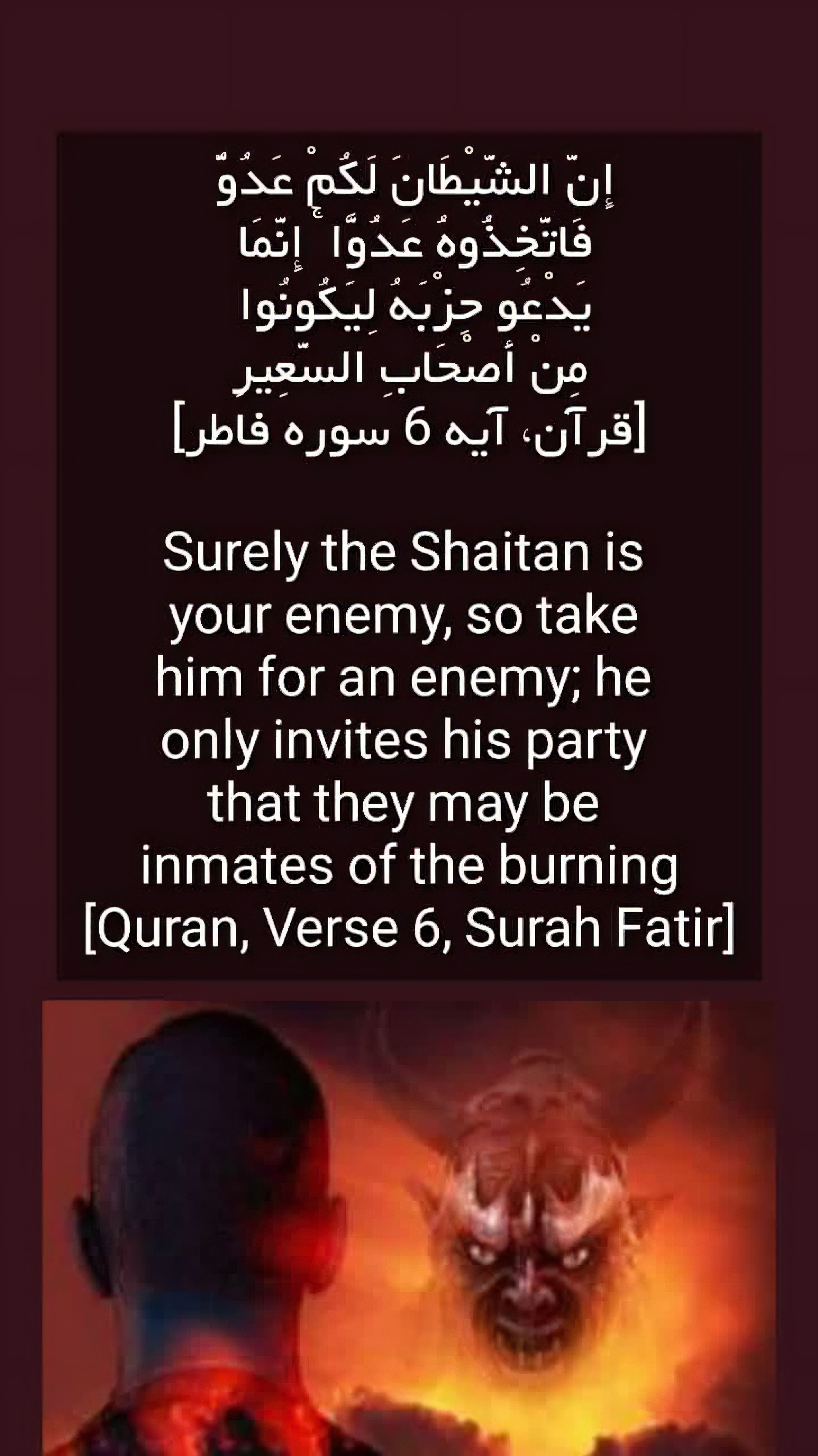
Taking Satan as an Enemy: Quranic Command
1. The Quranic Foundation
The command to take Satan as an enemy is rooted in the Quranic declaration: "Surely, the Satan is an enemy to you all. But rather, he calls his party in order for them to happen to be of the inmates of the Blazing Fire" (Quran 35:6). This verse is treated in the sources as a clear warning and directive: Satan's enmity is not figurative but fundamental. Believers are commanded to recognize it, resist it, and refuse to join his party.
The Quran reiterates this enmity in several verses: "Indeed, Satan is to man a clear enemy" (Quran 12:5); "O Children of Adam! Did I not enjoin upon you not to worship Satan? Indeed, he is to you a clear enemy" (Quran 36:60); and "O Adam! Verily, this [Satan] is an enemy to you and to your wife" (Quran 20:117). Believers are warned, "Do not follow the footsteps of Satan; he is your sworn enemy" (Quran 2:168) and "do not follow the footsteps of Satan. Indeed, he is to you a clear enemy" (Quran 2:208).
2. Satan and Iblis: Identity and Nature
Islamic sources distinguish between "Shaytan" and "Iblis." "Satan" is a common noun, applying to any harmful, rebellious, or deviant being, whether from the Jinn or humankind. "Iblis," by contrast, is the proper name of the specific entity who deceived Adam and now lies in wait for humans with his army and troops.
"And [mention] when We said to the angels, 'Prostrate before Adam'; so they prostrated, except for Iblees. He refused and was arrogant and became of the disbelievers" (Quran 2:34).
Iblis is described as a creature possessing will and consciousness, originating from the Jinn, not from the angels. He was created from intensely hot fire or toxic fire, while Adam was created from earth. Before Adam's creation, Iblis lived among the angels but had no superiority over them. After Adam was created, Iblis left the ranks of the angels and fell into evil and corruption. "And [mention, O Muhammad], the Day when He will gather them together [and say], 'O company of jinn, you have [misled] many of mankind.' And their allies among mankind will say, 'Our Lord, some of us made use of others, and we have [now] reached our term, which you appointed for us.' He will say, 'The Fire is your residence, wherein you will abide eternally, except for what Allah wills. Indeed, your Lord is Wise and Knowing.'" (Quran 6:128).
His enmity began with arrogance. When God commanded him to prostrate before Adam, he refused, considering himself superior because of his fiery origin. This disobedience, rooted in a distorted sense of superiority and envy, marked the beginning of his open and ancient enmity toward humanity. The Quran declares him an “open enemy” in verses such as: "So We said, 'O Adam, indeed this is an enemy to you and to your wife. Then let him not remove you from Paradise so you would suffer.'" (Quran 20:117) and "Indeed, Satan is an enemy to you; so take him as an enemy. He only invites his party to be among the companions of the Blaze." (Quran Surah Fatir 35:6).
Imam Musa al-Kazim (peace be upon him) on the Greatest Enemy:
Imam al-Kazim (peace be upon him) was once asked who one's archenemy is that one must fight, to which he replied, 'It is he who is closest to you and yet harbours the most enmity towards you … and he who provokes all your enemies against you, and he is Iblis [Satan].’
— Tuhaf al-’Uqul, no. 399
Imam al-Kazim (peace be upon him) said, ‘Combat your self to avert it against its desires, for this as incumbent upon you as fighting your enemy.’
— Tuhaf al-’Uqul, no. 399
A man asked Imam Musa Kazim (peace be upon him), “the holy war and combat against which one of the enemies and foes is more obligatory?'
The Imam (peace be upon him) reflected 'The nearest of them to you and those who are the most enemy and doing most of harm to you and their enmity be greatest and severest of all And their existence and is with their closeness and proximity to you, is most hidden and concealed from you'
— Bihar ul-Anwar Vol. 78, P 315
Imam Musa Kazim (peace be upon him) said, 'Nothing is more hurtful to Iblis [Satan] and his army than brothers in faith visiting each other for the sake of Allah.’
— al-Kafi, p. 188, no. 7
Distinction Between Shaytan and Iblis
The fundamental difference lies in their scope and grammatical classification:
- Shaytan: This is a common noun derived from the roots and signifying 'impure and base,' 'rebellious,' or 'a nefarious soul distanced from Allah and Truth.' It refers to any harmful, deviating, and rebellious entity, regardless of whether it is human, jinn, or animal, that aims to create division, discord, and corruption. The term encompasses general forces of corruption, wickedness, and deviation, including internal impulses like selfishness, carnal desire, avarice, aggression, and negligence, as well as external influences such as corrupt leaders or tempting situations. The Quran also uses “Shaytan” to refer to wicked and corrupt humans.
- Iblis: This is a proper noun that specifically designates the individual Shaytan who refused to obey Allah’s command to prostrate before Adam. He is the archetypal tempter and the leader of the forces of evil against humanity, alongside his soldiers and forces. His name “Iblis” is believed to derive from the fact that he despaired (ablasa) of God’s mercy.
In essence, while every Iblis is a Shaytan, not every Shaytan is Iblis. Iblis is a specific, prominent individual within the broader category of “Shaytan.”
Origins of Iblis
- Nature: Iblis is from the jinn, not an angel. The Quran states: "And when We said to the angels: Make obeisance to Adam; they made obeisance but Iblis (did it not). He was of the jinn" (Quran 18:50).
- Creation: He was created from intensely hot fire, "And the jinn We created before from scorching fire." (Quran 15:27), specifically toxic fire. It is mentioned that fire was created by Allah from a green tree, which originated from clay.
- Original Status: Before his disobedience, Iblis was a pious worshipper who lived among the angels. The angels thought he was one of them, but Allah alone knew his true nature. According to Imam Ja'far as-Sadiq (peace be upon him), Iblis was not an angel and was not connected to any heavenly affair, nor did he hold any special position.
From Dawood bin Farqad, from Abu Abdullah (peace be upon him), he said: The angels used to think that Iblis was one of them, but in Allah's knowledge he was not from them. What was in his heart was revealed through hamiyyah (* jealousy) and anger, and he said: "You created me from fire and created him from clay" [Quran 7:12]. Translator: * Refer to comment in Hadith 20775.
— Wasa'il al-Shia Vol. 15, Section 2, Chapter 57, Hadith 20776
Characteristics of Iblis
- The Fall: Iblis’s fall began when Allah commanded the angels to prostrate before Adam (peace be upon him). He refused, driven by pride, arrogance, envy, and jealousy, asserting his superiority because he was created from fire and Adam from clay, "He said, 'I am better than him. You created me from fire and created him from clay.'" (Quran 38:76). This act of disobedience made him a disbeliever, "He refused and was arrogant and became of the disbelievers." (Quran 2:34). Imam Ali (peace be upon him) condemned Iblis for his pride and racism, identifying him as the leader and forefather of all racist bigots.
Imam Ali (peace be upon him) condemning Iblis [Satan], said, ‘So he felt proud of his own creation over Adam’ s, and was racist against him because of his origin. The enemy of Allah, therefore, is the leader of all racist bigots, and the forefather of all those who consider themselves superior, who laid the very foundation of bigotry, and tried to wrest the cloak of might from Allah, and assumed the garb of exultation having shed the veil of self-abasement.’
— Nahjul Balaghah, Sermon 192
- Role as Enemy: Iblis is the archetypal tempter and the eternal enemy of mankind. His sole aim is to divert humanity from the Sirat al-Mustaqeem (straight path) and lead them astray from Allah's true guidance.
- Specific Actions: He desires to cause enmity and hatred among people, "Satan only wants to cause between you animosity and hatred through intoxicants and gambling and to avert you from the remembrance of Allah and from prayer. So will you not desist?" (Quran 5:91). He attempts to sabotage good deeds, such as marriage proposals, by whispering to encourage extravagant demands. He made the foundation of the denial of the Khalifa (peace be upon him) of Allah and leads those who deny this concept.
- Personal Attributes (ascribed): His kohl (eye application) is drowsiness, his linctus (for licking) is lying, and his snuff (for inhaling) is arrogance. He is described as the first one to lament, sing, and be sad.
- Progeny: Iblis is believed to have offspring, collectively referred to as "Satan," who are described as male and are believed to flow through human veins and dwell in human chests, causing difficulties. His offspring are considered kafirs (non-believers).
- Limitations: Iblis only calls people to evil; he has no power to force them. He admits he has no power over Allah's sincere servants, as those who believe in Allah's signs and follow the straight path are immune to his attacks.
- Granted Respite: Iblis requested and was granted respite by Allah until the Day of Reckoning to mislead Allah's creatures.
3. Characteristics of Shaytan (General Term)
Beyond Iblis, the general term "Shaytan" embodies a broader spectrum of evil:
- Nature as a Negative Force: Shaytan represents any negative force that opposes the laws of nature and the will of Allah, striving to create corruption, wickedness, and deviation. This force is unique to humans. When humans follow Shaytan, they go against their own natural laws and the laws of the Creator.
- Scope: Shaytan encompasses “Shaytans from among men and jinn” (Quran 6:112). These include Iblis and his army of wicked seducers, as well as wicked and corrupt humans who are tricksters, plotters, deceivers, and whisperers, casting doubts to divert people from the truth.
- Continuous Desire: The Quran highlights Shaytan’s continuous and perpetual desire to cause harm, enmity, and hatred, "Satan only wants to cause between you animosity and hatred through intoxicants and gambling and to avert you from the remembrance of Allah and from prayer. So will you not desist?" (Quran 5:91).
- Influence on Prophets: Even prophets and apostles are subject to Shaytan’s suggestions when they desire something, but Allah annuls these suggestions and establishes His own communications.
- Symbolic Meaning: “Shaytan” can also symbolically refer to harmful microbes.
Enmity Towards Humanity
Both Iblis and the broader concept of Shaytan are consistently described as “an open enemy” to humanity (Quran).
- Iblis’s Enmity: His refusal to prostrate to Adam marked the beginning of his animosity. He seeks to lead people away from the path of righteousness, causing discord, preventing good deeds, and exploiting human weaknesses such as selfish greed and anger. He is jealous of those who perform repeated prostrations to Allah.
- Shaytan’s Enmity: Shaytan dislikes what benefits humans and inclines towards what harms them, driven by envy. He calls his party to lead them astray and make them inmates of the Blazing Fire. Shaytan gathers around Shias to make them slip from Walayat-e-Ali (peace be upon him) by tongue or practically, aiming to mislead them from the Straight Right Path.
Imam Ali (peace be upon him) said, ‘Anything that distracts you from the remembrance of Allah is from Iblis [Satan].’
— Tanbih al-Khawatir, v. 2, p. 170
Imam Ali (peace be upon him) said, 'I praise Allah and seek His aid against the acts that led to Satan's banishment and his eviction, and [I seek] His protection from his snares and his deceitful ways.’
— Nahjul Balaghah, Sermon 151
4. What It Means to Take Satan as an Enemy
The command to “take Satan as an enemy” is not merely an emotional stance. It requires active opposition, non-compliance, and non-following of his footsteps. The Quran says: "O you who have believed, enter into Islam completely [and perfectly] and do not follow the footsteps of Satan. Indeed, he is to you a clear enemy." (Quran 2:208).
Imam Muhammad Baqir (peace be upon him) narrates that the Holy Prophet (peace be upon him and his family) said, “Allah, the Mighty and Sublime said: Whoever from the Muslim community obeys an unjust ruler not appointed by Allah, Allah will send chastisement on him even if there are good deeds of that community and even if the people are pious. Whoever from the Muslim community obeys the guide appointed by Allah, Allah will surely forgive him even if he has injustice and sins written in his scroll of deeds.”
— Thawab al-Amal wa iqab al-Amal by Shaykh Muhammad b. Ali al-Saduq, Book 3, Chapter 6, Hadith #1
Mohamed bin Musa bin al-Mutawakkil (r) narrated to us from Abdullah bin Ja’far al-Hiyari from Ahmed bin Mohammed from al-Hasan bin Mahboub from Husham bin Salem from Habib as-Sejistani from Abu Ja’far Imam al-Baqir that the Prophet (peace be upon him and his family) said: Allah said: I will punish every Muslim group who recognized the leadership of any unjust ruler whom I do not select, even if the individuals of such a group are pious and God-fearing. I, likewise, will forgive every Muslim group that recognized (only) the leadership of the just imams whom I appointed, even if the individuals of such a group wrong (themselves) and commit bad deeds.
— Fada?il al-Shia by Shaykh Muhammad b. Ali al-Saduq, Book 1, Chapter 12, Hadith #1
Vigilance is Essential
Imam Ali (peace be upon him) said: Do not curse Satan publicly, while you are his friend inwardly
— Turasol-Aemeh page 289. Sharh Nahjul Balaghah, vol 20, page 329.
Imam Ali (peace be upon him) said, ‘He who, in his friendship with you, is of no aid to you against your base self, his friendship is a curse on you, if only you knew.’
— Ghurar al-Hikam, no. 9041
Imam Mohammad al-Baqir (peace be upon him) said, 'Guard yourself against Iblis [Satan] with true dread.’
— Bihar al-Anwar, p. 164, no. 1
Imam Muhammad al-Baqir (peace be upon him) said: Protect yourself from Iblis with sincere fear.
— Tuhaf al-Uqul by Ibn Shu'ba al-Harrani, Volume 0, Page 285
Imam Jaffar al-Sadiq (peace be upon him) said, ‘If Satan is indeed an enemy, then why the negligence?!’
— Bihar al-Anwar, v. 78, p. 190, no. 1
Imam Jaffar al-Sadiq (peace be upon him) said, 'Iblis [Satan] lays out his traps in the Abode of Delusion, intending to ensnare none but our friends [i.e. lovers of the ahl al-bayt].’
— Tuhaf al-’Uqul, no. 301
Imam Jaffar al-Sadiq (peace be upon him) said, ‘Iblis [Satan] – may Allah’s curse be on him – says to his troops, ‘If I can gain mastery over three things in man, I will no longer care how much good he does for it will not be accepted from him: if he overrates his good deeds, forgets his sins, and is overcome by self-admiration.’
— al-Khisal, p. 112, no. 86
Believers must therefore be inimical to Satan, oppose him, and treat him as an enemy rather than befriending or obeying him. This is likened to taking precaution against an armed gang: one must close doors and gates to avoid being plundered.
Main Principles of Taking Satan as an Enemy
1. Fundamental Recognition of Satan as an Enemy
- Manifest and Open Enmity: It is imperative to recognize Satan as an open, manifest, and sworn enemy to humanity. The Holy Quran explicitly states: "Surely the Shaitan is your enemy, so take him for an enemy; he only invites his party that they may be inmates of the burning fire" (Quran 35:6). Other verses affirm this, such as "O Adam! Verily, this (Satan) is an enemy to you and to your wife" (Quran 20:117).
- Constant Threat: This enmity is not sporadic but constant, as he is described as always an open enemy.
- No Negligence: Imam Ja'far as-Sadiq (peace be upon him) warned against negligence in recognizing this enemy, stating, "If Satan is indeed an enemy, then why the negligence?"
2. Understanding Satan's Nature and Ultimate Goals
- Envy-Driven: Satan's actions stem from envy; he dislikes what benefits humans and inclines towards what harms them.
- Goal of Deviation and Hellfire: His primary objective is to deviate humanity from the right path, lead them astray into polytheism, and ultimately make them companions of the Blazing Fire. He will never cease his efforts until one is totally destroyed.
- Hindrance to Good: He actively works to prevent people from performing good deeds, leads them towards disobedience to God, causes enmity and hatred among people (often through intoxicants and games of chance), and makes them forget the remembrance of Allah and prayer.
3. Awareness of Satan's Deceptive Tactics
- Sweetening Evil: Satan suggests flowery words and makes disgraceful matters seem lighter to deceive people. He also promises things that are actually meant to lead astray.
- Exploiting Weaknesses: He exploits human weaknesses such as selfish greed, anger, transgression, and envy to achieve his goals.
- Inciting Immorality and Falsehood: He instructs people to do evil and immoral things and to speak about Allah without knowledge.
- Spreading Doubts and Traps: He sets up doubts to distance people from their Lord and uses the passions and desires of the heart as his traps, leading to sinful behavior.
- Individualized Deception: Satan uses varied methods to deceive and manipulate different individuals, targeting them based on their level of knowledge, piety, or worldliness. He even assigns a separate satan to each person.
- Ultimate Betrayal: He entices people to commit disbelief (Kufr) and then disavows them, claiming to fear Allah, which is a key part of his trickery.
4. Prescribed Human Response and Active Resistance
- Active Opposition and Avoidance: One must actively oppose Satan and treat him as an enemy, rather than befriending or obeying him. This also extends to avoiding his followers and rejecting his influence. Imam Ali (peace be upon him) cautioned against being outwardly inimical to Satan while being his friend inwardly.
- Submission to Divine Authority: The core response is to enter wholeheartedly into submission to Allah commanded by God "Do not follow the footsteps of Satan; he is your sworn enemy" (Quran 2:208). Following Allah's path is paramount, and one must vigilantly avoid following Satan's footsteps, which lead to polytheism and disbelief.
- Spiritual Practices:
o Acts of Worship: Fasting, charity, love for God, and seeking God's forgiveness are powerful means to repel Satan, with each act described as having a significant impact on him.
o Seeking Refuge: Actively seek refuge with Allah from Satan and use specific protective phrases.
o Remembrance and Caution: Remember Allah's words and remain cautious of Satan's false promises and enticements.
- Confronting the Inner Enemy (Nafs): Recognizing that the greatest enemy is often one's own tempting self (nafs) and unquenchable desires. Overcoming this internal enemy is crucial for victory against Satan.
- Cultivating Virtues: Actively combat haughtiness and intolerance within the heart, adopting humility as a weapon against him. Avoid transgression and envy, as these are spiritually damaging.
- Prayer for Protection: In prayer, it is recommended to ask Allah to rout Satan's troops, nullify his trickery, and count the faithful among his enemies, granting them strength not to obey or answer his calls.
5. Satan's Army and Allies
Satan does not act alone. Iblis has helpers and companions from his own offspring, from the Jinn, and from humans. Each executes his orders in a specific way. His troops are not equal in capability: some are fast, some slow; some work alone, others collaborate. The Quran also mentions human Satans, “Shaytans from among men and jinn” (Quran 6:112).
The armies of Iblis refer to his followers, consisting of both Jinn and humans who choose disobedience to God.
- Followers: Iblis is the leader of "the Satans," and his followers are those who have chosen to obey him and disobey God. The Quran mentions God's command to Iblis to "And incite [to senselessness] whoever you can among them with your voice and assault them with your horses and foot soldiers and become a partner in their wealth and their children and promise them." But Satan does not promise them except delusion." (Quran 17:64).
- Invisible Hosts: Satan is described as seeing people, while they do not see him, implying his hosts also operate from an unseen realm. He has a great number of hosts or a host that assists him.
- Individual Satans: There is a belief that a separate satan is assigned to each person, constantly whispering suggestions to commit sin, countered by an angel who deters from sin.
His rebellion stemmed from arrogance, pride, envy, and jealousy. He considered himself superior to Adam due to his creation from fire versus Adam's from clay. He is characterized by "kohl" (drowsiness), "linctus" (lying), and "snuff" (arrogance), as reported from Imam Ali (peace be upon him). These represent the vices he embodies and promotes. Satan is described as evil, wicked, cunning, deceitful, and an implacable enemy to humans, ungrateful to God, and rebellious.
6. Philosophical Reasons for Satan's Existence
The existence of Satan, despite his role as an enemy, serves a divine purpose as a test and a means of differentiation for humanity.
1. Testing Faith and Obedience:
- Satan was granted respite by God in order to test the faith of the children of Adam, whether they heed divine decrees or are misled by satanic reasoning.
- His existence is a part of God's tradition of trialing humans.
2. Differentiation of Believers:
- The Quran states, "And he [Satan] had no sovereignty over them save that We might differentiate those who believe in the Hereafter from those who doubt it" (Quran 34:21).
- Satan's influence allows God to distinguish between true believers and those who harbor doubt.
3. Spiritual Growth and Purification:
- By allowing Satan to exist, Allah provides a test for His slaves, allowing them to demonstrate their faith and devotion.
- This test enables individuals to purify their souls and grow closer to Allah.
- Confronting Satan's temptations and choosing righteousness leads to happiness and prosperity, while adhering to him causes misfortunes.
4. Limited Authority:
- Satan's authority is not absolute; he has no authority over those who have faith and rely on God. His authority is only over those who befriend him and those who associate others with God.
- He admits that he has no power over Allah's sincere servants.
7. Satan's Objectives
Satan's overarching objective is to lead humanity away from God and into Hellfire. The sources describe his invitation as designed to make people companions of the Blazing Fire. The meaning of Satan's enmity is that: he has no job other than misleading and straying humans; his entire effort is that not even a single human reaches the happiness of life and a good end.
His specific aims include:
- Misguidance and deviation: He strives to misguide all human beings, spread deviation, and separate them from God, the Quran, and religion.
- Ingratitude and disobedience: The goal and desire of Satan is the ingratitude of man. Following Satan is therefore ingratitude toward God. "[Allah] said, "Get out of Paradise, reproached and expelled. Whoever follows you among them - I will surely fill Hell with you, all together." (Quran 7:18).
- Division and enmity: Satan actively works to cast enmity and hatred among humans, disrupting families, communities, and societies. The present tense in the Quran indicates this is his perpetual will. "Satan only wants to cause between you animosity and hatred through intoxicants and gambling and to avert you from the remembrance of Allah and from prayer. So will you not desist?" (Quran 5:91).
- False promises and distraction: His promises are nothing but delusion. He distracts humans from the Hereafter, making worldly success seem the only value and religious warnings appear as superstitions. "But Satan does not promise them except delusion." (Quran 17:64). "and be not deceived about Allah by the Deceiver." (Quran 35:5).
- Turning to repentance:
The Quran says "Do not be like those who forget Allah, so He makes them forget their own souls. It is they who are the transgressors." (Quran 59:19)
Prophet Muhammad (peace be upon him and his family) said: ‘Sincere repentance is remorse for the sin as soon as it slips out from you; then you ask Allah for forgiveness, then you never return to it.’
— Kanz al-’Ummal, no. 10302
From Kumayl ibn Ziyad who said to Amir al-Mu'minin (peace be upon him): When a servant commits a sin and seeks Allah's forgiveness... He said: O Ibn Ziyad, that's repentance. I said: Is it not? He said: No. I said: How so? He said: When a servant commits a sin and says "Astaghfirullah" with movement. I said: What is movement? He said: The lips and tongue, intending to follow it with truth. I said: What is truth? He said: Confirmation of the heart and concealing the intention to never return to the sin from which he sought forgiveness. I said: If I do that, am I among those who seek forgiveness? He said: No, because you have not yet reached the foundation. I said: What is the foundation of seeking forgiveness? He said: Returning to repentance from the sin you sought forgiveness for, and this is the first level of worshippers. Abandoning sin and seeking forgiveness comprises six meanings - then he mentioned the hadith similarly. Obligation Of Sincere Repentance And Its Conditions
— Wasa'il al-Shia Vol. 16, Section 1, Chapter 87, Hadith 21029
Imam Ali (peace be upon him) said, 'Satan takes charge of him [the servant] and glamorizes the sin to him in order that he commit it, and makes him indulge false hopes of forgiveness in order that he delay it.’
— Nahjul Balaghah, Sermon 64
Muhammad ibn Yahya has narrated from Ahmad ibn Muhammad ibn ‘Isa from al-Hassan ibn Mahbub from Mu’awiyah ibn Wahab who has said the following: “I heard Abu ‘Abdillah (peace be upon him) saying, ‘When a servant (of Allah) repents in the form of the repentance of Nasuh (sincere advise to one’s soul, or name of a person who repented in the real sense), Allah then loves him, covers and protects him in this world and in the next life.’ I then asked, ‘How will He cover him?’ The Imam said, ‘He will make the two angels forget what they have written against him. He will inspire the parts of his body to hide his sins and the places of earth to hide the sins that he had committed thereat. Allah will meet him while there will be nothing to testify anything against him.’”
— Al-Kafi (Vol. 2) by Shaykh Muhammad b. Yaqub al-Kulayni, Book 1, Chapter 191, Hadith #1
- Partnership in wealth and children: Satan aims to share in human wealth and lineage through illicit earnings, adultery, and producing corrupt generations. "And incite [to senselessness] whoever you can among them with your voice and assault them with your horses and foot soldiers and become a partner in their wealth and their children and promise them." But Satan does not promise them except delusion." (Quran 17:64).
- Opposing the Prophets and their successors: He promotes evil doctrines and beliefs contrary to the truth.
Goals of Satan in Misguiding Humans
Satan's overarching goals are rooted in his original act of disobedience and envy towards Adam and his progeny. His primary objectives include:
- Leading to Disbelief and Polytheism: Satan's aim is to mislead people into polytheism (shirk) and disbelief (kufr). He entices people to commit disbelief and then disavows them, claiming to fear Allah, which is a trickery on his part.
- Leading to Hell: He explicitly vowed to God that he would "I will surely make [disobedience] attractive to them on earth, and I will mislead them all" (Quran 15:39) and that God would "most certainly fill hell with you [and with those among them who follow you all]." (Quran 38:85). His ultimate goal is to deviate everyone from the right path and make them his companions in Hell.
- Preventing Salvation and Good Deeds: Satan's role is to prevent people from doing good deeds and to lead them towards disobedience to God. He strives to hinder human salvation and prevent people from following the right path.
- Causing Enmity and Hatred: "Satan only wants to cause between you animosity and hatred through intoxicants and gambling and to avert you from the remembrance of Allah and from prayer. So will you not desist?" (Quran 5:91). He attempts to cause troubles and quarrels in families, create discord in schools, divisions within armies, and between rulers and the ruled, and among nations and social classes, all to make them join his party.
- Hindering Remembrance of Allah and Prayer: A key goal is "to keep you off from the remembrance of Allah and from prayer" (Quran 5:91). He attempts to take people away from reciting the Holy Quran and makes them forget the remembrance of Allah.
- Destroying Adam's Progeny: Satan declared that if granted respite until the Day of Resurrection, he would surely destroy Adam's progeny, all except a few.
- Making Humans Ungrateful and Forgetting the Hereafter: He plans to "lie in wait for them in Thy straight path. Then, I will certainly come to them from before them and from behind them, and from their right-hand and from their left-hand side; and [Thou shall not find most of them thankful" (Quran 7:16-17). He also strives to make people forget about the hereafter.
- Altering God's Creation: Satan vows, "I will mislead them, and I will arouse in them [sinful] desires, and I will command them so they will slit the ears of cattle, and I will command them so they will change the creation of Allah." (Quran 4:119).
8. Methods of Influence and Temptation
Satan employs a wide range of insidious and personalized tactics to divert humanity from the straight path.
1. Whispering and Suggestion (Waswasa):
- Insinuation into Hearts: Satan's primary method is creating doubts and making inner suggestions, whispering into their hearts, instilling doubts and uncertainties that can cause people to become unjust, mischief-makers, and unbelievers. He can insinuate negative thoughts into the human mind, flowing "through the human being like blood flows through their veins."
- External Suggestions: He can drop suggestions in a person's heart, sometimes in the words of others also, like for example, an improper friend.
- Personalized Attack: Satan assigns a separate satan to each individual, adapting his methods based on their level of knowledge and wisdom.
Imam Ali (peace be upon him) said, 'Satan takes charge of him [the servant] and glamorizes the sin to him in order that he commit it, and makes him indulge false hopes of forgiveness in order that he delay it.’
— Nahjul Balaghah, Sermon 64
From Fitr bin Khalifah, from Al-Sadiq Jafar bin Muhammad (peace be upon him) who said: When this verse was revealed "And those who, when they commit an indecency or wrong themselves, remember Allah and ask forgiveness for their sins" [Quran 3:135], Iblis climbed a mountain in Makkah called Thawr and shouted loudly to his demons who gathered around him. He said: This verse has been revealed, who will deal with it? A demon stood up and said: I will deal with it by such and such means. Iblis said: You are not up to it. Then another stood up and said something similar. Iblis said: You are not up to it. Then Al-Waswas Al-Khannas said: I will deal with it. Iblis asked: How? He said: I will make promises to them and give them false hopes until they commit the sin, and when they commit the sin I will make them forget to seek forgiveness. Iblis said: You are the one for it, and he assigned him this task until the Day of Resurrection.
— Wasa'il al-Shia Vol. 16, Section 1, Chapter 85, Hadith 20997
- Making Forgetful: He makes people forget the remembrance of Allah and forget their responsibilities.
2. Deception and False Promises:
- Making Evil Appealing: Satan makes people's deeds appealing to them, even if they are ugly. He makes evil fair-seeming to humans on earth and portrays falsehood to people in the likeness of truth.
- Exciting Vain Desires: He excites in them vain desires and promises them things that are not true, which are ultimately empty and misleading and nothing but delusion, "But Satan does not promise them except delusion." (Quran 17:64), "And I promised you, but I betrayed you." (Quran 14:22). He makes desires and wishes seem achievable.
- Suggesting Falsehood: He suggests flowery words and varnished falsehoods, and encourages speaking "against Allah what [you do not know]" (Quran 2:169).
- Threatening in God's Name: He threatens people in Allah's name to cause disobedience, making them think they are doing the right thing when they are actually disobeying Allah.
- Disguise and Lies: He may disguise himself as a reformer or a knowledgeable person, often wearing a turban and cloak to gain their trust and tell lies about them (Masumeen) to deviate from the straight path.
- Exploiting Hope in Mercy: He uses hope in Divine mercy to keep man from virtuous action, making reliance on Divine mercy a Satanic snare.
3. Exploiting Human Weaknesses:
- Intimate Awareness: Due to his intimate awareness of human nature and our specific personalities, he uses our human nature as well as the personal weaknesses of each of us against us.
- Selfish Greed and Anger: He exploits human weaknesses such as selfish greed and anger.
- Passions and Desires: The passions and desires of the heart are the traps of Satan, as the heart is pleased with what is prohibited by God.
- Targeting Specific Groups: He tempts a person who is careless in matters of Faith to become more so, encourages women to indulge in gossip and backbiting, and tempts others to bribery and theft. He uses women as a trap for men to commit sin.
4. Inciting Evil and Hindering Good:
- Enjoining Evil and Indecency: Satan "only enjoins you evil and indecency" (Quran 2:169).
- Obstruction of Worship: He works to prevent people from doing good deeds and distorting their intentions. He attempts to undermine prayer, making it hypocritical or causing people to forget to perform it. He also discourages acts of reward in the Hereafter while encouraging worldly tasks quickly.
- Financial and Family Corruption: He incites people to take bribes, charge interest, and rallies them against others, becoming a "partner in their wealth and children" (Quran 17:64).
5. Direct Interference and Manipulation:
- Continuous Pursuit: Satan declared, "I will certainly lie in wait for them in They straight path. Then, I will certainly come to them from before them and from behind them, and from their right-hand and from their left-hand side" (Quran 7:16-17).
- Interference in Life Stages: He takes part in the formation of the human fetus, raises his banner in markets every day, and even deceives people, including scholars, at the point of death, as illustrated by the story of the Najaf scholar whose recitation of the shahada was hindered by Satan over a promissory note.
- Manipulation through Others: He uses humans' eyes and tongues to lead them to misdeeds and spread false ideas and manipulates them into doing his bidding by making idle talk seem appealing.
Methods of Deception and Misguidance
Satan's primary method is waswasa—whispering. Linguistically, it means inviting someone to something quietly and secretly. For Adam and the Prophets, his influence was limited to suggestion and casting whispers. For the general public, it can involve deeper penetration into the heart and soul: "He whispers into the breasts of mankind" (Quran 114:5).
His tactics include:
- Feigning sincerity: He approaches with slogans of guidance, saying "Shall I guide you to the tree of eternity?", appearing as a sincere advisor (Quran 20:120).
- Making evil attractive: Iblis declared, "I will surely make [evil] fair-seeming to them on earth" (Quran 39:26).
- Creating forgetfulness: He makes humans forget repentance, the remembrance of Allah, and prayer.
- Sowing discord: "Satan only wants to cause between you animosity and hatred" (Quran 5:91).
- Exploiting weaknesses: He uses selfish greed, anger, envy, and carnal desires. Imam Ali (peace be upon him) described Satan's "safoof" (medicinal powder) as man's anger, his "kohl" as man's sleeping, and his "la'ooq" as man's telling lies.
- False promises and vain desires: He excites empty hopes and deceptive assurances, "Satan does not promise them except delusion." (Quran 17:64).
- Inciting specific sins: He incites bribery, interest, intoxicants, gambling, changing Allah's creation, and other forbidden acts.
- Personalized attack: He assigns a separate satan to each individual, adapting his approach to their level of knowledge and wisdom. He takes every person to Hell through a different route.
- Attacking from all directions: He comes "from before them and from behind them and from their right and from their left" (Quran 7:17), from the front by trivializing the Afterlife; from behind by encouraging hoarding wealth; from the right by casting doubt on spiritual matters; from the left by showcasing material pleasures.
- Deceitful threat in Allah's name:
Imam Ali (peace be upon him) said, 'O Kumayl! Verily Iblis [Satan] does not threaten them in his own name, rather he threatens them in Allah's name in order to cause them to disobey Him, and thus does he entangle them in difficulties.’
— Basharat al-Mustafa, p. 27
A hadith from Imam al-Sadiq (peace be upon him) records Iblis saying to his troops:
Imam Jaffar al-Sadiq (peace be upon him) said, ‘Iblis [Satan] – may Allah’s curse be on him – says to his troops, ‘If I can gain mastery over three things in man, I will no longer care how much good he does for it will not be accepted from him: if he overrates his good deeds, forgets his sins, and is overcome by self-admiration.’
— al-Khisal, p. 112, no. 86.
Imam Jaffar al-Sadiq (peace be upon him) said, 'Iblis [Satan] said, 'There are five types of people against whom I have no stratagem, whilst I have the rest of people firmly in my grasp: he who clings fast to Allah with a true intention and relies solely on Him in all his affairs, he who is in constant and abundant glorification of Allah day and night, he who pleases for his brother in faith whatever he pleases for himself, he who does not feel anxious about an affliction when it befalls him, and he who is satisfied with whatever Allah has allotted to him and does not worry about his sustenance.’
— al-Khisal, p. 285, no. 37.
9. Nature of Shaytan's Deception
Shaytan is characterized as an enemy to humans, disliking what benefits them and inclining towards what harms them, rooted in envy. The Holy Quran states, "Verily Satan unto man is an open enemy!" (Quran 17:53). Despite his cunning, the Quran also affirms that "Indeed! The cunning of Shaytan is feeble" (Quran 4:76), indicating that his power is weaker than Allah's protection. However, it is crucial to understand his methods to avoid his traps, as he sees you and you do not see him.
1. Whispering (Waswasa) and Insinuation:
Shaytan's primary method involves whispering into the hearts of men and jinn, instilling doubts and uncertainties. This can cause people to become unjust, mischief-makers, and unbelievers. He plants doubts in people's minds regarding the Holy Prophet and the words of Allah, and can even question the correctness of ablutions or prayers for those with suspicious natures. This influence is subtle and does not require Shaytan to physically appear or explicitly communicate. He leads people astray through gradual temptations. Shaytan also comes to individuals, even believers, at the time of their death, approaching from all sides to lead them astray.
2. Deceitful Promises and Adornment of Evil:
Shaytan gives false promises and excites vain desires, making them appear appealing and beautiful, even though they are ultimately empty and misleading and nothing but delusion. He makes people's deeds, even ugly ones, seem appealing to them, and portrays sinful actions as justified.
- He threatens people with poverty to discourage good deeds, such as charity, stating, "Satan threatens you with poverty and orders you to immorality, while Allah promises you forgiveness from Him and bounty. And Allah is all-Encompassing and Knowing." (Quran 2:268).
- He presents himself deceitfully, sometimes threatening in Allah's name to make people think they are doing right when they are actually disobeying.
- Shaytan suggests varnished falsehoods and makes disgraceful matters seem lighter, enticing people to speak against Allah without knowledge.
- He deceived Adam by swearing he was a sincere advisor, presenting the temptation of the tree of immortality and an undiminishing kingdom.
3. Exploiting Human Weaknesses and Desires:
Shaytan targets individual weaknesses and personalities, declaring that he tackles every person differently to lead him to the Hell. The passions and desires of the heart are his primary traps, leading people to disobey God's commandments. He exploits inclinations towards self-sufficiency, carnal desires, selfish greed, anger, laziness, and lethargy. He uses specific vices as his "weapons":
- Love of women: Described as his sword, used to attract men to sin.
- Drinking wine: Described as his snare.
- Love of wealth (dinar and dirham): Described as his arrow.
Shaytan also traps humans by:
- Installing arrogance and pride, making them feel superior.
- Magnifying small good deeds in their eyes, leading to boastfulness.
- Making them consider small sins insignificant.
He targets various groups, from revolutionaries to pious individuals, and those careless in faith or attached to worldliness.
4. Direct Incitement to Sin and Obstruction of Good Deeds:
Shaytan "only enjoins you evil and indecency," (Quran 2:169), inciting people to actions like taking bribes, charging interest, cheating, stealing, and telling lies. He uses his voice—which includes all kinds of misguiding songs and music—to beguile people. He works to prevent people from virtuous deeds and devotion:
- He tempts people through intoxicants and games of chance, distracting them from the remembrance of God and prayer.
- He encourages abstaining from prayer, or, if that fails, makes prayers hypocritical and nullifies them.
- He discourages acts of reward for the Hereafter while encouraging worldly tasks.
- Shaytan also promotes disrespect for elders and scholars, disobedience to parents, and disunity.
5. Subtle Manipulation and Active Interference:
- Shaytan gathers forces and works against people, sharing in their wealth and children, and making deceitful promises.
- He entices people to disbelieve (Kufr) and then disavows them, falsely claiming to fear Allah as a trickery.
- He can involve Shaitans from among men who possess Satanic characteristics, suggesting varnished falsehoods to deceive others and undermine divine verses.
- He leads people astray in subtle, gradual manners, sometimes tempting them to abandon non-obligatory spiritual practices, which then leads to laxity in obligatory duties.
- He can manipulate individuals into seeking power with ulterior motives, making them pretend to serve Islam and Muslims.
Imam Ali (peace be upon him) said, 'There are three types of temptation: the love of women, which Satan uses as his sword; drinking wine, which Satan uses as his snare; and love of the dinar and the dirham [symbols of wealth], which Satan uses as his arrow.’
— al-Khisal, p. 113, no. 91
Imam Jafar ibn Muhammad Al-Sadiq (peace be upon him) said: Indeed, Shaytan comes to one of our followers at the time of their death, approaching from their right and from their left to lead them astray from what they are upon. But Allah (swt), the Mighty and Glorious, refuses this, and this is the meaning of Allah’s (swt) words:
'Allah (swt) will keep firm those who believe, with the firm word, in this worldly life and in the Hereafter' (Surah Ibrahim 14:27).
— Man La Yahduruh al-Faqih (Vol. 1) by Shaykh Muhammad b. Ali al-Saduq, Book 1, Chapter 24, Hadith #360
10. Limitations of Satan's Power
Despite his relentless efforts, Satan's power is not absolute. He has no coercive authority over humans. On the Day of Judgment, he will disavow his followers, saying: "And I had no authority over you except that I invited you, and you responded to me" (Quran 14:22). He did not force anyone to follow him, "And he had over them no authority except [it was decreed] that We might make evident who believes in the Hereafter from who is thereof in doubt. And your Lord, over all things, is Guardian." (Quran 34:20).
The decision ultimately rests with humans. Although Satan's whispers are effective, the final decision is not with Satan, but with the humans themselves, because humans can stand against his whispers and reject him. God allowed Satan to tempt humans to distinguish believers from those in doubt: "That We might differentiate those who believe in the Hereafter from those who doubt it" (Quran 34:21). Satan himself admitted he cannot mislead God's sincere servants: "Except Your servants from among them, the purified ones" (Quran 15:40).
Satan's Power and Limitations
Shaytan is unequivocally described as an open enemy to humans, whose primary role is to lead them astray, hinder them from righteousness, and incite them towards disobedience to God. He employs various tactics, including whispering evil thoughts (waswasa) into the hearts of men and jinn, making wrong actions seem appealing, and exploiting human weaknesses like selfish greed and anger. He is constantly trying to tempt humans, even during prayers.
Crucial limitations to Satan's power:
- Weakness of Cunning: The Holy Quran states that "Indeed! The cunning of Shaytan is feeble" (Quran 4:76). This indicates that his power is not absolute and is ultimately subservient to Allah's will.
- No Authority Over Believers: Satan "has no power over those who believe and trust in their Lord" (Quran 16:99). His authority is limited to "only over those who take him as an ally and those who through him associate others with Allah." (Quran 16:100). Those who are devoted to Allah are under His guardianship and immune from Satan's temptations. "Indeed, My servants - no authority will you have over them, except those who follow you of the deviators." (Quran 15:42).
- Invitation, Not Coercion: Satan himself will confess on the Day of Judgment, "I had no authority over you, except that I called you and you obeyed me. So do not blame me; blame yourselves" (Quran 14:22). He can only invite and suggest; he cannot force humans to commit evil deeds or override their free will. His influence is compared to a bad friend encouraging wrongdoing, not possession.
- Physical Harm vs. Faith: While Satan can cause physical harm or affliction to believers, as seen with Prophet Ayub (peace be upon him), he does not overcome upon their Religion (their faith or spirituality). He overcomes the Believer upon his body but does not overcome his Religion.
- Divine Permission: Allah allows Satan to misguide human beings with whisperings and deceptions as part of a divine system that facilitates freedom of choice, allowing humans to determine their own success or failure.
11. The Role of Human Free Will in Resisting Temptation
Human free will is central to the Islamic understanding of temptation and resistance. Despite Satan's persistent efforts to mislead, humans retain the ultimate choice to act upon or reject his whispers and invitations.
- Choice and Accountability: Humans have "free will" and the "ultimate choice." Satan's influence is only effective if humans choose to follow him. Therefore, individuals are held responsible for their actions and decisions. On the Day of Judgment, Satan will disavow those who followed him, emphasizing that they are to blame themselves for accepting his invitation.
- Conscious Decision: Resisting Satan requires a conscious decision to turn away from his suggestions. Humans must not blame Satan for their mistakes but take responsibility for their own actions.
- Divine Decree and Free Will: While divine power and external factors can influence choices, they do not negate human free will. Allah's "permission" for Satan to tempt is precisely to allow for freedom of choice, which is fundamental to felicity and infelicity.
12. Means of Spiritual Protection Against Evil Influences
Protection from Satan's influence involves both seeking divine refuge and engaging in righteous actions:
1. Seeking Refuge in Allah (Istiadha):
- This is the primary means of protection. When reciting the Quran, one should seek refuge in Allah from Satan, "So when you recite the Qur'an, [first] seek refuge in Allah from Satan, the expelled [from His mercy]." (Quran 16:98).
- Specific supplications are mentioned, such as "My Lord, I seek refuge in You from the incitements of the devils" (Quran 23:97). "Say, "I seek refuge in the Lord of mankind, The Sovereign of mankind. The God of mankind, From the evil of the retreating whisperer -Who whispers [evil] into the breasts of mankind -From among the jinn and mankind." (Quran 114:1-6)
- Reciting Quranic verses and specific du'as, ahraz, or hijabs (amulets/charms) are effective counter-measures against Satan's harm or psychological problems.
2. Devotion and Righteous Deeds:
- Sincere Intention (Niyyat): Maintaining sincere intentions in actions, especially worship and prayer, is crucial to protect oneself from Satan's influence.
- Remembrance of God: Satan is only repelled when Allah is mentioned. Avoiding activities like intoxicants and games of chance, which distract from the remembrance of God and prayer, is vital.
- Fasting, Charity, Love for God, and Seeking Forgiveness: These acts are powerful deterrents against Satan. Fasting is said to darken his face, charity to break his back, and seeking God's forgiveness to sever his jugular vein.
- Surrendering to God: A person who surrenders their whole existence, ego, and will to God is totally in God's hands and immune from Satan's dominion, as "God has the authority over their will."
3. Awareness and Precaution:
- Being aware of Satan's whispers and tactics is essential.
- Prophet Muhammad (peace be upon him and his family) advised practical steps like closing doors, covering utensils, and tying waterskins to protect against harm, implying a vigilance against external influences including Satan.
- Avoiding situations that make one vulnerable to Satan, such as urinating on a grave or in standing water, urinating standing up, or sleeping without washing hands and mouth after eating, can also contribute to protection.
4. Divine Guardianship:
- When a person reaches a stage of devotion to Allah, they are placed under Allah's guardianship. Allah sends an alarming signal to believers whenever Satan insinuates into their thoughts and "will keep firm those who believe, with the firm word, in this worldly life and in the Hereafter" (Quran 14:27). This implies divine assistance in resisting temptation, especially at critical moments like the time of death, when Satan approaches from all sides.
From him, from Ali Bin Al-Hassan, from Mansour bin Yunus, from Abu Baseer, who has narrated the following: I said to Abu Abdullah (asws) about: “[16:98] So when you recite the Quran, seek refuge with Allah from the accursed Shaitan [16:99] Surely he has no authority over those who believe and rely on their Lord”, so he (asws) said; ‘O Abu Muhammad! By Allah (azwj), he (la) overcomes the Believer upon his body but does not overcome his Religion. He (la) had overcome upon Ayub (peace be upon him), so he (la) deformed his (peace be upon him) physique and did not overcome upon his (peace be upon him) Religion, and he (la) has overcome the Believers upon their bodies and does not overcome upon their Religion’. I said, ‘The Statement of the High: “[16:100] His authority is only over those who befriend him and those who associate others with Him.” He (asws) said: ‘The ones who associate with Allah (azwj), he (la) overcomes upon their bodies as well as upon their Religions’.
— Al-Kafi (Vol. 8) by Shaykh Muhammad b. Yaqub al-Kulayni, Book 1, Chapter 433, Hadith #1
13. The Consequence of Following Satan
Following Satan is described as a progressive descent, not a momentary lapse. The Quran uses the phrase “footsteps of Satan” (Quran 2:168) to show that he draws man step by step toward sin. One source outlines the progression: The first step is friendship and association with corrupt people. The second step is attending their gatherings. The third step is thinking about sin. The fourth step is committing suspicious acts and doubts. The fifth step is committing minor sins. And finally, in the subsequent steps, one becomes entangled in the worst major sins.
Another commentary describes seven spiritual stages: casting whispers, contact, entering the heart, remaining in the soul, making man a member of his party, becoming man’s guardian, and finally man becoming a Satan himself.
This path involves breaking the divine covenant: "Did I not enjoin upon you, O children of Adam, that you not worship Satan - [for] indeed, he is to you a clear enemy -" (Quran 36:60). Following Satan is accepting his guardianship, "And of the people is he who disputes about Allah without knowledge and follows every rebellious devil." (Quran 22:3). His authority is only over those who take him as a guardian and associate partners with Allah through him, "His authority is only over those who take him as an ally and those who through him associate others with Allah." (Quran 16:100).
The consequences include:
- Spiritual blindness and loss of innate goodness: The Quran describes those who yield to the devil as having "hearts wherewith they understand not, and having eyes wherewith they see not, and having ears wherewith they hear not. These are as the cattle - nay, but they are worse. These are the neglectful" (Quran 7:179).
- Moral corruption and invalidated deeds: Evil inclinations become manifest, good works are invalidated, and one may fall into disbelief.
- Social discord: Following Satan creates enmity and strife among people.
- Worldly distress: His path is full of excitement and apprehension, leading to restlessness, anxiety, and fear.
- Manifest loss: Taking Satan as a guardian instead of Allah results in a clear and manifest loss; one's spiritual and material wealth is wasted.
- Eternal Hellfire: The ultimate destination is Hell, from which there is no escape. Hell has seven gates, and for each gate a group of Satan's followers is assigned. The Quran states: "And indeed, Hell is the promised place for them all" (Quran 15:43).
A hadith from Imam Jafar al-Sadiq (peace be upon him) says:
From Abu Basir, from Abu Abdullah (peace be upon him) who said: Among the signs of Satan's association which there is no doubt in is that one becomes obscene, not caring what he says or what is said about him.
— Wasa'il al-Shia Vol. 16, Section 1, Chapter 71, Hadith 20892.
Muhammad ibn Yahya has narrated from Ahmad ibn Muhammad ibn ‘Isa from ibn Faddal from abu al-Maghra’ from abu Basir from Abu ‘Abdillah (peace be upon him) who has said the following: “Abu ‘Abd Allah (peace be upon him) has said, ‘Of the signs of the association of Satan with a person, without any doubt, is that he becomes abusive and is no more concerned about what he says or what is said about him.”’
— Al-Kafi (Vol. 2) by Shaykh Muhammad b. Yaqub al-Kulayni, Book 1, Chapter 131, Hadith #1
From Abdullah ibn Sinan, from Abu Abdullah (peace be upon him) who said: The Messenger of Allah (peace be upon him and his family) said: When you see a man who does not care what he says or what is said to him, he is a partner of Satan.
— Wasa'il al-Shia Vol. 16, Section 1, Chapter 72, Hadith 20903
Another hadith states that when a servant abandons an obligation from Allah's obligations or commits a major sin
From Abu Abdullah (peace be upon him) in a hadith - he said: Allah will neither look at His servant nor purify him when he abandons an obligation from Allah's obligations, or commits a major sin from the major sins. I said: Allah will not look at him?! He said: Yes, he has associated partners with Allah. I said: Associated partners with Allah?! He said: Yes, because Allah commanded him with a command while Iblis commanded him with another command, so he abandoned what Allah the Mighty and Majestic commanded him with, and followed what Iblis commanded him with. Therefore, this person will be with Iblis in the seventh level of Hell.
— Wasa'il al-Shia Vol. 1, Section 2, Chapter 2, Hadith 56
Imam Ali (peace be upon him) said, condemning those who follow Satan, 'They have taken Satan as the controller of their affairs, and he has in turn adopted them as his partners. He has laid eggs and hatched them in their bosoms, and creeps and crawls onto their laps, until he sees through their eyes and speaks with their tongues. Thus does he lead them to commit errors and glamorizes their own foolish deeds to them, like the act of one whom Satan has made partner in his domain, speaking lies through his tongue.’
— Nahjul Balaghah, Sermon 7.
14. Strategies for Protection and Resistance
The command to “take him as an enemy” requires active vigilance and resistance. The sources outline several means of protection:
- Seeking refuge in God (Isti'adhah): This is not merely saying "A'udhu billah," but establishing a spiritual connection, relying on God, and surrendering to Him, "And if an evil suggestion comes to you from Satan, then seek refuge in Allah. Indeed, He is Hearing and Knowing." (Quran 7:200). One must not wait for Satan to gain control; at the slightest whisper, seek refuge in God, "And if there comes to you from Satan an evil suggestion, then seek refuge in Allah. Indeed, He is the Hearing, the Knowing." (Quran 41:36). Before reciting the Quran, one should seek refuge: "So when you recite the Qur'an, [first] seek refuge in Allah from Satan, the expelled [from His mercy]." (Quran 16:98).
- Remembrance of God (Dhikr) and piety (Taqwa): The Quran states: "Indeed, those who fear God, when an impulse from Satan touches them, they remember [Him], and at once they have insight" (Quran 7:201). A hadith notes:
From Bakr bin Muhammad, from Abu Abdullah (peace be upon him) who said: Indeed the heart has two ears - the spirit of faith whispers good to it, and Satan whispers evil to it. Whichever of them dominates its companion prevails over it.
— Wasa'il al-Shia Vol. 20, Section 3, Chapter 1, Hadith 25706
Imam Ali (peace be upon him) said, ‘The remembrance of Allah is a repellent of Satan.’
— Ghurar al-Hikam, no. 5162
From Abu Basir, from Abu Abdullah (peace be upon him) who said: Among the hardest things for servants to do are: being fair with oneself, helping one's brother, and remembering Allah in all situations. I said: May Allah preserve you, what is meant by remembering Allah in all situations? He said: To remember Allah when about to commit a sin, so Allah's remembrance becomes a barrier between him and that sin. This is in Allah's words "Indeed, those who fear Allah - when an impulse from Satan touches them, they remember [Allah] and at once they have insight" [Quran 7:201].
— Wasa'il al-Shia Vol. 15, Section 2, Chapter 23, Hadith 20441
- Reliance on Allah (Tawakkul): Satan has "no authority over those who believe and rely on their Lord" (Quran 16:99).
- Righteous deeds: Fasting darkens Satan's face; charity breaks his back; love for the sake of God severs his tendons; seeking God's forgiveness severs his jugular vein. Recitation of the Quran is a repellent of Satan, and mentioning the virtues of the Imams is also a way to show enmity toward Satan.
Imam Mohammad al-Baqir (peace be upon him) said, 'Indeed we desire for ourselves and those we love to be blessed with well-being, but when Allah's command comes, we submit to what He loves.’
— Bihar al-Anwar, v. 46, p. 301, no. 44
- Responding to evil with good: Inciting the feeling of revenge in humans is one of Satan's tricks, but responding to evils with goodness is a divine recommendation, "And not equal are the good deed and the bad. Repel [evil] by that [deed] which is better; and thereupon the one whom between you and him is enmity [will become] as though he was a devoted friend." (Quran 41:34). This approach disarms enemies and may cause them to reconsider.
- Avoiding his footsteps: Believers are warned: "Do not follow the footsteps of Satan; he is your sworn enemy" (Quran 2:208). Imam al-Baqir (peace be upon him) explained that submitting to God as a whole means submitting to the Leadership with Divine Authority
Imam Mohammad al-Baqir (peace be upon him) said, ‘Allah, Blessed and most High said, ‘I will certainly punish every Muslim community who accepted the leadership of a tyrant leader who is not chosen by Allah.’
— al-Kafi, v. 1, p. 376, no. 4
- Using intellect: Allah has bestowed intellect upon humanity as a tool to confront Satan's deceptions.
Imam Mohammad al-Baqir (peace be upon him) said, ‘The creature of Allah most eligible for submission to the decree of Allah, Mighty and Exalted, is he who knows Allah, Mighty and Exalted.’
— al-Kafi, v. 2, p. 62, no. 9
Imam Mohammad al-Baqir (peace be upon him) said, 'Out of all that Allah has created, the worthiest person of submission to Allah's decree is he who knows Allah.’
— Bihar al-Anwar, v. 71, p. 153, no. 63
- Awareness of vulnerable situations: The situations that make one vulnerable, such as urinating on a grave or in standing water, urinating standing up, sleeping without washing hands and mouth after eating, or sleeping in an empty house. Protective measures like closing doors, covering utensils, and tying waterskins are advised.
- The greater jihad: The struggle against Satan is linked to the struggle against one's own lower self. The Prophet (peace be upon him and his progeny) distinguished between the lesser jihad and the greater jihad, stating: The greater jihad is the jihad of the self.
Imam Ali (peace be upon him) relates, ‘The Prophet (peace be upon him and his family) dispatched troops [to a mission]. On seeing the returning armies from the battlefront, he said, ‘Blessed are those who have performed the lesser jihad, and have yet to perform the greater one.’ When asked, ‘O Messenger of Allah, what is the greater jihad?’ the Prophet replied, ‘The jihad of the self’, and added, ‘The best jihad is that of one who combats his own self that is between his two sides.’
— Ma’ani al-Akhbar, p. 160, no. 1
From Al-Sakuni, from Abu Abdullah (peace be upon him) that the Prophet (peace be upon him and his family) sent a military expedition, and when they returned he said: Welcome to people who have completed the lesser jihad and still have the greater jihad remaining. It was asked: O Messenger of Allah, what is the greater jihad? He said: The jihad against one's self (nafs).
— Wasa'il al-Shia Vol. 1, Section 2, Chapter 1, Hadith 20208
From Musa ibn Ismail, from Musa ibn Jafar (peace be upon him), from his father, from his forefathers, from Amir al-Mu'minin (peace be upon them) who said: The Messenger of Allah (peace be upon him and his family) sent a military expedition. When they returned he said: Welcome to people who have completed the lesser jihad, but the greater jihad remains for them. It was said: O Messenger of Allah, what is the greater jihad? He said: The jihad against one's self (nafs). And he (peace be upon him and his family) said: The best jihad is one's struggle against their own self that lies between their sides.
— Wasa'il al-Shia Vol. 15, Section 2, Chapter 1, Hadith 20216
Imam Mohammad al-Baqir (peace be upon him) said, ‘There is no greater distinction than jihad, and no jihad like combatting one’s self.’
— Tuhaf al-’Uqul, no. 286
Imam Ali (peace be upon him) said, ‘The best jihad is combatting one’s self against its desires, and weaning it from the pleasures of this world.’
— Ghurar al-Hikam, no. 3232
Imam Ali (peace be upon him) said, ‘Struggle against your self in Allah’s worship just as one fights one’s enemy, and overcome it just as one overcomes one’s opponent, for the strongest of people is he who has triumphed over his self.’
— Ghurar al-Hikam, no. 4761
Imam Ali (peace be upon him) said, ‘Struggle against your lower desires, overcome your anger, oppose your bad habits, purify your self, perfect your intellect, and bring to completion the reward that is with your Lord.’
— Ghurar al-Hikam, no. 4760
Understanding the Nature of Waswas
Before detailing the strategies, it is important to understand the nature of waswas. It refers to subtle suggestions that attack the mind and heart, originating from jinn and humans who act like shayatin (devils). These whispers are a form of discreet, fast, and invisible communication from Satan, as noted in verse, "And indeed do the devils inspire their allies [among men] to dispute with you. And if you were to obey them, indeed, you would be associators [of others with Him]." (Quran 6:121) and Surah Al-Nas. Satan's efforts are inherently weak, as stated in Surah An-Nisa, "Indeed! The cunning of Shaytan is feeble" (Quran 4:76), but his tactics aim to exploit human weaknesses, create doubts in matters of worship (like purity, prayer, and fasting), and make individuals forget the remembrance of Allah. Recognizing waswas as originating from Satan is the first step in combating it.
Strategies to Resist Satanic Whispers
The primary approach to resisting waswas revolves around strengthening one's connection with Allah, active remembrance, and a firm resolve to ignore Satan's ploys.
1. Seeking Refuge with Allah
This is the foundational strategy, as Allah Himself advises in the Holy Quran:
- Direct Invocation: When Satan suggests evil, one should immediately seek refuge with Allah. The Quran advises: "And if an evil suggestion comes to you from Satan, then seek refuge in Allah. Indeed, He is Hearing and Knowing." (Quran 7:200)
- Specific Quranic Phrases: Recite "Auozo Billah" (I seek refuge in Allah) and "Bismillah" (In the Name of Allah). Surah Al-Nas explicitly guides: "I seek refuge in the Lord of men, the King of men, the God of men, from the whisperings of the slinking Satan."
- Comprehensive Refuge: Say: "My Lord, I seek refuge in You from the incitements of the devils," and "I seek refuge in Allah from Satan, the expelled [from His mercy]." Amir Al-Momineen advises seeking refuge with Allah and saying,
Imam Ali (peace be upon him) said, 'O Allah I seek refuge in You from looking good in the gleaming mirror of people's eyes whilst my inward self that I conceal [from others] be ugly in front of You, and from guarding myself [against sins] only for show in front of people whilst You know all there is to know about me, such that I may display my good side to people, leaving the bad deeds for You, in seeking nearness to mere servants of Yours and getting further and further away from Your good pleasure.’
— Nahjul Balaghah, Saying 276
Al-Hasan bin Ali al-Askari said in his exegesis: As for His saying which Allah has encouraged you to do and commanded you with when reading the Quran, "I seek refuge with Allah, the All-Hearing, the All-Knowing, from the accursed Satan," Amir al-Muminin (peace be upon him) said that the statement "I seek refuge with Allah" means "I protect myself with Allah" (until he said:) And seeking refuge is what Allah has commanded His servants to do when they recite the Quran, by His saying: "When you recite the Quran, seek refuge with Allah from the accursed Satan." And whoever adopts the etiquette of Allah, it will lead him to eternal success. Then he mentioned a long hadith from the Messenger of Allah (peace be upon him and his family) in which he says: If you want their evil not to afflict you and their harm not to reach you, then say when you wake up in the morning: "I seek refuge with Allah from the accursed Satan," for Allah will protect you from their evil.
— Wasa'il al-Shia Vol. 6, Section 4, Chapter 14, Hadith 7719
2. Specific Supplications and Recitations (Dhikr)
Regular and dedicated recitation of certain verses and prayers helps repel Satan:
- Affirmation of Faith: When experiencing waswasa, recite "Auozo Billah" and "Bismillah" and then say: "Aamanto Billah we Rosolehi Mukhlessan Lahud-deen." According to Abu Abdullah (peace be upon him), responding with "There is no god except Allah" is also recommended when experiencing evil thoughts.
- Powerful Recitations:
o Repeatedly say Estighfaar (seeking forgiveness), Salwaat (blessings upon the Prophet and his family), La Hawla Wala Qowwata Illa Billah (There is no power or might except with Allah), and Laa Ilaaha Illallah (There is no god but Allah). These recitations, performed with concentration and dedication, drive Satan away. Reciting Ayatul Kursi (2:255) is highly effective. Regularly recite the Four Quls (Surah Al-Kafirun, Al-Ikhlas, Al-Falaq, and An-Nas), as they are described as surahs that ward away waswas and khannas.
o Quranic Supplication: Recite: "RABBI A'OTHO BIKA MIN HAMAZAAT ASHSHAYATEEN" (My Lord, I seek refuge in You from the incitements of the devils).
o General Remembrance: Keeping busy with the remembrance of Allah, reciting the Holy Quran, and engaging in supplications (like Ziyara al-Jami'a al-Kabira, Ziyara Ashura, and the tradition of al-Kisa') are also protective measures.
3. Cultivating a Resilient Mindset and Attitude
A crucial aspect of resisting waswas is to adopt a specific mental and emotional stance towards these suggestions:
- Acknowledge Satanic Origin: The first step in tackling waswas is admitting that Waswasa is from Shaitan and being aware about its origin. Imam al-Sadiq (peace be upon him) highlighted that obeying Satan's whispers indicates a lack of true intelligence. Such a person needs to be reminded that waswas is from Satan.
Muhammad ibn Yahya has narrated from Ahmad ibn Muhammad from ibn Mahbub from ‘Abdallah ibn Sinan who said: “I mentioned to Abu ‘Abdillah (al-Sadiq) (as) a man who was afflicted with doubts in his ablution and prayer (constantly repeating them) and added that he is an intelligent man.” Abu 'Abdillah then said, ‘What kind of intelligence does he have, when he obeys Satan?’. I asked him, 'How is he obeying Satan?'. He replied, 'Ask him about this which he is doing, from which thing is it. He will certainly say to you, “It comes from the work of Satan.”
— Al-Kafi (Vol. 1) by Shaykh Muhammad b. Yaqub al-Kulayni, Book 1, Chapter 0, Hadith #10
- Ignore and Disregard: Consistently not to care to the repeated doubts at all and practicing the total ignoring of such doubts because of its Satanic origin. Imam Muhammad ibn Ali Al-Baqir (peace be upon him) advised:
Muhammad ibn Muslim narrated from Imam Muhammad ibn Ali Al-Baqir (peace be upon him) who said: If you experience frequent distraction (waswasah), ignore it, for it will soon leave you. It is only from Satan.
— Man La Yahduruh al-Faqih (Vol. 1) by Shaykh Muhammad b. Ali al-Saduq, Book 1, Chapter 50, Hadith #989
- Patience and Self-Control: Practice patience and self-control in the face of Satan's temptations, recognizing and resisting his deceit, and staying focused on spiritual goals.
- Strengthen Faith and Certainty: Understanding the meaning of the Quranic verses for seeking refuge strengthens one's iman (faith) and yaqin (certainty), making the seeking of refuge more effective. A continuous connection with the Quran is essential for guidance and protection.
- Be an Enemy to Satan: The Quran, Messengers, and Imams advise being inimical to Satan, opposing him, and treating him as an enemy, rather than befriending or obeying him.
4. Practical Measures and Actions
Beyond invocations and mindset, certain actions can help:
From Mu'awiya bin Ammar from Al-Sadiq peace be upon him regarding seeking refuge, he said: "I seek refuge in Allah, the All-Hearing, the All-Knowing, from the accursed Satan." Recommendation Of Seeking Protection (From Satan) At The Beginning ...
— Wasa'il al-Shia Vol. 6, Section 3, Chapter 57, Hadith 7548
- Good Deeds: Fasting, charity in the way of Allah, befriending someone for the sake of Allah, persevering in performing good deeds, and seeking God's forgiveness are all ways to repel Satan and break his influence.
- Seeking Guidance: If one suspects they are suffering from waswas, especially when unaware of their own condition, they should seek guidance from ordinary people, ulama, or fuqaha (Islamic scholars) to determine if they are indeed suffering from waswas.
- Submitting to Allah's Will: The general advice in the Quran is to "enter into submission and not to follow the footsteps of Satan." (Quran 2:208)
Guidance for Those Afflicted with Waswas
For individuals experiencing waswas, specific practical guidance is given by jurists:
- Disregard Doubts: Ayatollah Sistani states that the duty of someone experiencing waswas is to disregard it and assume the purity of anything they doubt is pure.
- Certainty Disregarded: Even if such an individual is certain of something's impurity—in a way that differs from how others gain certainty—their certainty is disregarded, and they are obligated to assume purity.
- Divine Excuse: If a person with waswas acts upon this religious ruling and assumes purity, they are excused before Allah, even if their action contradicts reality (e.g., their prayer is performed in impurity).
Imam al-Ridha (peace be upon him) said: If you experience frequent distraction (waswasah) during your prayer, continue with your prayer and do not repeat it.
— Man La Yahduruh al-Faqih (Vol. 1) by Shaykh Muhammad b. Ali al-Saduq, Book 1, Chapter 50, Hadith #988
From Muhammad bin Hamran who said: I asked Abu Abdullah (peace be upon him) about whispering thoughts [waswasa], even if they are frequent? He said: There is nothing to worry about regarding them, say: La ilaaha illallah (There is no god but Allah).
— Wasa'il al-Shia Vol. 7, Section 3, Chapter 16, Hadith 9028
From Muhammad bin Hamran who said: I asked Abu Abdullah (peace be upon him) about whispers even if they become frequent. He said: There is nothing wrong with them, just say "There is no god but Allah.
— Wasa'il al-Shia Vol. 7, Section 4, Chapter 37, Hadith 9379
Ismail ibn Muslim narrated from Imam Jafar ibn Muhammad Al-Sadiq (peace be upon him) from his forefathers (peace be upon him) that: The Messenger of Allah (sw) was approached by a man who said:
'O’ Messenger of Allah (sw), I complain to you about the whispers (waswasah) I experience during my prayers, to the point that I no longer comprehend what I have prayed, whether I have added something or omitted something.'
The Messenger of Allah (sw) responded: 'When you enter into your prayer, strike your left thigh with your right index finger, then say: In the name of Allah (swt), and with Allah (swt), I place my trust in Allah (swt). I seek refuge with Allah (swt), the All-Hearing, the All-Knowing, from the accursed Devil.
By doing this, you will strike him and ward him off, and he will be driven away from you.'.
— Man La Yahduruh al-Faqih (Vol. 1) by Shaykh Muhammad b. Ali al-Saduq, Book 1, Chapter 50, Hadith #984
15. Conclusion
Quran Surah Fatir 35:6 presents Satan as a declared, ancient, and persistent enemy of humanity. The exegetical sources describe him as a conscious being from the Jinn who rebelled out of arrogance and now leads an army of Jinn and human deviants. His goal is to mislead humans, foster ingratitude, create division, and ultimately lead them to Hellfire. He employs waswasa, beautification of evil, false promises, exploitation of weaknesses, and gradual entrapment. Yet his power is limited: he cannot compel anyone, and he has no authority over God's sincere servants.
Those who follow him face spiritual blindness, moral corruption, social discord, worldly anxiety, and eternal punishment. Protection lies in taking Satan as an enemy, seeking refuge in God, remembering Him, cultivating piety, performing righteous deeds, relying on Allah, and responding to evil with good. As Imam al-Sadiq (peace be upon him) asked: "If Satan is indeed an enemy, then why the negligence?!".
In Islamic teachings, Satan (Shaytan) is portrayed as the ultimate adversary of humanity, whose entire purpose is to lead individuals astray from the path of Allah. His characteristics, methods of misguidance, the severe consequences of following him, and the recommended strategies for confrontation are extensively detailed in the Quran and the traditions of the Ahl al-Bayt.
Nature of Satan (Shaytan): Satan is fundamentally an enemy to humans, driven by envy and a desire to cause harm. He is identified as a jinn, not an angel, who was created from intensely hot fire before the angels. He was once a pure and righteous creature, even classified among the angels, but his pride, envy, and jealousy led to his spiritual fall. He refused to prostrate before Adam (peace be upon him) when commanded by Allah, thereby disobeying God Almighty and choosing the wrong path. Allah describes Satan as a "Clarified enemy" and an "open enemy" to all people. He dislikes what benefits humans and inclines towards what harms them. He is an ungrateful creature and a rebellious servant of God. Satan is cunning, deceitful, and wicked, presenting himself in a way that makes people think they are doing the right thing when they are actually disobeying Allah. His promises are nothing but delusion and deception. He is an eternal enemy who will continue his efforts to misguide humanity until the end of time, lurking in ambush for humans on the Straight Path.
Methods of Misguidance: Satan employs diverse and insidious tactics to lead humans astray, often exploiting their inherent weaknesses. He whispers into hearts, instilling doubts and uncertainties that can cause individuals to become unjust, mischief-makers, and unbelievers. This influence is subtle and does not require physical appearance. Satan adorns people's deeds, making even ugly and sinful actions seem appealing and justified. He excites vain desires within them, presenting false promises that appear beautiful but are ultimately empty. He uses various tactics, including exploiting human weaknesses such as selfish greed, anger, laziness, and attachment to worldliness. Specific traps include inciting to take bribes and charging interest; using his "voice," which includes all kinds of songs and music that can misguide; tempting women to indulge in gossip and backbiting, and using women to attract men to commit sin; leading people towards intoxicating beverages and deadly drugs; and creating doubts in matters of worship, such as cleanliness, ablutions, and the correctness of prayers. His influence is gradual and stealthy. He does not deviate individuals in one day but tempts them with small, seemingly innocuous steps that lead to moral downfall. He threatens people in Allah's name to cause them to disobey Him, entangling them in difficulties. Satan desires to cause enmity and hatred among people by means of intoxicants, games of chance, and idolatry, thereby keeping them from the remembrance of Allah and from prayer. He attempts to cause quarrels in families, division in armies, and discord between rulers and the ruled. He tackles every person differently, assigning a separate satan to each individual based on their level of knowledge and wisdom, using unique methods to deceive them. He spreads traps to prevent believers from following the right path, hinders them from doing good deeds, and makes them forget the remembrance of Allah. Satan does not leave people in ease even at the point of death, attempting to make them renounce their faith in their final moments. He operates with a large army of wicked seducers, associates, helpers, and deputies, assaulting humanity from all sides. He ruins good deeds by distorting intentions for doing them. Satanic suggestions can also come from "Shaitans from among men" who exchange views and suggest misleading and deceiving words.
- Consequences of Following Satan: Following Satan inevitably leads to grave consequences in both this life and the Hereafter. It leads to straying from guidance and falling into far error. Satan's primary goal is to deviate people from the straight path. If Satan overcomes a person, it leads to their forgetting the remembrance of Allah. Those who succumb become part of Satan's party. He calls his party to lead them astray and make them inmates of the Blazing Fire. Following Satan results in manifest loss and punishment in this world and the Hereafter. The abode of those who follow him is Hell, where they shall not find any refuge. Those who follow Satan go against their natural laws and the laws of the Creator, losing their spiritual direction. Following Satan leads to separation from Allah and His sincere servants. The Quran describes those who yield to the devil as having "hearts wherewith they understand not, and having eyes wherewith they see not, and having ears wherewith they hear not. These are as the cattle - nay, but they are worse. These are the neglectful" (Quran 7:179).
Recommended Ways to Confront and Overcome His Temptations: The primary strategy to confront Satan is to treat him as an enemy and strengthen one's connection with Allah. Recognize Satan as an "open enemy" and actively oppose him, rather than befriending or obeying him. Seek refuge with Allah. The Quran advises: "So when you recite the Quran, seek refuge with Allah from the accursed Shaitan." Specific invocations include: "Auozo Billah" (I seek refuge in Allah), "Bismillah" (In the Name of Allah), and "RABBI A'OOTHO BIKA MIN HAMAZAAT ASHSHAYATEEN" (My Lord, I seek refuge in You from the incitements of the devils). Fasting, charity in the way of Allah, love for the sake of Allah, and seeking Allah's forgiveness (Estighfaar) are powerful acts that repel Satan. Fasting darkens his face, charity breaks his back, and seeking forgiveness severs his jugular vein. Reciting Salwaat, La Hawla Wala Qowwata Illa Billah (There is no power or might except with Allah), and Laa Ilaaaha Illallah (There is no god but Allah) with concentration drives Satan away. Engaging in good deeds and persevering in them breaks Satan's influence. Reciting Ayatul Kursi and the Four Quls (Surah Al-Kafirun, Al-Ikhlas, Al-Falaq, and An-Nas) helps ward away waswas. Recognize that waswas is from Satan and consistently disregard repeated doubts. Imam Muhammad ibn Ali Al-Baqir (peace be upon him) advised ignoring frequent distraction (waswasah), as it is from Satan and will soon leave. A continuous connection with the Quran, understanding its meanings, and contemplating the Hereafter helps strengthen faith (iman) and certainty (yaqin). Do not overestimate one's deeds, forget one's sins, or become conceited. Beware of Satan's "kohl" (sleeping), "safoof" (anger), and "la'ooq" (telling lies), as mentioned by Imam Ali (peace be upon him). Maintain a sincere intention (niyyat) in actions, particularly in worship and prayer, to protect against Satan's influence. Enter into submission and avoid following the footsteps of Satan. If one suspects suffering from waswas, seek guidance from scholars or jurisprudents (ulama or fuqaha'). Deliberate about the Hereafter and contemplate the consequences of following the devil's advice to find the righteous path and be liberated from temptations. Allah will aid those who find the righteous path.
References
Quranic References
- Quran 2:34
- Quran 2:168
- Quran 2:169
- Quran 2:208
- Quran 2:255 (Ayatul Kursi)
- Quran 2:268
- Quran 3:135
- Quran 4:76
- Quran 4:119
- Quran 5:91
- Quran 6:112
- Quran 6:121
- Quran 6:128
- Quran 7:12
- Quran 7:16-17
- Quran 7:17
- Quran 7:18
- Quran 7:179
- Quran 7:200
- Quran 7:201
- Quran 12:5
- Quran 14:22
- Quran 14:27
- Quran 15:27
- Quran 15:39
- Quran 15:40
- Quran 15:42
- Quran 15:43
- Quran 16:98
- Quran 16:99
- Quran 16:100
- Quran 17:53
- Quran 17:64
- Quran 18:50
- Quran 20:117
- Quran 20:120
- Quran 22:3
- Quran 23:97
- Quran 34:20
- Quran 34:21
- Quran 35:5
- Quran 35:6
- Quran 36:60
- Quran 38:76
- Quran 38:85
- Quran 39:26
- Quran 41:34
- Quran 41:36
- Quran 59:19
- Quran 114:1-6
- Quran 114:5
Other References
- Tuhaf al-’Uqul, no. 399
- Bihar ul-Anwar Vol. 78, P 315
- al-Kafi, p. 188, no. 7
- Wasa'il al-Shia Vol. 15, Section 2, Chapter 57, Hadith 20776
- Nahjul Balaghah, Sermon 192
- Tanbih al-Khawatir, v. 2, p. 170
- Nahjul Balaghah, Sermon 151
- Thawab al-Amal wa iqab al-Amal by Shaykh Muhammad b. Ali al-Saduq, Book 3, Chapter 6, Hadith #1
- Fada?il al-Shia by Shaykh Muhammad b. Ali al-Saduq, Book 1, Chapter 12, Hadith #1
- Turasol-Aemeh page 289. Sharh Nahjul Balaghah, vol 20, page 329.
- Ghurar al-Hikam, no. 9041
- Bihar al-Anwar, p. 164, no. 1
- Tuhaf al-Uqul by Ibn Shu'ba al-Harrani, Volume 0, Page 285
- Bihar al-Anwar, v. 78, p. 190, no. 1
- Tuhaf al-’Uqul, no. 301
- al-Khisal, p. 112, no. 86
- Nahjul Balaghah, Sermon 64
- Wasa'il al-Shia Vol. 16, Section 1, Chapter 87, Hadith 21029
- Al-Kafi (Vol. 2) by Shaykh Muhammad b. Yaqub al-Kulayni, Book 1, Chapter 191, Hadith #1
- Basharat al-Mustafa, p. 27
- al-Khisal, p. 285, no. 37
- al-Khisal, p. 113, no. 91
- Man La Yahduruh al-Faqih (Vol. 1) by Shaykh Muhammad b. Ali al-Saduq, Book 1, Chapter 24, Hadith #360
- Al-Kafi (Vol. 8) by Shaykh Muhammad b. Yaqub al-Kulayni, Book 1, Chapter 433, Hadith #1
- Wasa'il al-Shia Vol. 16, Section 1, Chapter 71, Hadith 20892
- Al-Kafi (Vol. 2) by Shaykh Muhammad b. Yaqub al-Kulayni, Book 1, Chapter 131, Hadith #1
- Wasa'il al-Shia Vol. 16, Section 1, Chapter 72, Hadith 20903
- Wasa'il al-Shia Vol. 1, Section 2, Chapter 2, Hadith 56
- Nahjul Balaghah, Sermon 7
- Wasa'il al-Shia Vol. 20, Section 3, Chapter 1, Hadith 25706
- Ghurar al-Hikam, no. 5162
- Wasa'il al-Shia Vol. 15, Section 2, Chapter 23, Hadith 20441
- Bihar al-Anwar, v. 46, p. 301, no. 44
- al-Kafi, v. 1, p. 376, no. 4
- al-Kafi, v. 2, p. 62, no. 9
- Bihar al-Anwar, v. 71, p. 153, no. 63
- Ma’ani al-Akhbar, p. 160, no. 1
- Wasa'il al-Shia Vol. 1, Section 2, Chapter 1, Hadith 20208
- Wasa'il al-Shia Vol. 15, Section 2, Chapter 1, Hadith 20216
- Tuhaf al-’Uqul, no. 286
- Ghurar al-Hikam, no. 3232
- Ghurar al-Hikam, no. 4761
- Ghurar al-Hikam, no. 4760
- Nahjul Balaghah, Saying 276
- Wasa'il al-Shia Vol. 6, Section 4, Chapter 14, Hadith 7719
- Al-Kafi (Vol. 1) by Shaykh Muhammad b. Yaqub al-Kulayni, Book 1, Chapter 0, Hadith #10
- Man La Yahduruh al-Faqih (Vol. 1) by Shaykh Muhammad b. Ali al-Saduq, Book 1, Chapter 50, Hadith #989
- Wasa'il al-Shia Vol. 6, Section 3, Chapter 57, Hadith 7548
- Man La Yahduruh al-Faqih (Vol. 1) by Shaykh Muhammad b. Ali al-Saduq, Book 1, Chapter 50, Hadith #988
- Wasa'il al-Shia Vol. 7, Section 3, Chapter 16, Hadith 9028
- Wasa'il al-Shia Vol. 7, Section 4, Chapter 37, Hadith 9379
- Man La Yahduruh al-Faqih (Vol. 1) by Shaykh Muhammad b. Ali al-Saduq, Book 1, Chapter 50, Hadith #984
- Wasa'il al-Shia Vol. 16, Section 1, Chapter 85, Hadith 20997
Quranic verses and hadiths of Ahl al-Bayt (peace be upon them) and sayings in Arabic, Persian and English.
https://eitaa.com/noorunalanoor
https://www.youtube.com/@110Inspire
https://youtube.com/@mustafaabbas4668?si=EnSIkaIECMiOmarE
https://youtube.com/@mustafaabbas8978?si=EMJylUW9_zruJx95