Posted by Mustafa Abbas on September 09, 2026 | Views: 5 | Ratings: 0
Download article from link below at the end
The Commandment on Moderation: A Comprehensive Analysis of Health, Spirituality, and Social Responsibility
Abstract
The Quranic verse "eat and drink and be not extravagant; surely He does not love the extravagant." (Surah Al-A'raf, Quran 7:31) presents one of the most comprehensive teachings in Islamic scripture regarding nutrition, health, and lifestyle. This article provides a systematic analysis of this verse and its related teachings, drawing from the Holy Quran, authentic Hadith collections, and the practical treatises of contemporary jurists. The verse was revealed in response to the self-imposed prohibitions of the pre-Islamic era of ignorance (Jahiliyyah), nullifying them while establishing the principle of benefiting from lawful blessings with the essential condition of avoiding extravagance. The concept of extravagance (Israf) extends beyond quantitative excess to encompass harmful overeating, wasting resources, transgressing from the lawful to the unlawful, and excessive indulgence in luxury. The traditions of the Ahl al-Bayt (peace be upon them) provide practical criteria for moderation, including the principle of dividing the stomach into three parts and the practice of eating when hungry and stopping before complete satiety. The prohibition of extravagance is rooted in its contradiction with gratitude, its harmful effects on physical and mental health, its contribution to social injustice, and its incompatibility with the spirit of servitude. This comprehensive framework demonstrates that physical health and spiritual excellence are inextricably linked within the Islamic worldview.
1. Introduction
1.1 The Central Verse and Its Significance
The Holy Quran, as the complete book of guidance, provides comprehensive instructions for all dimensions of human life. Among the most significant verses addressing nutrition and the etiquette of eating and drinking is verse 31 of Surah Al-A'raf:
"O children of Adam! attend to your embellishments at every time of prayer, and eat and drink and be not extravagant; surely He does not love the extravagant." (Quran 7:31)
This verse holds a distinctive position in Islamic teachings for several reasons. It simultaneously grants permission to benefit from divine blessings while conditioning this permission with the stipulation of avoiding extravagance and explicitly withdrawing divine love from those who transgress the limits. In Islamic tradition, this verse is regarded as the "summary of all medicine" and the "comprehensive essence of all principles of medicine and health" (khula?at kull al-?ibb).
Imam Musa Kazim (peace be upon him): Imam al-Kazim (peace be upon him) said, "Diet control is the fountainhead of remedies and the stomach is the house of all ailments, so condition your body while it can be conditioned."
(Makarim al-Akhlaq, v. 2, p. 180, no. 2468)
The initial instruction to "attend to your embellishments at every time of prayer" signifies the importance of physical and spiritual purity and presentation during worship. This includes wearing proper attire and maintaining cleanliness. Following this, the verse extends its guidance to daily life through the principles of consumption, forbidding Israf (extravagance).
This highlights his view that the core principles for maintaining health and preventing illness are encapsulated within this simple yet profound instruction for moderation. The renowned scholar Faiz Kashani also noted this, stating that God has gathered medicine in half of this verse.
Imam Ali (peace be upon him) provided clear, practical advice on eating habits and general health, directly correlating them with the principle of moderation derived from Surah Al-A'raf 7:31. He transmitted this wisdom to his son, Imam Hassan (peace be upon him), outlining four key practices to avoid the need for medicine:
- Eat Only When Hungry: "Do not begin eating unless you are hungry." This emphasizes listening to the body's natural signals and avoiding unnecessary consumption.
- Stop Before Full: "Do not leave it unless you are still willing to eat from it." This encourages leaving the table with some appetite remaining, preventing overeating and its associated ailments.
- Chew Food Thoroughly: "Chew [the food] well." Proper mastication aids digestion and nutrient absorption.
- Attend to Nature's Call Before Sleep: "Go to the toilet before going to bed." This ensures bodily comfort and cleanliness.
Commander of the Faithful Ali ibn Abi Talib (MGB) told his son Al-Hassan (MGB), “O my dear son! I will teach you four things by which you become needless of any medication.” He (MGB) said, “O Commander of the Faithful! Yes.” The Commander of the Faithful (MGB) said, “Never eat unless you are not hungry. Stop eating while you are still hungry; chew everything you eat very well; go to the toilet before going to bed. If you follow these instructions you will never need any medication.”
(Al-Khisal by Shaykh Muhammad b. Ali al-Saduq, Book 5, Chapter 55, Hadith #1)
Beware of Hastening towards Resorting to Medicine
Prophet Muhammad (peace be upon him and his family) said:
"Avoid medicine as long as your body can bear the ailment, but if it cannot bear the ailment, then resort to medicine." (Bihar al-Anwar, v. 81, p. 211, no. 30)
Imam Ali (peace be upon him) further added that
"A Muslim does not seek to treat himself [with medicine] until the ailment overcomes his health." (al-Khisal, p. 620, no. 10)
Imam Musa Kazim (peace be upon him): Imam al-Kazim (peace be upon him) said, "There is no medicine except that it exacerbates another ailment, and there is nothing more beneficial to the body than self-restraint from all except that which the body needs." (al-Kafi, v. 8, p. 273, no. 409)
Imam Jafar al-Sadiq (peace be upon him) said: "You have been made the physician of your own self, and the illness has been made clear to you, and you have been shown the sign of health, and you have been guided to the medicine, so see how you take care of yourself."
(Wasa'il al-Shia Vol. 1, Section 2, Chapter 1, Hadith 20210)
Other, wise sayings from Imam Ali (peace be upon him) reinforce these principles:
- Eating less will hinder many sicknesses of the body.
Imam Ali (peace be upon him) said, "A man who eats excessively, his health declines and his burden becomes heavier than he can endure."
(Ghurar al-Hikam, no. 8903)
This highlights the preventative power of moderation.
- Many a time has one eating hindered many eatings.
Amir al-muminin, Imam Ali (peace be upon him) said: "Many a single eating prevents several eatings."
(Nahj al-Balagha by al-Sharif al-Radi, Book 3, Chapter 171, Hadith #216)
This refers to how one instance of overeating can lead to discomfort or illness, preventing further enjoyment or normal function.
Imam Ali (peace be upon him) also stated, "It is possible for a medicine to be an ailment and an ailment to be a medicine."
(Nahjul Balaghah, Letter 31)
highlighting the nuanced nature of health interventions.
Furthermore, Imam Ali (peace be upon him) taught that "Hunger and disease cannot coexist." (Mustadrak al-Wasa’il, v. 16, p. 222, no. 19652)
indicating that controlling one's appetite is a key to preventing illness.
The principle of "eat and drink and be not extravagant" and Imam Ali (peace be upon him)'s interpretations have profound implications for both physical and spiritual well-being. Moderation prevents overeating, which is a major cause of various ailments and imbalances in the digestive system. It helps maintain a healthy body, preventing sluggishness and ensuring optimal functioning. Eating less is directly linked to hindering sicknesses. Extravagance (Israf) is condemned as a major sin in Islam, as "surely He does not love the extravagant." Those who are extravagant risk divine displeasure. Overeating is also said to spoil one's soul, leading to cruelty and increased susceptibility to negative influences. Adherence to moderation cultivates Taqwa (self-restraint) and fosters gratitude for divine blessings, aligning one with Allah's commands and earning His pleasure.
1.2 The Occasion of Revelation (Shan al-Nuzul)
Understanding the context of revelation is essential for proper interpretation. The verse was revealed in response to the false beliefs and practices of some Arabs during the pre-Islamic era of ignorance (Jahiliyyah). As mentioned: The occasion of revelation mentions that some Arabs in the pre-Islamic era, while in the state of i?r?m for Hajj, would forbid themselves from eating meat, fat, and wearing certain clothes, thinking this was an act of piety.
Through this revelation, God pursued three main objectives:
- Permission to benefit from lawful blessings: The verse establishes the principle of enjoying the pure and lawful sustenance that God has provided.
- Nullification of self-imposed prohibitions: The verse invalidates the false and self-made prohibitions of the age of ignorance, making clear that God has not forbidden what He has made lawful.
- Emphasis on not transgressing limits: While permitting enjoyment of blessings, the verse simultaneously emphasizes that this permission does not mean exceeding the bounds of moderation.
This context is crucial for understanding that the verse does not give absolute permission for any type of eating and drinking but rather establishes a balanced approach that combines enjoyment with restraint.
Through this and related revelations, God pursued several key objectives:
Nullifying Self-Imposed Prohibitions: A primary objective was to dismantle self-imposed, arbitrary restrictions that people mistakenly associated with piety or religious devotion. The revelation explicitly stated that true righteousness does not lie in these artificial difficulties but in a genuine fear of Allah (Taqwa) and in following practical, straightforward ways.
This objective is further reinforced by other revelations concerning self-imposed prohibitions, such as the verse: "O you who believe! Do not forbid (yourselves) the good things which Allah has made lawful for you."
Emphasizing Lawful Blessings: The revelations aimed to affirm that God's religion embraces lawful blessings and does not intend to deprive believers of what is good and permissible. The abolition of the door-entering custom demonstrated that practical and normal actions are not antithetical to piety. Furthermore, in the context of Hajj, the misunderstanding that trading during the pilgrimage season was a sin was also addressed. The verse "There is no blame on you if you seek bounty from your Lord" was revealed to remove this misapprehension, explicitly allowing pilgrims to engage in lawful trade after completing their ihram and rites.
Promoting Moderation and True Piety: By nullifying extreme and impractical customs, the revelation guided believers towards a balanced and moderate approach to religious observance. True righteousness is defined not by superficial and arduous rituals, but by guarding oneself against evil (Taqwa) and adhering to sensible, divinely ordained practices. This fosters a spirituality that is practical, avoids extremism, and redirects focus from invented hardships to sincere devotion and adherence to divine commands.
Surah Al-Ma'idah, Verse 87, addresses the critical Islamic principles of avoiding self-imposed prohibitions, promoting true asceticism, and emphasizing moderation within the divinely ordained limits. The verse states: "O' you who have Faith! Do not prohibit the good things that Allah has made lawful to you, and do not transgress. Verily Allah does not like the transgressors." (Quran 5:87)
The revelation of this verse occurred when Messenger of Allah (peace be upon him and his family) spoke to people about the Hereafter and the scenes of the Resurrection. Deeply moved, some individuals, including certain companions, decided to undertake severe self-imposed ascetic practices. They vowed to abstain from good food, comforts, to observe continuous fasting, abandon their wives, and minimize sleep at night, believing these actions constituted higher piety. Upon being informed, the Prophet (peace be upon him and his family) gathered the people and clarified the Islamic stance: "Asceticism is not to prohibit oneself that which is allowed. Rather it is to find that which is with Allah more secure than that which is in one's own possession."
(Bihar al-Anwar, v. 77, p. 172, no. 8)
This statement directly refuted the idea that true devotion required depriving oneself of lawful blessings.
A central objective of this verse is to prohibit believers from making unlawful what Allah has explicitly made lawful. The desire for piety can sometimes lead individuals to invent restrictions for themselves that are not sanctioned by divine law. This verse serves as a direct warning against such extremism, highlighting that true righteousness lies in adherence to God's commands, not in creating additional, often burdensome, prohibitions. The Prophet's own lifestyle exemplified this balance, confirming that enjoying lawful sustenance and companionship is part of the blessed life in Islam.
The verse and the Prophet's explanation redefine the concept of Zuhd (asceticism) in Islam. It clarifies that true asceticism is not about renouncing the lawful pleasures of this world entirely or adopting monastic practices. Instead, it is a spiritual detachment of the heart from worldly possessions, while still engaging with them lawfully. The Prophet's declaration that "The monasticism of my ummah is the holy struggle"
Prophet Muhammad (peace be upon him and his family) said: "Allah has not (written) ordained the monasticism for us (Muslims) Indeed monasticism of my ummah is jihad (holy war) on the course of Allah. (Jihad holy war is the monasticism of Muslims)" (Bihar ul-Anwar Vol. 70, P 115, & Vol. 82, P 114)
redirects the focus from isolated self-deprivation to active striving in Allah's path, which encompasses both spiritual and social dimensions.
The injunction "do not transgress" underscores the importance of moderation in all aspects of life, including religious practice. Islam is presented as the religion of Fitrah (nature), which forbids both "retreat and monasticism, or excess and defect." This means avoiding extremes in either direction—neither indulging excessively in worldly pleasures to the point of heedlessness nor depriving oneself of lawful blessings in a misguided pursuit of spirituality.
2. Conceptual Foundations: Israf and Tabdhir
2.1 Definition and Scope of Israf (Extravagance)
The term "Israf" linguistically means "transgression of limits" and "excess." In Quranic and narrative terminology, Israf refers to consuming more than necessary or beyond one's status and capacity, even in matters that are permissible (?alal).
- Prophet Muhammad (peace be upon him and his family) said:
"Eating anything and everything that one desires is wasting."
(Kanz al-’Ummal, no. 7366)
- Imam Sadiq (peace be upon him) described the lowest degree of extravagance as: Wastefulness is in three things: wearing your good clothes casually, throwing date pits right and left, and spilling excess water. And he said: There is no extravagance (or wastefulness) in food.
(Wasa'il al-Shia Vol. 5, Section 1, Chapter 28, Hadith 5880)
From Sulaiman bin Salih who said: I asked Abu Abdullah (peace be upon him): What is the least form of wastefulness? He said: Wearing your good clothes casually, spilling excess from your vessel, eating dates and throwing their pits here and there.
(Wasa'il al-Shia Vol. 5, Section 1, Chapter 28, Hadith 5875)
Extravagance, known as Israf in Islamic terminology, is a deeply condemned concept, explicitly forbidden in the Holy Quran and the traditions of the Holy Prophet (peace be upon him and his family) and the infallible Imams. It signifies exceeding limits in various aspects of life, not just monetary expenditure, and is considered a major sin.
Linguistically, Israf means "exceeding limits" and "extremism." In the context of consumption, it refers to "extravagance or immoderateness," which is defined as going beyond the medium course of action. This general definition forms the basis for its broader application in Islamic teachings.
The Holy Quran explicitly warns against Israf and associates it with negative outcomes:
- Displeasure of Allah: "...and eat and drink and be not extravagant; surely He does not love the extravagant." (Surah al-A'raf Quran 7:31). Similar warnings appear in Surah Al-Anaam, stating that "God does not love the extravagant ones" (Quran 6:141).
- Association with Satan: Extravagance and wastage are associated with being "brethren of the Satan", and it is stated that "Verily the wastrels are brethren of the Satan, and verily the Satan was ungrateful to his Lord" (Quran 17:27).
- Consequence for Disbelief: The Quran connects Israf with disbelief, stating, "And thus do We recompense him who is extravagant and does not believe in the communications of his Lord; and certainly the chastisement of the Hereafter is severer and more lasting." (Surah Ta Ha Quran 20:127).
The sunnah of the Holy Prophet and the teachings of the Imams further elaborate on the nature and scope of Israf:
- Forbidden Act: Israf is considered Haram (forbidden) and a major sin, according to the Holy Quran, the sunnat of the Holy Prophet, and the unanimous opinion of scholars.
- Divine Dislike:
And it has already been mentioned in the hadith of Dawud al-Raqqi, from Abu Abdullah (peace be upon him) who said: Indeed, moderation is a matter that Allah loves, and extravagance is a matter that Allah hates.
(Wasa'il al-Shia Vol. 21, Section 7, Chapter 27, Hadith 27862)
- Harmful Misuse of Wealth: Islam discourages wastefulness and extravagance, seeing them as harmful misuses of wealth.
Imam Ja'far al-Sadiq (peace be upon him) said: Economizing is something that Allah Azzawajal loves, and wastefulness is something that Allah abhors, even you throwing away a kernel, for it may be good for something, and even pouring out the leftover of your drink.
(al-Kafi by Shaykh al-Kulayni, Volume 4, Page 52)
Muslims are exhorted to confine themselves to necessities and check their desires.
While often used interchangeably or together, Israf and Tabdhir (squandering/wasteful spending) have distinct meanings:
- Tabdhir: Refers to spending something aimlessly or wrongfully, or spending in impermissible ways, even if the amount is small. It means "wasting the blessings of God." Giving wealth to an undeserving cause is also considered Tabdhir.
The Holy Quran explicitly condemns Tabdhir and warns against its consequences, highlighting its severe spiritual implications:
- Prohibition of Wasteful Spending: The Quran states, "Do not spend wastefully." This verse underscores that misusing or squandering money is considered a betrayal of the trust that Allah has placed in an individual, as wealth is ultimately a divine blessing entrusted to humanity.
- Association with Satan: One of the most potent condemnations of Tabdhir links those who engage in it to Satan. Allah (SWT) declares, "And give to the near of kin his due and to the needy and the wayfarer, and do not squander wastefully. Surely the squanderers are the fellows of the Shaitans and the Shaitan is ever ungrateful to his Lord" (Surah Al Isra'a, Quran 17:27-28). This verse emphasizes that wasting the blessings of God is an act of ingratitude and spiritual alignment with Satan.
- Divine Displeasure: The broader Islamic stance against extravagance and wastefulness indicates that such behavior is not beloved by Allah. "God does not love the extravagant ones" (Surah Al Anaam, 6:141), and this principle extends to Tabdhir, which is a particularly egregious form of waste.
The significance of avoiding Tabdhir lies in maintaining gratitude towards Allah, upholding the trust placed in believers regarding their wealth, and preventing spiritual degradation that results from such heedless actions. Imam Jafar al-Sadiq (peace be upon him) also noted the worldly consequence: 'O Ubayd, extravagance leads to poverty, and moderation leads to wealth.'
(Man La Yahduruh al-Faqih (Vol. 3) by Shaykh Muhammad b. Ali al-Saduq, Book 2, Chapter 1, Hadith #94)
Imam Jaffar Sadiq (peace be upon him) said about the verse: “but do not squander wastefully” – ‘[It refers to] one who spends for other than the obedience of Allah, who is a squanderer; and one who spends in the path of good, who is economical.’ (Tafsir al-’Ayyashi, v. 2, p. 288, no. 53)
- Israf: Refers to spending extremely or excessively, overspending, and living beyond one's means, even in permissible areas. It means "extravagance without being wasteful" in the sense of spending on something allowed, but in excess.
Prophet Muhammad (peace be upon him and his family) said, "There are four characteristics distinguishing a wasteful person: pride in his wrongdoing, eating that which does not belong to him, refraining from acts of courtesy, and refusal to acknowledge anyone who is of no use to him."
(Tuhaf al-’Uqul, no. 22)
The dictionary meaning of "exceeding limits" ensures Israf applies to all facets of life:
Monetary Aspects: This includes spending more than one's status (shaan) on items like dress, car, home, and ornaments, or simply consuming "more than needed." It is about excessive spending or waste of resources.
Beliefs (Israf in Belief): This implies holding untrue or inappropriate beliefs about oneself or others. For example, Fir'on's belief that he was God, declaring, ""O eminent ones, I have not known you to have a god other than me." (Quran 28:38). The Holy Quran describes him as "And indeed, Pharaoh was haughty within the land, and indeed, he was of the transgressors." (Surah Yunus Quran 10:83). Those who "do not believe in Allah (S.w.T.), Prophethood, Imams, Qiyama etc." are also considered to have acted extravagantly against their own souls.
The Holy Quran states regarding this specific form of extravagance: "And thus do We recompense him who is extravagant and does not believe in the communications of his Lord; and certainly the chastisement of the Hereafter is severer and more lasting." (Surah Ta Ha Quran 20:127)
This verse directly links the act of being "extravagant" with "not believing in the communications of his Lord," indicating that such disbelief is itself a form of exceeding limits against one's own soul. It is a willful turning away from the path that leads to salvation, thereby causing immense harm to the soul.
Actions (Israf in Action): This refers to performing detestable acts or avoiding advisable deeds. For example, the homosexual inclinations of the people of Prophet Lut (peace be upon him) are termed extravagance: "Most surely you come to males in lust besides females; nay, you are an extravagant people." (Surah al-A'raf Quran 7:81). In a broader sense, all the sins of actions and speech are a kind of extremism and every sinner is said to have crossed the limits.
In Charity: Giving all of one's harvest in charity, leaving oneself and one's family with nothing, is considered extravagance, illustrating that even good deeds can become Israf if done excessively and without moderation.
Al-Ayyashi in (his Tafsir) from Muhammad bin Muslim, from Abu Ja'far (peace be upon him) regarding His words: (and do not be extravagant, indeed He does not like those who are extravagant), he said: There was a man from the Ansar - he named him - who had a crop, and when he harvested it, he would give it all in charity, leaving himself and his family with nothing. So Allah considered that as extravagance.
(Wasa'il al-Shia Vol. 9, Section 5, Chapter 16, Hadith 11843)
Imam Hasan Askari (peace be upon him): Imam al-’Askari (peace be upon him) said, "Generosity has a set limit, and if taken to extremes becomes squandering." (Bihar al-Anwar, v. 69, p. 407, no. 115)
Warnings and sayings from the Prophet and Imams emphasize this consequence:
Prophet Muhammad (peace be upon him and his family) said, "There is nothing of good to be found in waste, and nothing of waste to be found in good." (Bihar al-Anwar, v. 77, p. 165, no. 2)
- The cause of poverty is extravagance.
Imam Jafar al-Sadiq (peace be upon him) said "O Ubayd, extravagance leads to poverty, and moderation leads to wealth."
(Wasa'il al-Shia Vol. 17, Section 1, Chapter 22, Hadith 21992)
- Extravagance (and waste) brings about poverty whereas planning brings about affluence.
Imam Jafar ibn Muhammad Al-Sadiq (peace be upon him) said: "I guarantee for the one who practices moderation that they will not face poverty."
(Footnote: Allah (swt), the Glorified and Exalted, said: They ask you what they should spend. Say: 'What is surplus.' (Surah Al-Baqarah, 2:219) – and 'surplus' refers to moderation.
And Allah (swt), the Glorified and Exalted, also said: And those who, when they spend, are neither extravagant nor miserly, but keep to a balance between those extremes. (Surah Al-Furqan, Quran 25:67) – 'balance' refers to moderation.)
(Man La Yahduruh al-Faqih (Vol. 2) by Shaykh Muhammad b. Ali al-Saduq, Book 1, Chapter 17, Hadith #2)
- Scarcity of blessing is another consequence of extravagance, as mentioned by Imam Jafar al-Sadiq (peace be upon him).
From Ibn Abi Ya'fur and Yusuf ibn Ammar who said: Abu Abdullah (peace be upon him) said: Indeed, with extravagance comes scarcity of blessing.
(Wasa'il al-Shia Vol. 21, Section 7, Chapter 27, Hadith 27859)
He said that "one who is extravagant will be made destitute by God."
From Ibn Abi Ya'fur and Yusuf ibn Ammar who said: Abu Abdullah (peace be upon him) said: Indeed, with extravagance comes scarcity of blessing.
(Wasa'il al-Shia Vol. 21, Section 7, Chapter 27, Hadith 27859)
From Maruk ibn Ubayd, from his father who said: Abu Abdullah (peace be upon him) said: "O Ubayd, indeed extravagance leads to poverty, and moderation leads to wealth."
(Wasa'il al-Shia Vol. 21, Section 7, Chapter 25, Hadith 27848)
Imam Musa Kazim (peace be upon him): "The one who squanders, wastes & spends lavishly, the beneficence’s & blessings are abated, terminated & cease to exist with him"
(Bihar ul-Anwar Vol. 78, P 327)
Prophet Muhammad (peace be upon him and his family) indicated that an example of extravagance is to eat whatever one likes.
"Eating anything and everything that one desires is wasting."
(Kanz al-’Ummal, no. 7366)
This highlights that even permissible acts like eating can become Israf if unchecked by moderation.
Imam Ali (peace be upon him) provided precise definitions and consequences of Israf. He stated,
Amir al-Mu'minin Imam Ali (peace be upon him) said: "Eating little is from chastity and eating a lot is from wastefulness."
(Uyun al-Hikam wa al-Mawa'iz by Ali bin Muhammad al-Laythi al-Wasiti, Volume 0, Page 372)
Imam Ali (peace be upon him): Imam Ali (peace be upon him) said, ‘The bane of liberality is squandering.’ (Ghurar al-Hikam, no. 3964)
According to Imam Ali, the three qualities (or signs) of an extravagant person are: (1) Eating more than required; (2) Wearing more than is suitable; (3) Buying things needlessly (or wanting to eat what they have not, buying what they have no money for, and wearing what they cannot afford).
Consequences of Israf according to Imam Ali include:
- Squandering is the epitome of destitution.
Imam Ali (peace be upon him) said: "Squandering is the epitome of destitution."
(Ghurar al-Hikam, no. 890)
- Imam Ali (peace be upon him) stated: "The extravagant person has three signs: he eats what does not belong to him, buys what does not belong to him, and wears what does not belong to him."
(Man La Yahduruh al-Faqih (Vol. 3) by Shaykh Muhammad b. Ali al-Saduq, Book 2, Chapter 1, Hadith #59)
- Imam Ali ibn Abu Talib stated that being wasteful leads to stagnation of wealth.
"Wasting leads to stagnation [of wealth] whereas thriftiness causes it to thrive." (Bihar al-Anwar, v. 72, p. 192, no. 9)
Imam Ali identified ignorance (jahl) as the root cause
"Ignorance is the root of every evil.
(Ghurar al-Hikam, no. 819)
Imam Ali (peace be upon him): Imam Ali (peace be upon him) said, ‘Ignorance is the ruination of every affair.’
(Ghurar al-Hikam, no. 930)
Imam Ali (peace be upon him) said: "Greed, voracity, and stinginess are a result of ignorance."
(Ghurar al-Hikam, no. 1694)
Imam Ali (peace be upon him) said: "You will not see an ignorant person except that he is either committing excess in what he does or falling short of what he ought to do." (Nahjul Balaghah, Saying 70)
He himself excelled in self-discipline in personal expenditure and did not approve of extravagant expenditure by his governors. He even voluntarily deprived himself of his right to subsistence from the Bayt-al-Mal.
Imam Jafar al-Sadiq (peace be upon him) offered practical guidance and spiritual interpretations concerning Israf. He clarified that waste is not found in actions that improve the body, but rather in actions that squander away wealth and harm the body.
"There is no waste in anything that improves the body…rather waste is found in all that squanders away wealth and harms the body."
(Bihar al-Anwar, v. 75, p. 303, no. 6)
When asked to distinguish extravagance from stinginess, Imam al-Sadiq advised, "Bread, meat, milk, vinegar and ghee; whatever you wish you can eat. But do not eat all of them at one time."
From Ishaq ibn Abd al-Aziz, from some of our companions, from Abu Abdullah (peace be upon him) that he said to him: We are on the road to Mecca and we want to enter ihram, so we apply (depilatory paste) but we do not have bran with us to scrub ourselves with from the lime paste, so we scrub ourselves with flour, and something has entered me regarding this that Allah knows best about it. He said: Are you afraid of extravagance? I said: Yes. He (the Imam) said: There is no extravagance in what benefits the body. Indeed, I sometimes order refined flour to be mixed with oil and scrub myself with it. Extravagance is only in what corrupts wealth and harms the body. I said: What is parsimony? He said: Eating bread and salt when you are able to have other things. I said: What is moderation? He said: Bread, meat, milk, vinegar, and clarified butter - sometimes this and sometimes that.
(Wasa'il al-Shia Vol. 21, Section 7, Chapter 26, Hadith 27857)
2.2 The Instances of Extravagance in Eating and Drinking
Based on the comprehensive analysis in the file, extravagance in eating and drinking includes the following:
1. Overeating and Quantitative Excess: Even consuming lawful (?alal) food to the extent that it harms the body or causes laziness and negligence constitutes extravagance.
2. Extravagance in Consuming Resources: This includes wasting additional water or throwing away extra food. Even in the case of abundant resources, the principle of avoiding excess applies.
Messenger of Allah (sw) said: Ablution (wudu) is a mud (a specific measure), and ghusl (ritual washing) is a saa' (a larger measure). There will come people after me who will underestimate these amounts, and those will be contrary to my Sunnah.
The one who adheres to my Sunnah will be with me in the enclosure of holiness (Paradise).
(Man La Yahduruh al-Faqih (Vol. 1) by Shaykh Muhammad b. Ali al-Saduq, Book 1, Chapter 8, Hadith #70)
From Abu Abdullah (peace be upon him) who said: Whoever exceeds in wudu is like one who performs it deficiently.
(Wasa'il al-Shia Vol. 1, Section 8, Chapter 31, Hadith 1164)
Imam Jafar ibn Muhammad Al-Sadiq (peace be upon him) said: Whoever exceeds the prescribed limits in his ablution (wudu) is like one who nullifies it”.
(Man La Yahduruh al-Faqih (Vol. 1) by Shaykh Muhammad b. Ali al-Saduq, Book 1, Chapter 9, Hadith #79)
From Abu Abdullah (peace be upon him) who said: Indeed Allah has an angel who records the waste in wudhu just as he records its transgression.
(Wasa'il al-Shia Vol. 1, Section 8, Chapter 52, Hadith 1283)
3. The Philosophy Behind Prohibiting Extravagance
3.1 Ingratitude and Wasting Divine Blessings
Extravagance and wastefulness are signs of ingratitude for the countless divine blessings. These acts represent the destruction or inappropriate use of the provisions God has created for human benefit. Extravagance and wastefulness are signs of ingratitude for the countless divine blessings, meaning the destruction or inappropriate use of the provisions God has created for the benefit of humanity and society.
Imam Ja'far al-Sadiq (peace be upon him) said: With wastefulness there is lack of barakah.
(al-Kafi by Shaykh al-Kulayni, Volume 4, Page 55)
From Ibn Abi Ya'fur, from Abu Abdullah (peace be upon him) regarding wudu, he said: Know that excellence is in doing it once, and whoever exceeds twice will not be rewarded.
(Wasa'il al-Shia Vol. 1, Section 8, Chapter 31, Hadith 1167)
Ingratitude for divine blessings encompasses attitudes and actions that fail to acknowledge or appropriately utilize the favors bestowed by Allah. Ingratitude is manifested in various ways, such as complaining about food received by saying, "I ate such and such food, and it harmed me." It also includes transforming love and affection into hatred and animosity, or showing oneself as helpless despite possessing health and strength. According to the Ahl al-Bayt, true gratitude involves avoiding the use of blessings in ways that displease Allah and instead utilizing them as commanded by Him. Imam Ali ibn Abu Talib (peace be upon him) stated, "Being grateful for Allah's blessings is not committing divinely forbidden acts."
Allah explicitly states that if one is grateful, He will increase His blessings, but if ungrateful, His punishment is severe. Blessings are said to endure with gratitude and diminish with ingratitude. Imam al-Sadiq (peace be upon him) affirmed that bounties last with gratitude and do not last with disbelief, further stating that gratitude increases bounties and offers security. The Prophet (s.a.w.w.) taught that Allah does not open the door of thanks for His servant and keep the door of increase shut, indicating a direct link between gratitude and the expansion of blessings. A consequence of ingratitude and wastefulness can be the loss of blessings altogether.
Imam Jafar al-Sadiq (peace be upon him) said: "It is written in the Torah: Be grateful to the one who bestows blessings upon you, and bestow blessings upon the one who is grateful to you. For blessings do not diminish when gratitude is shown, and they do not remain when ingratitude is shown. Gratitude increases blessings and provides security from change."
(Wasa'il al-Shia Vol. 15, Section 2, Chapter 44, Hadith 20618)
Prophet Muhammad (peace be upon him and his family) Appreciate God’s blessings given to you, and let them not vanish, for a lost blessing will hardly be regained
(Nahj Al-Fasahah)
3.3 Social Injustice
Extravagance leads to social injustice because excessive consumption by one individual means depriving others of their share of resources. The file notes: Excessive consumption by one individual means depriving others of their share of resources.
In Islam, extravagance, excessive consumption, and social injustice, particularly when leading to the deprivation of others' share of resources, are strongly condemned. Islamic teachings emphasize moderation, balance, and the equitable distribution of wealth, viewing individuals as trustees of divine blessings with responsibilities towards society.
4. Practical Criteria for Moderation in Eating and Drinking
4.1 The Rule of Dividing the Stomach into Three Parts
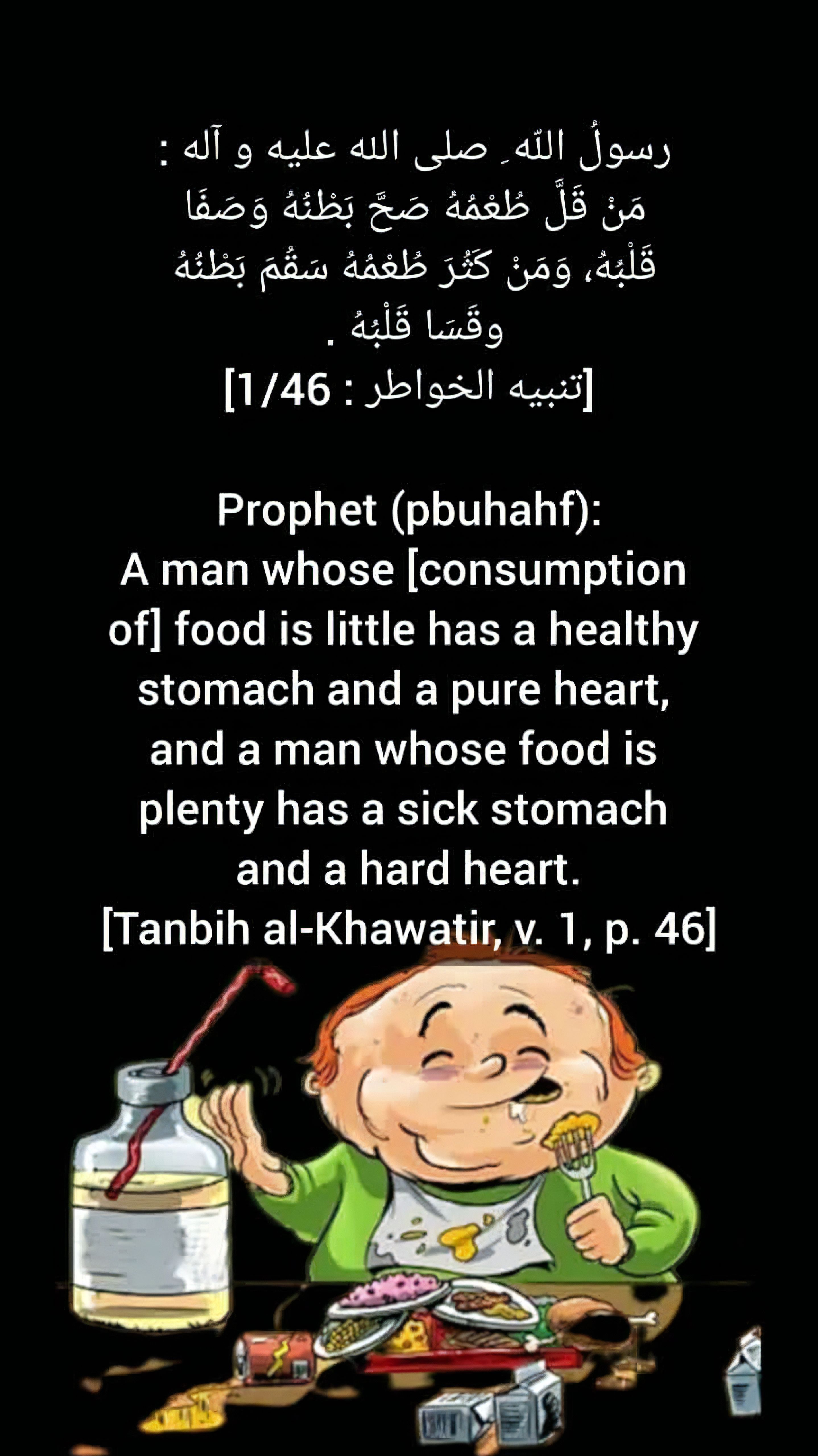
One of the most precise practical guidelines for portion control comes from the Sunnah of the Holy Prophet (PBUH) and the Imams (peace be upon him). Prophet Muhammad (peace be upon him and his family) said: "A man whose [consumption of] food is little has a healthy stomach and a pure heart, and a man whose food is plenty has a sickly stomach and a hard heart."
(Tanbih al-Khawatir, v. 1, p. 46)
Prophet Muhammad (peace be upon him and his family) said, "Man cannot fill a container worse than his stomach." (Tanbih al-Khawatir, v. 1, p. 100)
Muhammad ibn Yahya has narrated from Ahmad ibn Muhammad from ibn Sinan from Salih al-Niliy who has said the following: “Abu ’Abd Allah (peace be upon him), has said, ‘Allah, most Majestic, most Glorious, hates overeating.’ Abu ‘Abd Allah (peace be upon him), has said, ‘Children of Adam must eat to keep their backs straight. When one of you eats keep one-third of your stomach for food one-third for water and one-third for breathing and never become fat like pigs to be slaughtered.’”
(Al-Kafi (Vol. 6) by Shaykh Muhammad b. Ya qub al-Kulayni, Book 5, Chapter 21, Hadith #9)
The primary reasons and benefits behind this guideline include maintaining health (preventing overeating, which is linked to numerous diseases), avoiding overeating (Isr?f), spiritual well-being (fostering a state where one is more alert and capable of worship), and promoting moderation and balance.
While the exact measurement of one-third of the stomach's capacity is personal, the advice is to eat less and stop eating while still having an appetite. This ensures space for drinks and comfortable breathing, preventing the feeling of being overly full or heavy.
Other related advice from the Imams to complement this guideline includes only eating when hungry, stopping eating when still having an appetite, and chewing food well.
4.2 Eating When Hungry and Stopping Before Complete Satiety
Another key principle is eating only when truly hungry and stopping before reaching complete fullness. The file records multiple narrations on this point. Prophet Muhammad (peace be upon him and his family) said: "Eat when you desire and stop while you still desire." (Bihar al-Anwar, v. 62, p. 290)
4.3 Eating Only to Fulfill the Body's True Need
The file explains that the practical criterion for avoiding extravagance is eating to fulfill the body's true need, not merely out of habit or for pleasure: The purpose of eating: Eating should be for fulfilling the body's needs and maintaining capabilities, not for filling the stomach or mere pleasure.
Imam Muhammad al-Baqir (peace be upon him) said: "Whoever wants food not to harm him, let him not eat food until he is hungry and his stomach is clean; and if he eats, let him say basmalah, chew well, and stop eating food while he desires it and needs it." (Mizan al-Hikmah by Muhammad al-Rayshahri, Volume 1, Page 91)
Imam Zain-ul-Abideen (peace be upon him): "The right of your stomach is that you make it not into a container for that which is unlawful to you and you eat no more than your fill (shib')"
(Risalat al-Huquq)
The primary purpose of eating in Islam extends beyond mere physical sustenance. It is understood as a means to empower the believer for greater acts of worship and to maintain a healthy body, which is seen as an amanah (trust) from Allah (SWT). Eating is necessary for the body to function, allowing individuals to gain strength for prayer and other acts of obedience to Allah.
4.4 Choosing Halal and Tayyib Food
The Quran emphasizes the importance of consuming lawful and pure sustenance:
"O mankind, eat from whatever is on earth [that is] lawful and good and do not follow the footsteps of Satan. Indeed, he is to you a clear enemy." (Quran 2:168)
"O you who have believed, eat from the good things which We have provided for you and be grateful to God if it is [indeed] Him that you worship." (Quran 2:172)
Muslims must choose the best quality food and use lawful and pure sustenance.
The fundamental principle articulated in the Quran and Islamic teachings regarding food is that it must be both halal (permissible) and tayyib (pure, wholesome, and good). The Quran describes good food as "pure and lawful" and bad food as "impure and unlawful." This dual condition is crucial for Muslims.
1. Halal (Lawful/Permissible): Halal refers to food and drink that are permissible to consume according to Islamic law. The general principle in Islam is that everything is considered halal unless explicitly or implicitly prohibited by the Prophet (PBUH) or the Quran. Consuming lawful and pure sustenance is considered essential because it involves obeying Allah's commands and following the rules of piety. Muslims are urged to "Eat from the good things God provided for you, eat and thank Allah (SWT), if you only worship God." (Surah Al-Baqarah 2:172)
The Quran strictly prohibits certain foods, including: dead meat (carrion), blood (poured forth), the flesh of swine (pork), that over which the name of other than Allah has been invoked, and animals killed by strangling, violent blows, headlong falls, or gored to death. These prohibitions are part of a holistic approach to halal and haram, considering both physical and spiritual well-being. Islam prohibits foods that are harmful to the body, unhealthy, or unwholesome, and also those acquired through behaviors injurious to human society, such as gambling or exploitation.
It is emphasized that food must be obtained through legitimate means. The Quran warns that eating food not prepared from lawful means can lead one to "tread the path of Shait'an." Seeking lawful food through hard work is considered a fundamental aspect of worship, even a form of Jihad, and brings great rewards in the afterlife.
2. Tayyib (Pure/Wholesome/Good): Tayyib refers to food that is not only permissible but also pure, wholesome, clean, and beneficial. It encompasses the quality, cleanliness, and overall goodness of the food. Allah (SWT) created humans in "the best form" and provided them with "pure sustenance," indicating that pure sustenance is essential for maintaining moral, material, spiritual, and physical health (Quran 40:64). The Quran urges humans to "observe and think about their food and drink," highlighting Allah's blessings and inspiring gratitude.
Consuming halal and tayyib food is essential because it significantly impacts one's character (Akhlaq). Lack of adherence to this principle can lead to "bad Akhlaq, aggression, and oppression." Islamic narrations suggest that eating halal food positively affects a person's behavior and acceptance of guidance, seen as a way to express obedience to Allah and achieve a good upbringing.
Prophet Muhammad (PBUH) "enjoins them to do good and forbids them to do all that is unlawful, makes lawful for them all that is pure and unlawful all that is filthy, and removes their burdens and the entanglements in which they are involved" (Quran 7:157). This verse highlights that what is tayyib is made lawful, and what is khabith (filthy/impure) is made unlawful, indicating an inherent suitability or unsuitability of certain foods for human consumption and well-being.
4.5 The Etiquettes of Eating and Drinking
Imam Hassan (peace be upon him) enumerated twelve characteristics related to the dining table that every Muslim should know: "There are twelve qualities related to the dining table that every Muslim must know, four of them are obligatory, four are recommended practices (Sunnah), and four are etiquettes:
As for the obligatory ones, they are: recognition (of Allah (swt)), contentment, mentioning the name of Allah (swt) (Bismillah), and gratitude.
As for the recommended practices, they are: performing ablution before eating, sitting on the left side, eating with three fingers, and licking the fingers.
As for the etiquettes, they are: eating from what is directly in front of you, taking small bites, chewing well, and avoiding looking at people's faces.
(Man La Yahduruh al-Faqih, vol. 3, book 2, chapter 37, hadith 35)
Four Obligatory Characteristics (as principles):
- Recognition (of God)
- Contentment (Qana ah)
- Uttering the name of God (saying "Bismillah")
- Gratitude (Shukr)
Four Recommended Characteristics (Mustahab):
- Performing ablution (wu?u') before eating
- Sitting on the left side (leaning to the left)
- Eating with three fingers
- Licking the fingers
Four Etiquettes (Adab):
- Eating from what is in front of you
- Taking small morsels
- Chewing food well
- Not looking at the faces of others too much
The file also lists additional recommended practices:
- Washing hands before and after eating
- Saying "Bismillah" when starting to eat
- Taking small morsels and chewing food well
- Taking time while eating
- Starting and ending meals with salt
- Avoiding overeating
- Not eating very hot food
- Not blowing on food or drink
- Finishing what one has started eating
- Using the right hand for eating
5. The Consequences of Overeating and Extravagance
God’s Prophet (S) said, “Nothing is more despised by God than overeating.”
(Uyun akhbar al-Rida (Vol. 2) by Shaykh Muhammad b. Ali al-Saduq, Book 1, Chapter 1, Hadith #89)
5.1 Physical Consequences
The file documents extensive physical consequences of overeating:
1. Various Diseases and Digestive Disorders: Imam Ali (peace be upon him) said:
"Beware of the habit of overeating, for it stirs up ailments and provokes diseases."
(Ghurar al-Hikam— Volume 1, Page 169)
2. Imbalance in the Bodily System: Improper dietary habits, including overeating or consuming unhealthy foods, can cause electrical and chemical imbalances in the stomach and digestive organs.
5.2 Psychological and Spiritual Consequences
The file extensively documents the psychological and spiritual consequences of overeating:
1. Hardness of Heart and Lethargy in Worship: Prophet Muhammad (peace be upon him and his family) said: "Be warned against excessive food, for it poisons the heart with hardness, slows the limbs in performing acts of obedience, and blocks the souls from hearing counsel." (Bihar al-Anwar, v. 77, p. 182, no. 10)
Prophet Muhammad (peace be upon him and his family) said: "Beware of excessive food, for it makes the heart harden, slows the jawarih from obedience, and deafens himam from listening to admonition."
(Uddat al-Da'i wa Najah al-Sa'i by Ibn Fahd al-Hilli, Volume 0, Page 294)
Prophet Muhammad (peace be upon him and his family) said, "The light of inner knowledge is brought about by hunger whereas distance from Allah is caused by satiety. Proximity to Allah is brought about by loving the poor and drawing near to them, so do not eat to your fill lest the light of inner knowledge be extinguished from your hearts." (Bihar al-Anwar, v. 70, p. 71, no. 20)
Prophet Muhammad (peace be upon him and his family) said: "Do not let your hearts die with an abundance of food and drink, for hearts die like crops if too much water is given to them."
(Mustadrak al-Wasa'il by Mirza Husayn al-Nuri al-Tabrisi, Volume 16, Page 209)
Humayd ibn Ziyad has narrated from al-Hassan ibn Muhammad ibn Sama‘ah from Wuhayb ibn Hafs from abu Basir who has said the following: “Abu ‘Abd Allah (peace be upon him), once said to me, ‘O abu Muhammad, the stomach becomes excessive in its eating. A servant is nearest to Allah, most Majestic, most Glorious, when his stomach is empty and light. The most hated condition of a servant to Allah, most Majestic, most Glorious, is when his stomach is full.’”
(Al-Kafi (Vol. 6) by Shaykh Muhammad b. Ya qub al-Kulayni, Book 5, Chapter 21, Hadith #4)
Abu al-Hasan Imam Ali ibn Musa al-Ridha (peace be upon him) wrote to Muhammad ibn Sinan in response to his questions: "The reason for fasting is to understand the feeling of hunger and thirst, so that one becomes humble, submissive, rewarded, mindful, and patient. It serves as a reminder of the hardships of the Hereafter. Additionally, it breaks one’s desires and acts as a preacher in this world, guiding toward the Hereafter. Through fasting, one comprehends the severity of the state of the poor and destitute in this world and the Hereafter."
(Man La Yahduruh al-Faqih (Vol. 2) by Shaykh Muhammad b. Ali al-Saduq, Book 2, Chapter 1, Hadith #2)
2. Corruption of Piety (Taqwa): Imam Ali (peace be upon him) said:
"Overeating is the greatest aid to acts of disobedience." (Ghurar al-Hikam no. 9922)
Imam Ali (peace be upon him) said: "Overeating corrupts piety."
(Ghurar al-Hikam, no. 659)
3. Clouding the Light of Faith: The Holy Prophet (PBUH) warned:
"The light of inner knowledge is brought about by hunger whereas distance from Allah is caused by satiety. Proximity to Allah is brought about by loving the poor and drawing near to them, so do not eat to your fill lest the light of inner knowledge be extinguished from your hearts." (Bihar al-Anwar, v. 70, p. 71, no. 20)
4. Distance from God: Imam Sadiq (peace be upon him) said:
Humayd ibn Ziyad has narrated from al-Hassan ibn Muhammad ibn Sama‘ah from Wuhayb ibn Hafs from abu Basir who has said the following: “Abu ‘Abd Allah (peace be upon him), once said to me, ‘O abu Muhammad, the stomach becomes excessive in its eating. A servant is nearest to Allah, most Majestic, most Glorious, when his stomach is empty and light. The most hated condition of a servant to Allah, most Majestic, most Glorious, is when his stomach is full.’”
(Al-Kafi (Vol. 6) by Shaykh Muhammad b. Ya qub al-Kulayni, Book 5, Chapter 21, Hadith #4)
5. Neglect of Intellectual Nourishment:
Imam Hasan (peace be upon him): Imam Hasan (peace be upon him) said:
"I wonder about those who think about their body’s food, but do not think about their soul’s food. They keep undesirable food away from their belly, but fill up their heart with destructive subjects"
(Safinat’ul-Bihar 84, article of taste. Bihar Al-Anwar, vol 1, page 218.)
5.3 Economic and Environmental Consequences
Extravagance in food leads to the waste of financial resources, poverty, and environmental degradation.
The Quran explicitly associates extravagance with the path of Satan: "Indeed, the wasteful are brothers of the devils." (Quran 17:27)
6. The Integration of Nutrition, Health, and Spirituality
6.1 The Integration of Body and Soul
In Islamic teachings, physical health is the result of mental health, and one cannot achieve spiritual perfection without physical health. Islam promotes a balanced and integrated personality in which all dimensions of human existence are given due attention. In Islamic teachings, physical health is the result of mental health, and one cannot achieve spiritual perfection without physical health. Islam emphasizes a balanced and integrated personality in which all dimensions of human existence are given due attention.
Islam views the body and soul (Ruh) as fundamental components of human existence, with a unique, non-physical, yet intertwined relationship. The soul is considered the essence of the person, independent of the body, and it continues to exist after the body's death, which is seen as a temporary separation. The body serves as a vehicle for the manifestation of the soul in this world and a means for its actions. Islamic traditions emphasize that true spiritual vigor cannot exist without physical well-being, and physical fitness cannot be fully realized without spiritual health.
The Quran and the sayings of Islamic leaders stress the importance of balancing both physical and spiritual aspects. The body is regarded as a trust from God, requiring proper care and maintenance. As Imam Ali (peace be upon him) taught, there is a unity between the outer (physical) and inner (spiritual) sides of a person, and the physical can only truly reveal the spiritual when united with it.
Physical health is considered crucial in Islam, not as an end in itself, but as a means to achieve a healthy balance between the body and soul and to better fulfill religious obligations. Neglecting one's physical health can have spiritual implications, while taking care of the body enables a person to lead a healthy lifestyle and fulfill responsibilities towards family and society. Islamic precepts, rituals, and recommended practices are designed to achieve both spiritual and physical goals, promoting overall well-being.
Examples of the emphasis on physical health include:
- Maintenance and Prevention: Islam stresses maintaining health and preventing illness through adherence to health regulations. These include moderation in food and drink, avoiding intoxicants, practicing cleanliness, and engaging in physical activities.
- Athletics: Athletics are deemed important for perfecting the body and contributing to both spiritual and physical perfection, as a healthy body is necessary for a healthy mind.
- Prayer: Prayer is recognized not only as worship but also for its physical health benefits, providing exercise and stress reduction. Prophet Muhammad (peace be upon him and his household) stated that
Prophet Muhammad (peace be upon him and his family) said: "Ask God for good health and cure of all illness here and in the Hereafter; for if you are granted these in this world and in the next, you will be prosperous"
(Nahj Al-Fasahah)
- Seeking Healing: When prevention fails, seeking medical assistance from professionals is encouraged, alongside turning to Allah for comprehensive healing. Imam Ali (peace be upon him) advised,
"A Muslim does not seek to treat himself [with medicine] until the ailment overcomes his health." (al-Khisal, p. 620, no. 10)
Mental health is viewed as an integral part of the well-being of the soul. In Islam, a person with good mental health is one who benefits from faith and wisdom, finding peace, solace, hope, and tranquility through their relationship of trust in God, His Wisdom, and His Kindness. This profound connection with God allows them to remain steadfast despite worldly challenges, keeping their hearts enlivened and their minds active.
This emphasis a profound link between mental, emotional, and physical health. The healthiness of the body is often seen as a result of the healthiness of the mentality. Many mental and spiritual illnesses can manifest as physical diseases, underscoring the necessity of treating both body and soul for overall well-being. Emotional or mental trauma can interrupt the flow of energy, potentially leading to physical pain, illness, or disease. Conversely, spiritual practices like prayer and meditation can positively influence a person's energy system.
Despite this emphasis on balance, Islamic teachings clearly assert the primacy of the spiritual life. The soul is considered nobler than the body, and the body serves the soul. Spiritual affairs are supreme and more important than material aspects. While the body's perfection is temporary, the soul is eternal, destined for either bliss or torment in the afterlife. Therefore, true prosperity requires a balance, but with a greater emphasis on the life, health, vitality and strength of the soul.
6.2 The Concept of "Food" Beyond Physical Sustenance
From the perspective of the Ahl al-Bayt (peace be upon him), the word "?a am" (food) does not only refer to physical sustenance but also includes knowledge. Imam Baqir (peace be upon him), in interpreting the verse "Then let man look at his food" (Quran 80:24), said:
A number of our people has narrated from Ahmad ibn Muhammad ibn Khalid from his father from one he mentioned from Zayd al-Shahham from abu Ja’far (peace be upon him) who has said the following. “It is his knowledge that he acquires from whoever he acquires.” This he said in answer to the question ‘What is his food’ in the words of Allah, “Let the human being think about (how We produce) his food.” (80:24)?’
(Al-Kafi (Vol. 1) by Shaykh Muhammad b. Ya qub al-Kulayni, Book 2, Chapter 16, Hadith #8)
While the apparent meaning of Quran 80:24 and the verses that follow describes the miraculous provision of physical food (corn, grapes, olives, dates, etc.) from the earth through rain, the Ahl al-Bayt provide a deeper, spiritual interpretation. They explain that "food" in this context also refers to the knowledge and wisdom that nourishes the soul, crucial for spiritual growth and development.
This understanding is rooted in narrations from the Infallible Imams. Imam al-Baqir (peace be upon him)'s Interpretation: Zayd al-Shahham narrated that he asked Imam Muhammad al-Baqir (peace be upon him) about the meaning of "his food" in the verse "Then let man look at his food" (Quran 80:24). The Imam (peace be upon him) responded, "His knowledge which he is taking, from who he is taking it." Imam al-Baqir (peace be upon him) emphasized that this "food" is the knowledge one acquires and from whom one acquires it, implying that the soul, just like the body, requires its own sustenance. He also stated that this refers to man's knowledge, which he should seek from the Ahl al-Bayt, because the revelation came down in their houses, and seeking knowledge from other sources would be incomplete and weak.
The repeated emphasis on "from whom he acquires it" highlights a crucial aspect of this spiritual interpretation: the discernment of the source of knowledge. Just as one must be careful about the purity and lawfulness of physical food to maintain bodily health, one must be equally, if not more, vigilant about the purity and trustworthiness of the source of spiritual knowledge. The Imams of the Ahl al-Bayt are presented as the true and reliable fountains of spiritual nourishment.
The interpretations by the Ahl al-Bayt draw a powerful analogy between the body's need for physical sustenance and the soul's need for spiritual nourishment. While the body relies on grains, fruits, and other provisions from the earth, the soul thrives on knowledge, wisdom, and guidance. Imam Hasan (peace be upon him) eloquently expressed this, stating: "I wonder about those who think about their body's food, but do not think about their soul's food. They keep undesirable food away from their belly, but fill up their heart with destructive subjects."
6.3 The Impact of Nutrition on Mental and Intellectual Health
The file documents the connection between nutrition and mental health:
- Reduced Food Intake and Purification of Thoughts: Imam Ali (peace be upon him) stated that eating less can purify thoughts, and constant satiety prevents the purification of thoughts.
Imam Ali (peace be upon him): Imam Ali (peace be upon him) said, ‘Whoever eats less, their thought will be more purified.’ (Ghurar al-Hikam, no. 8462)
- Heaviness of Food and Intelligence: Imam Ali (peace be upon him) stated that the heaviness of food in the stomach has a negative effect on human intelligence.
Imam Ali (peace be upon him) said:
"How can one’s thought be purified if they are constantly full."
(Ghurar al-Hikam, no. 6975)
- Effect of Specific Foods on Cognitive Abilities: The file notes that certain foods like gourd (pumpkin), celery, frankincense, chickpeas, and rue are considered beneficial for increasing intelligence and cognitive abilities.
6.4 The Relationship Between Nutrition and Spiritual State
The file explains that the spiritual and emotional state of an individual can affect how the body benefits from food. Even if food is healthy, it may not be beneficial in states of emotional distress, grief, or fear. Prophet Muhammad (peace be upon him and his family) said:
"The heart bears wisdom when the stomach is empty, and the heart throws out wisdom when the stomach is full." (Tanbih al-Khawatir, v. 2, p. 119)
7. Social Responsibility and Environmental Protection
7.1 Human Responsibility as God's Vicegerent (Khalifah)
The Quran introduces humans as God's "vicegerent" (Khalifah) on earth, which means having the responsibility of "responsible guardianship" over creation, not absolute sovereignty. The Holy Quran introduces humans as God's 'vicegerent' (Khalifah) on earth, which means having the responsibility of 'responsible guardianship' over creation, not absolute sovereignty.
The Quran states that Allah made human beings a khalifah (representative or steward) on Earth (Quran 2:30). This is understood to mean that humans have the responsibility to be responsible caretakers over creation, not overlords. While humans may consume plants and animals and utilize the treasures of the earth and the sea, this must not be done wastefully or wantonly. This role extends to Adam and his offspring, making them responsible for guarding and preserving the Earth. The concept of "building the earth" also refers to this responsibility to preserve and care for the natural world, preparing the way for salvation.
7.2 Responsible Management of Natural Resources
Water: Even for resources that appear abundant, such as water, the principle of avoiding extravagance applies.
Energy: Consuming more than necessary is an instance of extravagance and includes the consumption of energy.
Imam Ali (peace be upon him): Imam Ali (peace be upon him) said, "The believer looks at the world with contemplative consideration, and only consumes thereof within the bounds of necessity." (Nahjul Balaghah, Saying 267)
7.3 Avoiding Environmental Destruction and Corruption on Earth
The Quran explicitly prohibits "corruption on earth":
"And do not commit corruption on the earth after its reformation." (Quran 7:56)
"And do not seek corruption in the land. Indeed, God does not like corrupters."
(Quran 28:77)
"Corruption has appeared throughout the land and sea by reason of what the hands of people have earned." (Quran 30:41)
The Quran strongly discourages corruption or mischief (fasad) in the environment. It warns that Allah does not like corruption and highlights the importance of responsible stewardship of the natural world. This stance is rooted in the understanding that the natural universe is aware and part of a whole, praising Allah, rather than a mere dead resource to be exploited without limit.
Several Quranic verses directly address this: "And do not commit abuse on the earth, spreading corruption" (Quran, 2:60); "And do not desire corruption in the land. Indeed, God does not like corruptors" (Quran 28:77); and "Corruption has appeared on the sea and land due to what has transpired by the hands of men, so He may let them taste part of [the consequence of] what they have done that perhaps they will return [to righteousness]" (Quran 30:41).
In these verses, fasad (corruption) is understood to include environmental destruction. Specific acts considered forms of corruption on Earth, according to the Quran, include cutting down trees, destroying agriculture, and polluting and destroying water, which carry "a very painful punishment."
The Quran explicitly warns against wasting resources, condemning those who do so. Allah states that He "does not like the wasteful" (Quran 7:31) and refers to squanderers as "the brothers of the Satans" (Quran 17:27). This is a very strong statement, implying that wasteful overconsumption is a form of evil or delusion.
The Quran contains several key principles related to environmental preservation: purposefulness of the environment (serving as a sign of Allah's power and wisdom); balance of the environment (inherent harmony and balance established by God); aesthetics of the environment (beauty of nature highlighted); biodiversity (existence of various living creatures and plants); and mastering the environment for human benefit (with responsibility).
Prophetic traditions (Hadith) offer valuable insights into environmental ethics, emphasizing conservation, responsible use of resources, and compassion for all living beings. Imam As-Sadiq (peace be upon him) encouraged cultivation and planting trees, stating: "Cultivate and plant trees. By God, people have not done any action more lawful and purer than this." Hazrat Mohammad (SAWW) advised seeking sustenance from the earth: "Seek for your sustenance in the depths of the Earth." Imam al-Sadiq (peace be upon him) explicitly warned:
"Do not cut down fruit trees for Allah will pour down punishment unto you."
(al-Kafi, v. 5, p. 264, no. 9)
8. Conclusion
8.1 Summary of Findings
The comprehensive analysis of verse 31 of Surah Al-A'raf and its related teachings reveals several important conclusions:
The Principle of Moderation: The verse establishes a balanced approach to eating and drinking, combining the enjoyment of lawful blessings with the essential condition of avoiding extravagance.
The Comprehensive Nature of Israf: Extravagance extends beyond quantitative excess to include harmful overeating, wasting resources, transgressing from lawful to unlawful, and excessive indulgence in luxury.
The Philosophical Basis: The prohibition of extravagance is rooted in its contradiction with gratitude, its harmful effects on physical and mental health, its contribution to social injustice, and its incompatibility with the spirit of servitude.
Practical Criteria for Moderation: The traditions provide clear practical guidelines, including the division of the stomach into three parts and the practice of eating when hungry and stopping before complete satiety.
The Integration of Health and Spirituality: The teachings demonstrate that physical health and spiritual excellence are inextricably linked, with nutrition directly affecting mental, emotional, and spiritual well-being.
Social and Environmental Responsibility: The principles of avoiding extravagance extend to responsible management of natural resources and protection of the environment.
8.2 Practical Recommendations
Based on the teachings examined, the following practical recommendations emerge:
Moderation in Consumption: Eat only when hungry and stop before complete fullness; allocate one-third of the stomach for food, one-third for water, and one-third for breathing.
Avoiding Extravagance: Do not consume more than necessary; avoid throwing away usable food; in gatherings, prepare only as much food as is needed.
Choosing Halal and Tayyib Food: Ensure the source of food is lawful and legitimate; use healthy and nutritious foods; avoid consuming harmful foods.
Gratitude: Consider food as a divine blessing; say "Bismill?h" before starting to eat and "Alhamdulill?h" after finishing.
Observing the Etiquettes of Eating: Wash hands before and after eating; take small morsels and chew food well; use the right hand for eating.
Paying Attention to Intellectual Nourishment: Just as one pays attention to physical nourishment, one should pay attention to the nourishment of the soul and intellect by carefully choosing sources of knowledge.
Environmental Protection: Through responsible consumption and avoiding extravagance, preserve natural resources; prevent the waste of water and energy.
9. References
Quranic References
Surah Al-A'raf (7:31) - "O children of Adam! attend to your embellishments at every time of prayer, and eat and drink and be not extravagant; surely He does not love the extravagant."
Surah Al-A'raf (7:56) - "And do not commit corruption on the earth after its reformation."
Surah Al-A'raf (7:81) - "Most surely you come to males in lust besides females; nay, you are an extravagant people."
Surah Al-Baqarah (2:168) - "O mankind, eat from whatever is on earth [that is] lawful and good and do not follow the footsteps of Satan. Indeed, he is to you a clear enemy."
Surah Al-Baqarah (2:172) - "O you who have believed, eat from the good things which We have provided for you and be grateful to God if it is [indeed] Him that you worship."
Surah Al-Baqarah (2:219) - "They ask you what they should spend. Say: 'What is surplus.'"
Surah Al-Furqan (25:67) - "And those who, when they spend, are neither extravagant nor miserly, but keep to a balance between those extremes."
Surah Al-Isra (17:27-28) - "And give to the near of kin his due and to the needy and the wayfarer, and do not squander wastefully. Surely the squanderers are the fellows of the Shaitans and the Shaitan is ever ungrateful to his Lord."
Surah Al-Ma'idah (5:87) - "O' you who have Faith! Do not prohibit the good things that Allah has made lawful to you, and do not transgress. Verily Allah does not like the transgressors."
Surah Al-An'am (6:141) - "God does not love the extravagant ones."
Surah Ta Ha (20:127) - "And thus do We recompense him who is extravagant and does not believe in the communications of his Lord; and certainly the chastisement of the Hereafter is severer and more lasting."
Surah Yunus (10:83) - "And indeed, Pharaoh was haughty within the land, and indeed, he was of the transgressors."
Surah Al-Qasas (28:38) - "O eminent ones, I have not known you to have a god other than me."
Surah Al-Qasas (28:77) - "And do not seek corruption in the land. Indeed, God does not like corrupters."
Surah Ar-Rum (30:41) - "Corruption has appeared throughout the land and sea by reason of what the hands of people have earned."
Surah 'Abasa (80:24) - "Then let man look at his food."
Other Islamic References
Primary Hadith Collections
Al-Kafi by Shaykh Muhammad b. Ya'qub al-Kulayni
Volume 1, Book 2, Chapter 16, Hadith #8
Volume 4, Page 52, Page 55
Volume 5, p. 264, no. 9
Volume 6, Book 5, Chapter 21, Hadith #4, #9
Volume 8, p. 273, no. 409
Man La Yahduruh al-Faqih by Shaykh Muhammad b. Ali al-Saduq
Book 1, Chapter 8, Hadith #70
Book 1, Chapter 9, Hadith #79
Book 1, Chapter 17, Hadith #2
Book 2, Chapter 1, Hadith #2, #59, #94
Book 2, Chapter 37, Hadith #35
Book 5, Chapter 55, Hadith #1
Wasa'il al-Shia
Volume 1, Section 8, Chapter 31, Hadith #1164, #1167
Volume 1, Section 8, Chapter 52, Hadith #1283
Volume 5, Section 1, Chapter 28, Hadith #5875, #5880
Volume 9, Section 5, Chapter 16, Hadith #11843
Volume 15, Section 2, Chapter 44, Hadith #20618
Volume 17, Section 1, Chapter 22, Hadith #21992
Volume 21, Section 7, Chapter 25, Hadith #27848
Volume 21, Section 7, Chapter 26, Hadith #27857
Volume 21, Section 7, Chapter 27, Hadith #27859, #27862
Bihar al-Anwar
Volume 62, p. 290
Volume 69, p. 407, no. 115
Volume 70, p. 71, no. 20; p. 115
Volume 72, p. 192, no. 9
Volume 75, p. 303, no. 6
Volume 77, p. 165, no. 2; p. 172, no. 8; p. 182, no. 10
Volume 78, p. 327
Volume 81, p. 211, no. 30
Volume 82, p. 114
Other Hadith Collections and Works
Al-Khisal by Shaykh Muhammad b. Ali al-Saduq
p. 620, no. 10
Al-Mustadrak al-Wasa'il by Mirza Husayn al-Nuri al-Tabrisi
Volume 16, p. 209, p. 222, no. 19652
Tafsir al-'Ayyashi
Volume 2, p. 288, no. 53
Nahj al-Balagha by al-Sharif al-Radi
Book 3, Chapter 171, Hadith #216
Letter 31
Saying 70, Saying 267
Ghurar al-Hikam
no. 659, no. 819, no. 890, no. 930, no. 1694
no. 3964, no. 8462, no. 8903, no. 9922
Volume 1, Page 169
Makarim al-Akhlaq
Volume 2, p. 180, no. 2468
Tanbih al-Khawatir
Volume 1, p. 46, p. 100
Volume 2, p. 119
Tuhaf al-'Uqul
no. 22
Kanz al-'Ummal
no. 7366
Uyun al-Hikam wa al-Mawa'iz by Ali bin Muhammad al-Laythi al-Wasiti
Volume 0, Page 372
Uyun akhbar al-Rida by Shaykh Muhammad b. Ali al-Saduq
Volume 2, Book 1, Chapter 1, Hadith #89
Uddat al-Da'i wa Najah al-Sa'i by Ibn Fahd al-Hilli
Volume 0, Page 294
Mizan al-Hikmah by Muhammad al-Rayshahri
Volume 1, Page 91
Nahj Al-Fasahah
Safinat'ul-Bihar
Page 84
Risalat al-Huquq by Imam Zain-ul-Abideen (peace be upon him)
Quranic verses and hadiths of Ahl al-Bayt (peace be upon them) and sayings in Arabic, Persian and English.
https://eitaa.com/noorunalanoor
https://www.youtube.com/@110Inspire
https://youtube.com/@mustafaabbas4668?si=EnSIkaIECMiOmarE
https://youtube.com/@mustafaabbas8978?si=EMJylUW9_zruJx95