KhanwadeAbuTalib.com
Posted by Mustafa Abbas on September 12, 2026 | Views: 9 | Ratings: 1
Download article from link below at the end
Hospitality in Islamic Teaching
Introduction
The Islamic teaching, "The guest arrives bringing his own sustenance and leaves taking away the sins of his hosts," encapsulates a profound spiritual dimension of hospitality in Islam. This teaching, found in various traditions from the Holy Prophet Muhammad (peace be upon him and his family) and the Imams of the Ahl al-Bayt (peace be upon them), highlights the blessings and forgiveness that accompany the act of hosting. "The guest descends with his sustenance and departs with the sins of the people of the house" (Bihar al-Anwar, v. 75, p. 461, no. 14).
The Guest Brings Sustenance
The first part of this teaching, "The guest arrives bringing his own sustenance," means that the guest's presence is not a financial burden on the host. Rather, their sustenance (rizq) is divinely provided and accompanies them. This concept is reiterated in several narrations:
- The Holy Prophet Muhammad (peace be upon him and his family) stated, "The guest arrives bringing his own sustenance..."
- He also taught that "no guest stays with a people except that his provision comes with him."
- Another tradition emphasizes that
Prophet Muhammad (peace be upon him and his family) said: "A guest carrys his own sustenance, removes the host's sins and causes them to vanish"
(Nahj al Fasahah; Tradition No. 72; Page No. 18)
Prophet Muhammad (peace be upon him and his family) also said:
"When God wills happiness and prosperity for a nation, he will bestow on them a gift. They asked: ‘what is that gift’. He replied: a ‘guest’"
(Bihar al-Anwar, volume 15, page 241. Jami' Al-Akhbar, page 136.)
Imam Jafar al-Sadiq (peace be upon him) said that Messenger of Allah said, ‘There is no guest who comes to a people without his sustenance in his lap.’”
(Al-Kafi (Vol. 6) by Shaykh Muhammad b. Ya qub al-Kulayni, Book 5, Chapter 38, Hadith #3)
- Imam Jafar al-Sadiq (peace be upon him) said further clarified,
Ali ibn Ibrahim has narrated from his father from al-Hassan ibn al-Husayn al-Farsiy from Sulayman ibn Hafs ibn al-Basriy who has said the following: “Abu ‘ Abd Allah (peace be upon him), has stated this Hadith.
‘Messenger of Allah, O Allah, grant compensation to Muhammad and his family worthy of their services to Your cause, has said, “When a guest comes and disembarks with a people, he comes with his sustenance from the sky. When he eats Allah forgives them because of his staying with them”
"When a guest comes and disembarks with a people, he comes with his sustenance from the sky. When he eats Allah forgives them because of his staying with them" (Al-Kafi, Volume 6, Book 5, Chapter 38, Hadith #1).
- Imam al-Kazim (peace be upon him) mentioned,
"Help descends on a people proportionate to their needs. A guest comes to a people but he comes with his sustenance in his lap.’”
(Al-Kafi (Vol. 6) by Shaykh Muhammad b. Ya qub al-Kulayni, Book 5, Chapter 38, Hadith #2)
This implies that the food and provisions consumed by the guest are not from the host's original allocated sustenance, but rather, a separate, divinely ordained portion that arrives with the guest. The host should therefore not fear scarcity or financial strain due to hosting, as Allah (SWT) provides for the guest through His grace, and the host becomes a means for this provision. This belief encourages generosity and removes any hesitation a host might have due to limited resources. It signifies a divine blessing that accompanies the guest, ensuring that their needs are met without imposing undue hardship on the host.
The Guest Departs with Sins
The second part of the teaching, "and leaves taking away the sins of his hosts," highlights the immense spiritual benefit for the host. The presence and departure of a guest are viewed as a means of atonement and forgiveness for the host's sins and those of their household. This aspect is profoundly emphasized:
- The Holy Prophet Muhammad (peace be upon him and his family) said, "The guest arrives bringing his own sustenance and leaves taking away the sins of his hosts."
- Another narration from the Prophet (peace be upon him and his family) states, "A guest carries his/her own sustenance, removes the host's sins and cause them to vanish."
- He also said that "When a guest comes upon a people, s(he) is accompanied by his own sustenance, and when he leaves them, he is a company to (God's) forgiveness for them."
This signifies that the guest acts as a conduit for divine mercy. Their presence in the home and their subsequent departure are occasions during which Allah (SWT) overlooks the shortcomings of the host and their family, granting them forgiveness. The act of honoring a guest, showing kindness, and providing for their needs is so beloved by Allah that it cleanses the host from their transgressions. The guests' virtue upon the host is considered greater than the host's virtue upon them because they bring this spiritual purification.
Overall Significance
This teaching collectively elevates hospitality from a mere social custom to a highly significant act of worship that brings both material blessings (sustenance) and spiritual purification (forgiveness of sins). It underscores the importance of treating guests with profound respect and generosity, viewing them not as a burden, but as a divine gift and a source of blessings for the household. It encourages believers to welcome guests with an open heart, trusting in Allah's provision and seeking His forgiveness through this virtuous deed.
The Spiritual Philosophy of Hospitality
The hadith reveals a rich spiritual philosophy underlying hospitality in Islam:
Divine Gift and Blessing: Guests are considered a "gift from God," a valuable and honorable blessing. When Allah (SWT) desires happiness and prosperity for a community, He sends guests to them, signifying spiritual growth and divine favor.
Prophet Muhammad (peace be upon him and his family) said:
"When God wills happiness and prosperity for a nation, he will bestow on them a gift. They asked: ‘what is that gift’. He replied: a ‘guest’"
(Bihar al-Anwar, volume 15, page 241. Jami' Al-Akhbar, page 136.)
Proximity to Allah and Reward: Serving guests is a direct means of earning immense reward and achieving closeness to Allah (SWT). Guests are considered "beloved of God." Entertaining them is a fundamental aspect of faith, bringing virtues and forgiveness. The spiritual reward for hosting guests is immense, compared to great acts of worship like reciting holy scriptures or praying with congregation.
Mercy and Protection: The act of hospitality is believed to please Allah (SWT), ease affairs, attract divine mercy and favor, and even cast away catastrophes from the family members. Hospitality has been a way of the Prophets and the Imams, and is an example of divine and righteous men.
Guest as Host's Guest: Islam emphasizes that the guest brings their own daily bread, and spiritually, the host becomes the guest of their guests, implying a reciprocal divine blessing.
Imam Mohammad Baqir (peace be upon him) said:
“Messenger of Allah has said, ‘If one visits his brother (in belief) in his house, Allah, the Most Majestic, the Most Holy, will say, ‘You are My guest and My visitor, your service is on Me and I, for your loving him, have made paradise obligatory for you.”’
(Al-Kafi (Vol. 2) by Shaykh Muhammad b. Ya qub al-Kulayni, Book 1, Chapter 77, Hadith #6)
Hospitality as a Fundamental Virtue
Hospitality is deeply ingrained in Islamic teachings and is highlighted by numerous prophetic traditions and the examples of the Ahl al-Bayt (peace be upon them). Honoring guests is considered a vital aspect of faith.
Imam Mohammad Baqir (peace be upon him) said:
Ali ibn Ibrahim has narrated from his father from Ibn Abi ‘Umayr from Ishaq ibn ‘Abd al-’Aziz from Zurarah who has said the following: “Abu Ja‘far (peace be upon him), has said, ‘Of the matters that Messenger of Allah, O Allah, grant compensation to Muhammad and his family worthy of their services to Your cause, taught to Ali (peace be upon him), was his saying, “Whoever believes in Allah and in the Day of Judgment, he must honor his guest.’””
(Al-Kafi (Vol. 6) by Shaykh Muhammad b. Ya qub al-Kulayni, Book 5, Chapter 39, Hadith #2)
Prophet Muhammad (peace be upon him and his family) said:
"He who has faith in Allah and the Last Day must honour his guest."
(Jami’a al-Akhbar, p. 377, no. 1053)
A Sign of Faith
Honoring guests is directly linked to one's belief in Allah and the Last Day. Messenger of Allah (peace be upon him and his family) stated, "He who has faith in Allah and the Last Day must honour his guest." This teaching was consistently imparted by the Prophet to his household. Abu Ja'far (peace be upon him) related that among the matters Messenger of Allah (peace be upon him and his family) taught Ali (peace be upon him) was his saying, "Whoever believes in Allah and in the Day of Judgment, he must honor his guest.
Imam Jafar al-Sadiq (peace be upon him) said
Muhammad ibn Yahya has narrated from Ahmad ibn Muhammad ibn ‘Isa from ‘Umar ibn ‘Abd al-’Aziz from Ishaq ibn ‘Abd al-’Aziz and Jamil and Zurarah who have said the following: “Abu ‘Abd Allah (peace be upon him), has stated this Hadith. ‘Of the matters that Messenger of Allah, O Allah, grant compensation to Muhammad and his family worthy of their services to Your cause, taught to Fatimah, ‘Alayha al-Salam, was his saying, “O Fatimah, whoever believes in Allah and in the Day of Judgment, he must honor his guest.’””
"Al-Kafi (Vol. 6) by Shaykh Muhammad b. Ya qub al-Kulayni, Book 5, Chapter 39, Hadith #1"
This underscores hospitality as a practical manifestation of faith.
Beloved of God
A guest is considered a "beloved of God," and serving them is a means of earning divine reward and achieving closeness to Allah. Disliking a guest is equated to disliking Allah, and Allah dislikes those who hate guests. Only a pious Momin (believer) entertains guests, suggesting it is a characteristic of piety. When Allah wishes to bless a community, He sends guests to them as a gift.
Prophetic and Imam's Tradition
Hospitality has been the consistent practice of the Prophets and the Imams (peace be upon them), serving as an exemplary tradition for divine and righteous individuals. The Ahl al-Bayt (peace be upon them) are noted for their exceptional hospitality. Imam Ali (peace be upon him) considered it among the three things most dear to him, even weeping if he did not have a guest for several days. Imam al-Sadiq (peace be upon him) was known for personally welcoming and serving guests, offering the best food, and stating that
Muhammad ibn Yahya Ahmad ibn Muhammad from af-Hassan ibn Mahbub from Yunus ibn Ya‘qub from ‘Isa ibn abu Mansur who has said the following: “I once was having food with abu ‘Abd Allah (peace be upon him), and he (the Imam) kept placing Kabab before me. He (the Imam) then said, ’O ‘Isa, it is said that if you like to find out how much one loves his brother (in belief), see how much he eats from the food of his brother.’”
(Al-Kafi (Vol. 6) by Shaykh Muhammad b. Ya qub al-Kulayni, Book 5, Chapter 32, Hadith #3)
Imam Hasan and Imam Husayn also exemplified going above and beyond to make guests feel welcome.
Universal Respect
Islamic teachings extend the virtue of hospitality to all, regardless of their belief. The Holy Prophet (peace be upon him and his family) said,
"No one should go to troubles that they cannot afford for a guest."
(Kanz al-’Ummal, no. 25876)
Furthermore, when a person enters a town, they are considered a guest of their co-religionists in that town until their departure.
It is narrated by al-Fudhayl ibn Yasar from Abu Ja’far (as) that Messenger of Allah (swt) (peace be upon him and his family) said: When a man enters a town, he is a guest of those among its people who share his faith until he departs. It is not appropriate for the guest to fast without their permission so that they do not prepare something and it goes to waste. Nor is it appropriate for them to fast without the guest's permission so that he does not feel constrained and refrain from what he desires for their sake.
(Man La Yahduruh al-Faqih (Vol. 2) by Shaykh Muhammad b. Ali al-Saduq, Book 2, Chapter 31, Hadith #1)
Part of Nobility and Good Manners
Honoring guests is regarded as an important aspect of Islamic good manners and is among the "ten characters that make up nobility."
Imam Jafar al-Sadiq (peace be upon him) said:
He said: Abul Qasim Ja’far ibn Muhammad ibn Qawlawyh - may Allah bless him with mercy, reported to me from ‘Ali ibn al-Husayn ibn Musa ibn Babawayh, who reported from ‘Ali ibn Ibrahim ibn Hashim, from Ahmed ibn Muhammad ibn Isa, from al-Haytham ibn Abi Masrooq al-Nahdi, from Yazid ibn Ishaq, from al-Husayn ibn Atiyyah, that: Abu Abdillah Ja’far ibn Muhammad, peace be upon him, said: "Nobility and virtue has ten characteristics and if you can acquire them, do your best. For a man may have them and his son may not. Or a son may have them, while the father may not. A slave may have them, while a free man may not." They asked: "What are those traits, O son of Messenger of Allah?" He said: "Truthful speech, faith at the time of hardship and peril, honesty and trustworthiness, mending relations with the consanguinal kith and kin, hospitality, feeding the beggar, to be rewarding and grateful for a good turn, to protect the neighbour, to protect the friend and above all, to be bashful and modest."
(Al-Amali by Shaykh Muhammad b. Muhammad al-Mufid, Book 26, Chapter 4, Hadith #4)
From Al-Hassan bin Atiyyah, from Abu Abdullah (peace be upon him) who said: Noble characteristics are ten, so if you can have them in yourself then have them, for they may be in a man but not in his child, and may be in a child but not in his father, and may be in a slave but not in a free person: truthfulness with people, truthful tongue, fulfilling trusts, maintaining family ties, hosting guests, feeding the beggar, reciprocating favors, protecting neighbors, protecting companions, and the head of them all is modesty.
(Wasa'il al-Shia Vol. 15, Section 2, Chapter 4, Hadith 20230)
Prophet Muhammad (peace be upon him and his family) said:
"Invite one whom you love in the way of Allah to partake of your food as a guest."
(Kanz al-’Ummal, no. 25881)
Not inviting guests is viewed negatively;
Imam Mohammad Baqir (peace be upon him) said:
From Asim bin Hamid, from Abu Hamza, from Abu [Peace be upon him], he said: I said to him: May I be sacrificed for you, what do you say about a Muslim who comes to another Muslim at his house, seeks permission to enter, but is neither given permission nor does the host come out to him? He said: O Abu Hamza, whichever Muslim visits another Muslim or seeks a need while he is at his home, asks permission but is neither given permission nor does the host come out to him, will remain in Allah's curse until they meet. I said: May I be sacrificed for you, in Allah's curse until they meet? He said: Yes.
(Wasa'il al-Shia Vol. 12, Section 1, Chapter 130, Hadith 16161)
Imam Jafar al-Sadiq (peace be upon him) said
"If your brother comes to your house [uninvited] then offer him whatever you have in the house, and if you invite him, then make a special effort for him."
(al-Mahasin, v. 2, p. 179, no. 1506)
Benefits for the Host
Engaging in hospitality brings numerous spiritual and worldly advantages to the host:
Forgiveness and Virtue
Guests are believed to bring divine forgiveness and cleanse the host's household from sins. According to a hadith from Abu Abdullah (peace be upon him), "When guests enter your home, they enter with forgiveness for you and your family, and when they leave, they leave with your sins and the sins of your family." This implies that "the guests' virtue upon you is greater than your virtue upon them." Another tradition states, "The guest arrives bringing his own sustenance and leaves taking away the sins of his hosts."
Divine Mercy and Favor
Practicing hospitality attracts Allah's mercy and favor, eases the host's affairs, and can ward off catastrophes.
Spiritual Reward and Provision
Allah (SWT) promises to increase the provision of those who welcome and feed guests and to reward them on the Day of Resurrection. The Prophet (peace be upon him and his family) taught that "no guest stays with a people except that his provision comes with him."
Paradise Becomes Obligatory
A person who honors guests for him paradise becomes obligatory.
Imam Mohammad Baqir (peace be upon him) said:
It is narrated from him (narrator of the Hadith above) from Ali ibn al-Hakam from Sayf ibn ‘Amirah from Jabir from abu Ja’far (peace be upon him) who has said the following: “Messenger of Allah has said, ‘If one visits his brother (in belief) in his house, Allah, the Most Majestic, the Most Holy, will say, ‘You are My guest and My visitor, your service is on Me and I, for your loving him, have made paradise obligatory for you.”’
(Al-Kafi (Vol. 2) by Shaykh Muhammad b. Ya qub al-Kulayni, Book 1, Chapter 77, Hadith #6)
Cultivating Generosity
Hospitality cultivates generosity, considered the greatest moral virtue and a means of nearness to Allah. By receiving guests, a person enhances sociability, expands friendships, sacrifices financially, shares wealth, and honors others—all qualities desired by Islam.
Proper Manners and Etiquette in Hospitality
Islamic teachings provide comprehensive guidance on how to practice hospitality respectfully and effectively, outlining responsibilities for both the host and the guest.
Host's Responsibilities
Commander of the Guest: The host is considered the "commander of the guest until they leave the house," signifying a deep sense of responsibility for the guest's well-being and comfort.
Imam Jafar al-Sadiq (peace be upon him) said
Ali ibn Ibrahim has narrated from his father from al-Nawfali from al-Sakuni from Abu ‘Abdillah (peace be upon him) who has said the following: “Messenger of Allah has said, ‘It is of the rights of a newcomer on the people of the house to gently escort him when entering and leaving.’ The Imam said that Messenger of Allah has said, ‘When anyone enters the house of his brother (in belief), the host then is his commander until he leaves.’”
(Al-Kafi (Vol. 2) by Shaykh Muhammad b. Ya qub al-Kulayni, Book 4, Chapter 18, Hadith #1)
It is improper to make a guest work; instead, the host should care for their needs.
Narration from Imam Jafar al-Sadiq (peace be upon him)
"I saw a guest once at Abi ‘Aabdillah’s [i.e. Imam al-Sadiq (peace be upon him)] house, who stood up to get something he needed, so Imam refused for him to do so, and stood up to get it himself, saying, ‘The Prophet of Allah (S) prohibited that a guest be allowed to do work." (al-Kafi, v. 6, p. 283, no. 1)
Al-Husayn from Muhammad has narrated from al-Sayyariy from ‘Ubayd ibn abu ‘Abd Allah al-Baghdadiy from those who narrated to him who has said the following: “Once abu al-Hassan, al-Rida’ ‘Alayhi al-Salam, had a guest who was sitting with him (the Imam) and speaking during the night. The lamp began to become dim and the man stretched his hand to repair it. Abu al-Hassan, stopped him seriously and he (the Imam) himself repaired the lamp saying, ‘We are a people who do not make the guests work.’”
(Al-Kafi (Vol. 6) by Shaykh Muhammad b. Ya qub al-Kulayni, Book 5, Chapter 37, Hadith #2)
Muhammad ibn Yahya has narrated from Ahmad ibn Musa from Dhubyan ibn Hakim from Musa al-Numayriy from ibn abu Ya‘fur who has said the following: “I once saw a guest with abu ‘ Abd Allah (peace be upon him), who stood up one day to work for him (the Imam). He (the Imam) prohibited him. He (the Imam) himself stood up to do that work. He (the Imam) (peace be upon him), said, Messenger of Allah, O Allah, grant compensation to Muhammad and his family worthy of their services to Your cause, prohibited making the guest to work. ”
(Al-Kafi (Vol. 6) by Shaykh Muhammad b. Ya qub al-Kulayni, Book 5, Chapter 37, Hadith #1)
Warm Welcome and Respect: Guests should be welcomed warmly, shown great attention, and made to feel comfortable and happy, without feeling like a burden. This includes making them feel at ease and not imposing anything difficult on them.
Provision with What is Available: Hosts are encouraged to provide whatever food and drink are available, even if resources are limited or circumstances are difficult. Imam Jafar al-Sadiq (peace be upon him) said
Muhammad ibn Yahya has narrated from Ahmad ibn Muhammad ibn ‘Isa from a number of our people who have narrated in a marfu‘ manner the following: “Abu ‘Abd Allah (peace be upon him), has said, ‘When your brother (in belief) comes to your house, offer him food, if he did not want, then offer him water and if he did not want water offer him wudu (to wash his face or perfume).’”
(Al-Kafi (Vol. 6) by Shaykh Muhammad b. Ya qub al-Kulayni, Book 5, Chapter 29, Hadith #2)
Family Involvement: All members of the household—husband, wife, and children—should treat guests warmly, avoiding laziness or jealousy. Imam Ali (peace be upon him) demonstrated respect for a guest and his family by helping the guest wash his hands, then ordering his son to help the guest's son, illustrating the distinction and honor.
Pure Intention and Veneration (Ikram): The primary goal when inviting guests should be to please Allah (SWT) (Kurbatan Ilallah), not to impress. Veneration (ikram) is crucial, meaning to struggle to show respect and honor, manifested in the intention, invitation method, banquet, serving, and location. The Prophet (peace be upon him and his family) also said that
"Whoever wants to be loved by Allah and His Prophet should eat with his guest."
(Tanbih al-Khawatir, v. 2, p. 116)
Meal Etiquette: The host should drink first among the people and perform ablution (wash hands) last among them. They should also start eating first and finish last, so that no guest may remain hungry.
Accompanying Guests: When receiving or seeing off a guest, the host should walk a little with them at the time of their arrival and departure, escorting them from their sanctuary to the door.
Imam Ali al-Rida (peace be upon him) said:
From Darim bin Qabisah and Nu'aim bin Salih together, from Al-Ridha, from his forefathers that the Messenger of Allah (peace be upon him and his family) said: Among the rights of a guest is that you walk with him and escort him from your sanctuary to the door. (Wasa'il al-Shia Vol. 12, Section 1, Chapter 128, Hadith 16154)
Not Hastening Departure: The Ahl al-Bayt (peace be upon them) tradition indicates they "do not assist our guests to leave us," meaning they do not hasten their departure.
Imam Jafar al-Sadiq (peace be upon him) said
From Hammad ibn Isa, from Hariz ibn Abdullah or someone else who said: Some people from Juhayna stayed as guests with Abu Abdullah (peace be upon him). He hosted them, and when they wanted to depart, he provided them provisions, gave them gifts, and bestowed upon them. Then he said to his servants: "Stay away from them, do not help them." When they finished, they came to bid him farewell and said: "O son of Messenger of Allah, you have hosted us and shown excellent hospitality, then you ordered your servants not to help us with the departure." He said: "We, the Ahlul Bayt (people of this household), do not help our guests with departure from our presence."
(Wasa'il al-Shia Vol. 11, Section 5, Chapter 62, Hadith 15250)
Muhammad ibn Idris reported at the end of (Al-Sara'ir), quoting from the book of Abu Abdullah Al-Sayyari, who said: Some guests stayed with Abu Al-Hassan Musa (peace be upon him). When they wanted to depart, his servants stayed back from them. They said to him: "O son of Messenger of Allah, if you would order the servants to help us with our departure?" He said to them: "As for when you are departing from us, no." (Wasa'il al-Shia Vol. 11, Section 5, Chapter 62, Hadith 15249)
Guest's Etiquette
Avoid Burdening the Host: Guests are advised not to burden the host with what they do not have, nor to bring things from outside that might cause discomfort or embarrassment. Pure souls refuse to expose a host to any hardship on account of his guest.
Prophet Muhammad (peace be upon him and his family) said:
"No one should go to troubles that they cannot afford for a guest."
(Kanz al-’Ummal, no. 25876)
Imam Jafar al-Sadiq (peace be upon him) said
From Al-Hasan bin Mahbub, from some of our companions, from Abu Abdullah (peace be upon him), he said: I asked him: What is the limit of generosity? He said: To give from your wealth the right that Allah has obligated upon you and place it where it belongs.
Wasa'il al-Shia Vol. 9, Section 1, Chapter 2, Hadith 11405
Respect Duration of Hospitality: Hospitality is particularly incumbent for the first two or three days. Messenger of Allah (peace be upon him and his family) said,
"A guest may expect to be honoured for two nights, then from the third night onwards he is considered to be one of the family and must eat whatever he gets."
(al-Kafi, v. 6, p. 183, no. 6)
Guests should not stay with their brother in belief to cause them difficulties.
Humility and Consideration: Guests should sit wherever the host tells them to, as the owner of the house knows its flaws better. They should also not impose their own fasting on the host. Accepting offered kindness, like a cushion or perfume, is also part of good manners.
Accepting Invitations and Reciprocation: Accepting invitations from fellow Muslims is encouraged to foster good relations. Ignoring a favor or failing to reciprocate it can weaken one's character. Regarding a Muslim visiting another Muslim, Imam Mohammad Baqir (peace be upon him) related,
Ali ibn Ibrahim has narrated from his father from Yahya ibn al-Mubarak from ‘Abd Allah ibn Jabalah from ‘Asim ibn Humayd from abu Hamza who has said the following: “Once I said to abu Ja’far (peace be upon him) ‘May Allah keep my soul in service for your cause, what do you say about a Muslim who comes to the door of a Muslim as a visitor, or for help when he is home, and is asked permission for a meeting but does not give permission, nor does he come out to see his visitor?’ The Imam said, ‘O abu Hamza, if a Muslim comes to a Muslim as a visitor, or for help and he is home, and is asked permission but he does not come out to meet him, he continues living in the condemnation of Allah until the two will meet.’ I (the narrator) then asked the Imam, ‘May Allah keep my soul in service for your cause, will he live with the condemnation of Allah until the two will meet?’ The Imam said, ‘Yes, O abu Hamza.’”
(Al-Kafi (Vol. 2) by Shaykh Muhammad b. Ya qub al-Kulayni, Book 1, Chapter 155, Hadith #3)
From Asim bin Hamid, from Abu Hamza, from Abu [Peace be upon him], he said: I said to him: May I be sacrificed for you, what do you say about a Muslim who comes to another Muslim at his house, seeks permission to enter, but is neither given permission nor does the host come out to him? He said: O Abu Hamza, whichever Muslim visits another Muslim or seeks a need while he is at his home, asks permission but is neither given permission nor does the host come out to him, will remain in Allah's curse until they meet. I said: May I be sacrificed for you, in Allah's curse until they meet? He said: Yes.
(Wasa'il al-Shia Vol. 12, Section 1, Chapter 130, Hadith 16161)
Duration of Hospitality
Islamic teachings provide clear guidelines on the duration of a guest's stay and the nature of hospitality:
Three Days of Hospitality: Hospitality is considered incumbent for the first day, the second, and the third.
- The Holy Prophet (peace be upon him and his family) said,
"Hospitality towards a guest is incumbent for the first day, the second day and the third day. After that, anything you give him is considered as charity towards him on your behalf." (al-Kafi, v. 6, p. 183, no. 2)
Special Treatment for Two Nights:
Imam Jafar al-Sadiq (peace be upon him) said
Ali ibn Ibrahim has narrated from his father from al-Hassan ibn af-Husayn al-Farsi from Sulayman ibn Hafs al-Basriy who has said the following: “Abu ‘ Abd Allah (peace be upon him), has stated this Hadith. ‘Messenger of Allah, O Allah, grant compensation to Muhammad and his family worthy of their services to Your cause, has said, “Special treatment should be offered to a guest for the two nights; but in the third night he is of the people of the family, and he eats what he receives.’””
(Al-Kafi (Vol. 6) by Shaykh Muhammad b. Ya qub al-Kulayni, Book 5, Chapter 36, Hadith #1)
Avoiding Hardship: Guests are advised not to stay so long as to cause difficulties for their host, defined as staying until the host has nothing left to spend on them.
Prophet Muhammad (peace be upon him and his family) said:
"A guest is a guest for three days; the more he stays, will he be under charity (to the poor); and thus, a guest should leave his host’s home after three days"
(Nahj al Fasahah; Tradition No. 73; Page No. 18)
This refers to staying until the host has nothing else to spend.
The Broader Concept of Rizq (Sustenance)
The teaching that "the guest arrives bringing his own sustenance" is deeply intertwined with the Islamic concept of rizq, which is Allah's divinely apportioned provision for all creation.
Allah as the Sole Provider: Allah is recognized as the ultimate Guarantor of sustenance and Provider of livelihood for all created beings. The Quran states, "Allah is Subtle with His servants; He gives provisions to whom He wills. And He is the Powerful, the Exalted in Might." (Quran 42:19).
This verse encapsulates several fundamental attributes of Allah (SWT) and His relationship with His creation, particularly His servants.
Allah is Benignant (Latif) to His Servants
The term "Benignant" translates the Arabic word Latif, which is one of the Most Beauteous Names of God Almighty. Latif is cognate with lutf, signifying gentleness, grace, compassion, and mercy.
- Gentleness and Consideration: Allah's lutf embodies gentleness and consideration, meaning He is All-Aware of the minutest affairs of His servants.
- Omnipotence with Facility: He is the Omnipotent Lord who performs all actions with ease and facility, extending His care to His creation.
- Kindness and Mercy: The phrase "Allah is Compassionate to the servants" further emphasizes that Allah is kind and merciful, a loving and caring God who takes care of those who worship Him.
- All-Attentiveness: Allah is described as all-attentive to His servants, providing for them in ways they may not even perceive. This divine grace means that He provides everyone with their daily sustenance, sometimes in a manner unbeknownst to them.
He Gives Sustenance to Whomsoever He Pleases
This part of the verse highlights Allah's absolute control and discretion over the provision of sustenance (rizq).
- Divine Will and Control: Allah's Divine Grace and Bounty are infinite. The expansion or straitening of provision depends solely upon His Divine Will. He extends sustenance to one He desires and restrains it from another, illustrating His complete power over all things. No one has the power to withhold or bestow sustenance except the All-Sustainer.
- Sustenance in a General Sense: Generally, sustenance refers to all forms of provision and means of subsistence. Allah amplifies and straitens the means of subsistence for whomsoever He pleases. He is "Knowing with all things" concerning this distribution, which is based on His Wisdom and consideration of the common good. Allah also makes abundant the means of subsistence for whom He pleases and straitens them for whom He pleases, affirming His control over the material welfare of His servants.
- Sustenance as a Test: Imam Ali (peace be upon him) explained that Allah apportions sustenance, abundantly and sparingly, distributing it to both the needy and the prosperous. This distribution is just, serving as a test for individuals, whether through prosperity or hardship, to assess their gratefulness and perseverance.
- Divine Promise for Obedience: Allah assures that for any servant who prefers His pleasure over their own desires, He will take care of their affairs, guarantee their sustenance through the heavens and earth, and be more involved in their trade than any other trader.
- Specific Interpretation of "Sustenance": According to a significant interpretation, the "sustenance" mentioned in this specific verse (Quran 42:19) refers to the Wilayat (divine guidance and leadership) of Ameerul Momineen Ali ibn Abi Talib (peace be upon him). This signifies that the leadership and spiritual guidance provided by the Ahl al-Bayt (peace be upon them) is a divine gift, bestowed by Allah upon those whom He pleases. This interpretation highlights a spiritual form of sustenance, crucial for guidance on the right path.
And He is the Strong, the Mighty One
This concluding phrase emphasizes Allah's supreme power, dominance, and authority.
- Invincible Might: Allah's Divine Might is invincible, and He is the Omnipotent, the Dominant, and the Victorious.
- Firm Administration: This attribute implies that Allah's administration is firm, and He has the upper hand, with His power dominant and in control of all things.
- Source of Help and Power: He is the Strong, the Mighty One, who helps whom He pleases. The verse from Surah Adh-Dhaariyat (Quran 51:58) further reinforces this, stating: "Surely Allah is the Bestower of sustenance, the Lord of Power, the Strong."
In essence, this verse proclaims Allah's profound kindness and all-encompassing awareness towards His servants, His absolute and wise control over all forms of sustenance (both material and spiritual, including the sacred Wilayat), and His ultimate, unchallenged power and might.
Sustenance from Unexpected Sources: Believers are taught that Allah can provide sustenance from
"And whoever fears Allah, He will make for him a way out And will provide for him from where he does not expect; and whoever trusts in Allah, He is sufficient for him; surely Allah attains His purpose; Allah indeed has appointed a measure for everything." (Quran 65:2–3)
These verses detail the specific conditions and promises related to receiving divine assistance and unexpected sustenance:
- "And whoever fears Allah, He will make for him a way out": This is a direct promise to those who practice Taqwa (being careful of one's duty to Allah).
- Overcoming Difficulties: Fearing Allah leads to a way out of difficulties and obstacles. This includes finding means to earn a livelihood or overcoming challenges in one's path.
- Ease in Matters: For those who fear Allah, He will make their matters easy for them, removing their misdeeds (sins) and increasing their reward. This divine intervention applies to both religious and worldly affairs. Imam Ja'far Sadiq (peace be upon him) clarified that this sustenance and way out will be provided in this world, not just in the hereafter.
- "And will provide for him from where he does not expect": This is the core promise regarding unexpected sustenance.
- Unexpected Sources: Allah provides for a person in ways they do not anticipate or foresee. This sustenance can come from sources beyond human calculation or conventional understanding. It means Allah makes the sustenance of believers come from unexpected sources.
- Purpose of Unexpected Provision: This method of provision serves a divine wisdom. When a servant does not know the source of their sustenance, their supplication and prayers to Allah increase, thereby strengthening their connection with the Divine.
- "and whoever trusts in Allah, He is sufficient for him": This part emphasizes the importance of Tawakkul (reliance and trust in Allah). If someone puts their trust in Allah, He will be enough for them and will provide for their needs. Allah promises to provide a solution for those who rely on Him.
- "surely Allah attains His purpose; Allah indeed has appointed a measure for everything": These phrases underscore Allah's unwavering ability to fulfill His promises and His precise control over all creation. Allah will surely accomplish His purpose, and He has set a measure for all things.
The Role of Effort and the Misinterpretation of Companions
It is crucial to understand that the promise of unexpected sustenance for those who fear Allah does not negate the necessity of making an effort. Some companions of Messenger of Allah (peace be upon him and his family), upon hearing this verse locked their doors and devoted themselves to worship, believing their provision was guaranteed. When Messenger of Allah (peace be upon him and his family) learned of this, he rebuked them, stating that Allah would not answer their supplications if they abandoned seeking sustenance. He emphasized the importance of continuing to seek livelihood, saying,
"Allah abhors the healthy-bodied idle person, who is neither occupied with Dunya's work nor the Hereafter's."
(Mizan al-Hikmah by Muhammad al-Rayshahri, Volume 3, Page 2412)
Imam Mohammad Baqir (peace be upon him) said:
"I find myself despising a man who faces difficulties in earning a livelihood, yet he lies on his back and says, 'O Allah (swt), provide for me,' while neglecting to go out into the land and seek Allah's (swt) bounty. Even the smallest ant comes out of its hole to seek its sustenance."
(Man La Yahduruh al-Faqih (Vol. 3) by Shaykh Muhammad b. Ali al-Saduq, Book 2, Chapter 1, Hadith #14)
Imam Jafar al-Sadiq (peace be upon him) said
"Do not be lazy in seeking your livelihood, for our fathers used to strive and seek it."
(Wasa'il al-Shia Vol. 17, Section 1, Chapter 18, Hadith 21980)
Imam Ali ibn Abi Talib (peace be upon him) further clarified that those who receive sustenance without having exerted physical effort (without walking, extending a hand, speaking, preparing, or exposing oneself to acquire it) are among those mentioned in Surah At-Talaq. This highlights that "unexpected" provision refers to circumstances where conventional efforts are absent or insufficient, yet Allah's power provides.
Imam Jafar al-Sadiq (peace be upon him) said
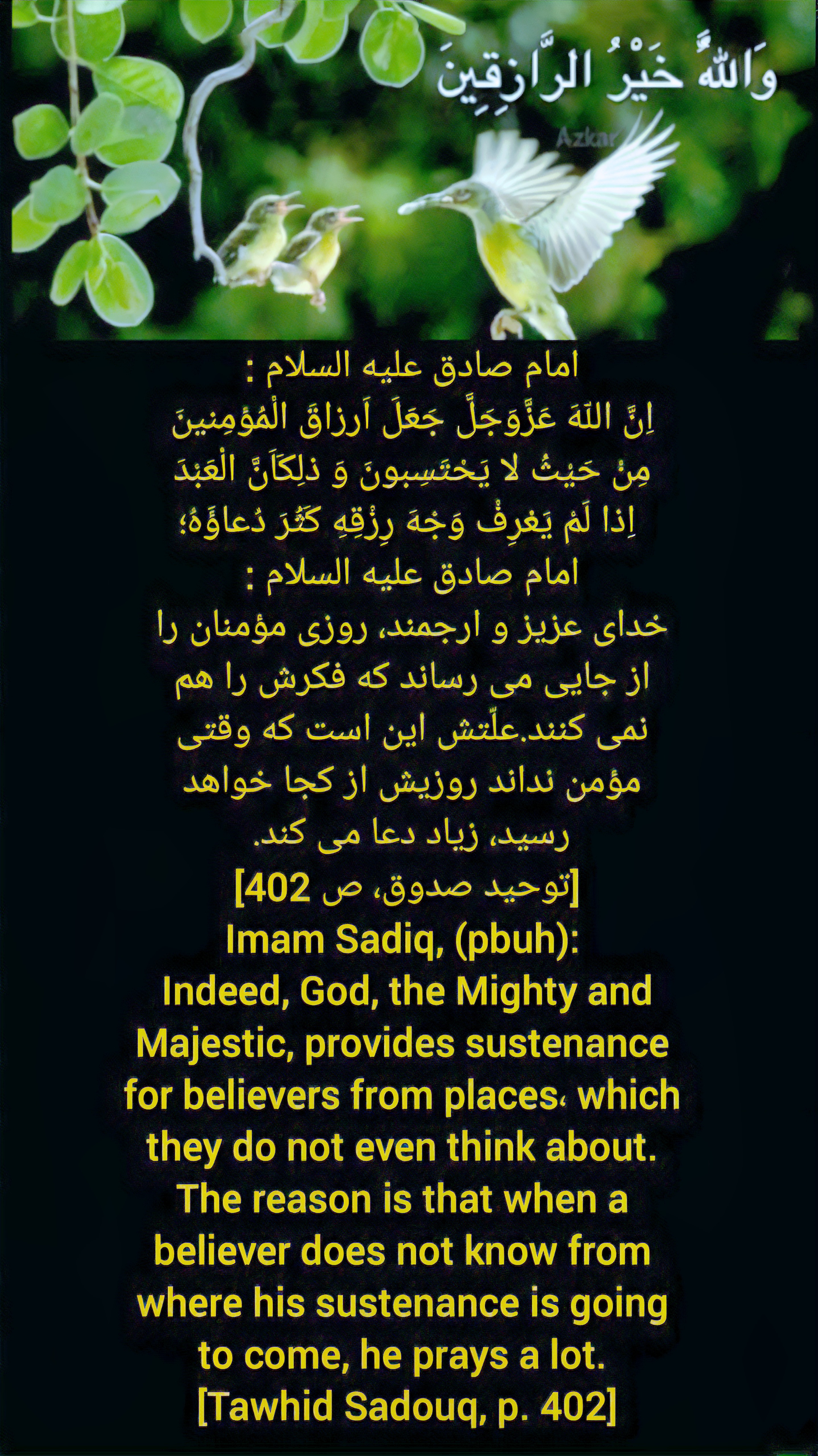
"Indeed Allah, the Mighty and Majestic, has made the provision of the believers come from where they do not expect, and that is because when a servant does not know from where his provision will come, his supplication increases."
(Wasa'il al-Shia Vol. 7, Section 2, Chapter 48, Hadith 8903)
Connection Between the Verses
Surah Ash-Shura (Quran 42:19) establishes the fundamental truth of Allah's absolute power and benevolence in providing sustenance to whomsoever He pleases. This verse sets the stage for understanding how Allah's provision is not bound by human expectations or means. His attribute of being "Benignant" (Latif) and "Strong, the Mighty One" means His ways of providing are limitless and subtle.
Surah At-Talaq (Quran 65:2-3) then provides the specific conditions for receiving special divine provision—a "way out" from difficulties and sustenance "from where he does not expect"—linking it directly to Taqwa (fearing Allah) and Tawakkul (trust in Allah). The boundless nature of Allah's power, as outlined in (Quran 42:19), is what enables Him to fulfill the promises made in (Quran 65:2-3). Therefore, (Quran 42:19) describes Allah's general capacity and will to provide, while (Quran 65:2-3) outlines how this capacity manifests for those who adhere to piety and reliance on Him, often through channels unseen and unanticipated by humans. This divine promise encourages sincere supplication, strengthens faith in Allah's all-encompassing mercy, and emphasizes that true sustenance, both material and spiritual (like Wilayat), is ultimately from Him.
Effort and Trust: While sustenance is guaranteed by Allah, individuals are still required to make an effort to secure it. Trust in Allah's provision does not negate the need for endeavor. The Quran states, "And that man shall have nothing but what he striveth for" (Quran 53:39).
Pre-ordained and Guaranteed: Every individual's sustenance is predetermined and guaranteed. A person's destined sustenance will inevitably reach him. This means the guest's sustenance is already decreed and merely manifests through the host's household.
Spiritual Benefits of Hospitality
Hosting guests is considered a highly rewarding act in Islam, extending beyond mere social courtesy:
Forgiveness and Virtue: It is explicitly stated that feeding and welcoming guests brings forgiveness and virtue, with the guests' virtue upon the host being greater than the host's virtue upon them.
Closeness to Allah: A guest is regarded as a beloved of God, and serving them is a means of earning reward and drawing closer to Allah.
Sign of Faith: Honoring guests is considered a vital aspect of faith, demonstrating one's belief in Allah and the Last Day.
Blessings and Growth: When Allah desires to bless a community, He sends guests as a gift, signifying their role as a source of blessing and spiritual growth.
Prophet Muhammad (peace be upon him and his family) said:
"When God wills happiness and prosperity for a nation, he will bestow on them a gift. They asked: ‘what is that gift’. He replied: a ‘guest’"
(Bihar al-Anwar, volume 15, page 241. Jami' Al-Akhbar, page 136.)
Problem Resolution: Having three guests in one's home in a month is said to help solve issues related to blessings (Barakat), sickness, progress, debts, and finances.
Immense Rewards: Hosting guests is considered a great spiritual reward, comparable to reciting the Holy Quran, Tawraat, Injeel, and Zaboor, or praying all of one's obligatory prayers (Namaaz) in congregation (Jama'at). The more guests one hosts, the greater the spiritual reward.
Freedom from Hellfire and Stinginess: A person who honors guests is promised to never enter Hellfire and is freed by Allah from stinginess.
Angels' Presence: It is stated that a night of hosting a guest is an obligatory right upon every Muslim, and if the guest is not welcomed, Angels will not enter that home.
The Religious Implications of Stinginess and Unwelcoming Behavior
In Islam, a lack of hospitality and stinginess are strongly condemned, carrying significant spiritual repercussions:
Displeasure of Allah and Lack of Reward: Disliking a guest is equated to disliking Allah, and Allah hates those who hate guests. A person hesitant to offer hospitality is deemed "unworthy of reward."
Imam Jafar al-Sadiq (peace be upon him) said
"Whoever shows people what Allah loves while confronting Allah with what He dislikes will meet Allah while He is hateful to him."
(Wasa'il al-Shia Vol. 1, Section 2, Chapter 11, Hadith 140)
Negative Character Traits: Stinginess is directly associated with "meanness" and can lead one to become vicious and mean-spirited. It is characterized as a negative trait that can affect one's faith, while miserliness is condemned.
Amir al-muminin, Imam Ali (peace be upon him) said:
"Stinginess encompasses the wickedness of all flaws, and it is a rein by which one is led to every wickedness."
(Nahj al-Balagha by From the speeches of Imam Ali (as), Volume 4, Page 90)
Imam Jafar al-Sadiq (peace be upon him) said
My father, Allah may have mercy upon him, narrated to us from Sa’d bin Abdullah from … al-Harithi that Abu Abdullah (a) said: Anyone who enjoys stinginess, envy, and cowardice cannot be believer. The believer is never coward, stingy, or acquisitive.
(Sifat al-Shi a by Shaykh Muhammad b. Ali al-Saduq, Book 1, Chapter 59, Hadith #1)
Imam Ali al-Rida (peace be upon him) said:
"Beware of stinginess for it is an infirmity that does not exist in a free person nor a believer; it is contrary to faith."
(Bihar al-Anwaar by Allamah Majlisi, Volume 75, Page 346)
A number of our people have narrated from Ahmad ibn abu ‘Abd Allah from his father, from abu al-Jahm from Musa ibn Bakr from Ahmad ibn Sulayman who has said the following: “Abu al-Hassan, Musa (peace be upon him), has said, ‘A stingy person is one who exercises stinginess in paying what Allah has made obligatory upon him to pay.’”
(Al-Kafi (Vol. 4) by Shaykh Muhammad b. Ya qub al-Kulayni, Book 1, Chapter 36, Hadith #4)
Spiritual Detriment: The Prophet (peace be upon him and his family) distinguished between generous individuals and those who are stingy or vile. A bakh?l (stingy person) eats but does not share, while a la'?m (vile person) neither eats nor shares, even discouraging others from generosity.
Denial of Paradise: Imam Ali (peace be upon him) declared it is forbidden for a miser to enter Paradise.
The Commander of the Faithful Imam Ali ibn Abi Talib (as) heard a man saying, The miser is more excusable than the oppressor.
He said to him: You have lied. Indeed, the oppressor may repent, seek forgiveness, and restore the injustice to its rightful owners. But the miser, when he becomes miserly, withholds zakat, charity, maintaining family ties, hospitality to guests, spending in the way of Allah (swt), the Mighty and Majestic, and other acts of goodness. It is forbidden for a miser to enter Paradise.
(Man La Yahduruh al-Faqih (Vol. 2) by Shaykh Muhammad b. Ali al-Saduq, Book 1, Chapter 16, Hadith #12)
When Amir al- Mu'minin (peace be upon him) heard a man saying: "The miser is more excusable than the oppressor." He said to him: "You have lied. The oppressor may repent, seek forgiveness, and return what he wrongfully took to its owners. But when the miser becomes stingy, he withholds zakat, charity, maintaining family ties, hosting guests, spending in the way of Allah, and doors of righteousness. And Paradise is forbidden for a miser to enter."
(Wasa'il al-Shia Vol. 9, Section 1, Chapter 5, Hadith 11458)
A number of our people have narrated from Ahmad ibn abu ‘Abd Allah from his father, from abu al-Jahm from Musa ibn Bakr from Ahmad ibn Sulayman who has said the following: “Abu al-Hassan, Musa (peace be upon him), has said, ‘A stingy person is one who exercises stinginess in paying what Allah has made obligatory upon him to pay.’”
(Al-Kafi (Vol. 4) by Shaykh Muhammad b. Ya qub al-Kulayni, Book 1, Chapter 36, Hadith #4)
Retribution on the Day of Judgment: A miserly person is eligible for Retribution on the Day of Reckoning. The Holy Quran states that being stingy and not spending in the way of Allah is bad for the person, and that they will be collared with what they grudge on the Day of Resurrection.
Surah Al-Imran (Quran 3:180) serves as a profound warning against stinginess and the refusal to spend in the way of Allah, particularly emphasizing the severe and humiliating consequences awaiting such individuals on the Day of Resurrection. The verse states:
"And let not those who are stingy with what Allah has given them of His bounty think that it is good for them. Rather, it is bad for them. They will be collared with what they withheld on the Day of Resurrection. And to Allah belongs the inheritance of the heavens and the earth, and Allah is Aware of what you do." (Quran 3:180)
This verse highlights that wealth, far from being a source of benefit when hoarded, will become a means of torment for the miserly in the afterlife. What a person possesses is attributed to Allah's grace, and it is incumbent upon them to spend it as commanded, failing which, the punishment will be severe.
Interpretation and Consequences of Stinginess in Quran 3:180
The core message of (Quran 3:180) centers on the transformation of hoarded wealth into a physical punishment and a source of profound regret.
1. "Collared with What They Withheld"
The central imagery of the verse is that the withheld wealth will be "collared" around the necks of the stingy on the Day of Resurrection. This metaphor signifies a literal and symbolic burden and punishment:
- Physical Torture: The verse explicitly states that what they were niggardly with "shall be made to cleave to their necks on the resurrection day." This means the very wealth saved through stinginess, even from one's family and the needy, will be put around their neck "in the form of a noose on the Day of Judgment." They will be brought to the grounds of Judgment "wearing this noose and will have to stand there ashamed, with this noose around their neck."
- Specific to Zakat: According to Hadith, this punishment is directly linked to the non-payment of Zakat. Imam Muhammad Baqir (peace be upon him) explained that for one who does not pay Zakat from their wealth, the Almighty Allah will make a serpent of fire from that wealth and put it around the neck of that person on the Day of Judgment. This serpent will sting the person continuously till the time he is giving account of his deeds.
My father (rah) said: it was narrated to me by Sa’d b. Abdillah from Ya’qub b. Yazid from Muhammad b. Abi ’Umayr from Abdillah b. Muskan from Muhammad b. Muslim who said: The narrator asked Imam Muhammad Baqir (peace be upon him) regarding the verse: they shall have that whereof they were niggardly made to cleave to their necks on the resurrection day. Imam (peace be upon him) replied, “For one who does not pay Zakat from his wealth, the Almighty Allah will make a serpent of fire from that wealth and put it around the neck of that person on the Day of Judgment. This serpent will sting the person continuously till the time he is giving account of his deeds. According to that verse, acting miserly in spending wealth means non payment of Zakat.”
(Thawab al-A mal wa iqab al-A mal by Shaykh Muhammad b. Ali al-Saduq, Book 3, Chapter 42, Hadith #1)
This interpretation clarifies that "acting miserly in spending wealth means non-payment of Zakat."
- Encircling Punishment: Other interpretations of the phrase "They will be encircled by what they withheld on the Day of Resurrection" (Surah Ali ‘Imran Quran 3:180) also refer to Zakat, stating that those who withhold it "will be punished on the Day of Resurrection by being confined and tormented by the very wealth they withheld."
2. Broader Consequences of Hoarding and Stinginess
Beyond the specific imagery of the collar, other Quranic verses and interpretations elaborate on the fate of the stingy, reinforcing the severe nature of this sin:
- Painful Chastisement and Branding: The Holy Quran warns that "those who treasure up gold and silver and do not spend it in the way of Allah will face a painful punishment on the Day of Judgment, and will be branded with the wealth they hoarded." This punishment is further detailed in Surah Al-Bara’at (Quran 9:34-35), where it states that these hoarded treasures "shall be heated in hellfire and therewith branded on their foreheads, their sides and their backs," with the admonition, "This is what you treasured up for yourselves! So taste what you have treasured!"
- Profound Regret: Stinginess in this life leads to deep remorse in the afterlife. Allah (swt) will "show them their deeds as regrets upon them" (Surah Al-Baqarah Quran 2:167). Imam Abu 'Abd Allah (peace be upon him) explained that this refers to a man who, due to stinginess, hoards his wealth without spending it in obedience to Allah. When he dies, this wealth is left to others. If it is then spent in obedience, he will find it in the balance of the other person, he then becomes regretful; it was his property. If it is spent in disobedience, he will have enabled the spender through that property to disobey Allah, the Most Majestic, the Most Glorious.
Ahmad ibn abu ‘Abd Allah has narrated from ‘Uthman ibn ‘Isa from those whom he has mentioned who has said the following: “This is about the meaning of the words of Allah, the Most Majestic, the Most Glorious, Thus Allah shows them their deeds that will make them regretful. (Quran 2:162)’ Abu ‘Abd Allah (peace be upon him), has said, This is a man who keeps his property without spending in obedience to Allah due to his stinginess. He then dies and leaves it (the property) for one who spends it in obedience to Allah or in disobedience of Allah. If it is spent in obedience of Allah and finds it in the balance of the other person, he then becomes regretful; it was his property. If it is spent in disobedience of Allah, he is the one who enabled the spender through that property to disobey Allah, the Most Majestic, the Most Glorious.’”
(Al-Kafi (Vol. 4) by Shaykh Muhammad b. Ya qub al-Kulayni, Book 1, Chapter 35, Hadith #2)
The refusal to spend in Allah's way is stated to cause feelings of want and deprivation.
- Disgraceful Chastisement and Distance from Divine Mercy: Those who are niggardly and hide Allah's blessings are warned of a disgraceful chastisement. A stingy person is described as away from Allah, His creations, and the Heaven, and is closer to the Hell Fire.
Messenger of Allah (swt), peace and blessings be upon him and his family, said: Nothing has eroded Islam as much as miserliness (shuhh).
He then added: This miserliness creeps in like the creeping of ants and has branches like the branches of a net.
(Man La Yahduruh al-Faqih (Vol. 2) by Shaykh Muhammad b. Ali al-Saduq, Book 1, Chapter 16, Hadith #10)
They become eligible for Retribution on the Day of Reckoning. This underscores that stinginess is not just a financial shortcoming but a spiritual illness that severs one from divine mercy and communal good.
Context of Divine Justice and Accountability
The concluding part of the verse, "And to Allah belongs the inheritance of the heavens and the earth, and Allah is Aware of what you do," provides crucial context. It reminds humanity that all possessions are ultimately Allah's. Humans are merely stewards of the bounties granted to them. This understanding implies:
- Temporary Custodianship: Whatever a person possesses is due to Allah's grace and favors. Humans have no inherent control over gain or loss, making them accountable for how they utilize these temporary trusts.
- Omniscience of Allah: Allah's awareness of all deeds reinforces the certainty of reckoning. Every act of stinginess or generosity is known to Him and will be accounted for.
- Consequences for Self: While stinginess appears to save wealth, the Quran emphasizes that "whoever is stingy is stingy only to himself." Allah is All-sufficient, while humans are all-needy.
In essence, Quran (3:180), supported by related verses and Hadith, vividly portrays stinginess as a self-inflicted harm leading to a terrible fate on the Day of Resurrection, where the very objects of their miserliness become instruments of their eternal regret and punishment.
Exemplars: The Prophet and the Ahl al-Bayt
The lives and teachings of the Holy Prophet (peace be upon him and his family) and the Imams of the Ahl al-Bayt (peace be upon them) exemplify the highest standards of hospitality:
Prophet Muhammad (peace be upon him and his family)
Prophetic Guidance: The Prophet (peace be upon him and his family) commanded, "Respect the guest even if he is a disbeliever," highlighting the universal nature of this virtue. He also instructed that the host should be generous, kind, and happy when receiving guests.
Generosity and Respect: He was known for treating his guests with immense respect and kindness. He would offer his own cushion or spread his cloak or shirt for them to sit on, as a sign of honor. For instance, he offered his only pillow to Salman Farsi. To 'Adi ibn Hatim, he prepared a seat using a sack and a pillow made of animal skin when nothing else was available.
Patience and Tolerance: He demonstrated extraordinary patience and tolerance, even with guests who overstayed their welcome, never asking them to leave despite his discomfort.
Guest's Provision: He taught that "no guest stays with a people except that his provision comes with him," suggesting that a guest's presence brings sustenance, easing the host's concern over provisions.
Duration of Hospitality: The Prophet (peace be upon him and his family) defined the incumbent period for hospitality: "Hospitality towards a guest is incumbent for the first day, the second day, and the third day." After these three days, any further provision is considered charity.
Imam Ali (peace be upon him)
Profound Regard for Guests: Imam Ali (peace be upon him) considered hospitality to be among the three things most dear to him, alongside Jihad with the sword and keeping fast on a hot day. He would often weep if he did not have a guest for several days, fearing that Allah might consider him degraded.
Respect for Guests and Their Families: He would personally help a guest wash their hands, and then instruct his own son to assist the guest's son in the same manner. This act was meant to highlight Allah's desire to distinguish the respect shown to a father in the presence of his son.
Simple Diet vs. Lavish Hospitality: In stark contrast to the lavish hospitality he extended to others, Imam Ali (peace be upon him) maintained an extraordinarily simple and humble diet. He frequently ate barley bread softened in water, often accompanied by just grains of salt. When hosting, he would ask the guest about their favorite dish and instruct that specific one to be prepared, while he himself would partake of his usual simple fare.
Imam al-Sadiq (peace be upon him)
Exceptional Generosity and Hospitality: Imam al-Sadiq (peace be upon him) was renowned for his exceptional generosity and hospitality. He would personally welcome and serve his guests, offering them the finest and most delicious food. He believed that hospitality was crucial for showing respect and kindness, often remarking, "one who loves us more will eat more here."
Commitment to Service: His commitment was such that he would instruct his servants to prepare large quantities of food daily, sufficient to feed many people.
Prohibition of Guest Service: He prohibited guests from performing tasks in his home, stating, "Allah's Messenger has prohibited hosts from asking the guest to do anything," and would complete the task himself.
Imam al-Rida (peace be upon him)
Etiquette: Imam Abu al-Hassan al-Rida (peace be upon him) provided a specific etiquette: it is "improper to make a guest work." Instead, the host should diligently attend to the guest's needs and ensure their comfort.
The Spiritual Purification Through Hospitality
The act of hosting guests is considered a profound spiritual practice, laden with divine blessings and a powerful means of attaining forgiveness. The presence of guests in a home is not merely a social event but a divinely ordained opportunity for the host to purify their soul and invite mercy into their household.
Divine Forgiveness Through Hosting Guests: A core teaching emphasizes that guests are a conduit for divine pardon, bringing forgiveness upon their arrival and removing sins upon their departure. According to Messenger of Allah (S), "When a guest comes and disembarks with a people, he comes with his sustenance from the sky. When he eats Allah forgives them because of his staying with them."
Removal of Sins: The Holy Prophet (S) taught that the guest arrives bringing his own sustenance and leaves taking away the sins of his hosts.
Divine Blessings and Sustenance: Guests are regarded as a direct gift from Allah (SWT), bringing their own sustenance and showering blessings upon the host's home, rather than being a burden. Messenger of Allah (S) taught that "When a guest comes and disembarks with a people, he comes with his sustenance from the sky." This is further emphasized by Imam al-Kazim (peace be upon him),
Muhammad ibn Yahya has narrated from Ahmad ibn Muhammad from Muhammad ibn Sinan from Musa ibn Bukayr who has said the following: “Abu al-Hassan, al-Awwal (peace be upon him), has said, ‘Help descends on a people proportionate to their needs. A guest comes to a people but he comes with his sustenance in his lap.’”
(Al-Kafi (Vol. 6) by Shaykh Muhammad b. Ya qub al-Kulayni, Book 5, Chapter 38, Hadith #2)
Increase in Blessings (Barakat): The arrival of guests is a sign of divine favor and a source of increased blessings for the household. Imam Ja'far al-Sadiq (peace be upon him) advised that inviting a guest is better than setting a slave free, and having three guests in one's home in a month can help solve various problems related to blessings (Barakat), sickness, progress, debts, and finances.
Imam Jafar al-Sadiq (peace be upon him) said
"If two believers were to enter the house of a believer and he were to feed them to full, this would be better than freeing a slave."
(Kitab al-Mumin by Husayn b. Sa id al-Ahwazi, Book 1, Chapter 7, Hadith #2)
Imam Jafar al-Sadiq (peace be upon him) said
"Whoever feeds a Muslim until he is satiated, no one of the creations of Allah will know what reward he will have in the Hereafter, not a nearby-stationed angel, nor a messenger prophet, but only the Lord of the worlds."
(Thawab al-A'mal wa Iqab al-A'mal by Shaykh al-Saduq, Volume 0, Page 136)
Conclusion
The teaching "The guest arrives bringing his own sustenance and leaves taking away the sins of his hosts" elevates hospitality beyond a mere social custom to a highly virtuous act of worship. It fosters generosity, trust in divine provision, and spiritual purification. By embracing guests with honor and kindness, believers fulfill a fundamental aspect of their faith, earning immense spiritual rewards and contributing to a compassionate community. In essence, Islamic teachings on hospitality encapsulate a profound ethical framework that elevates kindness, generosity, and respect for guests to an act of worship, deeply intertwined with one's faith and the pursuit of divine pleasure.
References
Quranic References
- Quran 2:162 (as cited in the hadith)
- Quran 2:167
- Quran 3:180
- Quran 9:34–35
- Quran 42:19
- Quran 51:58
- Quran 53:39
- Quran 65:2–3
Hadith and Other Islamic Source References
- Al-Amali by Shaykh Muhammad b. Muhammad al-Mufid, Book 26, Chapter 4, Hadith #4.
- Al-Kafi by Shaykh Muhammad b. Ya qub al-Kulayni:
- Vol. 2, Book 1, Chapter 77, Hadith #6.
- Vol. 2, Book 1, Chapter 155, Hadith #3.
- Vol. 2, Book 4, Chapter 18, Hadith #1.
- Vol. 4, Book 1, Chapter 35, Hadith #2.
- Vol. 4, Book 1, Chapter 36, Hadith #4.
- Vol. 6, Book 5, Chapter 29, Hadith #2.
- Vol. 6, Book 5, Chapter 32, Hadith #3.
- Vol. 6, Book 5, Chapter 36, Hadith #1.
- Vol. 6, Book 5, Chapter 37, Hadith #1.
- Vol. 6, Book 5, Chapter 37, Hadith #2.
- Vol. 6, Book 5, Chapter 38, Hadith #1.
- Vol. 6, Book 5, Chapter 38, Hadith #2.
- Vol. 6, Book 5, Chapter 38, Hadith #3.
- Vol. 6, Book 5, Chapter 39, Hadith #1.
- Vol. 6, Book 5, Chapter 39, Hadith #2.
- Vol. 6, p. 183, no. 2.
- Vol. 6, p. 183, no. 6.
- Vol. 6, p. 283, no. 1.
- Al-Mahasin, v. 2, p. 179, no. 1506.
- Bihar al-Anwar:
- v. 75, p. 461, no. 14.
- volume 15, page 241.
- Bihar al-Anwaar by Allamah Majlisi, Volume 75, Page 346.
- Jami' Al-Akhbar, page 136.
- Jami’a al-Akhbar, p. 377, no. 1053.
- Kanz al-’Ummal, no. 25876.
- Kanz al-’Ummal, no. 25881.
- Kitab al-Mumin by Husayn b. Sa id al-Ahwazi, Book 1, Chapter 7, Hadith #2.
- Man La Yahduruh al-Faqih by Shaykh Muhammad b. Ali al-Saduq:
- Vol. 2, Book 2, Chapter 31, Hadith #1.
- Vol. 2, Book 1, Chapter 16, Hadith #10.
- Vol. 2, Book 1, Chapter 16, Hadith #12.
- Vol. 3, Book 2, Chapter 1, Hadith #14.
- Mizan al-Hikmah by Muhammad al-Rayshahri, Volume 3, Page 2412.
- Nahj al-Balagha, Volume 4, Page 90 (from the speeches of Imam Ali).
- Nahj al Fasahah, Tradition No. 72, Page No. 18.
- Nahj al Fasahah, Tradition No. 73, Page No. 18.
- Sifat al-Shi a by Shaykh Muhammad b. Ali al-Saduq, Book 1, Chapter 59, Hadith #1.
- Tanbih al-Khawatir, v. 2, p. 116.
- Thawab al-A mal wa iqab al-A mal by Shaykh Muhammad b. Ali al-Saduq, Book 3, Chapter 42, Hadith #1.
- Thawab al-A'mal wa Iqab al-A'mal by Shaykh al-Saduq, Volume 0, Page 136.
- Wasa'il al-Shia:
- Vol. 1, Section 2, Chapter 11, Hadith 140.
- Vol. 7, Section 2, Chapter 48, Hadith 8903.
- Vol. 9, Section 1, Chapter 2, Hadith 11405.
- Vol. 9, Section 1, Chapter 5, Hadith 11458.
- Vol. 11, Section 5, Chapter 62, Hadith 15249.
- Vol. 11, Section 5, Chapter 62, Hadith 15250.
- Vol. 12, Section 1, Chapter 128, Hadith 16154.
- Vol. 12, Section 1, Chapter 130, Hadith 16161.
- Vol. 15, Section 2, Chapter 4, Hadith 20230.
- Vol. 17, Section 1, Chapter 18, Hadith 21980.
Quranic verses and hadiths of Ahl al-Bayt (peace be upon them) and sayings in Arabic, Persian and English.
https://eitaa.com/noorunalanoor
https://www.youtube.com/@110Inspire
https://youtube.com/@mustafaabbas4668?si=EnSIkaIECMiOmarE
https://youtube.com/@mustafaabbas8978?si=EMJylUW9_zruJx95