KhanwadeAbuTalib.com
Posted by Mustafa Abbas on August 18, 2026 | Views: 292 | Ratings: 141

Download article from link below at the end
Prophet Muhammad: The Ultimate Exemplar for Humanity
An Analysis of Qur’an ic Verse 33:21 and Its Implications
The Qur’an ic verse "Indeed, in the Messenger of Allah, you have an excellent example" stands as one of the most foundational declarations in Islamic theology, establishing Prophet Muhammad (peace be upon him and his family) as the supreme model of conduct and character for all believers. This verse, found in Surah Al-Ahzab (Qur’an 33:21), transcends mere admiration, calling believers to active emulation and practical application of the Prophet's example in every aspect of life.
The complete verse reads: "Indeed, in the Messenger of Allah, you have an excellent example for anyone whose hope is in Allah and the Last Day, and who remembers Allah frequently."
Understanding "Uswatun Hasanah" (The Excellent Example)
Linguistic and Theological Meaning
The term (uswatun hasanah) carries profound significance. According to classical and contemporary exegesis found in Shia sources, the word "uswah" specifically denotes a pattern to be followed—it implies active emulation rather than mere admiration or theoretical appreciation. The Qur'an employs this term in only two primary contexts: concerning Prophet Abraham and concerning Prophet Muhammad, highlighting the exceptional status of these figures as models for humanity.
The verse establishes that the Prophet's conduct "serves as the finest methodology, perfect conduct, and ultimate blueprint for human existence, transcending specific eras, locations, or circumstances." This comprehensive understanding underscores that the Prophet's example is not confined to a particular time or situation but offers universal guidance applicable across all generations and contexts.
The verse was revealed in the context of the Battle of the Trench (Ghazwat al-Khandaq), a pivotal moment when the Muslim community faced overwhelming odds and profound fear. The forces of the confederate tribes had besieged Medina, and the believers were tested with severe anxiety and hardship. In this challenging environment, the Prophet demonstrated remarkable steadfastness, patience, and unwavering trust in Allah.
As one tafsir explains, the hypocrites among the Muslims accused the Prophet's promises of victory of being mere deception to boost morale, while the true believers grew firmer in their faith and confidence in Allah. The verse was revealed to establish that the correct response to adversity is to take the Prophet as a model—in his patience, his trust in Allah, his strategic wisdom, and his refusal to succumb to despair despite apparent weakness.
The Scope of the Prophetic Example
Comprehensive Guidance for All Aspects of Life
Prophet Muhammad's example offers guidance in every dimension of human existence. His life and traditions serve as exemplary guides for Muslims in all aspects of life, including worship, ethics, governance, and interpersonal relations. He is considered a model for spiritual, mental, and behavioral guidance.
This comprehensiveness is rooted in the understanding that the Prophet did not merely convey abstract teachings but embodied them in his daily conduct. His entire existence —his words, deeds, and interactions—provided a practical demonstration of faith and righteousness. As the Qur'anic commentary emphasizes, "his actions and decisions are a model for believers to follow in order to achieve true faith and guidance."
The Integration of Worship and Ethics
One of the most significant aspects of the Prophet's example is the seamless integration of worship and ethics. His methods of devotion and his moral character are presented not as separate domains but as unified expressions of faith:
- Holistic Worship: The Prophet's way of worship embraced a balance of actions pleasing to God. He prayed, fasted, smiled, and cried, demonstrating that devotion permeates every aspect of existence. His worship was not limited to extreme or rigid behaviors but encompassed all actions performed with sincere intention.
- Worship as Spiritual Elevation: The purpose of worship and devotion, as exemplified by the Prophet, is to bring the soul to the highest status of perfection. His conduct teaches that true devotion extends beyond personal spirituality to encompass communal well-being and ethical conduct.
- Sincerity and Community Focus: The Prophet's devotion, and that of his household, was marked by sincerity and a deep understanding of Allah, often reflecting empathy and concern for the welfare of the community in their prayers and supplications.
The Moral Character of the Prophet
Prophet Muhammad's moral character is the cornerstone of Islamic ethics, providing a detailed framework for virtuous living. His noble character was a primary reason for people's attraction to Islam. The key virtues that defined his character include:
Truthfulness and Honesty: Known as "the truthful and honest one," these qualities were central to his being. Even before his prophethood, he was universally recognized for his integrity and trustworthiness, earning the titles Al-Sadiq (The Truthful) and Al-Amin (The Trustworthy).
Justice and Fairness: He treated all people with equal rights and respect, demonstrating an unwavering commitment to justice. His rulings were based on evidence, and he refused to show favoritism, even to those he loved.
Compassion and Mercy: He was a model of mercy, kindness, lenience, and good- naturedness towards his community and all people. His mercy and forgiveness increased even as his power grew. He was described as "a mercy to the people of the world."
Humility and Modesty: Despite his exalted status as the Messenger of Allah and the leader of the Muslim community, he lived with profound humility. He sat on the ground, ate simple food, mended his own clothes, and refused to accept special treatment or privileges. His modesty was so intense that it was said to be "more intense than that of a virgin in her veil."
Patience and Forbearance: He demonstrated unwavering patience and steadfastness despite constant confrontation, abuse, and disrespect from enemies. He endured pain and suffering for thirteen years in Makkah without being over-awed by the sheer force and numbers of arrogant Jahiliyah.
Generosity and Magnanimity: He was unmatched in generosity, benevolence, charity, and selflessness. He would distribute large amounts of money to the poor, sometimes leaving nothing for his own family at night. He was willing to sacrifice his desires for the sake of others.
Courage and Determination: He showed immense courage and determination in propagating his message and facing challenges. In battles, he was always at the forefront, closest to the enemy. His companions sought refuge in him during difficult times, and he never displayed fear or anxiety in battle.
The Prophet's Humility and Modesty
The Essence of Modesty in Islamic Teachings
The Prophet's modesty was not merely a personal trait but a fundamental aspect of his prophetic character and a teaching for all believers. Islamic teachings emphasize that modesty (haya') is intrinsically linked to faith (iman). The Prophet stated:
Messenger of Allah (peace be upon him and his family) said: "Modesty and faith are tied together, when one is taken away the other follows." (Wasail al-Shia Vol. 12, Section 1, Chapter 110, Hadith 15979)
Prophet Muhammad (peace be upon him and his family) said, "Verily every religion has a natural disposition and the natural disposition of Islam is modesty." (Kanz al-Ummal, no. 5757)
This inseparable bond between modesty and faith underscores that true conviction manifests through modest behavior, and the absence of modesty indicates a deficiency in faith. The Prophet advised believers to "Be modest in front of Allah just like your modesty with your righteous neighbours, for verily modesty with Allah increases one’s conviction." (Bihar al-Anwar, v. 78, p. 200, no. 28)
Practical Manifestations of Prophetic Humility
The Prophet's humility was evident in every aspect of his life:
In Daily Interactions: He would sit on the ground, eat on the ground, and sleep on a simple mat. He mended his own shoes, patched his own clothes, and performed household chores. He never reprimanded his servant, Anas bin Malik, even after years of service.
In Social Gatherings: When entering a meeting, he would sit at the nearest available spot. He would not distinguish himself from his companions, making it difficult for strangers to identify him. He would greet children first, demonstrating respect for all regardless of age or status.
In Worship: His prayer was characterized by profound humility. After the revelation of the verse "Successful indeed are the believers, who are humble in their prayers" (Qur’an 23:1 and 2), he lowered his head and cast his gaze upon the ground, setting a precedent for physical expression of spiritual humility.
In Leadership: He refused to be treated like a king or ruler. He declined special seating, refused to have people stand for him, and insisted on being treated as one of the people.
Imam Ja'far al-Sadiq (as) said: "The Messenger of Allah used to eat the food of a servant, sit in the manner of a servant, and know that he is a servant." (al-Kafi by Shaykh al-Kulayni, Volume 6, Page 271)
Ali ibn Ibrahim has narrated from his father from Safwan from ibn Muskan from al-Hassan al-Sayqal who has said the following: “I once heard abu Abd Allah (a.s.), saying, ‘Once an indecent woman passed by the Messenger of Allah, O Allah, grant compensation to Muhammad and his family worthy of their services to Your cause, when he was eating while sitting on the ground. She said, ‘O Muhammad, you eat like a slave and sit like one.’ He (the Messenger of Allah) said to her, ‘I am a slave and where is that slave who is a better slave than I am.’ She then said, ‘Give me a morsel from you food.’ He (the Messenger of Allah) gave her a morsel but she said, ‘No, by Allah, (I will not accept) until you give from what is in your mouth.’ The Messenger of Allah then took the morsel out of his mouth and gave it to her and she ate it.’ Abu Abd Allah (a.s.), has said that she thereafter was never affected by indecency until she left this world.’” (Al-Kafi (Vol. 6) by Shaykh Mu?ammad b. Yaqub al-Kulayni, Book 5, Chapter 23, Hadith #2)
Divine Exaltation for Humility
Islamic teachings consistently highlight that Allah raises those who are humble for His sake and lowers those who are arrogant.
"And do not turn your cheek [in contempt] toward people and do not walk through the earth exultantly. Indeed, Allah does not like everyone self-deluded and boastful. And be moderate in your pace and lower your voice; indeed, the most disagreeable of sounds is the voice of donkeys." (Qur'an 31:18 and 19),
The Prophet taught Indeed, humility increases the dignity of one endowed with it. Be humble, and Allah will exalt you.
Prophet Muhammad (peace be upon him and his family) said: "Humbleness increases its owner in high standing, so be humble and Allah will raise you up." (al-Kafi by Shaykh al-Kulayni, Volume 2, Page 121)
Prophet Muhammad (peace be upon him and his family) said, "Allah revealed unto me that we should be humble, so that nobody shows pride over anybody else, and no one intimidates another." (al-Targhib wa al-Tarhib, v. 3, p. 558, no. 1)
The Prophet himself explained the principle: "Allah revealed unto me that we should be humble, so that nobody shows pride over anybody else, and no one intimidates another." (al-Targhib wa al-Tarhib, v. 3, p. 558, no. 1"Allah revealed unto me that we should be humble, so that nobody shows pride over anybody else, and no one intimidates another.")
The Prophet as a Teacher and Educator
The Educational Mission of Prophethood
Prophet Muhammad's role as a teacher is fundamental to his mission. The Qur'an describes his educational function through three primary pillars:
"He raised up among the common people a Messenger from among themselves to recite to them His revelations, to purify them, and to teach them the Book and the wisdom." (Qur’an 62:2)
- Recitation of Divine Communications: Conveying the message of Allah as revealed to him, serving as the foundation for all subsequent guidance.
- Purification of the People: Cleansing individuals and communities from wrong beliefs, vile character traits, immoral actions, and spiritual diseases. This purification is essential for spiritual growth and enables individuals to benefit from divine guidance.
- Teaching the Book and Wisdom: Explaining the meanings of the Qur'an, providing insights, and guiding people on practical application. This goes beyond mere recitation to encompass authoritative interpretation and guidance.
The Prophet's Emphasis on Knowledge
The Prophet placed immense emphasis on education and the acquisition of knowledge, making it a fundamental aspect of Islamic life:
It is obligatory for every Muslim, man and woman to acquire knowledge.
Prophet Muhammad (peace be upon him and his family) said, "Seeking knowledge is an obligation on every Muslim. Indeed how Allah loves those who strive in their quest for knowledge." (al-Kafi, v. 1, p. 30, no. 1)
A number of our people has narrated has narrated from Ahmad ibn Muhammad al-Barqi from Ya’qub ibn Yazid from Abu Abdillah, one of our people narrated in a marfu‘ manner from Abu Abdillah (al-Sadiq) (as) that Rasulullah (sw) said: “Seeking knowledge is obligatory.” In another hadith, Abu 'Abdillah (as) narrated that Rasulullah (sw) said, “Seeking knowledge is obligatory for every Muslim. Let it be known that Allah loves those who seek knowledge.” (Al-Kafi (Vol. 1) by Shaykh Mu?ammad b. Yaqub al-Kulayni, Book 2, Chapter 1, Hadith #5)
Seek knowledge even if it be in China.
Prophet Muhammad (peace be upon him and his family) said, "Seek knowledge even in China, for verily to seek knowledge is an obligation on every Muslim." (Kanz al-Ummal, no. 28697)
Practical Steps to Promote Literacy
The Prophet took practical measures to foster education among Muslims:
Encouragement to Seek and Share: Prophet Muhammad (peace be upon him and his family) said, "The best form of charity is for the Muslim to gain knowledge and then teach it to his fellow Muslim brother." (Kanz al-Ummal, no. 16357)
Prophet Muhammad (peace be upon him and his family) said, "There is a support for everything, and the support for this religion is education." (Kanz al-Ummal, no. 28768)
A man asked Prophet Muhammad (peace be upon him and his family): “O Prophet of God! What is (the requirement of) knowledge?” Prophet Muhammad (peace be upon him and his family) replied: “Silence.” The man asked: “What is next?” Prophet Muhammad (peace be upon him and his family) replied: “Listening to knowledge (i.e. those who are knowledgeable).” The man asked: “And what is next?” Prophet Muhammad (peace be upon him and his family) replied: “Remembering it.” The man asked: “And what is next?” Prophet Muhammad (peace be upon him and his family) replied: “Acting upon it.” The man asked: “And what is next?” Prophet Muhammad (peace be upon him and his family) said: “Spreading and sharing it with others.” (Al-Kafi - Volume 1, Page 48)
He advised followers to listen to wise words, memorise them, act on them and teach them, outlining a comprehensive process for learning—acquisition, retention, application, and dissemination.
Prioritizing Learning Gatherings: On one occasion, upon entering the Masjid, he preferred a group engaged in religious discussions over a group offering prayers, joining the former. Prophet Mohammad (peace be upon him and his family) considered:
"An hour of seeking knowledge is better than praying one whole night, and a day of seeking knowledge is better than fasting three months" (Nahj al Fasahah; Tradition No. 205; Page No. 35)
"An hour of thinking is better than sixty years of praying" (Nahj al Fasahah; Tradition No. 207; Page No. 35)
The High Status of Knowledge and Scholars
The Prophet elevated the status of knowledge and those who acquire and impart it:
Prophet Muhammad (peace be upon him and his family) said, "The superiority of the scholar over others is as the superiority of the prophet over his community." (Kanz al-Ummal, no. 28798)
Hazrat Mohammad (peace be upon him and his family) : "A scholar who avails himself of his own knowledge is superior to a thousand simple worshipers (of God)" (Nahj al Fasahah; Tradition No. 125; Page No. 25)
Prophet Muhammad (peace be upon him and his family) said, "The superiority of the scholar over others is as the superiority of the prophet over his community." (Kanz al-Ummal, no. 28798)
Prophet Muhammad (peace be upon him and his family) said, "On the Day of Resurrection, the ink of the scholars will be weighed up against the blood of the martyrs, and the ink of the scholars will preponderate over the blood of the martyrs." (Tafsir al-Durr al-Manthur, v. 3, no. 423)
Hazrat Mohammad (peace be upon him and his family) : "When the resurrection day will come, the ink of the pen of scholars will be weighed against the blood of martyrs, so as a result of weighing the ink of the pen of scholars will get superiority over the bloods of the martyrs" (Lyali al Ekhbar. Vol. 2. P 272)
Prophet Muhammad (peace be upon him and his family) said, "There is a support for everything, and the support for this religion is education." (Kanz al-Ummal, no. 28768)
Prophet Muhammad (peace be upon him and his family) said, "No one can support [the cause of] the religion of Allah, the Exalted, except for one who is well-versed in all its aspects." (al-Firdaws, v. 1, p. 234, no. 897)
Prophet Muhammad (peace be upon him and his family) said, "If a day comes upon me in which I do not increase in knowledge that brings me closer to God Almighty, then may the sun not rise for me on that day." (Nahj al Fasahah; Volume 1, Page 177)
The Prophet as the Authoritative Interpreter
The Prophet's role as a teacher is inextricably linked to his function as the authoritative interpreter and commentator of the Qur'an. The Qur'an itself clarifies this: "And We revealed to you the message that you may make clear to the people what was sent down to them and that they might give thought." (Qur’an 16:44). This verse demonstrates that the Prophet was entrusted with explaining the meanings of the Qur'an and guiding people to reflect upon its teachings.
This interpretive authority includes:
Explaining Meanings: The Qur'an often presents general principles, leaving the details to be elaborated by the Prophet. For instance, while the Qur'an commands daily
prayers, it does not explicitly detail the method of performing them. This necessitates referring to the Prophet for practical instruction.
Providing Practical Guidance (Sunnah): The Prophet's actions and example serve as a vital source of practical guidance, demonstrating how divine commandments are to be implemented in daily life.
Imparting Wisdom: Beyond the Book itself, the Prophet teaches "wisdom"—divine knowledge, insightful understanding, and the cultivation of virtuous character traits.
The Prophet and Intellect (Aql)
The Supreme Importance of Intellect
Prophet Muhammad profoundly emphasized the critical importance of reason and intellect in Islam, establishing them as foundational elements for individual guidance, religious understanding, and societal progress. His teachings highlight intellect as a supreme divine gift and an indispensable tool for comprehending the truth and fulfilling one's purpose.
Prophet Muhammad (peace be upon him and his family) said, "The first thing that Allah created was the intellect." (Bihar al-Anwar, v. 1, p. 97, no. 8)
Prophet Muhammad (peace be upon him and his family) said, "The intellect is a light that Allah has created for mankind and which He has ordained to illuminate the heart, in order that with it, he may know the difference between the visually manifest things and the unseen things." (Aawali al-La ali, v. 1, p. 248, no. 4)
Intellect as the Basis of Religion and Humanity
The Prophet's teachings explicitly link intellect to the very essence of human existence and faith. A person's religion is inseparable from their intellectual faculty, and all virtues and righteous actions stem from the intellect. Imam Ali (peace be upon him) stated that Allah has not distributed anything better than the intellect among His servants, and that the worship and actions of a wise person surpass those of the merely active but ignorant worshipper.
The intellect is considered "the strongest foundation" of man, created by Allah out of His Light. It is regarded as "man's 'inner' prophet and guide, and as God's 'proof'." This internal guide works alongside the outward prophets, messengers, and holy leaders to direct individuals toward truth and righteousness.
Prophet Muhammad (peace be upon him and his family) said, "Verily all good is grasped through the intellect, and the man devoid of intellect has no religion." (Tuhaf al-Uqul, no. 54)
Prophet Muhammad (peace be upon him and his family) said, "The very basis of man is his intellect, and the man devoid of intellect has no religion." (Rawdhat al-Wa’aizin, p. 9)
The Prophet emphasized the relationship between intellect and true worship:
Prophet Muhammad (peace be upon him and his family) said, "The best form of worship is to gain an understanding [of religion]." (al-Khisal, p. 30, no. 104)
Encouragement of Intellectual Pursuit
The Qur'an encourages people to "think" and not simply follow the ways of their ancestors without questioning.
"Indeed, in the creation of the heavens and earth, and the alternation of the night and the day, and the [great] ships which sail through the sea with that which benefits people, and what Allah has sent down from the heavens of rain, giving life thereby to the earth after its lifelessness and dispersing therein every [kind of] moving creature, and [His] directing of the winds and the clouds controlled between the heaven and the earth are signs for a people who use reason." (Qur’an 2:164)
"And do not pursue that of which you have no knowledge. Indeed, the hearing, the sight and the heart - about all those [one] will be questioned." (Qur’an 17:36).
Islam, as taught by the Prophet, actively encourages all activities that enhance intellect and understanding:
Activities like learning, research, and traveling are encouraged.
Prophet Muhammad (peace be upon him and his family) said, "Seek knowledge even in China, for verily to seek knowledge is an obligation on every Muslim." (Kanz al-Ummal, no. 28697)
The Prophet's Exemplary Intellect
Prophet Muhammad himself embodies the perfection of intellect. Allah does not send any Prophet or Rasool until He perfects their intellect, and the Prophet's intellect is considered superior to the intellects of the entire community. Prophet Muhammad (peace be upon him and his family) said, “The Honorable the Exalted God created the intellect from light which was hidden in His treasure of Knowledge from before; and none of the appointed Prophets or nearby-stationed angels had any access to that treasure. God then established knowledge as its life, understanding as its soul, abstinence as its head, shame as its eyes, wisdom as its tongue, kindness as its concern, and mercy as its heart. Then he strengthened it with certitude, faith, honesty, tranquility, sincerity, kindness, generosity, contentment, submission and perseverance. Then the Honorable the Exalted God ordered it to go back and it did. Then God ordered it to come forward, and it did. Then God ordered it to talk. It said, “Praise be to God, who has no one to oppose Him, no one to equal Him, no one to be like Him and no one to match Him - the One to whom everything is humble, and everything is in humility”. God then said, “I swear by My Majesty and Honor and I have not created any creatures better, nobler, dearer, or more obedient than you. I am recognized to be the only One to be worshipped by you. I am called by you. I am the place for the people to turn to for hope due to you. The people will fear Me and are cautious due to you. Reward and punishment is given by you.”The intellect was proud of hearing these words and fell prostrate in worship. This prostration in worship lasted one-thousand years. Then the Blessed the Sublime God said, “Now raise your head and ask Me to grant you something, and that your intercession to be accepted by Me.” Then the intellect raised its head and said, “I ask You to accept my intercession on behalf of anyone who is intelligent.”God - may His Majesty be Exalted - told the angels, “Bear witness that I have accepted its intercession on behalf of anyone to whom I grant intelligence.” (Al-Khisal by Shaykh Mu?ammad b. Ali al-Saduq, Book 11, Chapter 3, Hadith #10)
From him, from Ahmad Bin Muhammad, from Ibn Fazzaal, from one of our companions who said: Abu Abdullah (asws) said: ‘The Rasool Allah (peace be upon him and his family) did not speak to the servants in accordance with his (peace be upon him and his family) own reasoning and intellect, at all. The Rasool Allah (peace be upon him and his family) said: ‘The group of Prophets (as), we (as) have been Commanded that we (as) should speak to the people in accordance with their intellects’. (Al-Kafi (Vol. 8) by Shaykh Mu?ammad b. Yaqub al-Kulayni, Book 1, Chapter 394, Hadith #1)
The Prophet actively guided people to apply their intellects and ask questions.
Prophet Muhammad (peace be upon him and his family) said, "The intellect is a light that Allah has created for mankind and which He has ordained to illuminate the heart, in order that with it, he may know the difference between the visually manifest things and the unseen things." (Aawali al-La ali, v. 1, p. 248, no. 4)
Prophet Muhammad (peace be upon him and his family) said: "Knowledge is coffers, the key for which is asking, so ask, may Allah have mercy upon you, as four people shall be rewarded: the one who asks, the one who speaks, the one who listens, and the one who loves them." (Tuhaf al-Uqul by Ibn Shu'ba al-Harrani, Volume 0, Page 41)
Prophet Muhammad (peace be upon him and his family) said, “Knowledge is like a treasure whose keys are questioning. Therefore ask questions - may God have Mercy upon you - as four groups will benefit from this: the ones who ask, the one who teaches, the one who hears, and the one who responds to the question being asked.” (Uyun akhbar al-Rida (Vol. 2) by Shaykh Mu?ammad b. Ali al-Saduq, Book 1, Chapter 1, Hadith #23)
Prophet Muhammad (peace be upon him and his family) said, "The quest for knowledge is incumbent upon every Muslim… by virtue of it the Lord is obeyed and worshipped, consanguinal relations are maintained, and the lawful is distinguished from the prohibited. Knowledge leads to action and action follows it. The fortunate ones are inspired by it whereas the wretched ones are deprived of it." (Amali al-Tusi, p. 488, no. 1069)
The Prophet and Struggle (Jihad)
The Concept of Struggle in Prophetic Teachings
The Holy Qur’an promises: "And those who strive for Us - We will surely guide them to Our ways. And indeed, Allah is with the doers of good." (29:69).
Prophet Muhammad extensively taught about the significance of struggle, emphasizing its profound impact on the value and acceptance of one's actions. His teachings highlight that struggle is not merely a physical endeavor but a spiritual journey that qualitatively transforms the merit of deeds.
Prophet Muhammad (peace be upon him and his family) said: "The people closest to the level of prophethood are the people of knowledge and jihad (struggle)." (Mizan al-Hikmah by Muhammad al-Rayshahri, Volume 3, Page 2067)
The Greater Struggle: Jihad al-Nafs
Hazrat Mohammad (peace be upon him and his family) : The Prophet of Islam (S) sent a group of Muslims to the battle front against the enemies. When they returned to the court of Apostle of Allah he said to them ',Well done, bravo, the group who performed the small jihad (holy war) & the big jihad has (yet) to be performed by them.' They said 'oh Prophet of Allah what is the great jihad?' The Prophet replied, 'jihad & war against the passions. (Of ego).' (Wasail ul Shia, Vol, P 122)
The most emphasized form of struggle is jihad-e-akbar, or the struggle against one's own self and its desires. The Prophet stated that this is the "true struggle" and the "greater struggle." This internal struggle involves:
Controlling one's thoughts, emotions, and actions to align them with divine will.
Achieving God's pleasure and nearness through sincere endeavor, humility before God, and controlling the imperious self with reason.
Practices such as fasting during the day and night awakening through prayers and communication with God.
Imam al-Sadiq (peace be upon him) related that "whoever becomes victorious over the self's whims and passions has already achieved God's-Pleasure."
The Lives of Prophets as Continuous Struggle
The lives of the prophets were full of trials, tribulations, and struggle. They surmounted these hardships through perseverance, forbearance, and patience, not by using miracles to escape difficulties. Prophet Muhammad's earthly life itself was a continuous struggle: he was born an orphan, lost his mother at a young age, then his grandfather, experiencing "suffering, pain and privation" so that he would bear them with fortitude and reach human perfection.
During his Makkan mission, the Prophet and his followers endured calumnies, humiliation, oppression, physical torture, social boycott, hunger, and severe hardship. Yet he laboured quietly but incessantly to call people to tawhid despite opposition. This period was crucial for laying firm foundations of monotheism.
Relationship Between Struggle and the Value of Actions
The Prophet's teachings fundamentally link the value of actions to the underlying intentions, knowledge, and sincerity cultivated through struggle:
Primacy of Intention: The cornerstone of the Prophet's teachings is that "all deeds are by their intentions, and for each person is what they intend." A good intention itself is "a worship act." The internal struggle to purify one's intention is paramount.
Sincerity (Ikhlas): Sincerity for Allah's sake is an essential component derived from the struggle against self-serving desires. The Prophet stated that "God will not accept those actions except the ones done out of sincerity for Him."
Knowledge and Action: The Prophet emphasized the crucial relationship between knowledge and action. Knowing about something must come first, and acting upon what you know must follow. True struggle involves acquiring knowledge and then diligently applying it to one's deeds.
Consistency of Words and Deeds: For actions to be of high value, they must be consistent with one's words. When consistency is achieved, their words and deeds are raised to a higher authority together.
The Prophet's Approach to Conflict and Warfare
Defensive Nature of Armed Encounters
The depiction of Prophet Muhammad as someone who enjoyed fighting wars is considered untrue and a reversal of his real personality. He was regarded as an Apostle of Peace, whose aim was to obliterate war and restore genuine peace to the world. He emphasized avoiding wars and violence as far as possible, resorting to them only as an absolute last resort when all other avenues were exhausted. His life demonstrates that he never initiated a war unless attacked first, framing defense as a social duty in Islam.
The Prophet established strict ethical guidelines for warfare that reflected Islam's commitment to justice and human dignity:
He instructed his forces to be friendly with the people and not to carry out raids or night assaults on them.
His guidance on warfare emphasized distinguishing between combatants and noncombatants.
He forbade the killing of non-combatants, destruction of trees and wells, and pursuit of those who had fled.
He reminded his soldiers not to neglect the basic principles of humanity even in battle.
He instructed his army not to cut down fruiting trees, emphasizing mercy and clemency even towards the environment during conflict.
Preference for Peace and Compromise
The Prophet preferred to reach a compromise with the enemy rather than killing their menfolk and leaving women and children without guardians. His approach to conflict resolution revealed a willingness "to compromise and adopt a conciliatory attitude in order to ensure peace," uninfluenced by "material thoughts or egotistic sentiments," always prioritizing "the greater good."
The Treaty of Hudaybiyyah: This stands as one of the most instructive episodes in the history of Islam, showing the Prophet's preference for peace, restraint, and long-term strategy over emotional or purely military reaction. Despite the seemingly one-sided terms initially, he patiently accepted the agreement, willing to make concessions to maintain peace and avoid conflict with the Quraysh. This treaty, despite initial appearances, proved to be a great victory for the Muslims, demonstrating successful diplomacy in securing the realm and expanding influence.
Military Command Style and Leadership
The Prophet's military leadership was marked by careful preparation, strategic deployment, consultation, and disciplined organization of troops:
Leadership by Example: He actively participated in defense efforts, such as digging the trench during the Battle of Khandaq, inspiring his companions. He was always at the forefront in the battlefield, facing the enemy.
Strategic Foresight and Decision-Making: The Prophet demonstrated far-sightedness in politics, economics, sociology, and warfare. He would not issue firm orders until he had complete information, after which he would make decisive judgments while remaining steadfast amidst changing circumstances.
Information-Based Decision-Making: He gave great importance to intelligence gathering, carefully studying and scrutinizing information before making decisions. His orders were always supported by reliable data about both enemy and friendly forces.
Consultative Decision-Making (Shura): He valued the opinions of his commanders and companions, consulting them on matters where there was no specific divine command.
He would listen carefully to their views, respect their advice, and refrain from imposing his own opinions.
The Prophet and Crisis Management
Key Principles of Prophetic Crisis Management
Prophet Muhammad (peace be upon him and his family) is presented as a leader whose crises were managed through a combination of unshakable faith in Allah, clear strategic thinking, consultation, patience, and moral restraint. Due to his deep faith and competence, "the Prophet was never at a loss while faced with the events and crises in his life," displaying "utmost patience, coolness and decisiveness on every occasion."
Core Prophetic Principles for Handling Difficulty
Patience (Sabr) and Inner Steadfastness: Patience is not passive resignation but active steadfastness and resistance in the path of truth. The Prophet's crisis management demonstrates that he does not allow external shocks to push him into despair, aggression, or sin. Instead, crises become occasions to manifest sabr, moral consistency, and trust in Allah's plan.
Trust in Allah and Refusal to Despair: The believer recognizes worldly life as "a transitory place of test" based on troubles. The Prophet's serenity and clarity under pressure reflect this understanding—he never allowed the idea of failure to enter his mind.
Turning Adversity into Opportunity: When calamities strike, the truly patient person is not "shattered"; rather, "he turns hardship into ease." In the Prophet's life, apparent setbacks became decisive openings for Islam's spread, illustrating a leadership pattern of using crises to create new positive configurations.
Moral Governance and Consultative Decision-Making: The Prophet emphasized consultation (shura)—engaging companions in discussion before major decisions, which helps build consensus and reduce fragmentation in times of stress. He also emphasized leniency and kindness, even towards war captives and internal opponents, avoiding revenge-driven reactions.
Examples of Prophetic Crisis Management
The Crisis of the Black Stone: When the Ka'bah was rebuilt, Meccan tribes disputed violently over who would gain the honor of placing the Black Stone. Bloodshed was imminent, so they agreed to appoint Muhammad as arbiter. He asked for a large cloth, placed the Stone in its center, and instructed four main tribes each to hold a corner and raise it together; once it reached its place, the Prophet himself set it in the wall of the Ka'bah. This illustrates preventive de-escalation and inclusive solution design.
The Treaty of Hudaybiyyah: When Quraish violated an earlier understanding, the Prophet declared decisively that he would renew peace and abstain from force despite the provocation. He chose long-term strategic vision over short-term emotion, opening the way for Islam's expansion and reducing bloodshed.
The Aftermath of Uhud: When Muslim forces were defeated and fled from the battlefield, the Prophet stood firm and did not flee. He became a rallying point for the fugitives, helping to revive their courage despite being severely injured.
The Qur'anic Definition of True Success
In the Qur'an, success is not measured by wealth or status but by pleasing Allah and attaining Paradise. True success is to:
Gain Allah's pleasure
Live a life of obedience and sacrifice for His sake
Be admitted into eternal gardens in the Hereafter
The Prophet's Call: Success Through Tawhid
The Prophet's first public message proclaimed: "Say, (O people), there is no god but Allah, so that you may achieve success." This shows that the foundation of success is tawhid—affirming that there is only one God and submitting to Him. Through tawhid, he destroyed false deities and superstitions, freed people from servitude to other humans and powers, and called them to a correct, God-centered way of life.
The Prophet as the Perfect Model of Successful Living
The verse "Indeed in the Messenger of Allah you have an excellent pattern" highlights several qualities that together define a successful life in Islam:
Excellent spiritual state and constant attention to Allah
Patience and perseverance in hardship
Awareness, wisdom, and sincerity in all decisions
Firm control over events without being broken by difficulty
Factors Behind the Prophet's Success
Core Personal Qualities: Unshakable faith in his mission, competence and efficiency in handling affairs with the precision of a specialist, and decisiveness—over 23 years of leadership, there is no incident where he was at a loss or indecisive.
Moral and Social Principles: The Prophet declared himself the herald of freedom, equality, justice, and fraternity, stating that an Abyssinian slave and a noble Quraysh leader were equal before him. These ethical principles attracted the oppressed and challenged unjust tribal hierarchies.
Strategic Gradualism and Realism: He started with a small, clear demand—belief in One God and his own prophethood—and then guided people step by step until a vast and complete program transformed their lives.
Success as Inner Peace and True Happiness
Islamic scholarship views success as a psychological or inner condition, not merely an external state. True success is linked to hayat tayyibah (a "good life")—a state of inner tranquility, stability, and peace with Allah, not just accumulation of material wealth. The Prophet cultivated hearts that found joy in prayer, remembrance, and obedience, not only in outward gains.
The Prophet emphasized that effort is essential for success. Citing the Qur'anic verse, "Man will not get anything unless he works hard" (Qur'an 53:39), Islamic teachings explain that one's success depends on one's own work. The Prophet said, "Verily Allah, most High, loves to see His servant weary from striving to earn his livelihood [lawfully]." (Kanz al-’Ummal, no. 9200)
"One who works is the friend of Allah, and one who does not work is considered by Allah to be His enemy."
Prophetic Emphasis on Agriculture and Greenery
Prophet Muhammad actively encouraged Muslims to engage in agriculture and planting, viewing these activities as highly rewarded by Allah and beneficial for humanity and all living creatures.
Prophet (peace and blessings be upon him and his family) said: "Whoever plants a tree from the beginning, or digs a valley that no one has preceded him in, or revives dead land, then it belongs to him, this is a decree from Allah (swt), the Mighty and Glorious, and His Messenger." (Man La Ya?duruh al-Faqih (Vol. 3) by Shaykh Mu?ammad b. Ali al-Saduq, Book 2, Chapter 13, Hadith #2)
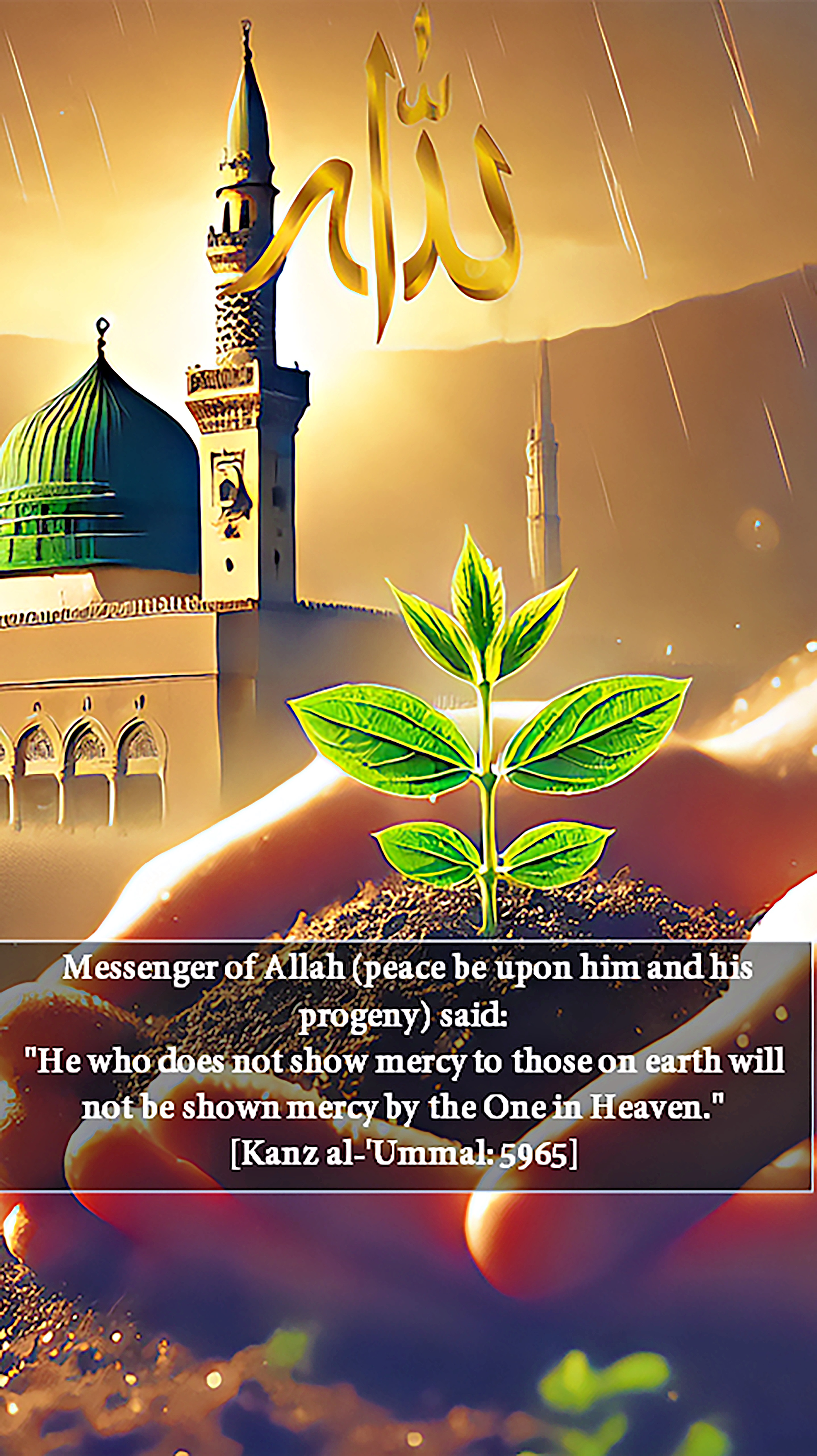
Prophet Muhammad (peace be upon him and his family) said, "When the Last Hour comes, if any of you happens to be holding a seedling in his hand, then if he is able to, let him not stand until he has planted it." (Kanz al-Ummal, no. 9056)
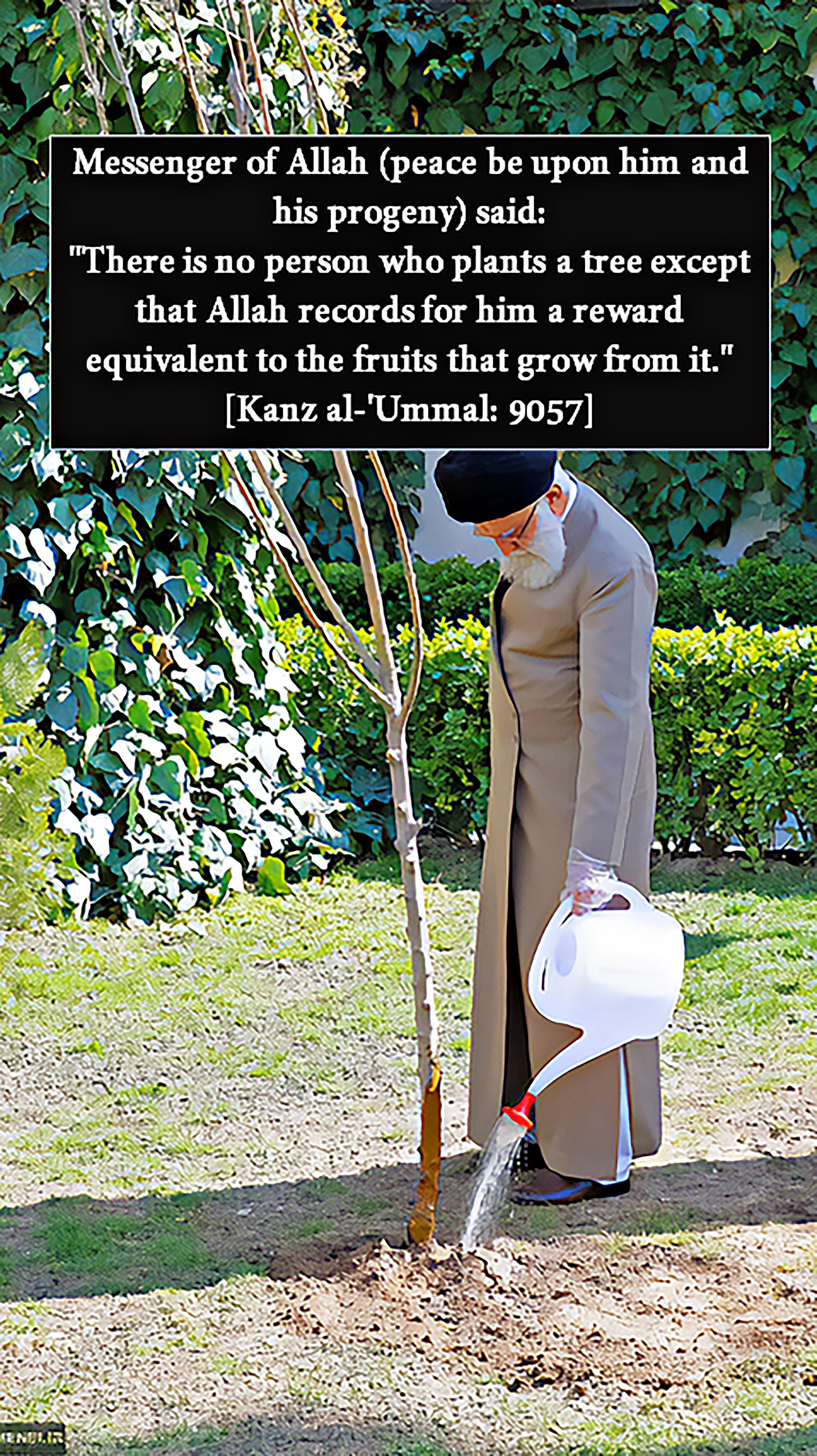
Prophet Muhammad (peace be upon him and his family) said, "Whoever plants a tree and patiently maintains it and tends to it until its fruition, every single fruit consumed from that tree is regarded by Allah as charity [on his behalf]." (Kanz al-Ummal, no. 9081)
A Form of Charity and Worship: The Prophet stated that "Every single Muslim that plants or cultivates anything of which humans, animals or birds may eat from is counted as charity towards them on his behalf." (Mustadrak al-Wasail, v. 13, p. 460, no. 15892).
Prophet Muhammad (peace be upon him and his family) said: "Any Muslim who plants a plant or sows a crop, and a person, bird, or animal eats from it, a charity will be recorded for him because of that." (Mustadrak al-Wasail by Mirza Husayn al-Nuri al-Tabrisi, Volume 13, Page 460)
Source of Best Wealth: When the Prophet was asked about the best wealth, he replied: "An agriculture that was cultivated by the hands of his farmer and he took care of it and paid its obligatory rights when he harvested it."
Promotion of Greenery and Environmental Stewardship
The Holy Qur’an frequently refers to the creation of gardens, crops, and natural bounties as signs of God's greatness and blessings for humanity. It encourages mindful interaction with these resources: Divine Provision and Guidance: The Qur’an states, "And He it is who causes gardens to grow, [both] trellised and untrellised, and palm trees and crops of different [kinds of] food and olives and pomegranates, similar and dissimilar. Eat of [each of] its fruit when it yields and give its due [zakah] on the day of its harvest. And be not excessive. Indeed, He does not like those who commit excess." (Qur’an 6:141). This verse underscores God as the ultimate provider and instructs humans to appreciate and share these blessings, while warning against extravagance.
Signs for Reflection: Another verse highlights the diversity within unity:
"And have you seen that [seed] which you sow?Is it you who makes it grow, or are We the grower?"(Qur’an 56:63 and 64)
"And within the land are neighboring plots and gardens of grapevines and crops and palm trees, [growing] several from a root or otherwise, watered with one water; but We make some of them exceed others in [quality of] fruit. Indeed in that are signs for a people who reason." (Qur’an 13:4). This calls for reflection on God's wisdom in creation.
God as the Grower: While humans work to sow seeds, it is ultimately God's favor and blessing that causes them to grow, reminding believers of their dependence on divine grace. "Indeed, Allah is the cleaver of grain and date seeds. He brings the living out of the dead and brings the dead out of the living. That is Allah; so how are you deluded?" (Qur’an 6:95).
"And Allah has caused you to grow from the earth a [progressive] growth." (Qur’an 71:17)
"He causes to grow for you thereby the crops, olives, palm trees, grapevines, and from all the fruits. Indeed in that is a sign for a people who give thought." (Qur’an 16:11)
The Prophet promoted agriculture and greenery, even allowing the cutting of trees in specific circumstances to facilitate flourishing agriculture and greenery. The overarching goal was to take "great steps towards promoting the prosperity of the Islamic land."
Responsible Utilization of Natural Resources: The Prophet laid down clear guidelines for the responsible use of the earth's resources, emphasizing a balance between enjoyment and preservation. Resources should be used in a sustainable, responsible, and beneficial to all of humanity manner.
Avoiding Waste and Extravagance: The Qur’an and Hadith strongly condemn waste and extravagance. "and eat and drink, but be not excessive. Indeed, He likes not those who commit excess." (Qur’an 7:31)
Prophet Muhammad (peace be upon him and his family) said, "There is nothing of good to be found in waste, and nothing of waste to be found in good." (Bihar al-Anwar, v. 77, p. 165, no. 2)
Prohibition of Corruption: The Qur’an also warns against "destroy[ing] crops and animals" through corruption, emphasizing preservation and improvement. "And when he goes away, he strives throughout the land to cause corruption therein and destroy crops and animals. And Allah does not like corruption." (Qur’an 2:205).
Rights of Farmers and Ethical Land Management
The Prophet placed a high value on the rights and dignity of those who worked the land:
He specifically advised Imam Ali (peace be upon him): “O Ali, you must not allow that farmers be oppressed before you; and you must not allow taxes on land to increase and you must not allow free labor on a Muslim” (meaning free labor when he is hired).”’ (Al-Kafi (Vol. 5) by Shaykh Mu?ammad b. Yaqub al-Kulayni, Book 2, Chapter 140, Hadith #2)
He encouraged actively seeking livelihood from the earth, stating, "Seek for your sustenance in the depths of the Earth." (Nahjul Fasahah, Fuqh AlQur’an, Volume 2, page 22)
Conditions for Benefiting from the Prophetic Example
The verse specifies that the exemplary role of the Prophet is particularly for those:
Whose hope is in Allah: Those who seek Allah's pleasure, mercy, and reward, not those whose concerns are limited to worldly matters.
And the Last Day: Those who believe in the Day of Judgment and the Hereafter, which makes them prepare for that day by following the path to salvation.
And who remembers Allah frequently: Those who live in a state of constant or frequent remembrance of Allah, making their hearts receptive to true guidance and
genuine emulation.
These three conditions indicate that truly aspiring believers, who are mindful of God and the afterlife, will actively seek to follow the Prophet's path. Emulating the Prophet is presented as a practical manifestation of one's faith, hope in God, and constant remembrance of Him.
From Reverence to Emulation: The Practical Application
The significance of the Prophet's life lies in its practical application. It is not sufficient to merely acknowledge his greatness; rather, believers are enjoined to study and actively emulate his behavior, character, and decisions.
The profound necessity of adhering to his example for salvation is underscored by the divine injunction: "Say, [O Muhammad], "If you should love Allah, then follow me, [so] Allah will love you and forgive you your sins. And Allah is Forgiving and Merciful." (Qur’an , 3:31). This indicates that following him is a direct demonstration of one's love and obedience to Allah.
Studying his character and conduct enables believers to learn valuable lessons and mold their own lifestyles to become more virtuous and lead a simpler life. A society cannot truly be Islamic unless its members sincerely tread his footsteps, heed his sayings, observe his glorious actions and attitudes, and, most importantly, follow them.
Achieving Perfection and Guidance
For those whose goal is the Hereafter and seeking God's pleasure, the sole path to achieving this is by following the Prophet in everything he commanded or prohibited. Emulating him is considered the best way to lead a righteous life and achieve true faith and guidance. This requires a deep understanding of his life and teachings, striving to imitate his actions not just in prayer, but in all aspects of life, including speech, actions, and transactions.
The Prophet embodied a climax of moral excellence and noble conduct. Key characteristics and virtues to study and emulate include:
Contemplation and Wisdom: He consistently contemplated Allah's greatness and the welfare of humanity, speaking precisely and meaningfully.
Punctuality and Orderliness: He led an active, energetic, and orderly life with a disciplined daily schedule.
Moral Excellence: He was a paragon of virtues such as modesty, truthfulness, kindness, patience, loyalty, honesty, courage, bravery, generosity, magnanimity, lenience, forgiveness, justice, and respect for all people.
Spiritual Values: His life teaches the importance of spiritual values, humility, selflessness, patience, faith, hope, and conviction in Allah, distancing oneself from worldly allurements.
The Qur’an ic declaration that Prophet Muhammad is "an excellent example" for believers establishes a comprehensive framework for Islamic life and spirituality. This is not merely a theoretical admiration but a call to active emulation in every dimension of human existence—from worship and ethics to social interactions, governance, and personal conduct.
The Prophet's life demonstrates that true greatness lies in humility, service, and devotion to Allah. His character, described by the Qur'an as "exalted," provides a practical blueprint for human perfection. His teachings on knowledge, intellect, struggle, and compassion offer guidance for navigating the complexities of human existence.
The conditions attached to the verse—hope in Allah, belief in the Last Day, and frequent remembrance of God—indicate that sincere emulation requires inner transformation and conscious effort. Those who meet these conditions will find in the Prophet a guiding light and a model for achieving spiritual growth, moral excellence, and ultimate success.
By actively reflecting on his life and lessons, believers can strive to be better individuals, make decisions aligned with spiritual values, and avoid ruin, thereby achieving safety, well-being, and true success. Prophet Muhammad (peace be upon him and his family) remains the "Noblest Exemplar" for humanity, his entire being a testament to the comprehensive moral and ethical teachings of Islam.
References:
Primary Sources
The Holy Qur'an
1. Qur'an 33:21 - "Indeed, in the Messenger of Allah, you have an excellent example"
2. Qur'an 23:1-2 - "Successful indeed are the believers, who are humble in their prayers"
3. Qur'an 31:18-19 - "And do not turn your cheek [in contempt] toward people..."
4. Qur'an 62:2 - "He raised up among the common people a Messenger..."
5. Qur'an 16:44 - "And We revealed to you the message that you may make clear..."
6. Qur'an 2:164 - Signs for people who use reason
7. Qur'an 17:36 - "And do not pursue that of which you have no knowledge"
8. Qur'an 29:69 - "And those who strive for Us - We will surely guide them..."
9. Qur'an 6:141 - "And He it is who causes gardens to grow..."
10. Qur'an 56:63-64 - "And have you seen that [seed] which you sow?"
11. Qur'an 13:4 - Signs for people who reason
12. Qur'an 6:95 - "Indeed, Allah is the cleaver of grain and date seeds"
13. Qur'an 71:17 - "And Allah has caused you to grow from the earth..."
14. Qur'an 16:11 - "He causes to grow for you thereby the crops..."
15. Qur'an 7:31 - "and eat and drink, but be not excessive"
16. Qur'an 2:205 - "And when he goes away, he strives throughout the land to cause corruption"
17. Qur'an 3:31 - "Say, [O Muhammad], 'If you should love Allah, then follow me'"
18. Qur'an 53:39 - "Man will not get anything unless he works hard"
Hadith Collections
Al-Kafi by Shaykh Mu?ammad b. Yaqub al-Kulayni
1. Volume 6, Page 271 - Imam Ja'far al-Sadiq (as) on the Prophet's humility
2. Volume 6, Book 5, Chapter 23, Hadith #2 - The Prophet eating like a servant
3. Volume 2, Page 121 - "Humbleness increases its owner in high standing"
4. Volume 1, Page 30, no. 1 - "Seeking knowledge is an obligation on every Muslim"
5. Volume 1, Book 2, Chapter 1, Hadith #5 - "Seeking knowledge is obligatory for every Muslim"
6. Volume 1, Page 48 - The Prophet on knowledge acquisition
7. Volume 8, Book 1, Chapter 394, Hadith #1 - Speaking to people according to their intellects
8. Volume 5, Book 2, Chapter 140, Hadith #2 - Advice on farmers' rights
Bihar al-Anwar
1. Volume 78, Page 200, no. 28 - Modesty increases conviction
2. Volume 1, Page 97, no. 8 - "The first thing that Allah created was the intellect"
3. Volume 77, Page 165, no. 2 - "There is nothing of good to be found in waste"
Kanz al-Ummal
1. no. 5757 - "Verily every religion has a natural disposition and the natural disposition of Islam is modesty"
2. no. 28697 - "Seek knowledge even in China"
3. no. 16357 - "The best form of charity is for the Muslim to gain knowledge..."
4. no. 28768 - "There is a support for everything, and the support for this religion is education"
5. no. 28798 - "The superiority of the scholar over others..."
6. no. 9056 - Planting a seedling at the Last Hour
7. no. 9081 - "Whoever plants a tree..."
8. no. 9200"Verily Allah, most High, loves to ..."
Other Hadith Collections
1. Wasail al-Shia Vol. 12, Section 1, Chapter 110, Hadith 15979 - "Modesty and faith are tied together"
2. al-Targhib wa al-Tarhib, v. 3, p. 558, no. 1 - "Allah revealed unto me that we should be humble..."
3. Nahj al Fasahah:
- Tradition No. 205, Page 35 - "An hour of seeking knowledge is better than praying one whole night"
- Tradition No. 207, Page 35 - "An hour of thinking is better than sixty years of praying"
- Tradition No. 125, Page 25 - "A scholar who avails himself of his own knowledge is superior..."
- Volume 1, Page 177 - "If a day comes upon me in which I do not increase in knowledge..."
4. Tafsir al-Durr al-Manthur, v. 3, no. 423 - Ink of scholars vs. blood of martyrs
5. al-Firdaws, v. 1, p. 234, no. 897 - "No one can support [the cause of] the religion of Allah..."
6. Aawali al-La ali, v. 1, p. 248, no. 4 - "The intellect is a light that Allah has created..."
7. Tuhaf al-Uqul, no. 54 - "Verily all good is grasped through the intellect..."
8. Rawdhat al-Wa'aizin, p. 9 - "The very basis of man is his intellect..."
9. al-Khisal, p. 30, no. 104 - "The best form of worship is to gain an understanding [of religion]"
10. Amali al-Tusi, p. 488, no. 1069 - "The quest for knowledge is incumbent upon every Muslim..."
11. Wasail ul Shia, Vol, P 122 - The greater struggle (jihad al-nafs)
12. Man La Ya?duruh al-Faqih (Vol. 3), Book 2, Chapter 13, Hadith #2 - Planting trees
13. Mustadrak al-Wasail, v. 13, p. 460, no. 15892 - Planting as charity
14. Mustadrak al-Wasail (Vol. 13), Page 460 - "Any Muslim who plants a plant..."
15. Al-Khisal, Book 11, Chapter 3, Hadith #10 - The creation of intellect
16. Uyun akhbar al-Rida (Vol. 2), Book 1, Chapter 1, Hadith #23 - Knowledge as treasure
17. Mizan al-Hikmah, Volume 3, Page 2067 - "The people closest to the level of prophethood..."
Secondary Sources
1. Lyali al Ekhbar, Vol. 2, P 272 - Ink of scholars vs. blood of martyrs
2. Nahjul Fasahah, Fuqh AlQur'an, Volume 2, page 22 - "Seek for your sustenance in the depths of the Earth"
Note: The document references both Shia and Sunni hadith collections, including:
- Al-Kafi (primary Shia hadith collection)
- Bihar al-Anwar (comprehensive Shia hadith encyclopedia)
- Wasail al-Shia (Shia hadith collection)
- Kanz al-Ummal (Sunni hadith collection)
- Tafsir al-Durr al-Manthur (Sunni tafsir)
- al-Targhib wa al-Tarhib (Sunni hadith collection)
- al-Firdaws (Sunni hadith collection)
- Mustadrak al-Wasail (Shia supplement)
- Man La Ya?duruh al-Faqih (Shia hadith collection)
- Al-Khisal (Shia hadith collection)
Qur'anic verses and hadiths of Ahl al-Bayt (peace be upon them) and sayings in Arabic, Persian and English.
https://eitaa.com/noorunalanoor
https://www.youtube.com/@110Inspire
https://youtube.com/@mustafaabbas4668?si=EnSIkaIECMiOmarE
https://youtube.com/@mustafaabbas8978?si=EMJylUW9_zruJx95