KhanwadeAbuTalib.com
Posted by Mustafa Abbas on August 21, 2026 | Views: 261 | Ratings: 270
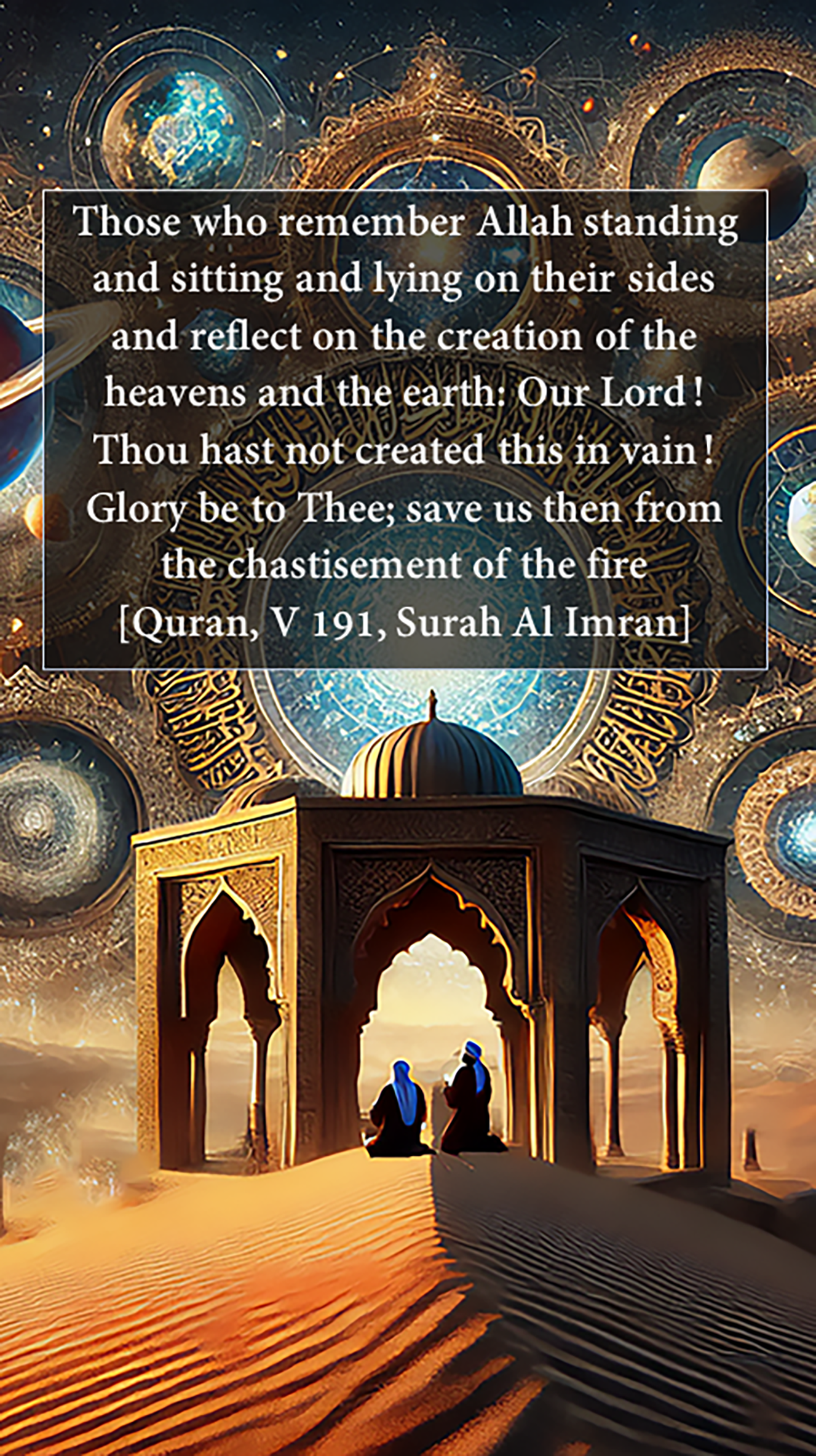
Download article from link below at the end
The Possessors of Intellect: A Comprehensive Study of Qur'an 3:191 and the Integration of Remembrance, Contemplation, and Divine Purpose
The Qur'anic verse 3:191 stands as one of the most profound and comprehensive descriptions of the spiritual and intellectual character of true believers. It states:
"Those who remember Allah while standing, sitting and lying on their sides, and meditate on the creation of the heavens and the earth, (seriously saying) 'Our Lord!
You have not created (all) this in vain! Glory be to you! Save us then from the torment of the Fire.'"
(Quran 3:191)
This verse, situated within Surah Al-Imran, encapsulates the essence of Islamic spirituality—a dynamic integration of continuous remembrance (dhikr), deep contemplation (tafakkur), theological conviction, and heartfelt supplication. The previous verse describes "the possessors of intellects" (ulu al-albab), those whose intelligence is not merely theoretical but is intimately connected with spiritual awareness and moral responsibility.
This article explores the multifaceted dimensions of this verse as elucidated through the teachings of the Qur'an, the prophetic traditions, and the profound insights of the Imams of the Ahl al-Bayt (peace be upon them). Drawing from the rich corpus of Islamic scholarship, we examine the nature of remembrance, the significance of contemplation, the conclusion that creation is not in vain, and the implications for the believer's relationship with Allah.
I. The Primacy of Intellect ('Aql) in Islamic Spirituality
The Intellect as the Foundation of Faith
Before examining the specific characteristics of "the possessors of intellects," it is essential to understand the foundational role of intellect ('aql) in Islam. The Prophet Muhammad (peace be upon him and his family) declared:
"The very basis of man is his intellect, and the man devoid of intellect has no religion."
(Rawdhat al-Wa’aizin, p. 9)
This profound statement establishes intellect not merely as a useful faculty but as the very foundation of human existence and religious commitment. Without sound intellect, one cannot properly understand, embrace, or practice faith in a meaningful way. Imam al-Sadiq (peace be upon him) further elaborated:
"Indeed, God, may His praise be exalted, created the intellect, and it was the first creation He created from the spiritual beings to the right of the Throne, from His light. He said to it, "Come forward," and it came forward. Then He said to it, "Go back," and it went back. Then God, blessed and exalted, said, "I created you as a magnificent creation and honored you above all My creation."
(Al-Khisal, volume: 2 pages: 589)
The intellect is described as a divine light created to illuminate the heart, enabling human beings to distinguish between the manifest and the unseen, between truth and falsehood. The Prophet (peace be upon him and his family) said:
"The intellect is a light that Allah has created for mankind and which He has ordained to illuminate the heart, in order that with it, he may know the difference between the visually manifest things and the unseen things."
(Aawali al-La’ ali, v. 1, p. 248, no. 4)
The Divine Address to the Intellect
A remarkable tradition from Imam al-Baqir (peace be upon him) describes the special status of the intellect:
"When God created the Intellect (al-`Aql), He examined it. Thereupon He said to it: `Come forward!' It came forward. Then He said: `Go back!' It went back. Thereupon He said: `By My power and majesty, I didn't create any creature dearer to me than thee! I will not make thee perfect except in one whom I love. Indeed, to thee are My orders and-prohibitions addressed. And for you are My rewards and retributions reserved."
(Selections-Usul-Al-Kafi-Al-Kulayni/1-Book-Intellect-Ignorance-Kitab-Al-Aql-Wa-Al-Jahl)
This narration establishes several critical points:
- The intellect is Allah's most beloved creation
- The perfection of intellect is reserved for those whom Allah loves
- Divine commands, prohibitions, rewards, and punishments are fundamentally tied to the intellect
- The intellect serves as the basis for human accountability
The Comprehensive Meaning of Intellect
As explained by Islamic scholars, the term 'intellect' ('aql) encompasses multiple dimensions:
First: The power to perceive good and evil, distinguish between them, and understand the causes of matters—this is the basis of religious obligation (taklif).
Second: A state and faculty that calls one to choose good and benefits while avoiding evil and harm.
Third: Understanding in the sense of knowledge, where intellect is contrasted with ignorance rather than insanity.
Imam al-Sadiq (peace be upon him) summarized five essential qualities for a meaningful life:
"Five things, whoever doesn't have them will not have much enjoyment: Intellect, manners, religion, generosity, and good character."
(Wasail al-Shia Vol. 15, Section 2, Chapter 8, Hadith 20296)
II. Continuous Remembrance of Allah (Dhikr) in All States
The Comprehensive Nature of Dhikr
The verse begins by describing those who "remember Allah while standing, sitting and lying on their sides." This comprehensive description emphasizes that remembrance is not confined to specific times, places, or postures but encompasses all states of human existence.
Imam al-Baqir (peace be upon him) provided profound insight into this continuous remembrance:
"The believer remains in a state of prayer as long as he is remembering Allah, whether he is standing, sitting or lying down. Indeed, Allah, the Mighty and Majestic, says: 'Those who remember Allah while standing or sitting or lying on their sides' [Quran, 3:191]."
(Amali al-Tusi, p. 79, no. 116)
This teaching expands the concept of prayer beyond the formal ritual (salat) to encompass a continuous spiritual state maintained through constant remembrance. Every moment of a believer's life can be transformed into an act of worship through this pervasive awareness of Allah.
Remembrance of Allah, according to the teachings of the Imams, is not limited to mere verbal recitation of phrases like "Glory be to Allah" or "Praise be to Allah." Rather, it encompasses a deeper and more comprehensive mindfulness:
- Mindfulness of Commands and Prohibitions: Remembering Allah in every situation means being mindful of Allah's commands and prohibitions in all aspects of life and striving to act accordingly. Imam al-Sadiq (peace be upon him) clarified what remembering Allah means:
"remembering Allah means when encountering what He has made lawful and unlawful - if it is an act of obedience, one performs it, and if it is an act of disobedience, one abandons it."
(Wasail al-Shia Vol. 15, Section 2, Chapter 23, Hadith 20428)
- A Barrier Against Sin: A crucial aspect of this remembrance is its role as a hindrance between a person and unlawful deeds. Imam Jafar al-Sadiq stated:
" Allah's remembrance becomes a barrier between him and that sin. This is in Allah's words "Indeed, those who fear Allah - when an impulse from Satan touches them, they remember [Allah] and at once they have insight" [Quran 7:201]."
(Wasail al-Shia Vol. 15, Section 2, Chapter 23, Hadith 20441)
- Constant Awareness: Imam al-Baqir emphasized that one should never neglect the remembrance of Allah in any situation. This demonstrates that remembrance is an everpresent state of the heart and mind, transcending physical conditions or environments.
Allah's Remembrance of His Servants
The reciprocal nature of remembrance is beautifully expressed in the Qur'anic verse: "Remember Me and I shall remember you" (2:152). Imam al-Baqir (peace be upon him) explained:
"Allah's remembrance of 'people who pray' is greater and superior to their remembrance of Him. Do you not observe that He has said (in the Noble Qur'an): {Remember Me and I shall remember you.}"
(Biharul Anwar, Volume 82, Page 199)
Imam Jaffar al-Sadiq (peace be upon him) elaborated:
"And let your remembrance of God be for the sake of His remembrance of you, for He remembers you even though He is independent of you. His remembrance of you is more sublime, more pleasing, and more complete than your remembrance of Him, and it precedes your knowledge of His remembrance of you."
(Bihar al-Anwar Volume: 93, Page: 158)
This reveals that the ability to remember Allah is itself a divine gift, stemming from Allah's prior remembrance and grace. The servant's remembrance is not an independent act but a response to Allah's initiative.
III. Contemplation on Creation (Tafakkur)
The Qur'anic Call to Contemplate
The verse continues by describing those who "meditate on the creation of the heavens and the earth." This deep contemplation (tafakkur) is central to the spiritual and intellectual journey of the believers.
The Qur'an repeatedly invites humanity to reflect on the signs of Allah in creation:
"Indeed, in the creation of the heavens and the earth and the alternation of the night and the day, there are signs for those of understanding." (Quran 3:190)
The concept of tafakkur—deep contemplation, meditation, and profound thinking—is an act encouraged by the Qur'an and emphasized in numerous narrations from the Ahl al- Bayt. Imam Ali (peace be upon him) said:
"Be aware! Knowledge without thinking has no profit! Be aware! Recitation of the Qur'an without reflection is of little use! Be aware! Worship lacking reflection has no effect!"
(Al-Kafi, Volume One, Page 36 and Tuhaful Uqul, Maani Al-Akhbar, page 226; Bihar Al-Anwar Volume 2, page 48-49, Aalamu Addeen, page 100, Mishkat Al-Anwar 137-138, Muniat Almureed 162.)
The Meaning and Significance of Tafakkur
Tafakkur is derived from the root word meaning to think deeply. It involves a state of deep contemplation and introspection, where one considers the mysteries of the universe, the meaning of divine revelations, and one's own existence and actions.
In the Qur'anic context, tafakkur specifically means:
Pondering on the creation of Allah—the heavens, the earth, and everything within the cosmos
Thinking deeply on the verses (ayat) of the Qur'an itself
Being considerate of everything in creation as signs pointing to the Creator
The Qur'an identifies numerous aspects of creation as divine signs (ayat):
- The Heavens and Celestial Bodies: The heavens are described as a protected canopy, adorned with stars, and governed by precise laws. The sun and moon move according to a fixed calculation. The Qur'an states:
"The sun and the moon move by precise calculation." (Quran 55:5)
Imam Ali (peace be upon him) said:
"These stars in the heaven are cities like the cities of earth. Each of the cities is connected (with the other cities) through a column of light."
(Safinat’ul-Bihar, volume 3, page 574. Tafseer Al-Qummi, vol 2, page 218.)
- The Earth as a Resting Place: The earth is described as a resting place, specially designed for human habitation. Imam Ali ibn al-Husayn (peace be upon him) explained:
"He [Allah] made it suitable for your nature and in harmony with your bodies. He did not make it severely hot and warm so it may burn you, nor severely cold so it may freeze you. Neither did He make it severely perfumed to give you headaches, nor did He make it terribly foul-smelling so it may sicken you. He neither made it severely soft like water so it may drown you, nor did He make it severely hard so it may obstruct you from making houses, buildings, and graves for your deceased. However, Allah made it with firmness so that you could benefit from it, enabling your bodies to walk upon it and your houses to hold together. He placed in it soft soil so that you could build your homes upon it, dig graves, and so that you could find other benefits."
(Al-Taw??d by Shaykh Mu?ammad b. ?Al? al-?aduq, Book 2, Chapter 62, ?ad?th #11)
- The Alternation of Night and Day: The continuous, rhythmic cycle of night and day is a profound sign of divine order and mercy. It provides rest and activity, light and darkness, enabling life to flourish.
- Water and Life: The Qur'an repeatedly emphasizes the water cycle, rain reviving dead earth, and the emergence of diverse life forms as signs of Allah's power and mercy.
- Human Creation and Diversity: The creation of human beings, the diversity of languages and colors, and the creation of spouses are all presented as signs for reflection.
Tafakkur as a Superior Form of Worship
The teachings of the Imams elevate tafakkur to a form of worship of the highest order. Imam al-Sadiq (peace be upon him) stated:
"The best worship is continuous/persistent contemplation about Allah and His power."
(Wasail al-Shia Vol. 15, Section 2, Chapter 5, Hadith 20260)
He also said:
"Thinking for an hour is better than worshipping for a year, for 'Only those who possess intellect take admonition.'"
(Bihar al-Anwar, v. 71, p. 327, no. 22)
Imam Ali (peace be upon him) declared:
"Pondering about the dominion of the heavens and the earth is the worship of the sincere ones."
(Ghurar al-Hikam, no. 1792)
This profound statement highlights the elevated status of intellectual reflection on the universe. According to Imam Ali, this act of contemplation is not merely a passive observation but a form of worship, specifically characteristic of those who possess sincerity.
The Distinction Between Tafakkur, Tadabbur, and Tadhakkur
Islamic scholarship distinguishes between closely related terms for reflection:
Tafakkur: General term for deep thinking and contemplation, involving the reordering of known matters to reach new conclusions. It is the search for understanding.
Tadabbur: Deeper, more nuanced understanding that considers the origin and consequences of a matter, particularly when reflecting on the Qur'an to unlock its hidden meanings.
Tadhakkur: Remembrance or attainment—the result and fruition of tafakkur. While tafakkur is the search for the Beloved, tadhakkur is the attainment of the Beloved.
Imam Khomeini explains:
"Tadhakkur stands above tafakkur, for verily tafakkur is the search (of the Beloved) and tadhakkur is the attainment (of the Beloved)."
"The strength and perfection of tadhakkur are dependent on the strength and perfection of tafakkur."
(Forty-Hadith-Exposition-Second-Revised-Edition-Sayyid-Ruhullah-Musawi-Khomeini/Eighteenth-Hadith)
While believers are encouraged to contemplate Allah's creation, they are cautioned against attempting to comprehend His essence. The Prophet Muhammad (peace be upon him and his family) said:
"Ponder about the creation of Allah, but do not ponder about Allah Himself lest you be ruined."
(Kanz al-Ummal, no. 5705)
Imam Muhammad Baqir (peace be upon him) advised:
"Beware of contemplating about Allah, but if you want to look at His greatness, then look at the greatness of His creation."
(Wasail al-Shia Vol. 16, Section 2, Chapter 23, Hadith 21327)
IV. The Conclusion: "Our Lord! You Have Not Created This in Vain!"
The Recognition of Purposeful Creation
The culmination of remembrance and contemplation is the profound realization: "Our Lord! You have not created (all) this in vain!" This declaration represents the intellectual and spiritual conclusion reached by those who truly reflect on creation.
The Qur'an consistently emphasizes that creation is not without purpose:
"We did not create the heavens and the earth and what is between them in play."
(Quran 21:16)
"We did not create them except with truth."
(Quran 44:39)
"Did you think that We created you in vain and that to Us you would not be returned?"
(Quran 23:115)
The term batil(vain) signifies falsehood, futility, play, or something devoid of real purpose. The verse rejects the notion that the universe is meaningless, accidental, or without ultimate direction.
Based on Qur'anic teachings, the purpose of creation encompasses several interconnected dimensions:
- Worship and Servitude: "I did not create the jinn and the humans except that they may serve Me" (Quran 51:56). This worship involves knowing Allah, which leads to proper worship.
- Manifestation of Divine Attributes: Creation serves as a manifestation of Allah's mercy, power, and wisdom. The universe and its contents are signs of His bounty and goodness.
- Accountability and Return: The purposeful nature of creation implies accountability. Humans were not created in vain but will be returned to Allah for reckoning.
- Learning and Perfection: The universe is a medium through which humans can learn lessons, attain Allah's pleasure, and safeguard themselves from His chastisement.
- Knowledge of Allah's Power and Knowledge: "It is Allah who has created seven heavens and of the earth, the like of them. [His] command descends among them so you may know that Allah is over all things competent and that Allah has encompassed all things in knowledge." (Quran 65:12).
The Logical and Theological Implications
The declaration "You have not created this in vain" leads to several significant theological conclusions:
- Afirmation of Divine Wisdom: Since Allah is abHakm (the AlkWise), His actions cannot be without purpose. Creating something in vain would be a deficiency, which is impossible for Allah.
- Affirmation of Divine Justice: Since Allah is al-'Adl (the Just), creation cannot conclude without moral accountability. The purposeful nature of creation implies ultimate justice.
- Affirmation of the Hereafter: Without a Hereafter, existence would indeed be in vain. The recognition of purposeful creation naturally leads to belief in resurrection and final judgment.
- Human Responsibility: The recognition of purpose implies that human deeds carry real consequences, and individuals are accountable for their choices.
Tafakkur Moves from Thought to Worship
One of the most crucial aspects of this Qur'anic model is that reflection does not remain an abstract intellectual exercise; it profoundly transforms into worship and moral action. The possessors of intellect are described as those who:
- Remember Allah in all states: standing, sitting, and lying down
- Reflect deeply on the creation of the heavens and the earth
- Conclude that creation is not in vain
- Glorify Allah (Subhanaka)
- Pray for salvation: "Save us then from the torment of the Fire"
This process of tafakkur yields several spiritual and moral fruits:
It cultivates humility before Allah
It reinforces the recognition of human accountability
It instills a wholesome fear of the Fire
It nourishes hope in divine mercy
It reorients one's life toward worship and obedience
V. "Glory Be to You!" — The Declaration of Divine Transcendence
The phrase "Subhanaka" — "Glory be to You" — is a quintessential expression of tanz?h, declaring Allah far above every deficiency, imperfection, or limitation. Creating something in vain, without wisdom, or without justice would undeniably constitute a defect.
The reflecting mind, comprehending Allah's absolute perfection, understands that such an act is impossible for Him. This declaration of divine glory is not merely praise; it is a rational and theological conclusion:
A wise Creator does not create absurdly
A just Creator does not create without consequence
Therefore, creation must be fundamentally tied to truth, purpose, and the ultimate return
The act of tasbih (glorifying) and tanzih (exalting) Allah forms the bedrock of authentic Islamic beliefs and thoughts, including:
Tawhid: Recognizing Allah as free from any taint of polytheism
Justice ('adl): Considering Allah as free from any form of injustice
Prophethood and Imamate: Affirming Allah's immunity from lacking purpose or a divine program to guide humanity
The Return (ma'ad): Knowing that Allah did not create in vain and that the world's end is not annihilation
Imam Ali (peace be upon him) taught:
"Reality of unity of God indicates that one shall not define His essence according to one's imaginations, and belief in His justice infers that one shall not accuse Him in any work."
(Nahjul Balaghah, Bihar Al-Anwar, vol 5, page 52. Aalamu Aldeen, page 318, Khasa'is Al-A'ima, page 124. Mutashabah AlQur'an, vol 1, page 105.)
Imam Jaffar al-Sadiq (peace be upon him), when asked to give proof that Allah is One, said,
"The continuous unity of management [in the cosmos] and the perfection of creation, as Allah, Mighty and Exalted, has said, “Had there been gods in them (i.e. the heavens and the earth) other than Allah, they would surely have fallen apart”[Qur’an 21:22].’
(al-Tawhid, p. 250, no. 2)
Imam al-Sadiq (peace be upon him) explained:
"[Faith in] Allah's divine Unity is that you do not deem applicable to your Lord that which applies to you, and [faith in] His divine Justice is that you do not blame Him for that which you are blameworthy."
(Maani al-Akhbar, p. 11, no. 2)
VI."Save Us Then from the Torment of the Fire" — The Turning to Divine Mercy
The Awareness of Accountability
The conclusion of the verse—"Save us then from the torment of the Fire"—demonstrates the profound awareness of accountability that accompanies true understanding. Those who recognize the purposefulness of creation also recognize the consequences of deviation from that purpose.
This supplication arises from:
- Awareness of human weakness: Despite understanding divine purpose, believers recognize their capacity for error and sin
- Recognition of divine justice: The Fire is a real consequence for those who deviate from the truth
- Hope in divine mercy: Despite the seriousness of accountability, believers turn to Allah seeking His protection and forgiveness
The Integration of Reflection and Supplication
The verse shows that intellectual reflection naturally leads to heartfelt supplication. Imam al-Sadiq (peace be upon him) explained that the possessors of intellect do not stop at philosophical reflection; they immediately convert understanding into worship and supplication.
The pattern established in this verse represents a complete spiritual journey:
- Remembrance (dhikr): Maintaining constant awareness of Allah
- Contemplation (tafakkur): Deep reflection on creation and its meaning
- Conviction: Recognizing the purposeful nature of creation
- Glorification (tasbih): Affirming Allah's perfection and transcendence
- Supplication (du'a): Seeking divine mercy and protection
The Practical Implications for Daily Life
The teachings derived from this verse have profound implications for the believer's daily existence:
- Transforming Ordinary Life into Worship: Through continuous remembrance, every moment and action can become an act of worship. As Imam al-Baqir taught, the believer remains in a state of prayer as long as they remember Allah.
- Cultivating Intellectual and Spiritual Awareness: Tafakkur should be a regular practice, involving deep reflection on creation, the Qur'an, and one's own existence and actions.
- Developing Tawhid Consciousness: Recognizing that creation is purposeful leads to a deeper understanding of Allah's unity, wisdom, and justice.
- Maintaining Moral Accountability: The awareness of divine purpose and ultimate accountability motivates ethical conduct and avoidance of sin.
- Practicing Humble Supplication: The journey from reflection to supplication cultivates humility before Allah and reliance on His mercy.
VII. The World: A Passage to the Hereafter
Imam Ali's Teaching on the Purpose of the World
Imam Ali (peace be upon him) provided profound insight into the relationship between this world and the Hereafter:
"World is created for another purpose, not for itself."
(Safinat’ul-Bihar, Bihar Al-Anwar vol70, page 133, Sharh Nahj Albalagha, vol 20, page 181, Nahj Albalagha page 557)
He elaborated:
"Verily Allah – glory be to Him – has made this world for what is after it and has put its inhabitants to trial so that He may know who from among them has the best deeds, and we have not been created for this world, nor have we been commanded to strive for it."
(Nahjul Balaghah, Letter 55)
This perspective establishes that the material world is not an ultimate goal but a means to achieve a higher, more significant objective. The world serves as a vehicle for human development, the expansion of justice, and the prosperity of all people.
The World as a Passage to the Hereafter
Imam Ali described the world as a "passage," a "thoroughfare," and a "road upon which people are passing." He advised:
"O people, certainly this world is a passage while the next world is a place of permanent abode. So, take from the passage (all that you can) for the permanent abode."
(Sermon 203 of Nahjul Balagha)
This means that individuals should focus on accumulating good deeds, positive influences, and sacrifices in this life to prepare for the eternal life in the Hereafter. The world is the time for deeds, not reckoning, while the Hereafter is the time for reckoning, not deeds.
The Hereafter is Secured Through the World
Imam Ali's profound statement, "The Hereafter is secured through the world," encapsulates a fundamental principle. This present life, with all its opportunities, challenges, and blessings, serves as the exclusive means and necessary preparation for achieving success and salvation in the Hereafter.
The Prophet Muhammad (peace be upon him and his family) stated:
"The world is the plantation for the Hereafter."
(Awali al-La’ali, v. 1, p. 267, no. 66)
This analogy means that our choices and actions in this life are like seeds we sow. Just as a farmer plants seeds and later harvests the crops, our deeds in this life will determine the harvest we reap in the afterlife.
The Significance of This Teaching for the Believer
Understanding the world as a passage to the Hereafter has several practical implications:
- Detachment from Worldly Attachments: The believer should not become overly attached to worldly gains or pleasures, as they are fleeting.
- Utilizing Blessings for the Hereafter: Worldly resources, talents, and opportunities are not merely for temporary enjoyment but are tools to earn divine pleasure and spiritual rewards.
- Maintaining Sincere Intention: The believer's actions should be performed with the intention of pleasing Allah and securing success in the Hereafter.
- Balancing Worldly and Spiritual Priorities: While engaging in worldly affairs, the believer maintains focus on the ultimate goal of eternal success.
VIII. The Role of Imam al-Sadiq's Argument Against "Nature"
The Challenge of Materialism
Imam al-Sadiq (peace be upon him) provided a powerful rational argument against those who attribute creation to "nature." This argument remains remarkably relevant to contemporary discussions about the origins of the universe and life.
When asked by Mufazzal about a group of people who claim that creation is the doing of nature itself, Imam al-Sadiq responded:
"Ask them about this nature: does it have knowledge and power to carry out such actions [as creation] or not? For if they answer that it has knowledge and power, then what is preventing them from acknowledging the existence of a creator? For verily this is His creation. If they claim that nature does these actions without knowledge or without purpose while having witnessed the exactness and wisdom therein, it is [obviously] known that this is the work of a very wise creator, and what they have called 'nature' is the very system running through creation."
(Bihar al-Anwar, v. 3, p. 67)
Imam al-Sadiq's argument presents a clear logical dilemma:
First Horn: If nature has knowledge and power sufficient to create and sustain the universe, then one is already describing something with the classical divine attributes. What they call "nature" is effectively the Creator under a different name.
Second Horn: If nature is blind, unconscious, and without purpose, then it cannot explain the order, precision, and wisdom evident in creation. Such features necessarily point to a wise and powerful Creator.
"Nature" as the System Running Through Creation
Imam al-Sadiq concluded that what people call "nature" is actually "the very system running through creation." This means that nature is not an independent creator but rather the way Allah's creative power appears and operates in the world.
This perspective affirms:
- The universe operates according to consistent laws established by Allah
- These laws are not autonomous but are maintained by divine will
- Observing order in nature leads to recognition of the Creator, not to a denial of Him
IX. The Egg Analogy: A Demonstration of Divine Design
The Egg as Evidence of Intelligent Design
Imam al-Sadiq (peace be upon him) used the analogy of an egg to demonstrate the existence of a wise and powerful Creator, particularly in his discourse with Abu Shakir al-Daisani.
The Imam described the egg in detail:
"this is a concealed stronghold. It has a solid cover, and inside the solid cover there is a soft layer. Inside the soft layer there is the egg yolk and the albumin. Neither does the egg yolk mix with the albumin, nor does the albumin mix with the egg yolk. Each remains in its state. No informer comes out of it to inform of its usefulness, nor has a defect informed of its decay. No one knows whether it will make a male or a female. Colours like that of the peacocks burst out of it. Do you not think that it is the product of a Planner [Mudabbir]?"
(Al-Kafi: vol. 1, pp 80)
After this detailed description, Imam al-Sadiq posed a direct question that do you not think that there is a creator for this?
The egg analogy illustrates divine design through several key aspects:
- Intricate and Purposeful Organization: The egg's multi-layered structure, from the hard shell to the delicate membranes and the two distinct, non-mixing liquids, demonstrates intricate organization that is far from random.
- Autonomous Development: The fact that a complex creature emerges from the egg without external interference highlights that the entire process is pre-programmed and guided by an internal blueprint.
- Necessity of a Creator: Imam al-Sadiq's rhetorical question challenges the notion that such complexity and purposeful development could arise spontaneously.
- Evidence of a Wise and Powerful God: The egg encapsulates profound evidence of a Creator's wisdom, precision, and power.
The Response of Abu Shakir al-Daisani
Confronted with this undeniable evidence of intelligent design, Abu Shakir al-Daisani was astonished. He bowed his head towards the ground, announced his repentance, embraced Islam, and declared:
"I bear witness that there is no God but Allah."
The egg analogy served as a clear and accessible proof of the existence of a wise, knowing, and powerful Creator.
X. The Importance of Knowledge and Understanding
Knowledge as a Fundamental Requirement
Islamic teachings emphasize that knowledge is essential for guidance, righteousness, and true understanding:
"Seeking knowledge is an obligation on every Muslim. Indeed how Allah loves those who strive in their quest for knowledge."
(al-Kafi, v. 1, p. 30, no. 1)
Prophet Muhammad (peace be upon him and his family) said,
"A little knowledge is better than a lot of worship."
(al-Mahajjat al-Baydha, v. 1, p. 22)
Imam Ali (peace be upon him) emphasized the connection between knowledge and meaningful worship:
"Allah is worshipped better by no means other than intelligence."
(al-Kafi by Shaykh al-Kulayni, Volume 1, Page 18)
"Worship without understanding is no good."
(Tuhaf al-Uqul, no. 204)
The teachings of the Imams warn against the consequences of neglecting knowledge and understanding:
Imam Ali declared:
"Be aware! Knowledge without thinking has no profit! Be aware! Recitation of the Qur'an without reflection is of little use! Be aware! Worship lacking reflection has no effect!"
(Al-Kafi, Volume One, Page 36 and Tuhaful Uqul, Maani Al-Akhbar, page 226; Bihar Al-Anwar Volume 2, page 48-49, Aalamu Addeen, page 100, Mishkat Al-Anwar 137-138, Muniat Almureed 162.)
This highlights that mere acquisition of knowledge, recitation, or ritualistic worship without deep thought is largely futile.
XI. Practical Applications for the Believer
Cultivating Continuous Remembrance
Based on the teachings examined, believers can cultivate continuous remembrance through:
- Regular Dhikr: Maintaining verbal and heart-based remembrance of Allah throughout the day
- Mindfulness of Allah's Presence: Being conscious of Allah's oversight in all actions and decisions
- Responding to Divine Signs: Recognizing and reflecting on the signs of Allah in creation
- Guarding Against Sin: Using remembrance as a barrier against unlawful deeds
- Integrating Dhikr into All States: Remembering Allah while standing, sitting, and lying down
Developing the Practice of Tafakkur
Believers can cultivate deep contemplation through:
- Regular Time for Reflection: Setting aside specific times, especially at night or before dawn, for silent contemplation and self-dialogue
- Contemplation on Creation: Reflecting on the heavens, the earth, the alternation of night and day, and other natural phenomena
- Self-Reflection: Examining one's own existence, actions, and intentions
- Study of the Qur'an: Reciting, reflecting, and pondering deeply on Qur'anic verses
- Learning from Parables and History: Deriving lessons from Qur'anic stories and historical events
Practical Steps for Spiritual Growth
- Seek Knowledge: Pursue religious knowledge and understanding as a continuous obligation
- Combine Knowledge and Action: Ensure that understanding leads to practical application and righteous conduct
- Maintain Sincerity: Cultivate pure intention in all acts of worship
- Practice Self-Accounting: Regularly review one's deeds, sins, and shortcomings
- Seek Forgiveness: Turn to Allah in repentance and seek His mercy and protection
- Balance Worldly and Spiritual Priorities: Utilize worldly blessings for the Hereafter while maintaining detachment from excessive worldly attachments
The Integrated Spiritual Vision of Qur'an 3:191
The verse 3:191 presents a comprehensive spiritual vision that integrates:
Intellectual engagement: Using the intellect to recognize divine signs in creation
Continuous remembrance: Maintaining constant awareness of Allah
Deep contemplation: Reflecting on the meaning and purpose of creation
Theological conviction: Recognizing that creation is purposeful and not in vain
Glorification: Affirming Allah's perfection and transcendence
Humble supplication: Turning to Allah seeking protection and mercy
The Possessors of Intellect as a Model
The "possessors of intellects" described in this verse represent the ideal model for believers. Their characteristics include:
- Integration of intellect and spirituality: Their intelligence is not separate from their faith but deeply connected to it
- Continuous spiritual awareness: Their remembrance of Allah is not confined to specific times but encompasses all states
- Deep reflection on creation: They contemplate the natural world as signs of the Creator
- Purposeful conviction: They recognize that existence has meaning and purpose
- Humble devotion: Their knowledge leads to glorification and supplication
The Qur'anic call to contemplate creation is not merely an intellectual exercise but a spiritual imperative. Through remembrance and reflection, believers come to recognize the purposeful nature of creation, the wisdom and justice of the Creator, and their own accountability. This recognition transforms ordinary existence into a continuous act of worship, leading to humility, gratitude, and a profound connection with the Divine.
Ultimately, the teachings derived from Qur'an 3:191 and the traditions of the Ahl al-Bayt point to the fundamental purpose of human existence: to know Allah, to worship Him, and to attain nearness to Him through conscious awareness, intellectual reflection, and righteous action. The world is a passage, and the Hereafter is the permanent abode. The believer's task is to use this passage to prepare for the eternal dwelling, recognizing that Allah has not created anything in vain.
May Allah grant us the intellect to understand His signs, the remembrance to remain aware of His presence, the reflection to recognize His wisdom, and the humility to turn to Him in supplication. Glory be to You! Save us then from the torment of the Fire.
References:
I. Quranic Verses (Primary Sources)
1. Quran 3:191 — "Those who remember Allah while standing, sitting and lying on their sides, and meditate on the creation of the heavens and the earth…"
2. Quran 2:152 — "Remember Me and I shall remember you."
3. Quran 3:190 — "Indeed, in the creation of the heavens and the earth and the alternation of the night and the day, there are signs for those of understanding."
4. Quran 7:201 — "Indeed, those who fear Allah – when an impulse from Satan touches them, they remember [Allah] and at once they have insight."
5. Quran 21:16 — "We did not create the heavens and the earth and what is between them in play."
6. Quran 21:22 — "Had there been gods in them (i.e. the heavens and the earth) other than Allah, they would surely have fallen apart."
7. Quran 23:115 — "Did you think that We created you in vain and that to Us you would not be returned?"
8. Quran 44:39 — "We did not create them except with truth."
9. Quran 51:56 — "I did not create the jinn and the humans except that they may serve Me."
10. Quran 55:5 — "The sun and the moon move by precise calculation."
11. Quran 65:12 — "It is Allah who has created seven heavens and of the earth, the like of them. [His] command descends among them so you may know that Allah is over all things competent and that Allah has encompassed all things in knowledge."
II. Hadith and Classical Scholarly Works
1. Rawdhat al-Wa‘aizin (The Garden of Preachers)
The Prophet Muhammad (peace be upon him and his family) said: "The very basis of man is his intellect, and the man devoid of intellect has no religion." (p. 9)
2. Al-Khisal (The Traits) – by Shaykh al-Saduq
Imam al-Sadiq (peace be upon him) said: "Indeed, God… created the intellect, and it was the first creation He created from the spiritual beings to the right of the Throne, from His light…" (vol. 2, p. 589)
3. Awali al-La ali (The Sublime Pearls) – by Ibn Abi Jumhur
The Prophet (peace be upon him and his family) said: "The intellect is a light that Allah has created for mankind and which He has ordained to illuminate the heart…" (vol. 1, p. 248, no. 4)
4. Usul al-Kafi (The Sufficient – Principles) – by al-Kulayni
Book of Intellect and Ignorance (Kitab al-Aql wa al-Jahl):
Imam al-Baqir (peace be upon him) said: "When God created the Intellect, He examined it. Thereupon He said to it: 'Come forward!' It came forward. Then He said: 'Go back!' It went back. Thereupon He said: 'By My power and majesty, I didn't create any creature dearer to me than thee!…'"
Imam Ali (peace be upon him) said: "Be aware! Knowledge without thinking has no profit! Be aware! Recitation of the Qur'an without reflection is of little use! Be aware! Worship lacking reflection has no effect!" (vol. 1, p. 36)
The Prophet (peace be upon him) said: "Seeking knowledge is an obligation on every Muslim. Indeed Allah loves those who strive in their quest for knowledge." (vol. 1, p. 30, no. 1)
Imam Ali (peace be upon him) said: "Allah is worshipped better by no means other than intelligence." (vol. 1, p. 18)
5. Amali al-Tusi (The Dictations of al-Tusi) – by Shaykh al-Tusi
Imam al-Baqir (peace be upon him) said: "The believer remains in a state of prayer as long as he is remembering Allah, whether he is standing, sitting or lying down…" (p. 79, no. 116)
6. Wasail al-Shia (The Means of the Shia)
Imam al-Sadiq (peace be upon him) said: "Five things, whoever doesn't have them will not have much enjoyment: Intellect, manners, religion, generosity, and good character." (vol. 15, Section 2, Chapter 8, Hadith 20296)
Imam al-Sadiq (peace be upon him) said: "Remembering Allah means when encountering what He has made lawful and unlawful – if it is an act of obedience, one performs it, and if it is an act of disobedience, one abandons it." (vol. 15, Section 2, Chapter 23, Hadith 20428)
Imam al-Sadiq (peace be upon him) said: "The best worship is continuous/persistent contemplation about Allah and His power." (vol. 15, Section 2, Chapter 5, Hadith 20260)
Imam Muhammad al-Baqir (peace be upon him) said: "Beware of contemplating about Allah, but if you want to look at His greatness, then look at the greatness of His creation." (vol. 16, Section 2, Chapter 23, Hadith 21327)
7. Bihar al-Anwar (The Oceans of Lights) – by al-Majlisi
Imam al-Baqir (peace be upon him) said: "Allah's remembrance of 'people who pray' is greater and superior to their remembrance of Him. Do you not observe that He has said: 'Remember Me and I shall remember you'?" (vol. 82, p. 199)
Imam Ja‘far al-Sadiq (peace be upon him) said: "And let your remembrance of God be for the sake of His remembrance of you, for He remembers you even though He is independent of you…" (vol. 93, p. 158)
Imam al-Sadiq (peace be upon him) presented the rational argument against those who attribute creation to "nature": "Ask them about this nature: does it have knowledge and power to carry out such actions or not?…" (vol. 3, p. 67)
Imam al-Sadiq (peace be upon him) said: "Thinking for an hour is better than worshipping for a year, for 'Only those who possess intellect take admonition.'" (vol. 71, p. 327, no. 22)
8. Al-Tawhid (On Divine Unity) – by Shaykh al-Saduq
Imam Ali ibn al-Husayn (peace be upon him) explained the purpose of the earth: "He [Allah] made it suitable for your nature and in harmony with your bodies…" (Book 2, Chapter 62, Hadith #11)
Imam Ja‘far al-Sadiq (peace be upon him) said: "[Faith in] Allah's divine Unity is that you do not deem applicable to your Lord that which applies to you, and [faith in] His divine Justice is that you do not blame Him for that which you are blameworthy." (p. 11, no. 2)
Imam Ja‘far al-Sadiq (peace be upon him), when asked to prove that Allah is One, said: "The continuous unity of management [in the cosmos] and the perfection of creation, as Allah has said: 'Had there been gods in them other than Allah, they would surely have fallen apart.'" (p. 250, no. 2)
9. Nahjul Balaghah (The Peak of Eloquence)
Imam Ali (peace be upon him) said: "Reality of unity of God indicates that one shall not define His essence according to one's imaginations, and belief in His justice infers that one shall not accuse Him in any work."
Imam Ali (peace be upon him) said: "World is created for another purpose, not for itself." (p. 557)
Imam Ali (peace be upon him) said: "Verily Allah – glory be to Him – has made this world for what is after it and has put its inhabitants to trial so that He may know who from among them has the best deeds, and we have not been created for this world, nor have we been commanded to strive for it." (Letter 55)
Imam Ali (peace be upon him) said: "O people, certainly this world is a passage while the next world is a place of permanent abode. So, take from the passage (all that you can) for the permanent abode." (Sermon 203)
10. Ghurar al-Hikam (The Exalted Aphorisms)
Imam Ali (peace be upon him) said: "Pondering about the dominion of the heavens and the earth is the worship of the sincere ones." (no. 1792)
11. Tuhaf al-Uqul (Gifts of the Intellects)
Imam Ali (peace be upon him) said: "Worship without understanding is no good." (no. 204)
12. Maani al-Akhbar (Meanings of the Traditions)
Imam al-Sadiq (peace be upon him) said: "[Faith in] Allah's divine Unity is that you do not deem applicable to your Lord that which applies to you, and [faith in] His divine Justice is that you do not blame Him for that which you are blameworthy." (p. 11, no. 2)
13. Safinat al-Bihar (The Ship of the Oceans)
Imam Ali (peace be upon him) said: "These stars in the heaven are cities like the cities of earth. Each of the cities is connected (with the other cities) through a column of light." (vol. 3, p. 574)
14. Tafsir al-Qummi (The Exegesis of al-Qummi)
Imam Ali (peace be upon him) said: "These stars in the heaven are cities like the cities of earth…" (vol. 2, p. 218)
15. Kanz al-Ummal (The Treasure of the Workers)
The Prophet Muhammad (peace be upon him and his family) said: "Ponder about the creation of Allah, but do not ponder about Allah Himself lest you be ruined." (no. 5705)
16. Mishkat al-Anwar (The Niche of Lights)
Imam Ali (peace be upon him) said: "Be aware! Knowledge without thinking has no profit!…" (pp. 137–138)
17. Muniat al-Murid (The Aspiration of the Seeker)
Imam Ali (peace be upon him) said: "Be aware! Knowledge without thinking has no profit!…" (p. 162)
18. A‘lam al-Din (The Signs of Religion)
Imam Ali (peace be upon him) said: "Be aware! Knowledge without thinking has no profit!…" (p. 100)
19. Al-Mahajjat al-Baydha’ (The White Path)
The Prophet (peace be upon him) said: "A little knowledge is better than a lot of worship." (vol. 1, p. 22)
20. Awali al-La’ali (The Sublime Pearls)
The Prophet Muhammad (peace be upon him and his family) said: "The world is the plantation for the Hereafter." (vol. 1, p. 267, no. 66)
III. Other Sources
Imam Khomeini, Forty Hadith: Exposition of the Eighteenth Hadith – discusses the distinction between tafakkur (deep contemplation), tadabbur (profound reflection), and tadhakkur (remembrance/attainment), explaining that "Tadhakkur stands above tafakkur, for verily tafakkur is the search (of the Beloved) and tadhakkur is the attainment (of the Beloved)."
Qur'anic verses and hadiths of Ahl al-Bayt (peace be upon them) and sayings in Arabic, Persian and English.
https://eitaa.com/noorunalanoor
https://www.youtube.com/@110Inspire
https://youtube.com/@mustafaabbas4668?si=EnSIkaIECMiOmarE
https://youtube.com/@mustafaabbas8978?si=EMJylUW9_zruJx95