KhanwadeAbuTalib.com
Posted by Mustafa Abbas on September 05, 2026 | Views: 326 | Ratings: 126
Download article from link below at the end
The Sword of Transgression: Divine Justice and the Consequences of Oppression in Islamic Teachings
Introduction
The Islamic tradition contains a profound body of wisdom regarding justice, oppression, and the inevitable consequences of transgression. Central to this corpus is the statement attributed to Imam Ali ibn Abu Talib (peace be upon him), the Commander of the Faithful: "Whoever draws the sword of aggression will be killed by it [himself]." This article explores this saying and the broader Islamic framework of justice, oppression, and divine retribution as presented in the provided source material.
The Core Saying and Its Significance
Imam Ali (peace be upon him) said: "Whoever draws the sword of transgression will be killed by it [himself]."
[Nahj al-Sa’ada, v. 1, p. 52]
Another formulation presented is:
"He who draws out the sword of revolt gets killed with it."
[Nahj al-Balagha: Wisdom 349]
The term baghy in this context refers to transgression or aggression, defined as exceeding limits driven by desire or greed, leading to enmity and injustice. In a broader Islamic context, al-Baghi can also refer to one who rebels or resists the authority of an Imam, a spiritual leader.
Meaning of the Saying
The saying conveys that a person who initiates aggression, injustice, or rebellion will ultimately become a victim of their own actions. The "sword of transgression" serves as a powerful metaphor for any act of injustice, hostility, or exceeding rightful bounds. It implies that the very means or methods used to harm others will, in due course, turn against the perpetrator, leading to their downfall or destruction.
This aphorism serves as a strong warning that ill deeds and oppressive actions inevitably rebound on the one who commits them, highlighting a universal law of consequence where the aggressor faces the same fate they inflict upon others.
Origin of the Saying
The saying is attributed to Imam Ali ibn Abu Talib (peace be upon him), the Commander of the Faithful (Amir Al-Momineen). It is recorded in several esteemed Islamic sources:
- Nahj al-Saada, volume 1, page 52
- Mizan ul Hikmah, Volume 1, Page 278
- Nahj al-Balaghah
- Bihar Al-Anwaar, Volume: 75, Page: 276
The consistent attribution to Imam Ali (peace be upon him) across these multiple sources underscores its significance within Shia Islamic tradition as a pivotal ethical and jurisprudential principle.
The Concept of Baghy (Transgression/Aggression)
The term baghy refers to exceeding limits driven by desire or greed, which leads to enmity and injustice. It is a transgression that causes people to act unfairly and harm others. In a broader Islamic context, al-Baghi can refer to one who rebels or resists the authority of an Imam, a spiritual leader. This definition extends to an armed revolt by a group against a just and legitimate government, intimidation of the general public, and pursuit of divisive political goals that damage national unity.
The context implies that the rebellion is against a just Imam or government, highlighting the grave nature of such an act within Islamic jurisprudence, as it undermines legitimate spiritual and temporal authority and societal stability.
Teachings of Imam Ali (peace be upon him) on Aggression and Injustice
Self-Destructive Nature of Aggression
Amirul Momineen Imam Ali (peace be upon him) frequently emphasized the self-destructive nature of aggression and tyranny:
- Self-inflicted destruction:
Imam Ali (peace be upon him) said: "Whoever draws the sword of agression will be killed by it [himself]." [Nahj al-Sa’ada, v. 1, p. 52]
This directly links the instrument of oppression to the oppressor's own demise.
- Ruin by one's own tyranny:
Imam Ali (peace be upon him) said: "The one who tyrannises others is ruined by his own tyranny." [Ghurar al-Hikam, no. 7835]
This signifies that the act of tyranny itself contains the seeds of the oppressor's downfall.
- Breaking and humiliation:
Imam Ali (peace be upon him) said: "Whoever acts tyrannically will be broken." [Ghurar al-Hikam, no. 7697]
- Imam Ali (peace be upon him) said: "Allah will humiliate and depose whoever acts tyrannically." [Ghurar al-Hikam, no. 8471]
These statements underscore that divine consequence for tyranny is not merely ruin but also humiliation and removal from power.
- Wrongdoing as a dangerous mount:
Imam Ali (peace be upon him) said: "The one who takes wrongdoing as a mount is thrown off by it." [Ghurar al-Hikam, no. 5391]
This illustrates that relying on injustice as a means to power or progress will inevitably lead to a fall.
- Aggression brings destruction: A concise yet profound saying from Imam Ali (peace be upon him) is
"Agression brings about destruction." [Ghurar al-Hikam, no. 795]
making it clear that aggression is a direct path to ruin.
- Igniting a troubling test:
Imam Ali (peace be upon him) said: "He who ignites the fire of a troubling test will become its firewood." [Ghurar al-Hikam, no. 10109]
suggesting that those who initiate strife and tribulation will themselves be consumed by it.
- Fear of retaliation:
Imam Ja’far Sadiq (a.s.) narrates that Amirul Momineen (a.s.) said, “One who oppresses people, fears retaliation."
[Thawab al-A mal wa iqab al-A mal by Shaykh Muhammad b. Ali al-Saduq, Book 3, Chapter 118, Hadith #11]
indicating an inherent psychological burden and anticipation of adverse consequences that oppressors live with.
- Divine annihilation of tyrants:
Imam Ali (peace be upon him) said: "Beware of behaving tyrannically with the servants of Allah, for [eventually] Allah annihilates every tyrant.’"
[Ghurar al-Hikam, no. 2695]
The Severity of Justice for the Wrongdoer
Imam Ali (peace be upon him) emphasized the severity of divine justice:
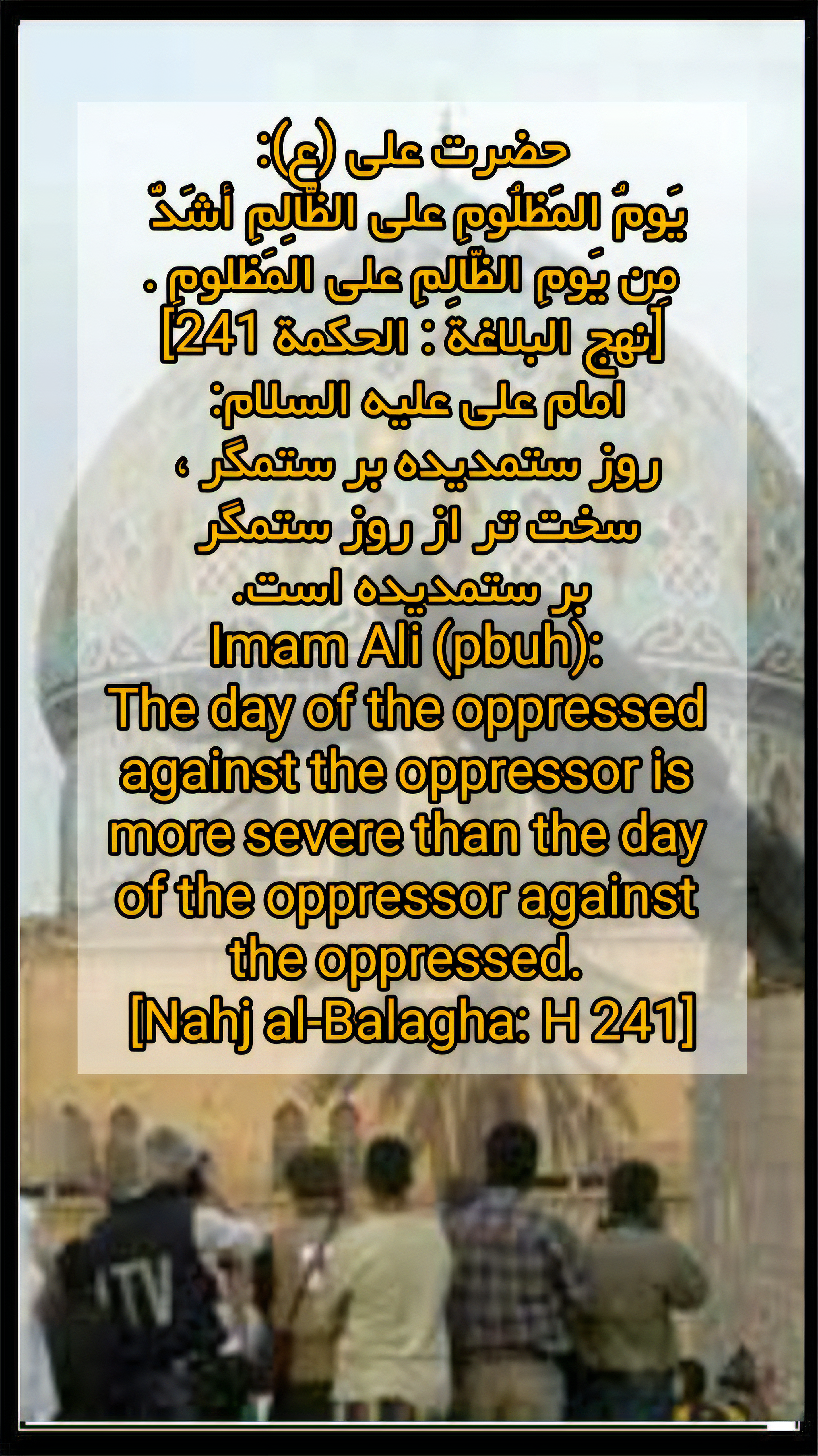
"The day that justice is brought to the wrongdoer is much more severe than the day oppression is done unto the oppressed." [Nahjul Balaghah, Saying 241]
This highlights the harsh reality of accountability.
Characteristics of an Oppressor
Imam Ali (peace be upon him) defined an oppressor by three signs:
- Oppresses those who are higher than him through opposition and disobedience
- Oppresses those who are inferior to him through violence and predominance
- Cooperates with other oppressors
Teachings of Imam Jafar al-Sadiq (peace be upon him)
Imam Jafar al-Sadiq (peace be upon him) also provided profound insights into the long-term consequences of oppression, emphasizing how it rebounds upon the oppressor or their lineage:
Reversal of Fortunes
Imam Jafar al-Sadiq (peace be upon him) said: "Whoever wrongs someone through oppression, Allah will send someone to oppress him similarly, or his children, or his descendants after him."
[Wasa'il al-Shia Vol. 16, Section 1, Chapter 77, Hadith 20952]
This implies that oppression will ultimately lead to a reversal of fortunes and the oppressor will be subject to the same kind of treatment they inflicted on others.
Allah Appoints an Oppressor
If one oppresses someone, Allah will appoint an oppressor upon him or upon his children. This shows a direct divine mechanism for retribution where the oppressor is made to taste their own medicine, often through others. Similarly,
Imam Jafar al-Sadiq (peace be upon him) said: "Whoever makes excuses for an oppressor's oppression, Allah will empower someone to oppress him. If he then supplicates, his supplication will not be answered, and Allah will not reward him for his oppression."
[Wasa'il al-Shia Vol. 16, Section 1, Chapter 80, Hadith 20966]
Harvesting What is Sown
Man harvests the same crop that he sows!
- Surah al-Shura (Quran 42:40):
“Whoever desires the harvest of the Hereafter - We increase for him in his harvest. And whoever desires the harvest of this world - We give him thereof, but there is not for him in the Hereafter any share.”
Imam Ali (peace be upon him) said: "Whatsoever you send in advance shall be reserved for you, and whatsoever you postpone, its benefit would be only for the others (and its responsibility is your burden)"
[Nahjul Balaghah. Sharh Nahjul Balaghah, vol 18, page 41. Girar Al-Hikam, page 104.]
Sowing bitter seeds one cannot harvest sweet and sowing sweet the crop will not be bitter! This signifies that oppressive actions inevitably yield bitter consequences for the doer.
Swift Punishment for Oppression
Prophet Muhammad (peace be upon him and his family) said: "The evil deed to be punished the quickest is agression." [al-Kafi, v. 2, p. 327, no. 1]
Prophet Muhammad (peace be upon him and his family) said: "The quickest evil to be punished is oppression. (by Allah (swt) in the Hereafter)"
[Man La Yahduruh al-Faqih (Vol. 4) by Shaykh Muhammad b. Ali al-Saduq, Book 1, Chapter 175, Hadith #5802]
highlighting the immediacy of divine retribution for this grave sin.
From Abdullah bin Maymun, from Ja'far bin Muhammad, from his forefathers (peace be upon them) who said: The Messenger of Allah (peace be upon him and his family) said: "Indeed, the quickest evil to be punished is transgression."
[Wasa'il al-Shia Vol. 16, Section 1, Chapter 74, Hadith 20922]
Allah Champions the Oppressed
Allah will turn the person's oppression against them, and Allah will champion the one who faced the other's oppression. And one whom Allah champions will always win.
Divine Warning Against Harming Believers
Imam Jafar al-Sadiq (peace be upon him) said: "Allah, Mighty and Exalted, said, ‘Let a man who harms a believing servant of Mine expect a war waged by Me’."
[al-Kafi, v. 2, p. 350, no. 1]
This signifies that harming a believer is an act of aggression against Allah Himself, leading to divine warfare against the oppressor.
Quranic Themes on Oppression and Justice
Quran 35:43: The Recoil of Evil Plots
A key Quranic verse that resonates with Imam Ali's saying is Surah Fatir (35:43):
"[Due to] arrogance in the land and plotting of evil; but the evil plot does not encompass except its own people. Then do they await except the way of the former peoples? But you will never find in the way of Allah any change, and you will never find in the way of Allah any alteration."
The key phrase translated as "the evil plot does not encompass except its own people" or "the evil plot does not encompass except its own people" means that the consequences of evil plotting return to and entrap their authors. While evil plots might temporarily affect others, their ultimate effect is self-destructive, leading to the plotters' disgrace and divine punishment.
“But the evil plot does not encompass except its own people”
This is the central principle.
The word Yahiqu means to surround, encircle, or close in on something from every direction, like a trap or a net.
So the meaning is:
An evil scheme becomes a trap that surrounds only the one who made it.
A person may plot evil against others. That plot may cause temporary harm. But its final and complete consequence returns to the plotter. The evil planner falls into his own trap. His plan becomes the cause of his own disgrace, ruin, and punishment.
This is a moral and spiritual law in the Quran:
- A liar is eventually destroyed by his own lies.
- A deceiver is eventually caught in his own deception.
- A tyrant is eventually crushed by the very system of oppression he built.
“But you will never find in the way of Allah any change, and you will never find in the way of Allah any alteration.”
This reinforces the previous point.
The phrase “the way of Allah” here means God’s established practice and law in dealing with nations and individuals.
Two words are used:
- Change (tabdil) – meaning the law itself cannot be replaced with something else.
- Alteration (tahwil) – meaning the law cannot be diverted or turned away from its target.
In other words:
God’s laws of justice are consistent. They do not change over time, and they cannot be avoided or redirected.
Just as physical laws govern the universe, God has moral and historical laws. One of them is that arrogance and evil plotting lead to downfall. No one can make an exception. No one can escape.
Quran 2:194: Response According to Injury
"whoever then acts aggressively against you, inflict injury on him according to the injury that he has inflicted on you, and be careful (of your duty) to Allah and keep in mind that Allah is with those who guard (themselves against evil)."
This verse establishes that while a response to aggression is permitted, it must be strictly limited "according to the injury" inflicted, emphasizing proportionality.
The principle of proportionality
The verse teaches one of the central principles of justice in Islam:
Punishment or retaliation must be equal to the offense—not greater.
This is also reflected in other verse:
- Surah al-Nahl (Quran 16:126):
“And if you punish, punish with an equivalent of that with which you were afflicted. But if you are patient, it is better for the patient.”
So the Quran allows justice, but it repeatedly reminds that forgiveness and patience are superior.
Quran 5:45: The Principle of Proportional Retaliation
"And We prescribed to them in it that life is for life, and eye for eye, and nose for nose, and ear for ear, and tooth for tooth, and (that there is) reprisal in wounds; but he who foregoes it, it shall be an expiation for him; and whoever did not judge by what Allah revealed, those are they that are the unjust."
This verse establishes the principle of exact correspondence in punishment—"a life is for a life, an eye for an eye"—while simultaneously encouraging pardon, which is described as an expiation for one's own sins.
God’s law is based on:
- Justice
- Proportionality
- Protection of life
- Limiting revenge
- Encouraging mercy
When humans replace that with laws based on bias, favoritism, bribery, or excessive punishment, they create oppression.
Quran 2:178-179: Retaliation and the Preservation of Life
"O you who believe! retaliation is prescribed for you in the matter of the slain, the free for the free, and the slave for the slave, and the female for the female, but if any remission is made to any one by his (aggrieved) brother, then prosecution (for the bloodwit) should be made according to usage, and payment should be made to him in a good manner; this is an alleviation from your Lord and a mercy; so whoever exceeds the limit after this he shall have a painful chastisement."
"And there is life for you in (the law of) retaliation, O men of understanding, that you may guard yourselves (against evil)."
The philosophy of qisas is that knowing the precise nature of the punishment for a crime acts as a deterrent, preserving lives and maintaining societal order.
Because:
- When a potential murderer knows he will face equal punishment, he is deterred.
- When society has a just system of retribution, people do not need to take revenge themselves.
- When punishment is limited and controlled, endless cycles of killing stop.
So the death penalty, when applied with strict justice and the option of mercy, protects the lives of society.
Quran 5:2: Cooperation in Righteousness, Not Sin
"And cooperate in righteousness and piety, but do not cooperate in sin and transgression; and be careful of (your duty to) Allah; surely Allah is severe in requiting evil."
The Command to Cooperate in Righteousness and Piety
The first part of the verse establishes a positive obligation: "cooperate in righteousness and piety." This calls upon believers to actively engage in mutual assistance and collaboration for the betterment of society and the fulfillment of divine commands.
- Meaning of Righteousness (Birr): Righteousness, in this context, encompasses belief in God and the performance of good deeds, including acts of worship and just dealings with others. It refers to the "collective good and piety."
- Meaning of Piety (Taqwa): Piety, or God-wariness (at-Taqwa), means to be on one's guard regarding orders and prohibitions of Allah. It is a state of conscious adherence to divine guidance and a fear of displeasing Allah.
- Essence of Cooperation: To cooperate in righteousness and piety means to join together in true faith and good deeds on the basis of the fear of Allah. This implies working together towards shared goals that are morally sound, just, and aligned with Islamic teachings. The text highlights that life is not possible without cooperation and that God explicitly commands it.
- Practical Manifestations: This cooperation is vital in all aspects of an Islamic society. Examples provided include building mosques and schools, helping the needy, fighting oppression, establishing economic, social and cultural associations. These are considered forms of constructive cooperation within the community.
- Interpersonal Relations: Beyond societal structures, this command also extends to individual interactions. Muslims are encouraged to work assiduously to maintain good relations, to cooperate in kindness and assistance for the needy and to be compassionate to each other. This fosters a supportive and harmonious community, fulfilling Allah's directive for believers to be compassionate to each other.
The Prohibition Against Cooperating in Sin and Transgression
The verse then establishes a clear prohibition: "but do not cooperate in sin and transgression." This forbids believers from engaging in any collaboration that leads to evil, injustice, or violation of rights.
- Meaning of Sin (Ithm): Sin is defined as "the evil action which brings regression in a blissful life." It encompasses any act that goes against Allah's commands and leads to moral or spiritual decline.
- Meaning of Transgression/Aggression (Udwan): Transgression or aggression is explained as usurping peoples genuine rights, giving rise to a feeling of insecurity for their lives, honour or property. This refers to acts of hostility, injustice, and violation of the legitimate rights of others.
- Avoiding Wrongdoing: This prohibition means that Muslims "should not cooperate or assist one another in committing sinful or aggressive acts." Instead, they are to "help and support one another in doing good and righteous deeds." The emphasis is on avoiding any form of joint effort that results in harm or wrongdoing.
- Enjoining Good and Forbidding Evil: The importance of this prohibition is further underscored by the principle of enjoining good and forbidding evil. Imam Hussain (a.s.) stated that Allah began with commanding good and forbidding evil as an obligation from Him,
Imam Hussain (peace be upon him) said: "Allah, firstly mentioned, 'command for good and forbid to do evil' as one of His obligatory services, since, He knew that if these two obligatory are performed and established, all the obligatory services out of easy and hard will get performed and established. Because, 'command for good and forbid to do evil' invites to Islam, along with giving out the right of those having right and opposing of the tyrants and oppressors" [Tuhaf al-Uqul. P 237]
This signifies that preventing cooperation in sin and aggression is crucial for upholding all divine duties and ensuring justice in society.
The Warning: "And be careful of (your duty to) Allah; surely Allah is severe in requiting evil"
The concluding part of the verse serves as a potent warning and a deterrent, highlighting the divine consequences of disregarding these commands.
- Emphasizing God-consciousness: The phrase be careful of (your duty to) Allah (or "fear Allah") reinforces the overarching principle of taqwa. This instruction is particularly significant as it suggests a potential likelihood of the audience rejecting or hesitating to follow the order, thereby necessitating a stern reminder.
- Severity of Divine Punishment: The statement "surely Allah is severe in requiting evil" emphasizes the gravity of disobeying these directives. It indicates that Allah will impose severe punishment upon those who choose to cooperate in sin and transgression or neglect their duty to cooperate in righteousness and piety. This serves as a strong motivation for believers to adhere strictly to the divine commands.
- Reinforcing Accountability: This final clause is described as an "emphasis over emphasis," firmly establishing the validity and seriousness of the preceding commands. It warns disobedient individuals of the consequences of their actions, ensuring that believers understand that their conduct, especially in matters of social cooperation, is under divine scrutiny and will be justly recompensed.
This verse establishes a general ethical principle governing all social relations: Muslims are ordered to cooperate in good causes but forbidden to participate in anything that endorses or supports aggression, unfair treatment, or sinful actions.
Quran 11:113: Prohibition Against Inclining to the Unjust
"And do not incline to those who are unjust, lest the fire touch you, and you have no guardians besides Allah, then you shall not be helped."
This verse conveys a profound prohibition regarding any form of association or support for oppressors. The phrase "do not incline to those who are unjust" is interpreted broadly to include:
- Hearty inclination and approval of oppressors
- Support and alignment with them
- Active participation in their acts
- Loyalty and dependence
- Wishing for their survival
- Praise and humbling before them
The verse underscores that any inclination towards the unjust carries severe divine consequences: punishment by fire, loss of divine protection and help, and being classified as a capital sin.
Quran 16:90: The Comprehensive Charter of Justice
"Verily, Allah enjoins justice and kindness (to others) and giving (the right of) the kindred, and forbids lewdness, and evil and insolence; He admonishes you so that you might remember."
This verse is considered a comprehensive charter of Islamic teachings regarding social, humanitarian, and ethical matters. Here, baghy (insolence) refers to any violation of one's own rights, oppression, and self-admiration with regards to others. It emphasizes universal justice as the law around which creation runs, with kindness to complement justice in exceptional circumstances.
Islamic Principles of Self-Defense and Proportionality
Distinction Between Defensive Force and Unlawful Aggression
Islamic teachings clearly distinguish between legitimate self-defense and unlawful aggression. The Quran permits fighting in self-defense but strictly within limits:
"And fight in the cause of Allah (against) those who fight you, but be not aggressive, for surely Allah loves not the aggressors." (Surah Al-Baqarah, 2:190)
This verse instructs Muslims not to initiate war unless opponents use weapons, making it clear that civil people, including women and children, are not to be invaded.
Prophet Muhammad (peace be upon him and his family) maintained a principle of not initiating aggression, with all his wars being defensive. Imam Ali (peace be upon him) further exemplified this by instructing his soldiers:
Imam Ali (peace be upon him) said: "Do not fight them unless they initiate the fighting, because, by the grace of Allah, you are in the right, and to leave them until they begin the fighting will be another proof for your side’s right against them. If, by the will of Allah, the enemy is defeated, then do not kill the one who runs away nor strike a helpless person nor finish off the wounded nor inflict harm on women." [Nahjul Balaghah, Letter 14]
The Necessity of Proportionate Retaliation
Even when force is permitted in self-defense, retaliation must remain proportionate and just. The Quran (2:194) states that if someone acts aggressively, the response must be limited to the injury that was inflicted, and Muslims should remain mindful of God and avoid exceeding justice.
This principle emphasizes "an eye for an eye, a tooth for a tooth," but strictly within the bounds of equality and justice. Imam Ali (peace be upon him) demonstrated this commitment to justice and mercy even towards his assassin, instructing his sons to only kill the actual killer and to give him only one stroke, exactly as he had been struck, if he did not survive.
Forgiveness and Forbearance
While retaliation is permitted within the bounds of proportionality, Islamic teachings also highly encourage forgiveness and forbearance. The Quran encourages the victim to forgo their right of retaliation and either forgive the criminal or settle for monetary compensation (diyyah). Forgiving can be an expiation for one's own sins.
The Nature of Injustice (Zulm) in Islamic Theology
Definition and Forms of Injustice
In Islamic theology, injustice or oppression (Zulm) is fundamentally defined as "putting or placing anything at an improper or unfitting place." The gravest form of injustice is considered to be associating partners with Allah (Shirk), as stated, "Surely, the association (Shirk) is a gross injustice."
My father narrated to us. He said: Sa`d b. `Abdullah narrate to us. He said: Ahmad b. Abi `Abdillah al-Barqi narrated to us from his father from Harun b. al-Jahm from al-Mufaddal b. Salih from Sa`d b. Turayf from Abi Ja`far al-Baqir (as). He said: "There are three types of injustice: an injustice that Allah will forgive, an injustice that He will not forgive, and an injustice that He will not neglect. As for the injustice that Allah will not forgive, it is associating partners with Allah. As for the injustice that He will forgive, it is when one commits an injustice towards himself in a matter that is between him and Allah. As for that which He will not neglect, it is the [ill] treatment of others."
[Al-Amali by Shaykh Muhammad b. Ali al-Saduq, Book 1, Chapter 44, Hadith #2]
Imam al-Baqir (peace be upon him) categorized injustice into three types:
- Injustice that Allah Does Not Forgive (Theological Injustice against Allah): This primarily refers to shirk (associating partners with Allah). The Quran states: "Verily Allah does not forgive that any partner should be ascribed to Him, but He forgives anything besides that to whomever He wishes."
- Injustice that Allah Forgives (Injustice Against Oneself): This refers to the injustice of a person towards themselves in their relationship with Allah, encompassing committing "small sins" or general acts of disobedience to God. If a person repents from this injustice, Allah will forgive them.
- Injustice that Allah Does Not Leave Undone (Social Injustice Against Others): This pertains to injustices committed by people against one another. This includes seizure of rights, words and deeds of hostility, confiscation of property, physical harm, and social disregard. This type of injustice is not left unquestioned by Allah, and in this case the punishment is severe.
Every Sin as Self-Oppression
In Islamic teachings, every sin is fundamentally understood as an act of injustice against the human self. The central Quranic basis for this concept is found in Surah al-Talaq (Quran 65:1):
"And whoever transgresses the limits of Allah has certainly wronged himself."
This teaching underscores that violating divine boundaries primarily harms the perpetrator. Every person who breaks divine laws commits injustice against their own soul. Sin is described as a snare of Satan, possessing an inner reality of fire, despite outwardly deceiving individuals with fleeting pleasure and lust.
The consequences of sin for the individual are profound:
- Darkening and hardening of the heart
- Deprivation of divine knowledge and gnosis
- Transformation into a niche for Satan
- Blocking self-knowledge
- Loss of intimate conversation with Allah
- Invalidation of worship
The Role of Leaders in Upholding Justice
Responsibilities of Ulul al-Amr
In Islamic governance, leaders, particularly the Ulul al-Amr (those in authority), bear profound responsibilities to uphold justice and prevent oppression:
- Implementing Divine Law: The ruler is obligated to enforce Islamic laws and regulations (Quran and Sunnah) without alteration.
- Preventing Oppression: Leaders are custodians of justice, tasked with actively opposing exploitative systems and preventing the innocent from being oppressed.
- Securing Rights: A leader must secure the rights of the weak from the strong, as a community that fails to do so is not safe from disturbance.
- Balance in Deeds: Rulers should maintain balance in their actions and take care of those under oppression.
- Guidance and Equity: Leaders should behave among the people as the Prophet (peace be upon him and his family) did, establishing divine bounds based on guidance and argument, with the goal of guiding the people and establishing justice rather than seeking personal power or gain.
Qualities of a Just Leader
To effectively fulfill their responsibilities, Islamic leaders should embody specific qualities:
- Justice and righteousness
- Wisdom and mercy
- Forbearance and understanding
- Humility
- Competence
Consequences of Neglecting Justice
Leaders who fail to uphold justice will face accountability and severe consequences from Allah. A leader who does not do justice will face Allah's wrath. If rulers unduly dominate and become tyrannical, disputes, strife in faith, and acute retribution from Allah will follow.
The Role of the Imams in Combating Oppression
Imam Husayn (peace be upon him) as the Archetype of Revolutionary Justice
Imam Husayn (peace be upon him) explicitly declared regarding his uprising:
"I swear by God that I shall never join hands with them like those humbled, nor escape like the slaves. I consider death as nothing but prosperity, and life with the unjust as nothing but a source of blame and misfortune"
[Naqtalel Hussein, page 246 and 256. Al-Irshad, vol2, page 97. Aalamu Alwara, page 242. Al-Manaqib, vol 4, page 86.]
Imam Hussain (peace be upon him) said: "Oh Allah, You know all that took place at our hand (struggle, movement against evils) was neither for the lust of kingship (power) nor to gain wealth but it was for manifesting the signs and symbols of Your religion and to bring about and implement amendment and correction (reform) in Your cities and make the oppressed and afflicted ones out of Your servants peaceful and that Your obligatory and desirable services and commands be put into practice" [Tuhaf al-Uqul, P 2.39]
Imam Hussain (peace be upon him) further said: "I have not stood up upon the incentive and provocation of self-conceit and arrogance and not as a chaos creator and oppressor and indeed I have come out (stood up) wishing the rectification of my grandfather Mohammed (peace be upon him and his family) ummah. I want to order the good deed and forbid the evil and put into practice the character and morale of my grandfather Muhammad (peace be upon him and his family) and father Ali Ibn Abi talib (as)."
[Maqtal Khawarzami, Vol. I, P 188]
His rise was to establish social justice among the people and destroy factors of terrible humiliation imposed by the Umayyad regime, to release people from tethers of degradation, and to restore natural dignity, establishing a rule of justice and equity.
The revolution of Imam Husayn (peace be upon him) became the major cause of all the revolutionary movements which took place after Karbala, encouraging Muslims, especially followers of Ahl al-Bayt, to revolt against tyrannical regimes.
Imam Ali (peace be upon him) and the Ethos of Combating Oppression
The entire life of Imam Ali (peace be upon him) was spent in waging war against injustice and oppression and against the oppressors and tyrants, and he instructed people that they should neither be oppressors nor accept being oppressed. He ordered his followers "to behave harshly with the oppressor" and to stop him from committing injustice.
Imam Ali (peace be upon him) said: "By Allah, if I was given all the seven domains with all that exists under its celestial spheres in order that I may disobey Allah to the extent of snatching a single grain of barley from an ant, I would not do it." [Nahjul Balaghah, Sermon 224]
The Role of Imam al-Qaim (peace be upon him)
The ultimate retribution for those who plot evil, particularly against the Holy Prophet (peace be upon him and his family), Imam Ali (peace be upon him), and Sayyida Fatima (peace be upon her), is reserved for the time of Imam al-Qaim (peace be upon him), who will "seek revenge, on behalf of Allah, against the oppressors." This signifies that divine justice, though sometimes delayed, is certain.
The Oppression against the Ahl al-Bayt
Theological Foundations for Severe Punishment
Al-Islam.org presents extensive theological and historical reasons explaining why oppression against the Ahl al-Bayt results in severe divine punishment:
- Divine Representation and Elevated Status: The Ahl al-Bayt are considered "the best of Allah's creation" and "God's chosen representatives." Injustice committed against them is thus "equivalent to injustice committed against God" Himself.
- Covenant of Allah and Living Embodiment of Quran: The Ahl al-Bayt are referred to as "the covenant of Allah" and "the protected Quran." Any evil plot or oppressive policy against them is, by extension, an attack on Allah's covenant.
- Source of Guidance and Security: They are "a source of guidance and models for moral values and lifestyle," and "a security for the people of the earth against discord."
- Obligatory Love and Wilayah: The Quran (42:23) commands love for the Prophet's "near relatives" (Ahl al-Bayt).
Say, [O Muhammad], "I do not ask you for this message any payment [but] only good will through kinship."
Hatred, rejection, and oppression against them directly contradict this divine command.
Consequences for the Oppressors
- Divine Wrath and Curse: Oppressors will face God's wrath and curse, eternal damnation of Allah, and will be cursed and damned.
- Exclusion from Paradise and Divine Favor: Paradise is forbidden for those who oppress the members of my Household, those who kill them, those who assist their oppressors or murderers, and those who insult them.
- Painful and Intensified Chastisement: They will receive a painful punishment and grievous chastisement.
- Worldly Consequences: Allah will destroy the houses of the oppressive.
- No Helper: According to Quran 35:37, "because for the unjust, there is no helper," implying no assistance to save them from divine punishment.
Divine Retribution and Accountability
Allah's Method of Using the Unjust Against One Another
Imam Muhammad ibn Ali (peace be upon him) articulated a profound principle of divine retribution:
Allah takes the revenge of an unjust from another unjust person. It is in accordance with the verse: "And thus will We make some of the wrongdoers allies of others for what they used to earn." [Quran 6:129]."
Another narration states:
Imam Muhammad Baqir (peace be upon him) said: “Allah retaliates an oppressor through another oppressor only. It is in the words of Allah, the Most Majestic, the Most Holy, ‘Thus do We make the unjust friends of one another because of their evil deeds.’” (6:129)
[Al-Kafi (Vol. 2) by Shaykh Muhammad b. Ya qub al-Kulayni, Book 1, Chapter 136, Hadith #19]
This illustrates a core Quranic tenet: tyrants and unjust individuals are often made instruments of punishment for one another, forming a crucial aspect of divine justice. Allah's universal order allows unjust forces to collide, clash, and punish each other, ensuring that oppression ultimately rebounds upon the oppressors.
Allah as "Al-Muntaqim" (The Avenger)
The divine name "Al-Muntaqim" means "The Avenger - He who constricts." It is crucial to understand that Allah's retribution differs completely from human vengeance. Human revenge often involves personal spite and gratification at another's pain. In contrast, Allah's retribution is pure justice, devoid of such motives, and is directed at restoring moral order.
Accountability and Forgiveness
Imam Muhammad Baqir (peace be upon him) clarified that: “One who does injustice to another the Almighty Allah takes accounts for the loss of wealth and life caused. However, He forgives the injustice between him and Allah if he repents.”
[Thawab al-A mal wa iqab al-A mal by Shaykh Muhammad b. Ali al-Saduq, Book 3, Chapter 118, Hadith #6]
Practical Lessons and Ethical Principles
Based on the combined wisdom of the Quran and the teachings of the Imams, several crucial lessons emerge:
- Avoid Evil: Any form of "evil plot"—be it personal scheming, social injustice, or political tyranny—is inherently self-destructive and cannot lead to true honor or stability.
- No Aid to Oppression: Believers must actively avoid becoming oppressors or aiding those who oppress, as helping an oppressor associates one with their fate and divine punishment.
- Embrace Justice: Justice is presented as the only secure "weapon." Imam Ali (peace be upon him) instructed that justice should be the ruler's "sword" for achieving victory and protection, contrasting it sharply with the sword of oppression that destroys its bearer.
- Active Resistance: Islam does not condone silence or inaction in the face of oppression. Muslims are expected to contribute to helping the oppressed and eliminating the oppressor's evil, which is considered a moral and intellectual imperative.
- Avoid Inclining to Oppressors: The prohibition extends to any form of support, sympathy, or reliance on those who embody injustice, as this leads to spiritual harm and punishment from Allah.
- Repentance: Repentance is a primary means of reversing the damage caused by sin and removing the veil it places over the heart and self-knowledge. It involves "returning to Allah with a firm intention to abstain from sin."
- Self-Accountability: Practicing self-judgment daily to evaluate good deeds versus wrongdoings is an important aspect of personal reform.
- Collective Responsibility: The duty to oppose oppression and promote justice is a collective responsibility of the Muslim community.
Conclusion
The saying, "Whoever draws the sword of oppression will be killed by it," attributed to Imam Ali ibn Abu Talib (peace be upon him), encapsulates a fundamental principle deeply ingrained in Islamic teachings: the inevitable self-destruction of oppression and aggression. This statement, while not a direct verse from the Holy Quran, mirrors and reinforces various Quranic themes, particularly the concept that evil machinations ultimately rebound upon their perpetrators.
The broader Islamic framework emphasizes justice as a cornerstone of faith and societal well-being, condemns all forms of oppression and injustice, and provides clear guidance on the responsibilities of leaders and individuals in upholding justice. The teachings of the Imams, particularly Imam Ali (peace be upon him) and Imam Jafar al-Sadiq (peace be upon him), consistently warn that aggression is an inherently self-destructive force, and that the instrument or act employed to harm others ultimately becomes the cause of the aggressor's own downfall.
Whether through direct retribution, a reversal of fortunes affecting them or their progeny, or being destroyed by their own cruel inventions, the ultimate fate of oppressors is ruin and accountability before Allah. The Quranic principle that "the evil plot does not encompass except its own people" serves as both a warning to the arrogant and a reassurance to believers that harmful schemes will not ultimately succeed against the truth. The divine plan ensures that justice will prevail, even if delayed, culminating in the ultimate establishment of justice through the advent of Imam al-Qaim (peace be upon him) who will avenge the wrongs committed against the righteous.
References
Quranic References
Surah Al-Baqarah (2:178-179) - Retaliation and the preservation of life
Surah Al-Baqarah (2:190) - Permission to fight in self-defense but not to be aggressive
Surah Al-Baqarah (2:194) - Response according to injury; principle of proportionality
Surah Al-Ma'idah (5:2) - Cooperation in righteousness and piety, not in sin and transgression
Surah Al-Ma'idah (5:45) - The principle of proportional retaliation (life for life, eye for eye)
Surah Al-An'am (6:129) - "Thus do We make the unjust friends of one another because of their evil deeds"
Surah Hud (11:113) - Prohibition against inclining to the unjust
Surah An-Nahl (16:90) - The comprehensive charter of justice
Surah An-Nahl (16:126) - Punish with equivalent of that with which you were afflicted
Surah Ash-Shura (42:23) - Command to love the Prophet's near relatives (Ahl al-Bayt)
Surah Ash-Shura (42:40) - Whoever desires the harvest of the Hereafter
Surah Fatir (35:37) - "Because for the unjust, there is no helper"
Surah Fatir (35:43) - "The evil plot does not encompass except its own people"
Surah At-Talaq (65:1) - "And whoever transgresses the limits of Allah has certainly wronged himself"
Islamic Sources and Hadith References
Primary Sources
Nahj al-Sa'ada - Vol. 1, p. 52
Nahjul Balaghah - Saying 241; Saying 349 (Wisdom 349); Sermon 224; Letter 14
Mizan ul Hikmah - Vol. 1, p. 278
Bihar Al-Anwaar - Vol. 75, p. 276
Ghurar al-Hikam - No. 795; No. 2695; No. 5391; No. 7697; No. 7835; No. 8471; No. 10109; p. 104
Al-Kafi - Vol. 2, p. 327, no. 1; Vol. 2, p. 350, no. 1; Vol. 2, Book 1, Chapter 136, Hadith #19
Wasa'il al-Shia - Vol. 16, Section 1, Chapter 74, Hadith 20922; Chapter 77, Hadith 20952; Chapter 80, Hadith 20966
Thawab al-A'mal wa Iqab al-A'mal - Book 3, Chapter 118, Hadith #6; Hadith #11
Man La Yahduruh al-Faqih - Vol. 4, Book 1, Chapter 175, Hadith #5802
Al-Amali - Book 1, Chapter 44, Hadith #2
Secondary Sources and Historical References
Naqtalel Hussein - p. 246, 256
Al-Irshad - Vol. 2, p. 97
Aalamu Alwara - p. 242
Al-Manaqib - Vol. 4, p. 86
Tuhaf al-Uqul - p. 237; p. 239
Maqtal Khawarzami - Vol. 1, p. 188
Sharh Nahjul Balaghah - Vol. 18, p. 41
Quranic verses and hadiths of Ahl al-Bayt (peace be upon them) and sayings in Arabic, Persian and English.
https://eitaa.com/noorunalanoor
https://www.youtube.com/@110Inspire
https://youtube.com/@mustafaabbas4668?si=EnSIkaIECMiOmarE
https://youtube.com/@mustafaabbas8978?si=EMJylUW9_zruJx95