KhanwadeAbuTalib.com
Posted by Mustafa Abbas on September 03, 2026 | Views: 223 | Ratings: 125
Download article from link below at the end
Unlocking Wisdom, the Treasure of Knowledge through Questioning in Islamic Tradition
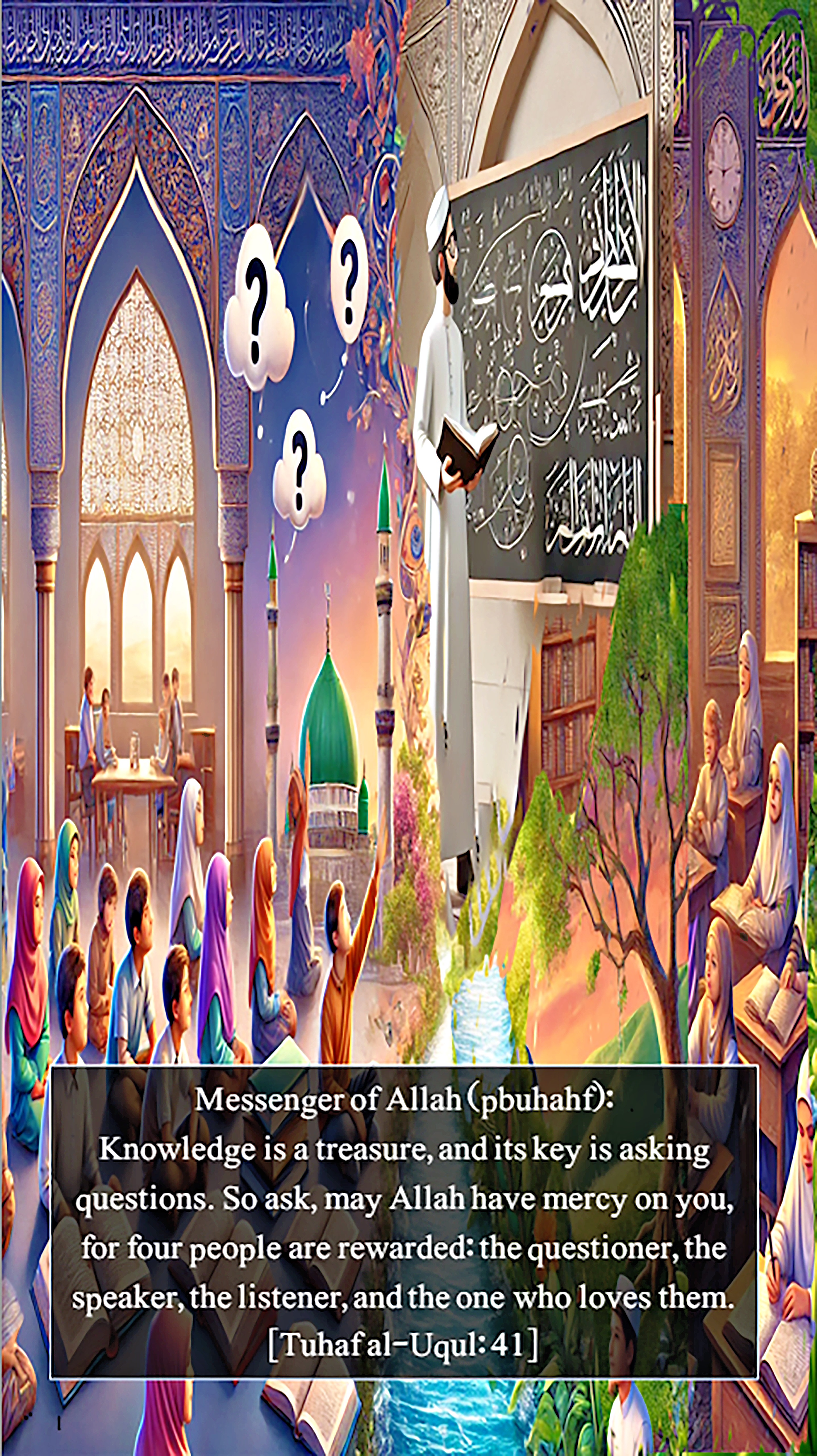
In the rich tapestry of Islamic teachings, few concepts are as profoundly emphasized as the pursuit of knowledge and the essential role of inquiry in its acquisition. Prophet Mohammad (peace be upon him and his progeny) articulated this principle in a foundational hadith that has resonated through centuries of Blamic scholarship. Prophet Mohammad (peace be upon him and his progeny) said: "Knowledge is coffers, the key for which is asking, so ask, may Allah have mercy upon you, as four people shall be rewarded: the one who asks, the one who speaks, the one who listens, and the one who loves them."
(Tuhaf al-Uqul by Ibn Shu'ba al-Harrani, Volume 0, Page 41)
A parallel narration of Prophet Mohammad (peace be upon him and his family) in Uyun akhbar al-Rida(Vol. 2, Book 1, Chapter 1, Hadith #23) conveys a similar teaching:
"Knowledge is like a treasure whose keys are questioning. Therefore ask questions — may Allah have Mercy upon you — as four groups will benefit from this: the ones who ask, the one who teaches, the one who hears, and the one who responds to the question being asked."
This profound statement encapsulates a comprehensive philosophy of learning that elevates questioning from a mere intellectual exercise to a spiritually significant act with far-reaching communal implications. The hadith establishes a framework for understanding knowledge acquisition that remains remarkably relevant for contemporary educational discourse.
The Central Metaphor: Knowledge as Treasure
The Prophet's comparison of knowledge to "treasures" or "coffers" carries multiple layers of meaning that illuminate the Islamic understanding of learning.
The Intrinsic Value of Knowledge
The imagery of treasure signifies knowledge's immense worth and profitability, surpassing material wealth in importance and permanence.
Prophet Mohammad (peace be upon him and his family) said: “Acquire knowledge since learning is a good deed, teaching equals saying Allah’s glorifications, and discussing about knowledge equals participating in a holy war. Teaching knowledge to the one who doesn’t know it is giving charity. Granting knowledge to the proper persons brings Allah’s pleasure, since one knows the lawful and the unlawful using knowledge and knowledge would lead its seeker to Paradise. Knowledge is a guide in case of fear; it is a companion in case of loneliness; it is a guide in case of hardships; it is a weapon against the enemies; and an ornament in the presence of friends. Allah promotes some people by means of knowledge to such a high rank that they are the leaders of goodness and must be obeyed. Their deeds must be taken into consideration and their works must be followed. The angels are inclined to be their friends and they anoint them with their own wings while they pray. Everything including the fish in the sea, the beasts in the desert and the quadrupeds ask for forgiveness for them since knowledge brings life to the hearts and light to the eyes and power against sluggishness. Allah opens the doors to the homes of the good people for the learned men. He grants them association with the good ones in this world and in the Hereafter. Allah is obeyed and served by means of knowledge. Allah is recognized as One by means of knowledge. The bonds of relationship are fastened by means of knowledge. What is lawful and unlawful is recognized by means of knowledge. Knowledge is the prelude to action. Any action follows knowledge. Allah inspires it to the blessed ones and deprives the miserable ones from it." (Al-Khisal by Shaykh Muhammad b. Ali al-Saduq, Book 21, Chapter 8, Hadith #20)
It can be explained through several major themes:
1. Knowledge is worship in all its forms
The Prophet begins:
“Acquire knowledge since learning is a good deed, teaching equals saying Allah’s glorifications, and discussing about knowledge equals participating in a holy war.”
Here, three activities are raised to the level of worship:
- Learning is not only a means to an end; the very act of seeking knowledge is a good deed.
- Teaching is compared to dhikr, the glorification of Allah, because it spreads truth and keeps divine guidance alive among people.
- Scholarly discussion and debate are compared to jihad, not because they involve violence, but because they are a struggle against ignorance, error, and falsehood.
Thus, a student, a teacher, and a scholar engaged in study are all engaged in sacred acts.
2. Knowledge is the highest form of charity
Prophet Mohammad (peace be upon him and his family) says:
“Teaching knowledge to the one who doesn’t know it is giving charity. Granting knowledge to the proper persons brings Allah’s pleasure.”
Material charity feeds the body for a day, but knowledge feeds the mind and soul for a lifetime and beyond. When you teach someone, you give them something that continues to benefit them and others. This is a form of sadaqah jariyah—ongoing charity.
But the hadith also adds an important condition: knowledge should be given to “the proper persons.” This means those who are sincere, ready, and will use it for good. Knowledge placed in the wrong hands can become a source of harm, while knowledge placed in the right heart becomes a source of divine pleasure.
3. Knowledge is a companion in every condition
Prophet Mohammad (peace be upon him and his family) describes knowledge as:
“a guide in case of fear; a companion in case of loneliness; a guide in case of hardships; a weapon against the enemies; and an ornament in the presence of friends.”
This is a deeply human description. Knowledge is not confined to schools or books. It accompanies a person:
- In fear, it gives clarity and courage.
- In loneliness, it becomes an intimate companion.
- In hardship, it shows the way out.
- Against enemies, it is a weapon of insight and wisdom.
- Among friends, it is an ornament that beautifies a person’s character and speech.
Unlike wealth or status, knowledge cannot be stolen, lost, or left behind. It is an inward treasure that remains with a person in every state.
4. Knowledge elevates human beings spiritually and socially
The hadith continues:
“Allah promotes some people by means of knowledge to such a high rank that they are the leaders of goodness and must be obeyed. Their deeds must be taken into consideration and their works must be followed.”
This is not worldly promotion, but moral and spiritual leadership. People of true knowledge become models of goodness. Their example carries authority, and their actions become a standard for others. This is why scholars have always held a high rank in Islamic civilization—not merely as intellectuals, but as inheritors of prophetic wisdom.
5. Knowledge attracts the love of angels and the prayers of creation
Prophet Mohammad (peace be upon him and his family) says:
“The angels are inclined to be their friends and they anoint them with their own wings while they pray. Everything including the fish in the sea, the beasts in the desert and the quadrupeds ask for forgiveness for them.”
This is a striking image. The scholar who acts on knowledge is not isolated. The angels honor them, and even the creatures of the earth and sea pray for their forgiveness. Why? Because true knowledge brings benefit to the whole of creation. A learned person acts with justice, wisdom, and mercy, and this indirectly serves all living things. The universe itself recognizes and responds to the presence of a soul illuminated by knowledge.
6. Knowledge gives life, light, and strength
The Prophet explains why creation prays for the learned:
“since knowledge brings life to the hearts and light to the eyes and power against sluggishness.”
Three gifts are mentioned:
- Life to the hearts: ignorance is a kind of spiritual death. Knowledge revives the heart, making it aware of Allah and its purpose.
- Light to the eyes: knowledge gives inner sight, allowing a person to see truth from falsehood and to perceive the deeper meanings of existence.
- Power against sluggishness: knowledge overcomes laziness, weakness, and despair. It energizes the soul to act and to strive.
This is why the Prophet said elsewhere that seeking knowledge is an obligation upon every Muslim. It is not a luxury, but a necessity for spiritual life.
7. Knowledge opens the company of the righteous
The hadith states:
“Allah opens the doors to the homes of the good people for the learned men. He grants them association with the good ones in this world and in the Hereafter.”
Knowledge is not only an individual treasure; it is also a means of connection. The learned are welcomed into the circles of the righteous. In this world, they find companionship with people of goodness, and in the Hereafter they will be raised with them. This is because knowledge, when sincere, aligns a person with the community of faith and virtue.
8. Knowledge is the foundation of religion and right action
The Prophet then lists the essential functions of knowledge:
“Allah is obeyed and served by means of knowledge. Allah is recognized as One by means of knowledge. The bonds of relationship are fastened by means of knowledge. What is lawful and unlawful is recognized by means of knowledge.”
Without knowledge, worship becomes guesswork, recognition of Allah becomes unclear, family ties are neglected, and the boundaries of right and wrong are blurred. Knowledge is therefore not separate from faith; it is the very instrument through which faith is understood and practiced correctly.
9. Knowledge precedes action
The hadith concludes:
“Knowledge is the prelude to action. Any action follows knowledge. Allah inspires it to the blessed ones and deprives the miserable ones from it.”
This is a fundamental principle in Islam: action without knowledge is dangerous, and knowledge without action is incomplete. True knowledge naturally leads to action, and right action must be built upon sound knowledge.
Finally, the hadith reminds us that knowledge is ultimately a divine gift. Allah grants it to those who are spiritually ready and sincere, and withholds it from those who are heedless. This teaches humility: even the effort to learn is a sign of divine favor.
Prophet Mohammad (peace be upon him and his family) said that "Knowledge is the head of all good and ignorance is the head of all evil." (Bihar al-Anwaar by Allamah Majlisi, Volume 74, Page 175)
Prophet Mohammad (peace be upon him and his family) further explained that "The good of this world and the Hereafter comes with knowledgeand the worst of this world and the Hereafter lies with ignorance." (Bihar-ul-Anwar, vol.1, p. 204) indicating its comprehensive benefit.
Imam Ali (peace be upon him) elaborated on this superiority, stating: "There is no treasure more profitable than knowledge" (al-Kafi, v. 8, p. 19, no. 4). He further distinguished knowledge from wealth by observing:
"knowledge is better than wealth for wealth is reduced by spending whereas knowledge causes your spendings to flourish, and any good product of wealth ceases when it ceases to exist."
(Nahjul Balaghah, Saying 147)
And
"knowledge is better than wealth. Knowledge guards you, while you have to guard the wealth. Wealth decreases by spending, while knowledge multiplies by spending, and the results of wealth die as wealth decays." (Nahj al-Balagha by al-Sharif al-Radi, Book 3, Chapter 147, Hadith #182)
This profound observation establishes that knowledge guards a person against ignorance and misguidance, while material possessions require constant protection and can be lost or stolen.
Imam Zayn al-'Abideen (peace be upon him) eloquently conveyed the intrinsic worth of knowledge: "Were people aware of what lies in the obtainment of knowledge, they would pursue it even though they had to make voyages and endanger their lives to obtain it."(Usul-I-Kafi, vol. 1, p. 35)
His words can be unpacked in several dimensions:
1. Knowledge is not mere information
The Imam is not speaking only of facts, degrees, or worldly expertise. He is speaking of transformative knowledge—knowledge that illuminates the mind, purifies the heart, and draws a person closer to Allah. This kind of knowledge gives life its true meaning. Most people do not perceive this, so they remain satisfied with superficial learning or no learning at all.
2. The seeker would sacrifice everything
He says people would “make voyages and endanger their lives” if they knew what knowledge contains. This echoes the great tradition of seekers who traveled vast distances—sometimes on foot, through danger—to sit at the feet of a single teacher or to obtain a single hadith or truth. The point is not recklessness, but priority: when something is truly precious, difficulty becomes insignificant.
3. Knowledge has intrinsic worth
Many pursuits are valued only for what they bring—money, status, comfort. But the Imam is saying that knowledge is valuable in itself, because it is the nourishment of the human soul. A soul without knowledge is like a body without food. That is why the pursuit of knowledge is a form of worship and a spiritual struggle in Islam.
4. People are asleep to its value
The phrase “were people aware” implies that humanity is in a kind of heedlessness. The treasure is buried, and only those who wake up to its worth will strive for it. The Imam’s statement is both a lament and an invitation—a call to awaken to the true rank of knowledge.
5. Knowledge is worth the risk
History shows that great scholars and saints endured exile, poverty, and danger for knowledge. Why? Because they had tasted what lies within it: light, certainty, wisdom, freedom from ignorance, and nearness to the Divine. Once tasted, no price seems too high.
In essence, Imam Zayn al-Abideen (peace be upon him) is teaching that the greatest journeys are not only across lands, but across the distances of ignorance and heedlessness within the self—and those journeys are worth every sacrifice.
This demonstrates that the pursuit of knowledge is considered worth any sacrifice, as it is essential for spiritual well-being and worldly success.
The Hidden Nature of Knowledge
The treasure metaphor also conveys that knowledge is not always readily apparent or easily accessible. Just as physical treasures are often hidden, requiring effort and the right tools to uncover, knowledge demands active pursuit. This understanding is reinforced by the statement: "This knowledge (the knowledge of the holy Prophet and Ahlul Bayt(a.s.)) is under a lock and the key to it is asking"
(Al-Kafi, Volume 1, Book 2, Chapter 9, Hadith #3).
This saying points to a profound spiritual principle: the knowledge of the Prophet and his purified family (peace be upon them) is a hidden treasure, and it is not given casually. It is stored like something precious behind a locked door, and the only way to open that door is to ask.
1. The lock is not to withhold, but to protect
Sacred knowledge is not ordinary information. It is a trust from Allah, containing the deepest truths about faith, the soul, right action, and the path to Allah. Because it is so precious, it is not scattered before every passerby.
The lock signifies:
- Value – A thing that is locked away is recognized as precious.
- Depth – This knowledge has layers that cannot be reached by surface reading or idle curiosity.
- Protection – It is safeguarded from misuse, distortion, arrogance, and those who would take it lightly.
So the lock is not a barrier of cruelty. It is a means of honor. Allah and His chosen ones do not hide knowledge out of stinginess; they protect it so that only sincere seekers receive it.
2. Asking is the first movement of humility
To ask is to admit, “I do not know.”
That admission is the beginning of all true learning. As long as a person thinks they already know, or feels too proud to ask, the door remains closed. But the moment they ask with sincerity, the lock begins to turn.
In the Quran, Allah commands:
“Ask the people of the Reminder if you do not know.” (Quran 16:43)
Thus, asking is not a sign of weakness. It is the key that Allah Himself has placed in the seeker’s hand.
3. Asking turns the seeker toward the source
The knowledge of the Prophet and Ahlul Bayt is not found in every book or every speaker. It resides with its rightful bearers. Therefore, the seeker must ask:
- Allah, as the Prophet himself prayed, “My Lord, increase me in knowledge” (Quran 20:114).
- The Quran, by reflecting and questioning its meanings with an open heart.
- The Ahlul Bayt, who are the inheritors of prophetic wisdom and the living interpreters of revelation.
Asking means turning away from self-reliance and toward those whom Allah appointed as guides. It is an act of spiritual orientation.
4. Asking is different from disputing
The key works only when asking is done with the right intention.
Sincere asking seeks understanding, not argument. It seeks to act, not merely to know. It comes from need, not from pride. When a person asks in this way, the answer enters the heart and becomes light.
But if someone asks only to challenge, to show off, or to satisfy idle curiosity, the key will not open the lock. The door remains closed because the asking itself was not true.
5. The door opens for those who truly seek
This saying is ultimately an invitation.
Allah and the Ahlul Bayt are waiting for the seeker to ask. The lock is there not to reject, but to awaken desire, effort, and humility. The very act of asking is already a form of worship and a sign that the seeker is ready to receive.
Once the question is sincere, the knowledge comes, not only as information but as light, guidance, and nearness to Allah.
In summary: the knowledge of the Prophet and his family is a locked treasure, and asking is the key because it combines humility, need, sincere turning to the rightful source, and readiness to receive. Whoever asks with a pure heart will find the door opening, not because they were worthy, but because they finally asked.
This explains that knowledge is treasured with its people and you have been ordered to seek it from its people. This indicates that knowledge is like a guarded treasure held by those qualified to carry it, implying the need to seek it with proper effort and from the right custodians.
The Depth of Knowledge
The metaphor of a treasury also points to the profound depth and expansiveness of knowledge, suggesting it is far more than superficial understanding. Imam Ali (peace be upon him) states that "Every container becomes cramped by what is placed therein, except the container that holds knowledge, for verily it expands because of it." (Nahjul Balaghah, Saying 205)
This saying expresses a beautiful paradox: material things crowd whatever contains them, but knowledge enlarges its container.
1. The image of the container
Every physical container—a cup, a room, a bag—has limits. The more you put into it, the tighter and more cramped it becomes, until it can hold nothing more.
But knowledge is different. The human heart and mind are not physical vessels in the ordinary sense. When they hold knowledge, they do not become fuller in a limiting way; they become more spacious.
2. Knowledge is not a weight—it is light
Material things take up space because they belong to the world of quantity. But knowledge belongs to the world of meaning, truth, and light.
When light enters a room, it does not crowd the room. It makes the room feel larger, clearer, and more open. In the same way, when true knowledge enters the heart, it expands the heart. It removes the walls of ignorance, narrow-mindedness, fear, and confusion.
That is why the soul that learns does not become heavier—it becomes freer.
3. Knowledge creates capacity for more knowledge
In worldly things, the more you acquire, the more burdened you become. Wealth, possessions, status—they fill life with attachment and worry.
But with knowledge, the opposite happens. One truth opens the way to many other truths. Understanding one matter creates the ability to understand deeper matters. The more a person learns, the greater their capacity to learn becomes.
The seeker of knowledge never says, “I am full.” Instead, every new insight makes the soul more aware of what it has not yet reached, and therefore more spacious.
Prophet Mohammad (peace be upon him and his family) said: "There are two insatiable types of people who are never satisfied by their quest the seeker of knowledge and the seeker after this world."
(Kanz al-’Ummal, no. 28726)
4. The container of knowledge is the heart
In spiritual language, the real container of knowledge is not the brain alone, but the heart—the inner center of understanding, faith, and character.
A heart filled with ignorance is cramped:
- It is narrow in its judgments.
- It is limited in its patience.
- It is closed to other people and other possibilities.
- It is imprisoned by its own desires and assumptions.
But when knowledge enters the heart sincerely:
- It widens the heart’s capacity for compassion.
- It deepens its patience.
- It opens it to truth from many directions.
- It frees it from the tightness of ego.
Thus knowledge does not merely fill the heart—it transforms the heart into a larger vessel.
5. Divine knowledge has no end, and so its vessel must expand
The knowledge spoken of here is not merely technical information. It is the knowledge that leads to Allah, to self-knowledge, to wisdom, and to right action.
Since Allah is infinite, knowledge of Him and His ways has no limit. Therefore the heart that sincerely seeks this knowledge is given an ever-expanding capacity. Allah says in the Quran:
“Is one whose chest Allah has expanded for Islam, so that he is upon a light from his Lord…?”
(Quran 39:22)
This expansion is a divine gift. The more the heart carries of sacred knowledge, the more room it is given.
This suggests that the "treasury" of the mind or soul grows in capacity as more knowledge is acquired, indicating its boundless nature.
The hadith explicitly identifies "questioning" or "asking" as the key that unlocks the treasures of knowledge. This metaphor emphasizes that learning is not a passive reception of information but an active, dynamic pursuit initiated by inquiry.
Questioning as Cure for Ignorance
Ignorance is a disease; questioning is its medicine
In Islamic thought, ignorance (jahl) is not merely the absence of facts. It is a state of the soul that leads to misguidance, arrogance, wrongdoing, and distance from Allah. The Quran repeatedly contrasts those who know with those who do not:
“Say: Are those who know equal to those who do not know?” (Quran 39:9)
This powerful statement portrays ignorance as a form of blindness that can only be remedied through persistent questioning. Silence in the face of ignorance is described as the complete form of blindness, suggesting that failing to ask questions when one lacks understanding is itself a spiritual and intellectual deficiency.
Questioning as Prevention of Peril
The Quran warns:
“And do not pursue that of which you have no knowledge. Indeed, the hearing, the sight, and the heart—about all those one will be questioned.” (Quran 17:36)
Imam as-Sadiq (peace be upon him) emphasized the critical importance of inquiry, stating: "Indeed (many) people perish for not having asked questions." (sharah Usul al-Kafi, Volume 2, Page 106)
This underscores that failing to inquire about matters one does not understand can result in spiritual danger.
This perspective transforms questioning from a mere option into a necessity for spiritual and intellectual survival. A society in which the people refrain from asking questions is in danger of destruction. This illustrates the collective harm caused by widespread reluctance to seek knowledge through inquiry.
Questioning as Integral to Knowledge
The Prophet Mohammad (peace be upon him and his progeny) declared that "Asking properly is one half of knowledge" (Nahj al Fasahah; Tradition No. 240; Page No. 40).
This statement elevates the ability to formulate and pose effective questions as a significant component of wisdom itself. It suggests that the quality of one's questions reflects the depth of one's understanding and the sincerity of one's pursuit of truth.
Amir al-muminin, Imam Ali (peace be upon him), said: "These hearts are receptacles, and the best of them are the most receptive." (Mizan al-Hikmah by Mohammad al-Rayshahri, Volume 3, Page 2602)
The Hearts There Are Locks
“Do they not then reflect on the Quran? Nay, on the hearts there are locks.” (Quran 47:24)
is one of the Quran’s most powerful warnings. It teaches that the Quran is not merely a book to be recited or read quickly. It must be pondered deeply. And if a person does not reflect on it, the problem is not with the Quran—it is with the heart. The heart has become locked.
1. Reflection on the Quran is a divine demand
The word used in the verse is tadabbur—deep reflection, looking behind the words to their meanings and implications.
Allah says elsewhere:
“This is a blessed Book which We have revealed to you, that they may reflect upon its verses and that those of understanding may be reminded.” (Quran 38:29)
So the purpose of revelation is not just recitation, but reflection. The Quran repeatedly asks:
“Will they not then reflect upon the Quran? If it had been from other than Allah, they would have found within it much contradiction.” (Quran 4:82)
Reflection means asking:
What is Allah saying?
What does this mean for my life?
Am I living according to this?
A person who reads without reflection is like someone who looks at a locked door but never thinks to open it.
2. The locks are not on the Quran—they are on the hearts
The verse does not say the Quran is unclear. It says the hearts are locked. The Quran is light:
“O mankind, there has come to you clear proof from your Lord, and We have sent down to you a manifest light.” (Quran 4:174)
But light cannot enter a closed room. If the heart is locked, the Quran’s light remains outside.
Allah describes the disbelievers:
“They have hearts with which they do not understand, eyes with which they do not see, and ears with which they do not hear.” (Quran 7:179)
Their physical faculties work, but their spiritual faculties are sealed. That is why they can hear the Quran and still not be guided. The problem is not in the message; it is in the receiver.
3. What causes the heart to be locked?
The Quran and hadith explain that hearts do not become locked suddenly. They are locked gradually through:
A. Sins
Allah says:
“Nay, but what they used to earn has rusted upon their hearts.” (Quran 83:14)
Imam Baqir (peace be upon him) explained the above verse as:
“In the heart of every servant (of Allah) there is a white dot. When he commits a sin a black dot appears in the white one. If he repents the black dot goes away, but if he continues committing sins the black dot enlarges until it covers the white dot and when the white dot is covered the person thereafter does not return to good things as Allah, the Most Majestic, the Most Holy, has said, ‘In fact, their hearts are stained by their deeds.’” ( Quran 83:14 )
(Al-Kafi (Vol. 2) by Shaykh Mohammad b. Ya qub al-Kulayni, Book 1, Chapter 111, Hadith #20)
Imam Jafar al-Sadiq (peace be upon him) said:
"When a man commits a sin a black dot appears in his heart. If he then repents, the dot will disappear, if he commits more sins it will increase until it will take over his heart and he then will never have salvation."
(Al-Kafi (Vol. 2) by Shaykh Mohammad b. Ya qub al-Kulayni, Book 1, Chapter 111, Hadith #13)
So sin does not just affect the body—it darkens the heart. Over time, the heart becomes covered, and truth can no longer penetrate it.
B. Arrogance
The Quran says:
“I will turn away from My signs those who are arrogant upon the earth without right.” (Quran 7:146)
Arrogance makes a person feel that they do not need to reflect or ask. They believe they already know enough. This pride locks the heart more firmly than any sin.
C. Blindly following desires and traditions
Allah describes those who reject truth because of what their forefathers followed:
“When it is said to them: Follow what Allah has revealed, they say: Rather, we will follow what we found our fathers upon.” (Quran 2:170)
They do not ask whether their inherited path is true. Their refusal to question keeps their hearts locked.
D. Love of this world
Prophet Mohammad (peace be upon him and his family) said: "Love of the world is the origin of every act of disobedience and the beginning of every sin." (Tanbih al-Khawatir, v. 2, p. 122)
Imam Jafar al-Sadiq (peace be upon him) said: "The root of all sin is love of this world."
(Wasa'il al-Shia Vol. 16, Section 1, Chapter 61, Hadith 20821)
When the heart is filled with worldly ambition, wealth, status, and distractions, there is no space left for divine light. The heart becomes a container crowded with desires, and knowledge cannot expand it.
4. The locked heart cannot ask, and therefore cannot be cured
The locked heart does not ask. It does not reflect. It does not seek. It is content with its darkness.
Allah says:
“Indeed, it is not the eyes that become blind, but the hearts within the chests become blind.”
(Quran 22:46)
A blind heart cannot even see its own blindness. That is why the Quran says:
“Do they not then reflect on the Quran? Nay, on the hearts there are locks.” (Quran 47:24)
Imam Jafar al-Sadiq (peace be upon him) said: "Allah does not answer a supplication that comes from a hard heart." (al-Kafi by Shaykh al-Kulayni, Volume 2, Page 474)
Imam Jafar al-Sadiq (peace be upon him) said: "When the heart of one of you softens, then let him supplicate, for the heart does not soften until it becomes sincere."
(Wasa'il al-Shia Vol. 7, Section 2, Chapter 28, Hadith 8758)
The absence of reflection is not a neutral state. It is a sign that the heart has closed itself against Allah. And when the heart closes, guidance cannot enter, and a person drifts toward destruction.
5. The key to the locked heart is sincere asking and turning to Allah
The lock is real, but it is not unbreakable. Allah says:
“Is one whose chest Allah has expanded for Islam, so that he is upon a light from his Lord…?” (Quran 39:22)
Expansion comes from Allah. But the servant must ask for it.
Imam Jafar al-Sadiq (peace be upon him) said: "Desire (for Allah’s (swt) mercy) and fear (of His displeasure) do not gather together in a heart except that Paradise becomes obligatory for it. So when you pray, turn your heart fully toward Allah (swt), the Mighty and Majestic, for there is no believing servant who turns his heart fully toward Allah (swt) in his prayer and supplication except that Allah (swt), the Mighty and Majestic, turns the hearts of the believers toward him, strengthens him with their love, and grants him Paradise along with their affection”.
(Man La Yahduruh al-Faqih (Vol. 1) by Shaykh Muhammad b. Ali al-Saduq, Book 1, Chapter 31, Hadith #632)
The Quran shows that even when hearts are hardened, Allah can open them if the person turns sincerely:
“Then your hearts became hardened after that, being like stones or even harder. But indeed, from stones there are rivers that gush forth…” (Quran 2:74)
The key is:
- Asking Allah to open the eyes and the heart.
Imam Jafar al-Sadiq (peace be upon him) said: "O Lord, I plead before You through the rights of Mohammad and the family of Mohammad (a.s.) with You to give light to my eyes, understanding in my religion, certainty in my heart, sincerity in my deeds, safety to my soul, increase in my sustenance and gratefulness to You as long as You will keep me (living).” - Reflecting with humility, not with pride.
Allah says:
“And when they hear what has been revealed to the Messenger, you see their eyes overflowing with tears because of what they have recognized of the truth.” (Quran 5:83)
- Asking the people of knowledge—the Prophet, his family, and the righteous scholars—to explain the Quran.
Allah commands:
“Ask the people of the Reminder if you do not know.” (Quran 16:43)
- Repentance from sin, which polishes the heart and removes the rust.
6. Reflection is a form of questioning the Quran
When a person reflects on the Quran, they are asking:
- Why did Allah reveal this verse?
- What is He teaching me here?
- How does this apply to my life?
- What is the state of my heart?
This questioning is not doubt; it is the sincere search for guidance. The Quran invites this:
“Will they not then reflect upon the Quran?”
The one who never asks such questions reads words without meaning. But the one who asks with a humble heart finds that the Quran begins to unlock the heart, verse by verse.
This implies that questions not only provide external information but also stimulate internal contemplation and realization.
A distinctive feature of the hadith is its identification of four groups of people who receive divine reward for their involvement in the pursuit and sharing of knowledge. This framework highlights the communal and collaborative nature of learning in Islam.
1. The Questioner (Seeker of Knowledge)
The questioner initiates the learning process by posing inquiries. The hadith refers to them as "the ones who ask", "the one who asks", or "those who ask questions". Their reward stems from their earnest desire to learn, their humility in acknowledging what they do not know, and their active pursuit of understanding.
Prophet Mohammad (peace be upon him and his family) said, "Seeking knowledge is an obligation on every Muslim. Indeed how Allah loves those who strive in their quest for knowledge." (al-Kafi, v. 1, p. 30, no. 1)
and promises a great reward for those who tread this path.
Prophet Mohammad (peace be upon him and his family) said: "Angels spread out their wings for the seekers of knowledge, for they are pleased with what they seek" (Nahj Al-Fasahah)
Prophet Mohammad (peace be upon him and his family) said, "When death comes to the seeker of knowledge whilst he is in that state [of seeking knowledge], he dies as a martyr."
(al-Targhib wa al-Tarhib, v. 1, p. 97, no. 16)
The questioner's role is vital because their inquiry sets in motion a chain of knowledge dissemination that benefits the entire community. The pursuit of knowledge is explicitly likened to jihad (struggle in the way of Allah).
Imam Ali (peace be upon him) stated:
"A person setting forth for the acquisition of knowledge is like the one who struggles in the way of Allah." (Bihar al-Anwar, vol. 1, p. 179), highlighting the spiritual merit of even the journey undertaken in pursuit of knowledge.
Imam Jafar al-Sadiq (peace be upon him) said: "Seek knowledge and adorn yourself with forbearance and dignity together with it (knowledge), and humble yourself to the one you teach knowledge, and humble yourself to the one from whom you seek knowledge, and do not be tyrannical scholars so that your falsehood drives away your truth."
(Mujam al-Ahadith al-Mutabara by Shaykh Mohammad Asif Muhsini Book 1, Chapter 5, Hadith #1)
Imam Jafar al-Sadiq (peace be upon him) said: "Seek knowledge and adorn it with forbearance and dignity, and be humble to those whom you teach knowledge, and be humble to those from whom you seek knowledge, and do not be tyrannical scholars for your falsehood will override your truth."
(Wasa'il al-Shia Vol. 15, Section 2, Chapter 30, Hadith 20503)
True seekers are distinguished by their aim for proper understanding (Fiqh) and intelligence, acting upon knowledge, and teaching it for the sake of Allah, earning them the title "Great" in the unseen realms. These individuals take the first step in a process that perfects religion and leads to Paradise.
2. The Teacher (Speaker/Responder/Instructor)
The teacher possesses knowledge and shares it by responding to questions. The hadith refers to them as "the one who teaches", "the one who speaks", "those who respond to the questions", or "the answerer." Their role is critical for guiding others and disseminating divine wisdom.
Prophet Mohammad (peace be upon him and his family) said: “Teaching knowledge to the one who doesn’t know it is giving charity. "
(Al-Khisal by Shaykh Muhammad b. Ali al-Saduq, Book 21, Chapter 8, Hadith #20)
Imam Hasan (peace be upon him) said: "Teach people, and learn the knowledge of others, so that you may perfect your own knowledge and learn what you did not know." (Mizan al-Hikma, volume: 8, pages: 37)
Imam Baqir (peace be upon him) said: "The teacher of Knowledge among you receives the reward of the student and has a merit over the latter. So seek Knowledge from its possessors and teach it to your brothers in the same way as the learned taught you." (Al-Kafi, Volume 1, Page 35)
Imam Mohammad Baqir (peace be upon him) said: "Whoever teaches a chapter of guidance will have a reward similar to those who act upon it, without decreasing anything from their rewards. And whoever teaches a chapter of misguidance will bear sins similar to those who act upon it, without decreasing anything from their sins."
(Wasa'il al-Shia Vol. 16, Section 2, Chapter 16, Hadith 21271)
Imam Jafar al-Sadiq (peace be upon him) said: "Whoever teaches something good will have a reward similar to the one who acts upon it. I asked: If someone else teaches it, will that reward continue for him? He said: If all people teach it, the reward will continue for him. I asked: What if he dies? He said: Even if he dies."
(Wasa'il al-Shia Vol. 16, Section 2, Chapter 16, Hadith 21270)
Imam Jafar al-Sadiq (peace be upon him) said: "Seek Knowledge and adorn it with forbearance and dignity. Be humble to those whom you teach and to those from whom you learn. Don't be tyrannical in your teaching conduct, for you will forfeit that to which you are entitled on account of it." (Usul Al-Kafi)
Teachers carry a great responsibility to transmit knowledge accurately, and the Prophet Mohammad (peace be upon him and his family) warned that: "A curb of fire will be put on the mouth of whoever conceals his knowledge when asked to offer it" (Nahj Al-Fasahah)
Prophet Mohammad (peace be upon him and his family) said: "The people who will suffer the most severe punishment on the Day of Resurrection are those who are scholars whose knowledge did not benefit them." (Bihar al-Anwar, volume 2, page 38)
Prophet Mohammad (peace be upon him and his family) said: "One who knows something and does not observe it, and does not use his knowledge, his punishment in the hereafter would be the most severe"
(Bihar al-Anwar, volume 2, page 38)
Prophet Mohammad (peace be upon him and his family) said: "Whoever seeks knowledge for four reasons will enter Hell: to boast about it to scholars, to argue with fools about it, to turn people's attention to himself, or to gain favor with princes."
(Bihar al-Anwar, volume 2, page 38)
Amir al-muminin, Imam Ali (peace be upon him), said: "Indeed the scholar who conceals his knowledge (ilm) will be resurrected on the Day of Judgment with the most putrid smell, and every small creature from the creatures of the earth will curse him." (Wasa'il al-Shia Vol. 16, Section 2, Chapter 40, Hadith 21539)
Amir al-muminin, Imam Ali (peace be upon him), said: "The seekers of knowledge are of three types. You can distinguish them from each other by their characteristics and signs. (1) One group are those who learn for insincere argumentation. (2) One group are those who learn for stonewalling and deception. (3) One group are those who learn for understanding and for acting by it. As for those of insincere argumentation, they bring harm and doubt to groups of men. They gown themselves in reverence, but they are void of piety. May Allah knock their chests and cut their noses. As for those who learn for stonewalling and deception, they obstruct those like them, and they humble themselves for the rich. Thus, they consume those for their sweetness, and they destroy their religion. May Allah blind them from their sight and sever their affect on the legacy of the scholars. As for the group who learn for understanding and for acting by it, they are seen melancholy and grieving. They stand in prayer in the darkness of the night, and they bow in their evening robes. They work [in good deeds], and they are cautious and afraid of everyone except their trusted brethren. May Allah strengthen their foundations and grant them safety on the Day of Resurrection. (Al-Am?l? by Shaykh Muhammad b. Ali al-Saduq, Book 1, Chapter 91, Hadith #1)
Teachers are considered "conduits" of divine guidance, distributing the treasure of knowledge. Their elevated status is emphasized by specific rights, such as being magnified, respected in their sessions, listened to well, and defended from backbiting. They are to be respected like a father, and students must free their minds and hearts for them.
The ethical responsibilities of teachers extend beyond mere information transmission. They must act upon their knowledge, embody the teachings of Islam in their conduct, show kindness and compassion towards students, and foster critical thinking rather than blind imitation.
Prophet Mohammad (peace be upon him and his family) advised: "Be humble to your teachers as well as to your students, and be not despotic scholars" (Nahj Al-Fasahah).
Amir al-muminin, Imam Ali (peace be upon him), said "Be humble to those from whom you learn and to those whom you teach, and do not be among the arrogant scholars, for your ignorance will not be remedied by your knowledge." (Mizan Al-hikmah, Volume 3, Page 2083)
Imam Jafar al-Sadiq (peace be upon him) said: "Be humble to the one to whom you teach knowledge, and humble to the one from whom you seek knowledge, and do not be arrogant scholars, for your falsehood takes away your truth." (Mizan Al-hikmah, Volume 3, Page 2083)
- The Listener
The listener attentively hears both the question and its answer. The hadith mentions "the one who hears" or "the one who listens" as among those rewarded. Their willingness to listen, absorb, and respect the process of learning is meritorious.
"Those who listen to speech and follow the best of it." (Quran 39:18)
“And when they hear what has been revealed to the Messenger, you see their eyes overflowing with tears because of what they have recognized of the truth. They say: Our Lord, we have believed, so write us among the witnesses.” (Quran 5:83)
Messenger of Allah stated that "O Abu Dharr, sitting for an hour discussing knowledge is more beloved to Allah than standing in prayer for a thousand nights, praying a thousand rak'ahs each night. And sitting for an hour discussing knowledge is more beloved to Allah than participating in a thousand battles and reciting the entire Quran."
He said: O Messenger of Allah, is discussing knowledge better than reciting the entire Quran? The Messenger of Allah (peace be upon him) said: "O Abu Dharr, sitting for an hour discussing knowledge is more beloved to Allah than reciting the entire Quran twelve thousand times! You must discuss knowledge, for through knowledge you will know what is lawful and what is unlawful. O Abu Dharr, sitting for an hour"
(Bihar al-Anwar, Vol.1, P.203).
Listening and Contemplating: Imam Ali described the insightful person as one "The truly insightful person is the one who hears and thinks, looks and sees, benefits from the lessons, and then follows a clear path, avoiding the pitfalls." (Mizan al-Hikmah, Volume 1, Page 266)
Merely looking at the face of a learned person is considered an act of worship, prophet Mohammad (peace be upon him and his family) said, "Looking at the face of a scholar out of love for him is an act of worship."
(Nawadir al-Rawandi, p. 11)
Prophet Mohammad (peace be upon him and his family) said: "Looking at [the face of] a scholar is worship, looking at [the face of] a just Imam is worship, looking at one’s parents with kindness and mercy is worship, and looking at the face of a brother whom you love for the sake of Allah is worship."
(Amali al-Tusi, p. 454, no. 1015)
Imam Mohammad Baqir (peace be upon him) said: "Whoever listens to a speaker has worshipped him. If the speaker is conveying from Allah, the Mighty and Majestic, then he has worshipped Allah. And if the speaker is conveying from Satan, then he has worshipped Satan."
(Wasa'il al-Shia Vol. 17, Section 2, Chapter 101, Hadith 22645)
Imam Jafar al-Sadiq (peace be upon him) was once asked regarding the Prophet (S)’s saying, ‘Looking at the faces of scholars is an act of worship’, to which he replied, ‘It refers to the scholar whom looking at reminds you of the Hereafter, and whoever is not thus, then looking at him is a trial.’ (Tanbih al-Khawatir, v. 1, p. 84)
Imam Mohammad Taqi (peace be upon him) said: "The one who lends ear to a speaker he has worshiped him. So if the speaker is from Allah's side (speaks the word of Allah) then he has adorned Allah and if the speaker is speaking from the tongue of Satan then he has worshiped Satan" (Tuhaf al-Uqul P 456)
The listener who attends a session of knowledge, even without asking, participates in a sacred act, and their patience, attentiveness, and decorum are considered a meritorious form of worship. Their presence fosters an environment conducive to learning and reflection.
- The One Who Loves Them
This category encompasses anyone who cherishes, supports, or appreciates the acts of seeking, teaching, and listening to knowledge. The hadith refers to them as "the one who loves them" or "those who like the above three". This reward highlights the importance of fostering a supportive environment for learning within the community.
The inclusion of "the one who loves them" broadens the circle of divine reward to include even those who do not directly participate in the exchange of knowledge. This demonstrates the communal value and blessing associated with the pursuit of knowledge in Islam. It emphasizes that cultivating positive sentiment towards knowledge and its participants—valuing intellectual inquiry, respecting scholars, and supporting learners—is itself meritorious in the sight of Allah.
The notion that loving and supporting seekers, teachers, and listeners of knowledge brings reward is implied by the emphasis on respect for scholars and students, and by statements that those who love people who acquire, act upon, and teach knowledge "for the sake of Allah" share in their spiritual environment and orientation.
The Broader Rewards and Benefits of Seeking Knowledge
Beyond the specific rewards mentioned in the hadith, Islamic teachings enumerate numerous benefits for sincere seekers of knowledge.
Perfection of Religion: Seeking knowledge leads to the perfection of religion and is a means of gaining wisdom and understanding, as well as piety, conviction, and recognition of oneself and one's Lord.
Prophet Mohammad (peace be upon him and his family) said, "The quest for knowledge is incumbent upon every Muslim… by virtue of it the Lord is obeyed and worshipped, consanguinal relations are maintained, and the lawful is distinguished from the prohibited. Knowledge leads to action and action follows it. The fortunate ones are inspired by it whereas the wretched ones are deprived of it."
(Amali al-Tusi, p. 488, no. 1069)
Prophet Mohammad (peace be upon him and his family) said: "The excellence of knowledge is more beloved to Allah than the excellence of worship, and the best part of your religion is piety."
(Wasa'il al-Shia Vol. 20, Section 3, Chapter 31, Hadith 25823)
Prophet Mohammad (peace be upon him and his family) said: "A little knowledge is better than a lot of worship." (al-Mahajjat al-Baydha, v. 1, p. 22)
Amir al-muminin, Imam Ali (peace be upon him), said: "The perfection of religion is seeking knowledge and working by it." (Tuhaf al-Uqul by Ibn Shu'ba al-Harrani, Volume 0, Page 199)
Path to Paradise: Seeking knowledge is one of the great acts of worship that leads one to the path of Paradise.
Prophet Mohammad (peace be upon him and his family) said: "He who goes out to seek knowledge is himself sought after by Paradise." (Kanz al-’Ummal, no. 28842)
Prophet Mohammad (peace be upon him and his family) said, "The people who are closest to the rank of prophethood are the people of knowledge and striving." (al-Mahajjat al-Baydha, v. 1, p. 14)
Prophet Mohammad (peace be upon him and his family) said: "Verily the knowledgeable man is superior to the [mere] worshipper as the sun is to the stars, and the worshipper is superior to the one who does not worship as the superiority of the moon to the stars." (Bihar al-Anwar, v. 2, p. 19, no. 49)
Imam Jafar al-Sadiq (peace be upon him) narrates from his father that the Holy Prophet (s.a.w.s.) said, “The ranks of the people of Quran come next to that of the prophets and messengers. Don’t ever consider the people of Quran as weak and don’t reduce their rights for they have a high status near Allah.”
(Thawab al-A mal wa iqab al-A mal by Shaykh Muhammad b. Ali al-Saduq, Book 2, Chapter 153, Hadith #1)
Divine Reward and Forgiveness:
Prophet Mohammad (peace be upon him and his family) said, "The seeker of knowledge is the seeker of mercy; the seeker of knowledge is the pillar of Islam and is given his recompense with the prophets."
(Kanz al-’Ummal, no. 28729)
Prophet Mohammad (peace be upon him and his family) who said: "Whoever treads a path seeking knowledge Allah makes him tread a path to Paradise, and the angels lay down their wings for the seeker of knowledge in satisfaction with him, and whoever is in heaven and whoever is on earth seeks forgiveness for the seeker of knowledge even the fish in the sea, and the fadl of the scholar over the worshiper is like the fadl of the moon over the rest of the stars on the night of a full moon, and the scholars are the inheritors of the prophets; the prophets did not leave behind dinar or dirham, rather they left behind knowledge and whoever takes from it has taken an abundant share."
(al-Kafi by Shaykh al-Kulayni, Volume 1, Page 34)
Amir al-muminin, Imam Ali (peace be upon him), said: "Whoever's death comes while seeking knowledge, then there would be just a level between him and the prophets."
(Mizan al-Hikma, Volume 3, Page 2072)
Equivalence to Holy Struggle:
Prophet Mohammad (peace be upon him and his family) said: "He who goes out to seek knowledge is indeed on the path of Allah until he returns." (Kanz al-’Ummal, no. 28702)
Imam Amir ul Mu'mineen Ali (peace be upon him) said, "The one who seeks for knowledge is like a warrior in the cause of religion for the way of Allah." (Mizan al-Hikma, volume: 8, page: 31)
This powerful analogy elevates the pursuit of knowledge to the level of jihad, emphasizing its spiritual significance.
A Form of Worship: Seeking knowledge is considered a great act of worship in Islam and equivalent to worshiping Allah. To remember Allah through knowledge is equal to observance of fasting, and to learn knowledge is equal to practicing devotional acts.
Prophet Mohammad (peace be upon him and his family) said, "He who seeks knowledge is as one who spends his day fasting and his night praying. Verily a chapter of knowledge that a man learns is better for him than for him to have as much gold as a mountain and give it all away in the way of Allah."
(Munyat al-Murid, p. 100)
Teaching it is considered an act of giving alms.
Prophet Mohammad (peace be upon him and his family) said: “Teaching knowledge to the one who doesn’t know it is giving charity. "
(Al-Khisal by Shaykh Muhammad b. Ali al-Saduq, Book 21, Chapter 8, Hadith #20)
Closeness to Allah: It is a means of getting closer to Allah and a tie between Allah and the individual. The aim behind seeking knowledge should be divine, for the pleasure of Allah and serving His creatures.
Prophet Mohammad (peace be upon him and his family) said, "If a day comes upon me in which I do not increase in knowledge that brings me closer to Allah Almighty, then may the sun not rise for me on that day." (Nahj al Fasahah; Volume 1, Page 177)
Continuous Increase in Knowledge: The Holy Quran encourages Muslims to seek knowledge with the prayer,
"And say: O my Lord! Increase me in knowledge." (Quran 20:114)
Allah promises to "let him know what he knows not" if one acquires and practices knowledge.
Clarification of Obligations: Knowledge clarifies obligations, prevents error in practice and helps to distinguish between what is lawful and what is prohibited. It is essential for making informed decisions and judgments. Knowledge enables its possessor to rise to the heights of goodness and to noble position.
Empowerment and Progress: Knowledge organizes social life and empowers believers to fulfill their responsibilities. It is essential for a nation's progress and prosperity; no nation can have a considerable position in the world without being armed with knowledge and sciences.
Superiority to Wealth: Imam Ali stated that seeking knowledge is more pertinent to you than seeking wealth.
Amir al-muminin, Imam Ali (peace be upon him), said, "The treasurers of wealth perish during their own lifetimes, whereas the knowledgeable ones remain alive for all time, their individual selves may pass away, but the likes of them continue to remain in the hearts." (Nahjul Balaghah, Saying 113)
Amir al-Mu'mineen, Imam Ali (peace be upon him) said: "knowledge is better than wealth for wealth is reduced by spending whereas knowledge causes your spendings to flourish, and any good product of wealth ceases when it ceases to exist." (Nahjul Balaghah, Saying 147)
Guidance and Companionship: Knowledge lights the way
Amir al-muminin, Imam Ali (peace be upon him), said, "Knowledge is the lamp of the intellect."
(Ghurar al-Hikam, no. 536)
Amir al-muminin, Imam Ali (peace be upon him), said, "Verily knowledge is the life of the hearts, the light of the eyes from blindness and the strength of the bodies against weakness."
(Amali al-Saduq, p. 493, no. 1)
Through question-answer, teaching, and listening, knowledge circulates within the community, preserving religion and protecting people from misguidance. This communal aspect is why multiple roles in the learning process—seeker, teacher, listener, and supporter—are all promised reward. The true guides of Islam, particularly the progeny of the Holy Prophet, actively invited people to ask questions and provided valuable knowledge in response, increasing thinking power and providing a valuable treasure of knowledge.
A crucial question addressed by Islamic scholarship is the scope of knowledge that the obligation to seek encompasses.
Primary Focus on Religious Knowledge
It is the knowledge of precaution (taqwa) and certainty without which actions cannot be correct. This encompasses understanding one's obligations in prayer, fasting, family life, social relations, and other practical areas of life.
The hadith of Prophet Mohammad (peace be upon him and his family): “Seeking knowledge is obligatory for every Muslim. Let it be known that Allah loves those who seek knowledge.”
(Al-Kafi (Vol. 1) by Shaykh Muhammad b. Yaqub al-Kulayni, Book 2, Chapter 1, Hadith #5)
A Muslim must at least acquire knowledge of their religious duties relevant to their life, such as prayer, fasting, and financial transactions.
Amir al-muminin, Imam Ali (peace be upon him), said: "Shall I not inform you of the true faqih (*)? He who does not make people despair of Allah's mercy, does not make them feel safe from Allah's punishment, does not give them license for disobedience to Allah, and does not leave the Quran desiring something else instead of it. Indeed, there is no good in knowledge without understanding. Indeed, there is no good in recitation without contemplation. Indeed, there is no good in worship without comprehension. Translator: * One who has a good knowledge and understanding of the hadith (ilm). Recommendation Of Reflecting On The Meanings Of The Quran," (Wasa'il al-Shia Vol. 6, Section 4, Chapter 3, Hadith 7661)
Imam 'Ali (peace be upon him) stated, "The fruit of knowledge is action in accordance with it." (Ghurar al-Hikam, no. 4624), emphasizing that knowledge completes the din (religion) and is superior to wealth.
Amir al-muminin, Imam Ali (peace be upon him), said, "It is incumbent upon the knowledgeable man to act upon what he knows, and then to seek to learn that which he does not know." (Ghurar al-Hikam, no. 6196)
Amir al-muminin, Imam Ali (peace be upon him), said: "The perfection of religion is seeking knowledge and working by it." (Tuhaf al-Uqul by Ibn Shu'ba al-Harrani, Volume 0, Page 199)
Imam al-Sadiq (peace be upon him) stressed the importance of acquiring good understanding in religion (Fiqh),"The one who understands his religion from the Book of Allah, mountains will move before he does [in his faith], and the one who enters a matter with ignorance [i.e. accepts religion ignorantly] will leave it in ignorance." (Bihar al-Anwar, v. 23, p. 103, no. 11)
Imam Jafar al-Sadiq (peace be upon him) said, "One tradition that you understand is better than a thousand traditions that you merely narrate." (Ma’ani al-Akhbar, p. 2, no. 3)
Imam Jafar al-Sadiq (peace be upon him) said, "The narrator of traditions who understands religion is better than a thousand worshippers who have neither understanding of religion nor knowledge of traditions."
(Bihar al-Anwar, v. 2, p. 150, no. 24)
Imam Jafar al-Sadiq (peace be upon him) said, "There is no man from among you who will become a jurist until they understand the intents of our speech." (Ma’ani al-Akhbar, v. 2, p. 3)
Imam Musa al-Kadhim (peace be upon him) said: "Gain fiqh in the religion of Allah, for fiqh is the key of insight, the completion of worship, and the means to lofty ranks and venerable status in religion and Dunya. And the favor of the Faqih over the worshipper is as the favor of the sun over the planets, and whoever does not gain fiqh in his religion, Allah will not be satisfied with his work."
(Mizan al-Hikmah by Mohammad al-Rayshahri, Volume 3, Page 2454)
Extension to All Beneficial Knowledge
While religious knowledge holds primary importance, scholars also extend the obligation to include all beneficial sciences necessary for the welfare and advancement of the Muslim community, any knowledge which is beneficial and necessary to Islam must be regarded as religious science when pursued with pure intentions.
Sciences crucial for the functioning and defense of Islamic society—such as economics, medicine, technology, or social sciences—are included under this umbrella when pursued for Allah's sake and community service. Muslims are urged to acquire it from wherever and whoever they can, regardless of whether it be from a Muslim or non-Muslim source.
Prophet Mohammad (peace be upon him and his family) is believed to have valued worldly education, as evidenced by his instruction for non-Muslim prisoners of war to teach ten Muslims in exchange for freedom, implying that such education was not limited to religious topics. This indicates an inclusive attitude towards any knowledge that genuinely serves truth, justice, and human betterment.
The distinction is made between individual obligation (fard alayn)—the knowledge every Muslim must acquire to fulfill their personal religious duties—and collective obligation (wajib kifai)—the study of everything necessary for the spiritual and material development and well-being of an Islamic community. This explains that if enough individuals in the community pursue such knowledge to meet the societal need, the obligation is fulfilled for everyone; otherwise, it becomes a sin upon the entire community.
The Criterion of Benefit
A crucial aspect mentioned is the distinction between beneficial and useless knowledge. Prophet Mohammad (peace be upon him and his family) advised: "Ask Allah (to give you) useful knowledge, and take refuge with Him from useless knowledge." (Nahj Al-Fasahah). This establishes benefit as the primary criterion for what knowledge should be sought, rather than restricting it by category alone. Knowledge is considered beneficial if it brings one closer to Allah through obedience, sincerity, and taqwa; benefits oneself and others spiritually, morally, or materially in a lawful way; and is accompanied by correct action and good character. This further explains that knowledge is considered valuable or useful if it is beneficial to humanity and open to research.
Prophet Mohammad (peace be upon him and his family) categorized knowledge into three types: "Verily knowledge is but three things a decisive verse [of the Qur’ an], an upright obligatory act, or an established recommended act, and anything else is of the extra achievements.”(al-Kafi, v. 1, p. 32, no. 1)
This categorization reinforces the focus on practical, beneficial knowledge.
Islamic teachings provide detailed guidance on the etiquette of asking questions, emphasizing sincerity, respect, and proper intention.
Sincere Intention
Questions must be asked for the sake of Allah and genuine understanding, not for argument, showing off, or worldly gain. The aim behind seeking knowledge is more important than the knowledge itself. Imam al-Sadiq (peace be upon him) advised: "it is for the scholar – if he is asked something of which he does not know – to say: “All?h is more knowing” and it is not for other than the scholar to say that."
(Mujam al-Ahadith al-Mutabara by Shaykh Mohammad Asif Muhsini Book 1, Chapter 7, Hadith #4)
This differentiates between constructive inquiry, driven by a sincere desire to learn, and questions motivated by a desire to test, embarrass, or show off.
One must purify their intention and regularly assess why knowledge is being sought, ensuring it is for Allah and not for status, competition, or praise. Seeking knowledge "for the sake of Allah the Exalted, and not for the sake of people is inseparable from humility in questioning.
Imam Ja’far al-Sadiq (peace be upon him) said: “Whoever acquires knowledge, acts upon it and teaches it for the sake of Allah, he is known in the realm of hidden heavens as “Great”. For him it is said that he acquired knowledge for the sake of Allah, acted upon it for the sake of Allah and taught it for the sake of Allah.”
(Al-Kulayni, Al-Kafi, vol.1, p. 35, hadith # 6)
Students are advised to:
Honour and magnify the teacher, treating the session as sacred.
Listen attentively and not interrupt; question after understanding.
Maintain a low, respectful voice and not speak over the teacher.
Choose appropriate timing and avoid excessive or burdensome inquiries.
Purify intention, ensuring questions are for Allah's sake, not for argument or display.
Questions should be asked in a pleasant way, which is considered "half of knowledge," and that students should avoid insisting in a way that bothers the teacher. It is further advised that "if a student is unable to hear or comprehend due to distance or a shortcoming in intellect, they should apologize first and then ask for clarification in a temperate way."
Islam discourages certain types of questions:
Misleading or Destructive Questions: Questions asked with the intention of spoiling people's faith, distorting constructive ideas, or fermenting disturbance.
Excessive or Useless Questions: Asking too many questions without reason, or those that are useless, vulgar, merely for argument, or unrelated to real-life needs. Allah dislikes three things in His creatures the most: To talk on Religious issues undeservedly, Wastage of money and belongings, Questioning frequently without any aim or objective.
Imam Ali Raza (peace be upon him) said: "Allah dislikes futile (useless) talk & squandering the wealth & much begging (asking things)" (Bihar ul-Anwar Vol. 78. P 335)
Questions Causing Dislike or Harm: The Quran warns against asking about things that may offend or cause harm if the answer is revealed. The believers are not to ask about things that may offend them or cause harm if the answer is revealed to them.
The Quranic verse:
“O you who believe! do not put questions about things which if declared to you may trouble you”
(Quran 5:101)
teaches that not every question is beneficial. While Islam encourages asking to cure ignorance, it also forbids excessive, hypothetical, and harmful questioning. Allah’s silence on certain matters is a mercy, and probing into them may turn that mercy into hardship.
Islamic teachings identify several psychological barriers that prevent people from asking questions.
Pride is identified as one of the most serious barriers to seeking knowledge. It manifests as a feeling of superiority, a refusal to admit ignorance, or looking down on others. This indicates that knowledge is not accessible to those who are arrogant, emphasizing the necessity of humility and curiosity.
Imam Mohammad Baqir (peace be upon him) said, "No sooner does an iota of pride enter a man’s heart than he incurs a loss in his intellect." (Bihar al-Anwar, v. 768, p. 186, no. 16)
Imam Ali-un-Naqi (peace be upon him) said: "Self-conceit stops and restrain from seeking knowledge and becomes the cause of (people's) despise, scorn, and ignorance" (Ayun ush-Shia, Vol. 2, P 39)
Shyness is presented as a severe impediment, often leading to ignorance and a paucity of insight.
Imam Jafar al-Sadiq (peace be upon him) said: "Whoever's face becomes too soft (shy), his knowledge becomes weak." (Wasa'il al-Shia Vol. 12, Section 1, Chapter 111, Hadith 15981)
A student must not be shy to ask questions about complicated subjects, as not doing so will result in a lack of knowledge.
Imam Ja'far al-Sadiq (peace be upon him) warned that A society in which the people refrain from asking questions is in danger of destruction.
Imam Jafar al-Sadiq (peace be upon him) said: "the people are destroyed because they do not ask questions."
(Mujam al-Ahadith al-Mutabara by Shaykh Mohammad Asif Muhsini Book 1, Chapter 6, Hadith #2)
Imam Jafar al-Sadiq (peace be upon him) said: "Indeed (many) people perish for not having asked questions." (Al-Kafi Volume 1, Page 40)
He also likened religious knowledge and insight to a house with a lock, stating: The key to this lock is asking and answering questions.
Imam Jafar al-Sadiq (peace be upon him) said "Knowledge is a treasure, the key for which is asking. Therefore ask, may Allah have Mercy upon you. Four people shall benefit from knowledge: those who ask questions; those who respond to the questions; those who listen to them; and those who like the above three." (Al-Khisal Book 5, Chapter 82, Hadith #1)
This subtle barrier involves the false belief that one already possesses sufficient knowledge or that one's understanding is complete. This illusion undermines the motivation to seek clarification or further insight. Real knowledge, by its nature, should dissolve egoism and arrogance. A sign of true knowledge is the ease with which a person admits ignorance and accepts truth from others.
Arrogance is cited as a reason wisdom (hikma) is denied to people, as an arrogant heart will not acquire wisdom.
Prophet Mohammad (peace be upon him and his family) said: "The most abhorrent of people is the arrogant one." (Amali al-Saduq by Shaykh al-Saduq, Volume 0, Page 73)
Amir al-muminin, Imam Ali (peace be upon him), said: "Foolishness and arrogance cannot exist in the heart of a scholar." (Wasa'il al-Shia Vol. 16, Section 1, Chapter 70, Hadith 20885)
Amir al-muminin, Imam Ali (peace be upon him), said, "Only an ignorant person is proud of his own opinion." (Ghurar al-Hikam, no. 9471)
This includes the attitude of "I already understand," which stifles the impetus to ask sincere questions.
Fear, in its various forms, can deter individuals from asking questions. This includes fear of being judged, appearing ignorant, or having to alter one's behavior based on the answer received. Beneficial knowledge often prompts humility, reflection, and repentance; those unwilling to face this inner struggle may avoid questions that awaken their conscience.
Additionally, a person might fear receiving a clear answer that would necessitate a change in their behavior, particularly if it challenges their attachment to worldly interests.
The Communal Nature of Knowledge
The hadith's identification of four rewarded groups reveals that knowledge in Islam is fundamentally communal rather than individual. The process of questioning, teaching, listening, and supporting creates an ecosystem of learning that benefits the entire community.
This explains that through question-answer, teaching, and listening, knowledge circulates within the community, preserving religion and protecting people from misguidance. This communal aspect is why multiple roles in the learning process— seeker, teacher, listener, and supporter—are all promised reward.
The four roles are interdependent—the questioner needs the teacher, the teacher needs listeners, and all need the support and love of the community. The rewards for all four groups demonstrate that participation in the culture of learning extends beyond active involvement to include appreciation and support.
This communal framework challenges the idea that only scholars may engage with knowledge. While scholars have a special responsibility, the hadith establishes that questioners, listeners, and supporters are also rewarded. This democratizes the pursuit of knowledge, encouraging all members of the community to participate in the learning process.
The hadith further explains that Prophet Mohammad (peace be upon him and his family) and the Imams (peace be upon them) employed a gradual and age-appropriate teaching approach, which inherently requires interaction and questioning, as the manner of instruction varies based on the individual's inquiries. In this "school of the Prophets," students become active participants whose questions shape the delivery of knowledge.
Contemplation (Tafakkur) and Knowledge
Beyond questioning, Islamic teachings emphasize the role of contemplation (tafakkur) in acquiring knowledge.
The Quran states: "Are those who know and those who do not know alike? Only the men of understanding are mindful." (Quran 39:9)
This verse is one of the clearest Quranic declarations of the superiority of knowledge over ignorance. It comes in the context of comparing the believer who worships Allah with devotion and the one who is heedless. The verse uses knowledge as the dividing line between the two.
Let us explore its depths.
1. The rhetorical question: the answer is obvious
The verse asks:
"Are those who know and those who do not know alike?"
This is a rhetorical question. The answer is not merely "no"—it is an emphatic denial. They are not equal in any meaningful sense:
- Not in this world.
- Not in the Hereafter.
- Not in their understanding of Allah.
- Not in their behavior.
- Not in their final destiny.
The Quran uses this rhetorical style elsewhere to make the truth unmistakable:
"Is he who is on a clear proof from his Lord like those to whom their evil deeds have been made attractive?" (Quran 47:14)
And:
"The blind and the seeing are not alike, nor are darkness and light, nor are the shade and the heat."
(Quran 35:19–21)
Knowledge is light; ignorance is darkness. The one who knows walks in light, while the one who does not know stumbles in the dark.
2. "Only the men of understanding are mindful"
The second part of the verse adds a crucial dimension:
"Only the men of understanding are mindful."
The Arabic word for "men of understanding" is ulul-albab—those who possess lubb, which means the core or essence of something. Ulul-albab are those whose intellects have penetrated to the core of things, beyond surface appearances.
They are the ones who:
- Reflect deeply.
- Understand the purpose of existence.
- Recognize the signs of Allah in creation and revelation.
- Connect knowledge to action.
- Remember Allah in all states.
The word translated as "mindful" is yatadhakkarun—they remember, they take heed, they are reminded. It implies a living awareness that translates knowledge into spiritual alertness.
So the verse teaches: knowledge alone is not enough. Only those with deep understanding—who reflect and are mindful—truly benefit from what they know.
3. The connection to previous themes: knowledge as light and ignorance as disease
Throughout our exploration, we have seen that:
- Knowledge is a lock, and the key is the question.
- Ignorance is a disease, and the cure is to ask.
- Sitting with scholars and gathering for knowledge opens the heart.
- The heart that holds knowledge expands, while the heart of ignorance remains cramped.
This verse now draws the ultimate conclusion: the knower and the ignorant are fundamentally different beings.
They may look the same outwardly. They may live in the same cities, speak the same language, and perform the same rituals. But inwardly, one is alive and the other is spiritually dead.
Prophet Mohammad (peace be upon him and his family) said: "Whoever remembers death very often, Allah will love him." (Mizan al-Hikmah by Mohammad al-Rayshahri, Volume 1, Page 504)
4. The Quranic foundation: Allah elevates the people of knowledge
This verse is part of a larger Quranic theme. Allah repeatedly elevates those who possess knowledge:
"Allah will raise those who have believed among you and those who were given knowledge by degrees."
(Quran 58:11)
And:
"Indeed, among His servants, only those who have knowledge fear Allah." (Quran 35:28)
The fear of Allah mentioned here is not terror; it is khashyah—awe, reverence, and deep awareness of Allah's majesty. This fear is born only from true knowledge of who Allah is.
Therefore, the one who knows is closer to Allah. The one who does not know is distant, even if he performs outward acts of worship.
5. The difference between knowledge and mere information
The verse speaks of "those who know" in the deepest sense. It does not mean anyone who has accumulated facts.
True knowledge (ilm in the Quranic sense) has three qualities:
A. It leads to humility
The truly knowledgeable person recognizes how little he knows before Allah's infinite knowledge.
"And they say: Exalted is You! We have no knowledge except what You have taught us."
(Quran 2:32)
B. It leads to action
Knowledge that is not practiced is not true knowledge in the Islamic sense. Imam Ali (peace be upon him) stated: "Knowledge is associated with action. Therefore, he who knows should act, because knowledge calls for action; if there is a response well and good, otherwise it (i.e., knowledge) departs from him." (Nahjul Balagha Hadith 366)
C. It leads to mindfulness
The verse itself says: "Only the men of understanding are mindful." Knowledge that does not make a person more aware of Allah, more conscious of the Hereafter, and more careful in conduct is not beneficial.
6. "The men of understanding" in the Quran
The Quran describes ulul-albab in several places. They are:
- Those who remember Allah standing, sitting, and lying down.
- Those who reflect on the creation of the heavens and the earth.
- Those who say: "Our Lord, You did not create this in vain." (Quran 3:191)
- "Those who listen to speech and follow the best of it." (Quran 39:18)
- "Those who fulfill Allah's covenant and do not break it." (Quran 13:20)
Thus, ulul-albab are not merely intellectuals. They are people of deep spiritual intelligence, whose understanding leads them to worship, reflection, and obedience.
7. The practical implications for the seeker of knowledge
This verse instructs us that:
A. Knowledge is a trust and a responsibility
The one who knows is not like the one who does not know, and therefore the one who knows carries a greater responsibility.
B. Ignorance is not an excuse
The verse makes clear that ignorance is not equal to knowledge. Therefore, the believer must strive to leave ignorance and enter the ranks of those who know. Allah commands:
"Ask the people of the Reminder if you do not know." (Quran 16:43)
C. Mindfulness is the fruit of knowledge
The ultimate goal of learning is not to become a walking encyclopedia, but to become a person who is mindful of Allah—one who remembers, reflects, and acts with awareness.
8. The connection to the Ahlul Bayt
In the Shia tradition, the highest embodiment of "those who know" after the Prophet are the Ahlul Bayt (peace be upon them). They are the ulul-albab in the fullest sense—those whose knowledge is from Allah, whose understanding is pure, and whose mindfulness is perfect.
Prophet Mohammad (peace be upon him and his family) said: "I am the city of knowledge and Ali is its gate so who so ever intends to acquire knowledge must come through the gate"
(Jamia Saghir Vol. 1, P 415, Hadith 2705)
The Imams of the Ahlul Bayt are the true inheritors. They are the ones who truly know, and their knowledge leads to perfect mindfulness of Allah.
9. The spiritual dimension: knowledge as a light in the heart
The Quran says:
"Is one whose chest Allah has expanded for Islam, so that he is upon a light from his Lord...?"
(Quran 39:22)
This verse appears just a few verses after the one we are discussing. It shows that true knowledge is not merely in the mind; it is a light that expands the chest and transforms the soul.
Imam Hasan al-Mujtaba (peace be upon him) said: "You should contemplate, for it is the life of the insightful's heart and the keys to the doors of wisdom."
(Bihar al-Anwaar by Allamah Majlisi, Volume 75, Page 115)
Imam Hasan al-Mujtaba (peace be upon him) said: "It is for you to ponder because it is the (source of the) life of visionist’s heart" (Bihar ul-Anwar Vol. 78. P 1 15)
Imam Jafar al-Sadiq (peace be upon him) said: "Indeed this Quran contains beacons of guidance and lamps for darkness, so let one who seeks polish his vision and open his sight to the light, for contemplation/reflection is life to the heart of the insightful one, just as one seeking light walks in darkness with illumination." (Wasa'il al-Shia Vol. 6, Section 4, Chapter 3, Hadith 7655), describing it as a form of worship superior to many outward devotions because it leads to enduring Allah-consciousness and obedience.
Imam Jafar al-Sadiq (peace be upon him) said: "The best worship is continuous/persistent contemplation about Allah and His power." (Wasail al-Shia Vol. 15, Section 2, Chapter 5, Hadith 20260)
A famous hadith attributed to Imam Jafar al-Sadiq (peace be upon him), "Thinking for an hour is better than worshipping for a year, for “Only those who possess intellect take admonition”[Quran 39:9]."
(Bihar al-Anwar, v. 71, p. 327, no. 22)
This superiority is understood to apply to hearts illuminated with divine cognizance, which perceive the world with profound understanding and remain heedful of Allah.
Contemplation is called the key to the doors of ma?rifah and to the treasure chests of knowledge and excellence. Without dedicating time to self-reflection and pondering Allah's signs in creation, an individual cannot truly embark on the journey of genuine humanness and spiritual perfection.
Prophet Mohammad (peace be upon him and his family) provided guidance on the limits of contemplation:
"Ponder about the creation of Allah, but do not ponder about Allah Himself lest you be ruined."
(Kanz al-Ummal, no. 5705)
Imam Jafar al-Sadiq (peace be upon him) said: "Beware of contemplating about Allah, for contemplating about Allah only increases one in confusion. Indeed vision cannot comprehend Allah [Quran 6:103], nor can He be described by measure." (Wasa'il al-Shia Vol. 16, Section 2, Chapter 23, Hadith 21334)
This guidance directs believers to contemplate Allah's signs in creation, which affirm His existence, oneness, and wisdom without falling into anthropomorphic imaginings.
This explains that true tafakkur is a process that must establish a foundation for conscious servitude towards Allah that is suffused with love and understanding. It is meant to remove the rust of negligence from the heart and guide an individual from disobedience to obedience.
The hadith "Knowledge is treasures, and the key to them is asking" has profound implications for contemporary educational practice.
Cultivate an inquisitive mindset: Recognize that asking questions is not a sign of weakness but an essential tool for learning. A student must not be shy to ask questions about complicated subjects, as not doing so will result in a lack in their knowledge.
Ask with sincerity: Ensure questions are aimed at genuine understanding rather than argument or show. It emphasizes that questions should be asked for the sake of Allah and learning, never out of malice, sarcasm, or an attempt to prove someone's inability.
Listen attentively: Value the learning that comes from hearing others' questions and answers. The listener who attends a session of knowledge, even without asking, participates in a sacred act.
Be humble: Recognize the limits of one's knowledge and be willing to learn from others. Humility towards one's teacher is considered a source of glory and honour.
Create welcoming environments: Establish classroom norms where sincere questions are valued and respected. Teachers at Islamic centers should become very inquisitive when students do not indulge in rigorous questioning and intellectually challenging scientific dialogue.
Model inquiry: Demonstrate how to ask good questions and how to respond to questions with patience and respect. Debates and scientific discussions are considered to be a kind of teaching and researching, and teaching, researching, and studying are respectable acts of worship.
Encourage critical thinking: Foster dialogue and debate, not just passive reception of information. Teachers at the Islamic centers believe in asking their students questions and allowing them ask any question they like, thus creating room for dialogue and rational thinking.
Respond with kindness: Even to difficult or challenging questions, respond with gentleness and clarity. If a student is unable to hear or comprehend due to distance or a shortcoming in intellect, the teacher should explain the matter without anger, provided the request is made politely.
Encourage children's questions: Answer questions with patience and age-appropriate clarity. Parents should entertain questions from their children about Islam, providing able answers and clearing doubts.
Model curiosity: Demonstrate a love of learning and inquiry in daily life. Parents should take an active role in their child's Islamic education, recognizing that the real foundation for a child's faith is established at home.
Avoid shutting down questions: Refrain from dismissing questions as irrelevant or disrespectful. Neglecting or dismissing children's questions risks extinguishing their Allah-given urge for discovery.
Create space for discussion: Set aside time for family discussions about faith, life, and learning. An effective way to teach children about Islam is through short comments or stories shared in the context of everyday life.
Provide channels for inquiry: Establish Q&A sessions at mosques and community centers. Islam places a great deal of emphasis on creating avenues whereby people may ask questions and receive answers to these questions. Celebrate questioning: Recognize and encourage those who ask thoughtful questions. The Prophet (peace be upon him and his family) accepted and answered such questions rather than discouraging them.
Support scholars and learners: Create an environment where both teachers and students are valued and supported. The four groups benefit from knowledge: those who ask questions; those who respond to the questions; those who listen to them; and those who like the above three.
Balance authority with accessibility: Maintain scholarly authority while remaining approachable and welcoming to questioners. Scholars should hold regular Q&A sessions at mosques, madrasahs, and youth programs, responding to questions with patience and respect.
The hadith of the Prophet Mohammad (peace be upon him and his progeny)
"Knowledge is coffers, the key for which is asking, so ask, may Allah have mercy upon you, as four people shall be rewarded: the one who asks, the one who speaks, the one who listens, and the one who loves them." (Tuhaf al-Uqul by Ibn Shu'ba al-Harrani, Volume 0, Page 41), provides a comprehensive framework for understanding the Islamic approach to knowledge acquisition.
This profound teaching establishes that:
- Knowledge is invaluable treasure, superior to material wealth and essential for spiritual and worldly success. There is no treasure more profitable than knowledge and that knowledge serves as a protection, whereas wealth requires protection.
- Questioning is the key that unlocks this treasure, making active inquiry essential for genuine understanding. Knowledge is under a lock and the key to it is asking and that the cure for blindness (i.e. ignorance) is to prolong the question.
- The pursuit of knowledge is communal, benefiting and rewarding not just the questioner but also teachers, listeners, and supporters. The hadith identifies four groups will benefit from this: the ones who ask, the one who teaches, the one who hears, and the one who responds to the question being asked.
- Intention matters—questioning becomes an act of worship when pursued with sincerity and a desire for truth. The aim behind seeking knowledge is more important than the knowledge itself and that questions should be asked for the sake of Allah and learning.
- Contemplation complements inquiry—deep reflection on knowledge and its sources leads to spiritual growth and understanding. Thinking for an hour is better than worshipping for a year and that contemplation is the key to the doors of ma?rifah and to the treasure chests of knowledge and excellence.
In a world where information is abundant but understanding is scarce, this hadith offers timeless guidance. It challenges passivity and encourages active engagement with knowledge. It elevates questioning from a mere intellectual exercise to a spiritually significant act. And it reminds us that the pursuit of knowledge is not a solitary endeavor but a communal responsibility—one that benefits all who participate and all who support the culture of learning.
As the Prophet (peace be upon him and his progeny) taught: "Ask Allah (to give you) useful knowledge, and take refuge with Him from useless knowledge" (Nahj al Fasahah). May we all be among those who ask with sincerity, teach with generosity, listen with attentiveness, and love the pursuit of knowledge— for the sake of Allah and the benefit of all humanity.
References
Quranic References
- Quran 16:43 – “Ask the people of the Reminder if you do not know.”
- Quran 20:114 – “And say: O my Lord! Increase me in knowledge.”
- Quran 39:9 – “Say: Are those who know equal to those who do not know?” / “Only those who possess intellect take admonition.”
- Quran 39:22 – “Is one whose chest Allah has expanded for Islam, so that he is upon a light from his Lord…?”
- Quran 47:24 – “Do they not then reflect on the Quran? Nay, on the hearts there are locks.”
- Quran 17:36 – “And do not pursue that of which you have no knowledge. Indeed, the hearing, the sight, and the heart—about all those one will be questioned.”
- Quran 5:101 – “O you who believe! do not put questions about things which if declared to you may trouble you.”
- Quran 39:18 – “Those who listen to speech and follow the best of it.”
- Quran 5:83 – “And when they hear what has been revealed to the Messenger, you see their eyes overflowing with tears because of what they have recognized of the truth. They say: Our Lord, we have believed, so write us among the witnesses.”
- Quran 58:11 – “Allah will raise those who have believed among you and those who were given knowledge by degrees.”
- Quran 35:28 – “Indeed, among His servants, only those who have knowledge fear Allah.”
- Quran 2:32 – “And they say: Exalted is You! We have no knowledge except what You have taught us.”
- Quran 3:191 – “Those who remember Allah standing, sitting, and lying down, and reflect on the creation of the heavens and the earth…”
- Quran 13:20 – “Those who fulfill Allah's covenant and do not break it.”
- Quran 4:82 – “Will they not then reflect upon the Quran? If it had been from other than Allah, they would have found within it much contradiction.”
- Quran 4:174 – “O mankind, there has come to you clear proof from your Lord, and We have sent down to you a manifest light.”
- Quran 7:179 – “They have hearts with which they do not understand, eyes with which they do not see, and ears with which they do not hear.”
- Quran 83:14 – “Nay, but what they used to earn has rusted upon their hearts.”
- Quran 7:146 – “I will turn away from My signs those who are arrogant upon the earth without right.”
- Quran 2:170 – “When it is said to them: Follow what Allah has revealed, they say: Rather, we will follow what we found our fathers upon.”
- Quran 22:46 – “Indeed, it is not the eyes that become blind, but the hearts within the chests become blind.”
- Quran 2:74 – “Then your hearts became hardened after that, being like stones or even harder. But indeed, from stones there are rivers that gush forth…”
- Quran 6:103 – “Vision cannot comprehend Him.”
- Quran 35:19–21 – “The blind and the seeing are not alike, nor are darkness and light, nor are the shade and the heat.”
- Quran 47:14 – “Is he who is on a clear proof from his Lord like those to whom their evil deeds have been made attractive?”
Other References (Hadith & Literary Sources)
- Tuhaf al-Uqul by Ibn Shu'ba al-Harrani, Volume 0, Page 41 – “Knowledge is coffers, the key for which is asking…”
- Uyun akhbar al-Rida (Shaykh al-Saduq), Vol. 2, Book 1, Chapter 1, Hadith #23 – “Knowledge is like a treasure whose keys are questioning…”
- Al-Khisal by Shaykh Mohammad b. Ali al-Saduq, Book 21, Chapter 8, Hadith #20 – Long hadith on the virtues of knowledge
- Bihar al-Anwar by Allamah Majlisi, Volume 74, Page 175 – “Knowledge is the head of all good and ignorance is the head of all evil.”
- Bihar al-Anwar, vol. 1, p. 204 – “The good of this world and the Hereafter comes with knowledge…”
- Al-Kafi, v. 8, p. 19, no. 4 – “There is no treasure more profitable than knowledge” (Imam Ali)
- Nahjul Balaghah by al-Sharif al-Radi, Saying 147 – “knowledge is better than wealth for wealth is reduced by spending…”
- Nahj al-Balagha, Saying 147 (variant) – “knowledge is better than wealth. Knowledge guards you, while you have to guard the wealth…”
- Nahjul Balaghah, Saying 205 – “Every container becomes cramped by what is placed therein, except the container that holds knowledge…”
- Nahjul Balaghah, Saying 113 – “The treasurers of wealth perish during their own lifetimes, whereas the knowledgeable ones remain alive for all time…”
- Usul al-Kafi, vol. 1, p. 35 – “Were people aware of what lies in the obtainment of knowledge, they would pursue it even though they had to make voyages and endanger their lives…” (Imam Zayn al-'Abideen)
- Al-Kafi, Volume 1, Book 2, Chapter 9, Hadith #3 – “This knowledge (the knowledge of the holy Prophet and Ahlul Bayt) is under a lock and the key to it is asking”
- Nahj al Fasahah, Tradition No. 240, Page No. 40 – “Asking properly is one half of knowledge”
- Mizan al-Hikmah by Mohammad al-Rayshahri, Volume 3, Page 2602 – “These hearts are receptacles, and the best of them are the most receptive.” (Imam Ali)
- Al-Kafi (Vol. 2), Book 1, Chapter 111, Hadith #20 – Imam Baqir's explanation of Quran 83:14
- Al-Kafi (Vol. 2), Book 1, Chapter 111, Hadith #13 – Imam al-Sadiq on sins darkening the heart
- Tanbih al-Khawatir, v. 2, p. 122 – “Love of the world is the origin of every act of disobedience…”
- Wasa'il al-Shia Vol. 16, Section 1, Chapter 61, Hadith 20821 – “The root of all sin is love of this world.” (Imam al-Sadiq)
- Al-Kafi, Volume 2, Page 474 – “Allah does not answer a supplication that comes from a hard heart.” (Imam al-Sadiq)
- Wasa'il al-Shia Vol. 7, Section 2, Chapter 28, Hadith 8758 – “When the heart of one of you softens, then let him supplicate…” (Imam al-Sadiq)
- Man La Yahduruh al-Faqih (Vol. 1), Book 1, Chapter 31, Hadith #632 – Supplication with full attention to Allah
- Al-Kafi, v. 1, p. 30, no. 1 – “Seeking knowledge is an obligation on every Muslim…”
- Nahj Al-Fasahah – “Angels spread out their wings for the seekers of knowledge…”
- Al-Targhib wa al-Tarhib, v. 1, p. 97, no. 16 – “When death comes to the seeker of knowledge… he dies as a martyr.”
- Bihar al-Anwar, vol. 1, p. 179 – “A person setting forth for the acquisition of knowledge is like the one who struggles in the way of Allah.” (Imam Ali)
- Mujam al-Ahadith al-Mutabara by Shaykh Mohammad Asif Muhsini, Book 1, Chapter 5, Hadith #1 – Imam al-Sadiq on seeking knowledge with forbearance
- Wasa'il al-Shia Vol. 15, Section 2, Chapter 30, Hadith 20503 – Imam al-Sadiq on seeking knowledge with humility
- Mizan al-Hikma, volume: 8, pages: 37 – “Teach people, and learn the knowledge of others…” (Imam Hasan)
- Al-Kafi, Volume 1, Page 35 – “The teacher of Knowledge among you receives the reward of the student…” (Imam Baqir)
- Wasa'il al-Shia Vol. 16, Section 2, Chapter 16, Hadith 21271 – “Whoever teaches a chapter of guidance will have a reward similar to those who act upon it…” (Imam Baqir)
- Wasa'il al-Shia Vol. 16, Section 2, Chapter 16, Hadith 21270 – Imam al-Sadiq on teaching good
- Usul Al-Kafi – “Seek Knowledge and adorn it with forbearance and dignity…” (Imam al-Sadiq)
- Nahj Al-Fasahah – “A curb of fire will be put on the mouth of whoever conceals his knowledge…”
- Bihar al-Anwar, volume 2, page 38 – “The people who will suffer the most severe punishment… are those who are scholars whose knowledge did not benefit them.”
- Bihar al-Anwar, volume 2, page 38 – “Whoever seeks knowledge for four reasons will enter Hell…”
- Wasa'il al-Shia Vol. 16, Section 2, Chapter 40, Hadith 21539 – “Indeed the scholar who conceals his knowledge will be resurrected… with the most putrid smell…” (Imam Ali)
- Al-Am?l? by Shaykh al-Saduq, Book 1, Chapter 91, Hadith #1 – Three types of seekers of knowledge (Imam Ali)
- Nahj Al-Fasahah – “Be humble to your teachers as well as to your students…”
- Mizan Al-hikmah, Volume 3, Page 2083 – “Be humble to those from whom you learn and to those whom you teach…” (Imam Ali)
- Mizan Al-hikmah, Volume 3, Page 2083 – Imam al-Sadiq on humility in teaching and learning
- Bihar al-Anwar, Vol. 1, P.203 – “O Abu Dharr, sitting for an hour discussing knowledge is more beloved to Allah than standing in prayer for a thousand nights…”
- Mizan al-Hikmah, Volume 1, Page 266 – “The truly insightful person is the one who hears and thinks, looks and sees…” (Imam Ali)
- Nawadir al-Rawandi, p. 11 – “Looking at the face of a scholar out of love for him is an act of worship.”
- Amali al-Tusi, p. 454, no. 1015 – “Looking at [the face of] a scholar is worship…”
- Wasa'il al-Shia Vol. 17, Section 2, Chapter 101, Hadith 22645 – “Whoever listens to a speaker has worshipped him…” (Imam Baqir)
- Tanbih al-Khawatir, v. 1, p. 84 – Imam al-Sadiq on looking at scholars
- Tuhaf al-Uqul, P 456 – “The one who lends ear to a speaker he has worshiped him…” (Imam Mohammad Taqi)
- Amali al-Tusi, p. 488, no. 1069 – “The quest for knowledge is incumbent upon every Muslim…”
- Wasa'il al-Shia Vol. 20, Section 3, Chapter 31, Hadith 25823 – “The excellence of knowledge is more beloved to Allah than the excellence of worship…”
- Al-Mahajjat al-Baydha, v. 1, p. 22 – “A little knowledge is better than a lot of worship.”
- Tuhaf al-Uqul, Volume 0, Page 199 – “The perfection of religion is seeking knowledge and working by it.” (Imam Ali)
- Kanz al-’Ummal, no. 28842 – “He who goes out to seek knowledge is himself sought after by Paradise.”
- Al-Mahajjat al-Baydha, v. 1, p. 14 – “The people who are closest to the rank of prophethood are the people of knowledge and striving.”
- Bihar al-Anwar, v. 2, p. 19, no. 49 – “Verily the knowledgeable man is superior to the [mere] worshipper as the sun is to the stars…”
- Thawab al-A'mal wa iqab al-A'mal by Shaykh al-Saduq, Book 2, Chapter 153, Hadith #1 – Ranks of the people of Quran
- Kanz al-’Ummal, no. 28729 – “The seeker of knowledge is the seeker of mercy…”
- Al-Kafi, Volume 1, Page 34 – “Whoever treads a path seeking knowledge Allah makes him tread a path to Paradise…”
- Mizan al-Hikma, Volume 3, Page 2072 – “Whoever's death comes while seeking knowledge, then there would be just a level between him and the prophets.” (Imam Ali)
- Kanz al-’Ummal, no. 28702 – “He who goes out to seek knowledge is indeed on the path of Allah until he returns.”
- Mizan al-Hikma, volume: 8, page: 31 – “The one who seeks for knowledge is like a warrior in the cause of religion…” (Imam Ali)
- Munyat al-Murid, p. 100 – “He who seeks knowledge is as one who spends his day fasting and his night praying…”
- Nahj al Fasahah, Volume 1, Page 177 – “If a day comes upon me in which I do not increase in knowledge that brings me closer to Allah…”
- Ghurar al-Hikam, no. 536 – “Knowledge is the lamp of the intellect.” (Imam Ali)
- Amali al-Saduq, p. 493, no. 1 – “Verily knowledge is the life of the hearts…” (Imam Ali)
- Al-Kafi (Vol. 1), Book 2, Chapter 1, Hadith #5 – “Seeking knowledge is obligatory for every Muslim…”
- Wasa'il al-Shia Vol. 6, Section 4, Chapter 3, Hadith 7661 – “Shall I not inform you of the true faqih?…” (Imam Ali)
- Ghurar al-Hikam, no. 4624 – “The fruit of knowledge is action in accordance with it.” (Imam Ali)
- Ghurar al-Hikam, no. 6196 – “It is incumbent upon the knowledgeable man to act upon what he knows…” (Imam Ali)
- Bihar al-Anwar, v. 23, p. 103, no. 11 – “The one who understands his religion from the Book of Allah…” (Imam al-Sadiq)
- Ma’ani al-Akhbar, p. 2, no. 3 – “One tradition that you understand is better than a thousand traditions that you merely narrate.” (Imam al-Sadiq)
- Bihar al-Anwar, v. 2, p. 150, no. 24 – “The narrator of traditions who understands religion is better than a thousand worshippers…” (Imam al-Sadiq)
- Ma’ani al-Akhbar, v. 2, p. 3 – “There is no man from among you who will become a jurist until they understand the intents of our speech.” (Imam al-Sadiq)
- Mizan al-Hikmah, Volume 3, Page 2454 – “Gain fiqh in the religion of Allah…” (Imam Musa al-Kadhim)
- Nahj Al-Fasahah – “Ask Allah (to give you) useful knowledge, and take refuge with Him from useless knowledge.”
- Al-Kafi, v. 1, p. 32, no. 1 – “Verily knowledge is but three things: a decisive verse [of the Qur’an], an upright obligatory act, or an established recommended act…”
- Mujam al-Ahadith al-Mutabara, Book 1, Chapter 7, Hadith #4 – “it is for the scholar – if he is asked something of which he does not know – to say: ‘All?h is more knowing’…” (Imam al-Sadiq)
- Al-Kafi, vol. 1, p. 35, hadith #6 – “Whoever acquires knowledge, acts upon it and teaches it for the sake of Allah, he is known in the realm of hidden heavens as ‘Great’…” (Imam al-Sadiq)
- Bihar ul-Anwar Vol. 78, P 335 – “Allah dislikes futile (useless) talk & squandering the wealth & much begging (asking things)” (Imam Ali Raza)
- Bihar al-Anwar, v. 768, p. 186, no. 16 – “No sooner does an iota of pride enter a man’s heart than he incurs a loss in his intellect.” (Imam Baqir)
- Ayun ush-Shia, Vol. 2, P 39 – “Self-conceit stops and restrain from seeking knowledge…” (Imam Ali-un-Naqi)
- Wasa'il al-Shia Vol. 12, Section 1, Chapter 111, Hadith 15981 – “Whoever's face becomes too soft (shy), his knowledge becomes weak.” (Imam al-Sadiq)
- Mujam al-Ahadith al-Mutabara, Book 1, Chapter 6, Hadith #2 – “the people are destroyed because they do not ask questions.” (Imam al-Sadiq)
- Al-Kafi, Volume 1, Page 40 – “Indeed (many) people perish for not having asked questions.” (Imam al-Sadiq)
- Al-Khisal, Book 5, Chapter 82, Hadith #1 – “Knowledge is a treasure, the key for which is asking…” (Imam al-Sadiq)
- Amali al-Saduq, Volume 0, Page 73 – “The most abhorrent of people is the arrogant one.”
- Wasa'il al-Shia Vol. 16, Section 1, Chapter 70, Hadith 20885 – “Foolishness and arrogance cannot exist in the heart of a scholar.” (Imam Ali)
- Ghurar al-Hikam, no. 9471 – “Only an ignorant person is proud of his own opinion.” (Imam Ali)
- Mizan al-Hikmah, Volume 1, Page 504 – “Whoever remembers death very often, Allah will love him.”
- Nahjul Balagha, Hadith 366 – “Knowledge is associated with action. Therefore, he who knows should act…” (Imam Ali)
- Jamia Saghir Vol. 1, P 415, Hadith 2705 – “I am the city of knowledge and Ali is its gate…”
- Bihar al-Anwaar, Volume 75, Page 115 – “You should contemplate, for it is the life of the insightful's heart…” (Imam Hasan)
- Bihar ul-Anwar Vol. 78, P 115 – “It is for you to ponder because it is the (source of the) life of visionist’s heart” (Imam Hasan)
- Wasa'il al-Shia Vol. 6, Section 4, Chapter 3, Hadith 7655 – “Indeed this Quran contains beacons of guidance…” (Imam al-Sadiq)
- Wasail al-Shia Vol. 15, Section 2, Chapter 5, Hadith 20260 – “The best worship is continuous/persistent contemplation about Allah and His power.” (Imam al-Sadiq)
- Bihar al-Anwar, v. 71, p. 327, no. 22 – “Thinking for an hour is better than worshipping for a year…” (Imam al-Sadiq)
- Kanz al-Ummal, no. 5705 – “Ponder about the creation of Allah, but do not ponder about Allah Himself lest you be ruined.”
- Wasa'il al-Shia Vol. 16, Section 2, Chapter 23, Hadith 21334 – “Beware of contemplating about Allah, for contemplating about Allah only increases one in confusion…” (Imam al-Sadiq)
- Sharah Usul al-Kafi, Volume 2, Page 106 – “Indeed (many) people perish for not having asked questions.” (Imam al-Sadiq)
- Kanz al-’Ummal, no. 28726 – “There are two insatiable types of people who are never satisfied by their quest: the seeker of knowledge and the seeker after this world.”
Quranic verses and hadiths of Ahl al-Bayt (peace be upon them) and sayings in Arabic, Persian and English.
https://eitaa.com/noorunalanoor
https://www.youtube.com/@110Inspire
https://youtube.com/@mustafaabbas4668?si=EnSIkaIECMiOmarE
https://youtube.com/@mustafaabbas8978?si=EMJylUW9_zruJx95