Posted by Mustafa Abbas on August 14, 2026 | Views: 501 | Ratings: 285
Download article from link below at the end
The Most Beloved Servants of Allah: A Comprehensive Analysis of Prophetic Teachings
In the vast corpus of Islamic tradition, few teachings capture the essence of spiritual excellence as profoundly as Prophet Muhammad (peace be upon him and his family(ic statement recorded in Tuhaf al-Uqul. The
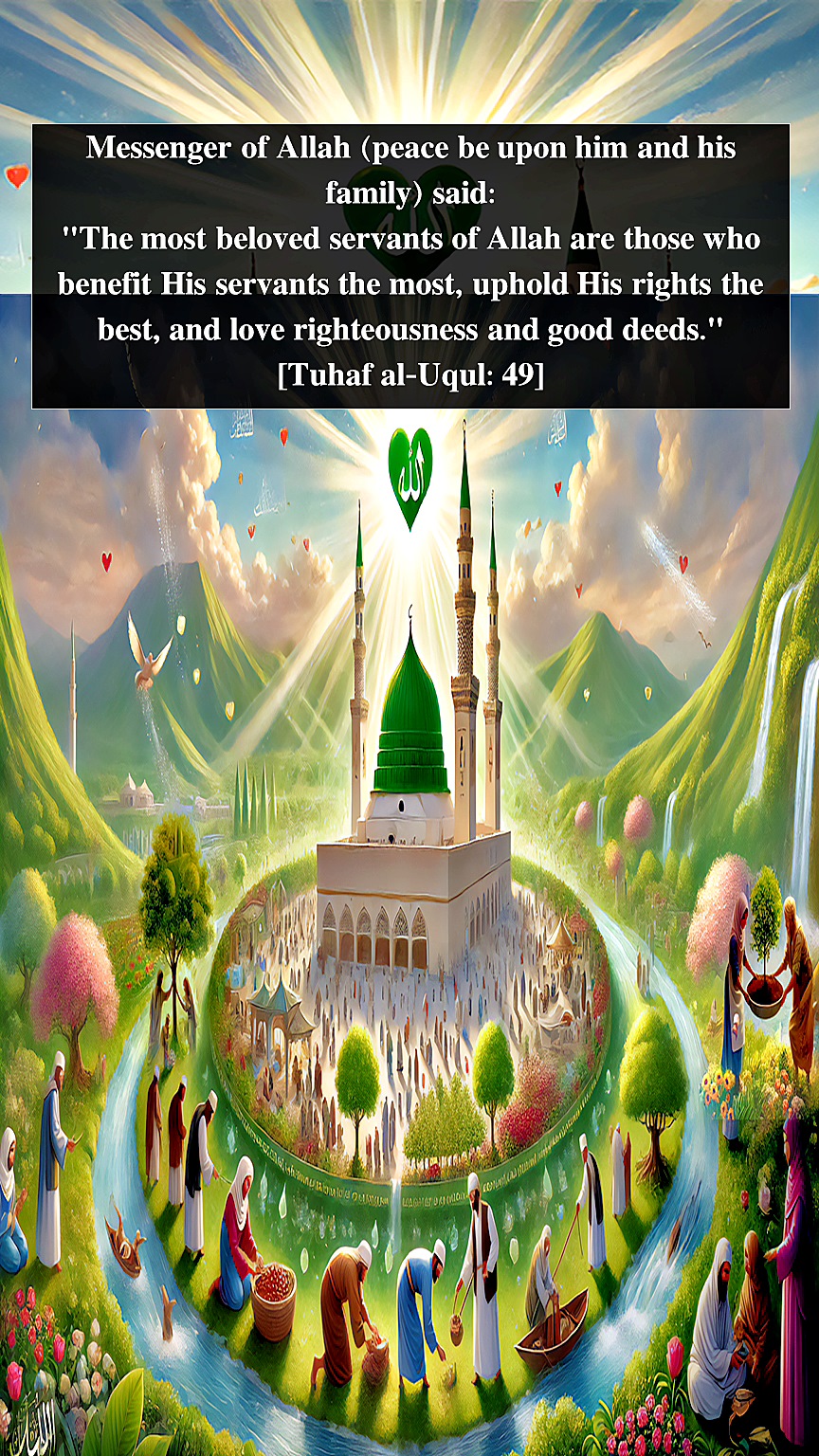
Messenger of Allah (peace be upon him and his family) declared:
"The most beloved of Allah’s servants to Him are those that are the most useful to His servants, and the most persistent of them in establishing His right, those who endear virtue and its practices." (Tuhaf al-’Uqul, no. 49)
This comprehensive prophetic saying establishes a tripartite framework for understanding what constitutes spiritual excellence and divine love. It transcends mere ritualistic devotion, presenting a holistic vision of faith that integrates social responsibility, personal piety, and an intrinsic love for virtue. This article explores these three dimensions in depth, drawing upon the rich tradition of the Ahl al-Bayt (peace be upon them) to illuminate the path toward becoming among the most beloved servants of God.
Part One: Most Beneficial to His Servants
The first and perhaps most emphasized characteristic of those beloved to Allah is their active beneficence toward others. This principle establishes that true spirituality cannot exist in isolation; it must manifest in tangible service to creation.
The Foundation: All Creation as Allah's Dependents
A profound Hadith Qudsi transmitted through Imam Ja'far al-Sadiq (peace be upon him) establishes the theological basis for this teaching:
"Allah, the Most Majestic, the Most Holy, has said, 'Creatures are My dependents. The most beloved among them to Me is the most compassionate of them toward the others and who endeavors the most to help them.'"(Al-Kafi, Volume 2, Book 1, Chapter 84, Hadith #10)
The concept of 'iyal Allah (the dependents of Allah) carries profound implications. Just as family members depend on their provider for sustenance and protection, all creatures depend entirely on Allah for their existence, well-being, and provision. This divine declaration establishes a sacred relationship: when we serve Allah's creatures, we are serving His dependents, and this service becomes a direct path to His love.
Imam Ali ibn Abi Talib (peace be upon him) elaborated on this concept in his renowned sermon:
"His creatures are His dependants, for whom He has guaranteed the means of subsistence, and apportioned provisions." (Nahj al-Balagha, Sermon 91)
The implication is clear: Allah has taken upon Himself responsibility for His creation, and He loves those who mirror this divine attribute by caring for His dependents.
Prophet Muhammad (peace be upon him and his family(ic Emphasis on Benefiting Others
The Messenger of Allah consistently emphasized that the measure of one's value lies in their benefit to others. When asked directly about the most beloved people to Allah, he responded:
"The most beneficial of people to people."(Wasail al-Shia Vol. 16, Section 3, Chapter 22, Hadith 21713)
This response is remarkable in its simplicity and depth. It does not specify ritual worship, theological knowledge, or ascetic practice—though these remain important—but rather identifies benefit to others as the primary criterion for divine love.
Another profound narration states:
"All creation are the dependents of Allah, and the most beloved to Allah, the Mighty and Majestic, are those who benefit His dependents most."(Wasail al-Shia Vol. 16, Section 3, Chapter 22, Hadith 21720)
Prophet Muhammad (peace be upon him and his family( further specified that this beneficence should extend to the most intimate level of human life:
"The creatures are the dependents of Allah. The most beloved creature to Allah is the one who is most beneficial to Allah's dependents (like family members) and who provides the utmost happiness to a family." (Al-Kafi, Volume 2, Book 1, Chapter 70, Hadith #6)
This teaching emphasizes that while our service should extend to all creation, it begins at home—with our families and those immediately dependent upon us.
The Believers as Servants to One Another
Imam Ja'far al-Sadiq (peace be upon him) further illuminated the nature of mutual responsibility among believers:
"The believers are like servants for each other."
When asked, "How can they be each other's servants?" the Imam replied:
"They benefit each other."(Al-Kafi, Volume 2, Book 1, Chapter 72, Hadith #9)
This teaching transforms the concept of brotherhood from a passive relationship to an active commitment to mutual service. A believer is not merely expected to avoid harming others but is called to actively serve, support, and benefit fellow believers.
The relationship among believers is further described as that of a single body:
It has been reported that Imam Ja'far al-Sadiq (peace be upon him) said:
" The believers in their reverence, affection and compassion for each other are like one body; when it falls ill, it affects all over with restlessness and fever." (Kitab al-Mu?min by ?usayn b. Sa?id al-Ahwazi, Book 1, Chapter 3, Hadith #9)
This organic unity demands that believers share one another's burdens and actively seek to alleviate their suffering.
Comprehensive Aid and Support
Islamic teachings, particularly as transmitted through the Imams of the Ahl al-Bayt, provide extensive guidance on what it means to benefit others. Imam Ja'far al-Sadiq (peace be upon him) outlined seven obligatory rights that believers owe to one another:
- Empathy and Reciprocity: To love for one's brother what one loves for oneself, and to dislike for him what one dislikes for oneself—the "simplest right" that serves as the foundation for all others.
- Comprehensive Assistance: To help with one's self, wealth, tongue, hands, and feet. This includes not only material aid but also emotional support, guidance, and practical assistance.
- Mutual Pleasure: To pursue what pleases one's brother and avoid what displeases him (within the bounds of obedience to Allah).
- Sincere Counsel: To be his eyes, his guide, and his mirror—providing honest feedback and guidance.
- Sharing Resources: Not to eat to satiety while he is hungry, not to drink to quenching while he is thirsty, and not to clothe oneself while he remains without clothing.
- Practical Sharing: If one has a servant and the other does not, to send one's servant to wash his clothes, prepare his food, and make ready his bedding.
- Visitation and Support: To visit him when ill, attend his funeral, and hasten to fulfill his needs before he must ask.
The Immense Rewards for Helping Believers
The tradition records extraordinary rewards for those who actively benefit their fellow believers. Imam Ja'far al-Sadiq (peace be upon him) stated:
" Whoever fulfills a need for his believing brother, Allah will fulfill one hundred thousand needs for him on the Day of Resurrection, the first of which is Paradise, and among them is that He will admit his relatives, acquaintances, and brothers to Paradise provided they are not Nisaba (enemies of Ahlul Bayt)." (Wasail al-Shia Vol. 16, Section 3, Chapter 25, Hadith 21753)
Prophet Muhammad (peace be upon him and his family( (peace be upon him and his family) further emphasized:
" Whoever fulfills a need for a believer, Allah will fulfill many needs for him, the least of them being Paradise." (Bihar al-Anwaar by Allamah Majlisi, Volume 71, Page 285)
These narrations establish that service to fellow believers is not merely a commendable act but an investment in one's own salvation. The "least" reward for fulfilling a single need of a believer is Paradise itself.
Even the effort to help, regardless of outcome, carries immense reward:
On the authority of Ishaq ibn Ammar, on the authority of Abu Basir, on the authority of Abu Abdullah (peace be upon him), who said: Whoever strives to fulfill the need of his Muslim brother and exerts himself in it, and Allah enables him to fulfill it, Allah, the Exalted and Glorified, will record for him a Hajj and an Umrah, and a two-month retreat in the Sacred Mosque, and fasting during those two months.(Wasail al-Shia Vol. 10, Section 9, Chapter 12, Hadith 14104
|
|
)
The comparison is striking: striving to help a fellow believer surpasses the reward of an entire month of spiritual retreat in the holiest mosque.
The Consequences of Neglecting Aid
Conversely, the tradition warns severely against neglecting the duty to help fellow believers when capable. Imam Ja'far al-Sadiq (peace be upon him) warned:
" Whenever a believer comes to his brother with a need, it is a mercy from Allah that He has driven and directed to him. If he fulfills the need, he has accepted the mercy by accepting it. If he turns him away from his need while being able to fulfill it, he has only turned away from himself a mercy that Allah the Mighty and Majestic had driven and directed to him. Allah the Mighty and Majestic will store that mercy until the Day of Resurrection, until the one who was turned away from his need becomes the one who decides about it - if he wishes he can direct it to himself, and if he wishes he can direct it to someone else. Then he said: Be certain that he will not turn it away from himself. O Ismail, whoever's brother comes to him with a need that he can fulfill but does not fulfill it, Allah will set upon him a snake that will bite his thumb in his grave until the Day of Resurrection, whether he is forgiven or punished." (Wasail al-Shia Vol. 16, Section 3, Chapter 25, Hadith 21757)
Imam al-Sadiq (peace be upon him) said: "There is no believer who abandons his brother while he is able to support him except that God abandons him in this world and the hereafter . (Bihar al-Anwar - Volume: 75, Page: 17)
A particularly striking narration describes the punishment for neglecting this duty:
It has been reported that Imam al-Sadiq (peace be upon him) said: " If any believer asks his fellow brother to help him and he refuses while he is able to do, Allah will impose on him a serpent in his grave to bite his fingers." (Kitab al-Mu?min by ?usayn b. Sa?id al-Ahwazi, Book 1, Chapter 5, Hadith #13)
These severe warnings underscore the gravity of failing to serve one's fellow believers when one has the capacity to do so.
Beyond Fellow Believers: Universal Compassion
While the teachings emphasize service to fellow believers, the principle extends to all of Allah's creation. Messenger of Allah (peace be upon him and his family) said:
" All creation are the dependents of Allah, and the most beloved to Allah, the Mighty and Majestic, are those who benefit His dependents most." (Wasail al-Shia Vol. 16, Section 3, Chapter 22, Hadith 21720)
Another narration, transmitted by Abu Abdillah (peace be upon him) as a Hadith Qudsi, states:
"Allah, the Most Majestic, the Most Holy, has said, 'Creatures are My dependents. The most beloved among them to Me is the most compassionate of them toward the others and who endeavors the most to help them." (Al-Kafi, Volume 2, Book 1, Chapter 84, Hadith #10)
Prophet Mohammad (peace be upon him and his family) said:
" All people are (members of) God’s household, but the dearest to Him are the most beneficial for their own family " (Nahj al Fasahah; Tradition No. 1543; Volume 1, Page 477)
This compassion extends to all creatures, as Prophet Muhammad (peace be upon him and his family( (peace be upon him and his family) demonstrated through his treatment of animals and his admonition to show mercy to all of God's creation. Prophet Mohammad (peace be upon him and his family) said;
" Show mercy to those on the earth, and the One (Allah (swt)) in the heavens will show mercy to you."
(Man La Yahduruh al-Faqih (Vol. 4) by Shaykh Muhammad b. Ali al-Saduq, Book 1, Chapter 175, Hadith #5806)
The Virtues of Benefiting Others: A Summary
The tradition enumerates numerous spiritual and practical virtues associated with being beneficial to others:
Divine Love and Protection: Those who benefit others are beloved to Allah and under
His special protection. Imam Musa al-Kadhim (peace be upon him) stated:
" The generous person of good character is under Allah's protection - Allah does not abandon him until He enters him into Paradise. Allah has not sent any prophet or successor except that he was generous, nor was any of the righteous except that he was generous. My father continued to counsel me about generosity until he passed away. And he said: Whoever gives out the complete zakat from his wealth and places it in its proper place will not be asked from where he acquired his wealth." (Wasail al-Shia Vol. 21, Section 7, Chapter 22, Hadith 27820)
Paradise as the Ultimate Reward: Multiple narrations emphasize that Paradise is the residence of the generous and those who benefit others. Prophet Muhammad (peace be upon him and his family( (peace be upon him and his family) declared:
" The generous person is close to Allah, close to people and close to Paradise." (Bihar al-Anwar, v. 73, p. 308, no. 37)
Removal of Calamities: Charity and beneficence protect from calamities and even lengthen life. Prophet Mohammad (peace be upon him and his family) taught: "Give charity, and cure your sick ones through the giving of charity, for verily charity repels accidents and illnesses, and is a source of increase in your life spans and your good deeds." (Kanz al-’Ummal, 16113)
Prophet Mohammad (peace be upon him and his family) said: "A Muslim's charity prolongs his life, prevents him from bad deaths, and causes the Exalted God to save him from overweening and vanity" (Nahj al Fasahah; Tradition No. 113; Page No. 24)
Effective cure: Imam Ali (peace be upon him) said, "Charity is an effective cure." (Nahjul Balaghah, Saying 7)
Imam Muhammad Baqir (peace be upon him) said: "Goodness and charity eliminate poverty, increase lifespan, and protect their giver from seventy types of ill-fated deaths." (Man La Yahduruh al-Faqih (Vol. 2) by Shaykh Muhammad b. Al? al-Saduq, Book 1, Chapter 20, Hadith #2)
Part Two: Most Upright in Fulfilling His Rights
The second characteristic of those beloved to Allah is their steadfastness in fulfilling Allah's rights. This encompasses a comprehensive devotion to divine commandments and a deep sense of accountability.
The Meaning of "Allah's Rights"
The concept of haqq Allah (the right of Allah) refers to the obligations that the Creator has established for His creatures. These include the fundamental duties of worship, obedience, and ethical conduct.
Imam Ali (peace be upon him) says: "Allah, glory be to Him, has made the rights of the people the prelude to His rights; therefore, he who fulfils the rights of Allah’s servants ends up fulfilling Allah’s rights." (Ghurar al-Hikam, no. 4780)
Imam Zayn al-'Abidin said: "The greatest right of God against you is that you worship Him without associating anything with Him. When you do that with sincerity (ikhlas), He has made it binding upon Himself to give you sufficiency in the affair of this world and the next." (Risalat al-Huquq by Imam Zayn al-'Abidin (a.s), Book 1, Chapter 2, Hadith #1)
The Ahl al-Bayt (peace be upon them) are described as the Proofs of Allah and those who stand for the Commandments of Allah. Their lives serve as the perfect exemplification of upholding Allah's rights.
|
|
The Centrality of Obedience and Piety
The tradition emphasizes that the most beloved servants are the most pious and obedient. Prophet Muhammad (peace be upon him and his family( (peace be upon him and his family) taught: " The most beloved of Allah’s servants to Him are those that are the most useful to His servants, and the most persistent of them in establishing His right, those who endear virtue and its practices." (Tuhaf al-Uqul, no. 49)
Prophet (peace be upon him and his family) said: "Three qualities which, when present in a person, enable him to savour the taste of faith: that nothing is more beloved to him than Allah and His Messenger, that to be burned in the Fire is more beloved to him than to denounce his religion, and that he loves for the sake of Allah and hates for the sake of Allah." (Kanz al-’Ummal, no. 72)
The key to attaining nearness to Allah is obedience. From Abu Basir who said: I asked Abu Abdullah (Imam Jafar al-Sadiq) (peace be upon him) about the saying of Allah Mighty and Majestic: "Fear Allah as He should be feared" [Quran 3:102]. He said: "He is obeyed and not disobeyed, He is remembered and not forgotten, He is thanked and not denied." (Wasail al-Shia Vol. 15, Section 2, Chapter 18, Hadith 20366)
The Path of Piety and Righteousness
Imam Zayn al-'Abidin (peace be upon him) taught about the person most beloved to Allah: "Verily the one whom Allah is most pleased with from among you is the one who is the most generous towards his dependents." (Bihar al-Anwar, v. 78, p. 136, no. 13)
Imam Muhammad al-Baqir (peace be upon him) elaborated on the qualities of beloved servants:
"The most beloved servant of Allah in His sight is a servant to whom providing Benevolent Assistance is most beloved and who loves to perform such act." (Al-Kafi, Volume 4, Book 1, Chapter 20, Hadith #3)
The Most Beloved Actions
The tradition identifies specific actions that are particularly beloved to Allah, demonstrating how one can uphold His rights:
- Performing Obligatory Acts: The most beloved thing to Allah is performing what He has made obligatory. Imam Jafar al-Sadq (peace be upon him) said the following:
“Allah, the Most Blessed, the Most High, has said, ‘The most beloved matter to Me through which My servant seeks to be loved is to fulfill what I have made obligatory upon him.” (Al-Kafi (Vol. 2) by Shaykh Muhammad b. Ya?qub al-Kulayni, Book 1, Chapter 40, Hadith #5)
- Prayer (Salat): Prophet Muhammad (peace be upon him and his family( (peace be upon him and his family) described prayer as the most beloved action to Allah.
From Ibn Masud who said: I asked the Messenger of Allah (peace be upon him): Which deeds are most beloved to Allah? He said: Prayer at its proper time. I said: Then what? He said: Being good to parents. I said: Then what? He said: Striving (jihad) in the path of Allah. (Wasail al-Shia Vol. 4, Section 2, Chapter 1, Hadith 4651)
- Fulfilling Rights of Others: Among the most beloved actions is fulfilling the rights of believers. Imam al-Sadiq (peace be upon him) stated:
"Allah has never been worshipped with anything better than fulfilling the right of a believer." (Kitab Al-Mumin-Al Husayn Ibn Said Al-Kufi-Al-Ahwazi)
- Consistency in Good Deeds: Even small deeds, when performed consistently, are beloved.
Imam Mohamad Baqir (peace be upon him) said: "The most beloved deeds to Allah, the Mighty and Majestic, are those that the servant maintains consistently even if they are small." (Wasail al-Shia Vol. 1, Section 2, Chapter 21, Hadith 224)
Imam Muhammad Baqir (peace be upon him) said: "The most beloved deeds to Allah, the Mighty and Majestic, are those that the servant maintains consistently even if they are small." (Wasail al-Shia Vol. 1, Section 2, Chapter 21, Hadith 224)
Characteristics of the Upright Servant
The tradition describes the most beloved servants as possessing specific characteristics:
|
|
Truthfulness and Trustworthiness: Prophet Muhammad (peace be upon him and his family( (peace be upon him and his family) taught:
“The nearest of you to me on the Day of Resurrection and the worthiest of my intercession will be the one who is the most truthful amongst you, the most reliable amongst you in regard to his trusts, the most genial of you in disposition, and the closest amongst you to the common people.”
(Forty Hadith Exposition-Sayyid Ruhullah Musawi Khomeini)
Humility and Simplicity: The beloved servant lives simply, finds peace in prayer, and worships God in solitude. As the tradition describes:
Imam Jafar al Sadiq (peace be upon him) said, “A believer’s characteristics include strength of religiousness; limited gentleness; certitudein belief; eagerness in understanding the religion; liveliness in guidance; constant in kindness; being shut-eyed at lustfulness; knowledgeableness accompanied with patience; gentleness in gratitude; proper generosity; frugality at times of being wealthy; patience at times of poverty; forgiveness at times of being in power; obedience to his leader; eagerness to piety; wanting to attend holy war; praying even though he is busy; patience at times of difficulty; strength at times of calamities; patience with disagreeable things; thankfulness when receiving blessings; not backbiting; not being haughty; not oppressive; patience when oppressed; not cutting off ties of kinship; not lazy; not bad-tempered; not hard-hearted; his eyes are not after lust; doesn’t overeat; will not be overcome by lust; doesn’t get jealous of the people; is neither too stingy, nor a spendthrift - rather he is frugal; assists the oppressed; has mercy with the indigent; exerts himself for the sake of others, while others are in comfort due to him; is not attached to this world; doesn’t complain to the people about the hardships of this world; others are after their own business, but he doesn’t get too involved with his business; doesn’t get weary of being patient; doesn’t get feeble in his opinion; would never spoil his religion; would guide whoever consults with him; would assist whoever assists him; abstains from what is vain, insulting and out of ignorance. These are a believer’s characteristics.” (Al-Khisal by Shaykh Muhammad b. Ali al-Saduq, Book 24, Chapter 2, Hadith #23)
Inner Self-Reformation: Imam Jafar al Sadq (peace be upon him) said: "The Messenger of Allah (peace be upon him and his family) said: Four traits, whoever has them, even if he had sins from his head to his feet, Allah would replace them with good deeds: truthfulness, modesty, good character, and gratitude."(Wasail al-Shia Vol. 12, Section 1, Chapter 110, Hadith 15973)
Patience and Contentment: The beloved servant is patient in hardship and content with Allah's decree. Amir al-Muminin Imam Ali (peace be upon him) used to say: "O son of Adam, if you want from this world what suffices you, then the least of what is in it will suffice you. But if you want what does not suffice you, then all that is in it will not suffice you." (Wasail al-Shia Vol. 21, Section 7, Chapter 15, Hadith 27775)
The Comprehensive Nature of Righteousness
Imam al-Sadiq (peace be upon him) said: "Indeed, Allah, Blessed and Exalted is He, specified the Messenger of Allah (peace be upon him and his family) with the noblest of moral traits. Hence, test yourselves; if they are in you, then praise Allah, Exalted and Glorious is He, and desire towards Him for more of them. Then he mentioned them, the ten: certainty, contentment, patience, thankfulness, satisfaction, good mannerisms, openhandedness, sense of honor, courage and manliness." (Ma?ani al-?Akhbar by Shaykh Muhammad b. Ali al-Saduq, Book 1, Chapter 182, Hadith #3)
Imam Zayn al-'Abidin (peace be upon him) identified two drops particularly beloved to Allah:
"There is no drop which is dearer to Allah more than two drops: The drop of blood (which drips out) on the course of Allah (Jihad) & the drop of tear in the darkness of night by which a servant does not want anything except (pleasing & loving) Allah" (Bihar ul-Anwar Vol. 100, P 10)
This teaching illustrates that both physical sacrifice for the faith and sincere spiritual devotion in solitude are deeply cherished.
The tradition also warns against the greatest threat to upholding Allah's rights: insincerity and hypocrisy. Imam Zain-ul-Abideen (peace be upon him) said: "The most hated people before God are those who have accepted leadership of an Imam but do not follow his actions." (Tuhaful Uqul, page 202)
This highlights that true devotion requires not just intellectual acceptance but practical implementation of divine guidance.
Part Three: To Whom Good is Made Beloved
The third characteristic of those beloved to Allah is an intrinsic, heartfelt love for goodness (al-ma'ruf) and its practice. This dimension goes beyond merely performing good deeds; it encompasses a transformed inner disposition.
Al-Ma'ruf (literally "that which is known") refers to all that is recognized as good, virtuous, and righteous in Islamic tradition. It encompasses the full spectrum of goodness—from the obligatory to the recommended, from external actions to internal states.
Those who are beloved to Allah are described as those to whom goodness and its practice have been made beloved by Allah Himself. This is a divine gift—a transformation of the heart that makes virtue not merely an obligation but a passion.
This tradition emphasizes that the beloved servants are not merely compliant with divine commands but are internally inclined toward virtue. As Imam Mohammad Baqir (peace be upon him) stated:
"Indeed among the most beloved servants of Allah to Allah are those whom He has made to love good deeds and made them love doing them." (Wasail al-Shia Vol. 16, Section 3, Chapter 1, Hadith 21560)
Imam Mohammad Baqir (peace be upon him) described this inner transformation: "If you want to know if there is good in you, then look at your heart. If it loves the people who obey Allah and hates those who disobey Him, then there is good in you and Allah loves you. And if it hates the people who obey Allah and loves those who disobey Him, then there is no good in you and Allah hates you. And a person is with whom he loves." (Wasail al-Shia Vol. 16, Section 2, Chapter 18, Hadith 21300)
The Comprehensive Virtues of Beloved Servants
From Imam Mohammad Baqir (peace be upon him) who said: "Prophet Muhammad (peace be upon him and his family( (peace be upon him and his family) was asked about the best of servants? He said: Those who when they do good they feel glad, and when they do wrong they seek forgiveness, and when they are given they show gratitude, and when they are tested they show patience, and when they become angry they forgive." (Wasail al-Shia Vol. 1, Section 2, Chapter 24, Hadith 260)
Another narration describes the beloved servants as those who:
From Ali ibn Uthman ibn Razin, from who narrated it, from the Commander of the Faithful (peace be upon him) who said: "Six qualities, whoever has them will be before Allah and on His right: Indeed Allah loves the Muslim person who loves for his brother what he loves for himself, dislikes for him what he dislikes for himself, is sincere in friendship, recognizes my virtue, follows in my footsteps, and considers my end." (Wasail al-Shia Vol. 12, Section 1, Chapter 122, Hadith 16113)
The Place of Generosity and Good Character
Goodness encompasses both generosity and good character. Prophet Muhammad (peace be upon him and his family( (peace be upon him and his family) taught: "Good nature is half of religion." (al-Khisal, p. 30, no. 106)
Prophet Mohammad (peace be upon him and his family) said: "Be good- tempered, for the most good- tempered are the best in religion" (Nahj al Fasahah; Tradition No. 1966; Volume 1, Page 570)
Prophet Mohammad (peace be upon him and his family) said: "Islam is to be good-natured ." (Kanz al-’Ummal, no. 5225)
The Virtues of Gentleness, Clemency and Leniancy
Gentleness is among the most beloved qualities. Imam Mohammad Baqir (peace be upon him) said:
"Indeed Allah is gentle and loves gentleness, and He gives for gentleness what He does not give for harshness." (Wasail al-Shia Vol. 15, Section 2, Chapter 27, Hadith 20478)
Prophet Mohammad (peace be upon him and his family) said: "When Allah wishes to bestow good on a household, he introduces leniency into it." (Sharh Nahjul Balaghah li Ibn Abi al-Hadid, v. 6, p. 339)
Prophet Mohammad (peace be upon him and his family) said: "Verily Allah, Mighty and Exalted, is lenient and loves leniency in all matters." (Kanz al-’Ummal, no. 537)
Clemency and forbearance are also beloved. Imam Ali Zayn al-'Abidin (peace be upon him) taught that among the most lovable ways to Allah are:"The Messenger of Allah (peace be upon him and his family) said: Among the most beloved paths to Allah, the Mighty and Majestic, are two gulps: a gulp of anger returned with forbearance, and a gulp of calamity returned with patience." (Wasail al-Shia Vol. 12, Section 1, Chapter 114, Hadith 16005)
Imam Mohammad Taqi (peace be upon him) said: There are three (acts, which make the servants reach the good pleasure & approval of Allah
1. Plentifulness of repentance.
2. Soft natured & forbearance.
3. Abundance of alms giving.
And there are three acts the doer of which does not repent.
1. Not making hurry.
2. Taking advice.
3. Trusting Allah while making decision (Ehqaq ul-Haqq, Vol. 12, P 438)
The tradition teaches that love for goodness begins with divine grace and is cultivated
through practice. Imam (peace be upon him) taught: "Give charity early in the day, for calamities do not surpass it. Whoever gives charity at the beginning of the day, Allah (swt) will protect him from the evil that descends from the sky that day. And if he gives charity at the beginning of the night, Allah (swt) will protect him from the evil that descends from the sky during that night." (Man La Yahduruh al-Faqih (Vol. 2) by Shaykh Muhammad b. Ali al-Saduq, Book 1, Chapter 20, Hadith #6)
Imam Jafar al Sadiq (peace be upon him) said:
"Whoever gives charity in the morning, Allah will protect him from the misfortune of that day."
(Wasail al-Shia Vol. 11, Section 5, Chapter 15, Hadith 15056)
The more one practices goodness, the more it becomes beloved. As Imam Ali (peace be upon him) advised: "Generosity cultivates love." (Ghurar al-Hikam, no. 357)
Part Four: The Ahl al-Bayt as the Living Embodiment
The teachings examined above find their perfect embodiment in the Ahl al-Bayt—the purified Household of Prophet Muhammad (peace be upon him and his family( (peace be upon them). The Imams (peace be upon them) exemplify the three characteristics identified in Prophet Muhammad (peace be upon him and his family(ic saying.
Most Beneficial to His Servants
The Ahl al-Bayt are described as the ultimate guides and benefactors of humanity. They are a source of spiritual guidance and wisdom
Amir al-Mu’minin Ali (a.s.) said the following. “We, the Ahl al-Bayt (family of the Holy Prophet), are the tree of Prophet Muhammad (peace be upon him and his family(-hood, the station of the Messenger-ship of (Allah), the center wherein the angels interchange, the house of blessings and the mine of knowledge.” (Al-K?fi (Vol. 1) by Shaykh Muhammad b. Ya?q?b al-Kulayn?, Book 4, Chapter 31, Hadith #2)
Imam Mohammad Baqir (a.s.) said the following about the words of Allah. “(Muhammad), you are only a Warner. For every nation there is a guide. (13:7)” The Imam (a.s.) said that at all times there is a guide from us who guides people to the teachings of the Holy Prophet (s.a.) Of the guides who possess Divine authority after the holy Prophet (s.a.) is Amir al-Mu’minin (a.s.) and his successors one after the other.” (Al-K?fi (Vol. 1) by Shaykh Muhammad b. Ya?q?b al-Kulayn?, Book 4, Chapter 10, Hadith #2)
Ibrahim ibn Harun al-Hiti said: Muhammad ibn Ahmad ibn Abu al-Thalj said: Ja`far ibn Muhammad ibn al-Husayn al-Zuhri said: Ahmad ibn Sabih said: Zarif ibn Nasib said, on the authority of `Isa ibn Rashid, That Muhammad ibn `Ali ibn al-Husayn was asked to interpret the Word of the Mighty and High: As a niche in which is a lamp.” He explained: The niche is the Light of Knowledge contained in the Chest of Prophet Muhammad (peace be upon him and his family(. The lamp is in a glass; the glass is the chest of `Ali. The knowledge of Prophet Muhammad (peace be upon him and his family( was transferred to `Ali’s Chest. The glass is as if it were a brightly shining star, lit from a blessed olive-tree. He added: Light, neither eastern nor western. He said: “Neither Jewish nor Christian.’ The oil whereof almost gives light though fire touches it not. He said: “The learned from the Progeny of Muhammad more or less give knowledge before they are even asked. Light upon light, meaning an Imam, endorsed through the light of knowledge and wisdom, one after another, from the Progeny of Muhammad, and that is from Adam to the Day of Judgement. These successors were appointed by Allah, the Mighty and High, as His Caliphs on Earth and His Proofs for His Creation. The Earth is not free at any time from at least one of them. The proof of this statement can be found in the words of Abu Talib regarding the Messenger of Allah: Muhammad! You are the Trustworthy, the Lord, and the Magnanimous Master, For the noble, the best, the generous, and the pure in lineage. You are the Most Auspicious of the fortunate surrounded by the luckiest. Since the time of Adam there has always been amongst us a divinely-guided successor. I have recognized you as the truthful in words that is not refuted. You spoke the truth when you were but a beardless child. He (Abu Talib) says: “You spoke with knowledge as a child, even before anything was revealed to you. You were like Abraham who told his people as a youth: Surely I am clear of what you set up (with Allah); and like Jesus when he spoke from his cradle that Surely I am a servant of Allah; He has given me the Book and made me a prophet; and He has made me blessed wherever I may be. In a similar poem, Abu Talib said the following regarding the Messenger of Allah: There is no one like him among men, master of kinsfolk. If they compare him at the time when he becomes manifested, Then the Lord of the servants endorsed him by His Light, And made apparent the righteousness of the religion which will not be short-lived. He says in it: The fair faced one for the sake of whom one prays for rain. He is a spring for the orphans, and a safeguard for the helpless. The perishing children of Hashim circumambulate around him (to be his ransom), Hence, they are in ease, and excess with him. He is the Balance of Truth which does not break a promise, even for a grain of barley. And he is a Balance of Justice whose measurement does not go astray. (Al-Tawhid by Shaykh Muhammad b. Ali al-Saduq, Book 2, Chapter 15, Hadith #4)
Muhammad ibn Ibrahim ibn Ishaq al-Taleqani - may God be pleased with him - narrated that Abu Sa’id al-Hassan ibn Ali al-Ado’we quoted Umar ibn al-Mukhtar, on the authority of Yahya al-Himani, on the authority of Qays ibn al-Rabi’a, on the authority of Al-A’amash, on the authority of Ababiat ibn Rub’ee Al-Asady, on the authority of Ayoob al-Ansari, “Fatimah (MGB) visited Prophet Muhammad (peace be upon him and his family( (MGB) when he (MGB) became so ill that he was about to die. When she saw that he (MGB) was so ill, tears poured down her cheeks from her eyes. Prophet Muhammad (peace be upon him and his family( (MGB) told her (MGB), ‘O Fatimah! God - Exalted is His Remembrance - took a close look at the Earth and chose your father (MGB) from amongst all of the people on it. Then He took another close look at the Earth and chose your husband Ali (MGB) and inspired me to marry you off to him (MGB). O Fatimah! You should know that out of God’s generosity He joined you in marriage to the one whose belief is the greatest of all people; who is the most patient of all; and whose knowledge is the most of all.’ Fatimah (MGB) became happy after hearing this. Then Prophet Muhammad (peace be upon him and his family( (MGB) decided to tell her about the best thing which God had granted Muhammad (MGB) and his Holy Household. Thus, he (MGB) added, ‘O Fatimah! Ali (MGB) has eight characteristics as follows: his belief in God and His Prophet (MGB); his knowledge; his wisdom; his wife (MGB); his two sons who are Al-Hassan (MGB) and Al-Hussein (MGB); his (MGB) enjoining other people to do good deeds; his (MGB) admonishing other people against evil; and his (MGB) judgement which is based upon God’s Book. O Fatimah! We are the Members of a Holy Household and have been given seven characteristics as follows which has never been granted to anyone in the past and will not be given to anyone in the future. Our Prophet (MGB) who is your father is the best of all Prophet Muhammad (peace be upon him and his family(s (MGB); his Trustee who is also your husband is the best of all the Trustees; our martyrs are the Master of the Martyrs (MGB) who are your father’s uncle Hamzih, and Ja’far who will have two wings with which to fly in Paradise; the sons of this nation who are your two sons are from us.’” (Al-Khisal by Shaykh Muhammad b. Ali al-Saduq, Book 9, Chapter 13, Hadith #8)
Their entire mission was dedicated to serving Allah's creation by leading them to truth and salvation. The verse:
"You are the best nation that has been raised up for the (benefit of) people" (Qur'an 3:110)
Most Upright in Fulfilling His Rights
The Ahl al-Bayt are the epitome of devotion to Allah's rights. Imam Ali (peace be upon him) declared:
"The Imam needs a wise heart, an expressive tongue and a staunch soul [i.e. authority] in establishing the truth." (Ghurar al-Hikam, no. 11010)
Imam Ali (a.s.) said, "It is the duty of an Imam to rule in accordance with what Allah has revealed, and that he delivers what he has been entrusted with. If he does that, then it is the duty of the people to listen to him and to obey him and to hearken [to his call] when they are called." (Kanz al-’Ummal, no. 14313)
Al-Husayn ibn Muhammad has narrated from from Mu‘alla ibn Muhammad from al-Washsha’ from ‘Abdallah ibn Sinan who has said the following. “I asked abu ‘Abdallah (a.s.) about the words of Allah, the Most Majestic, the Most gracious. “Among Our creatures are a group who guide and judge with the Truth.” (7:181). The Imam (a.s.) said, “Such people are the Imams (a.s.).” (Al-K?fi (Vol. 1) by Shaykh Muhammad b. Ya?q?b al-Kulayn?, Book 4, Chapter 108, Hadith #13)
The Ahl al-Bayt not only performed good deeds but were inherently drawn to all forms of goodness. Their love and devotion to Allah and His commands were unparalleled. Prophet Muhammad (saww) said: "Abide to the cordiality of us, Ahl al-Bayt, for he who meets Allah with love for us will enter Paradise with our intercession. By Him Who holds my spirit, no servant benefits from his work except by the cognition of us." (Amali al-Mufid by Shaykh al-Mufid, Volume 0, Page 13)
Prophet, peace be upon him and his progeny, said: "Adhere yourselves to our love, the Ahlul Bayt, for surely, whoever meets Allah, having love for us (in his heart) he shall enter Paradise with our intercession. And By Him Who controls my spirit, a servant (of Allah) benefits nothing from his (good) deeds, unless he has recognized our Truth." (Al-Am?l? by Shaykh Muhammad b. Muhammad al-Muf?d, Book 6, Chapter 2, Hadith #2)
Imam al Sadiq (peace be upon him) was asked about the meaning of `hasten to the best of deeds;’ Hence he replied: “The best of the deeds is the Guardianship [al-wilayah].” In another tradition the best of deeds is said to be kindness towards Fatimah and her children (peace be upon him)." (Al-Tawhid by Shaykh Muhammad b. Ali al-Saduq, Book 2, Chapter 34, Hadith #2)
Imam Jafar al Sadiq (peace be upon him) said: "There is no good in this world except for two types of men: a man who increases in good deeds every day, and a man who remedies his sins with repentance. But how can he achieve repentance? By Allah, even if he prostrates until his neck breaks, Allah will not accept from him except through our Wilayah (allegiance, guardianship) - the Ahl al-Bayt." (Wasail al-Shia Vol. 16, Section 1, Chapter 86, Hadith 21023)
The teachings of the Ahl al-Bayt serve as the practical path for believers to cultivate these qualities:
|
|
- Through Beneficence: Following their example of generosity and service
- Through Piety: Emulating their devotion and adherence to divine commands
- Through Love: Developing the same love for goodness and virtue
Part Five: Practical Applications
Cultivating Beneficence
Begin with Family: Start by serving those closest to you. The tradition emphasizes that "the most beloved creature to Allah is the one who is most beneficial to Allah's dependents (like family members) and who provides the utmost happiness to a family."
Extend to Community: Gradually extend service to neighbors, fellow believers, and then all of humanity. Prophet Muhammad (peace be upon him and his family( (peace be upon him and his family) taught:
"The best of people is one whom people benefit from." (Amali al-Saduq by Shaykh al-Saduq, Volume 0, Page 73)
Serve All of Creation: Recognize that all creatures are Allah's dependents and deserve compassion. Prophet Mohammad (peace be upon him and his family) said: "The All-Merciful, Blessed and most High, has mercy on those who are merciful (towards others). Have mercy on the dwellers of the earth and the [Lord of the] Heavens will have mercy on you."(Kanz al-’Ummal, no. 5969)
Fulfill Obligations: Begin with what is obligatory—prayer, fasting, zakat, and other divine commands. The most beloved thing to Allah is performing what He has made obligatory.
Develop Consistency: Even small deeds, when performed consistently, become beloved. The most beloved of deeds to Allah are those that are most regular, even if they are few.
|
|
Seek Divine Grace: Remember that love for goodness is ultimately a divine gift. Pray to Allah to make goodness beloved to you.
Practice Virtue: Actively engage in good deeds even when difficult. The more one practices goodness, the more it becomes beloved.
Reflect on the Beauty of Goodness: Contemplate the inner beauty of virtue—its harmony with our nature, its benefits for society, and its rewards in the Hereafter.
Surround Yourself with Righteous People: Keep company with those who love goodness.
Imam Zayn al-Abidin (a.s.) said, "Sitting with the righteous brings about righteousness." (Bihar al-Anwar, v. 78, p. 141, no. 35)
Prophet Muhammad (peace be upon him and his family(ic saying under examination presents a comprehensive vision of spiritual excellence that integrates three essential dimensions:
- Active Beneficence: The most beloved servants actively serve and benefit others, recognizing all creation as Allah's dependents.
- Upright Devotion: They steadfastly fulfill Allah's rights through obedience, piety, and comprehensive devotion.
- Intrinsic Love for Goodness: They have been transformed so that goodness and its practice are beloved to them.
These three characteristics are not separate but mutually reinforcing. True beneficence flows from devotion to Allah. True devotion manifests in service to creation. Love for
|
|
goodness encompasses both.
The Ahl al-Bayt (peace be upon them) embody this perfect synthesis, serving as both guides and exemplars. Following their path is the means by which believers can cultivate these qualities and attain nearness to Allah.
The tradition offers immense hope: the path to becoming among the most beloved servants is open to all who sincerely strive. The rewards—divine love, protection, and ultimately Paradise—are beyond measure. Prophet Mohammad (peace be upon him and his family) said:
"Allah has promised those who have believed among you and done righteous deeds that He will surely grant them succession [to authority] upon the earth just as He granted it to those before them and that He will surely establish for them [therein] their religion which He has preferred for them and that He will surely substitute for them, after their fear, security, [for] they worship Me, not associating anything with Me. But whoever disbelieves after that - then those are the defiantly disobedient." (Qur'an 24:55)
And among the signs of Allah's love for His servants is that
"At this time God, the Exalted, becomes his hearing and sight, power, knowledge and existence. Thereupon the character of the gnostic becomes divine."
(Forty Hadith Exposition-Sayyid Ruhullah Musawi Khomeini)
May Allah make us among those who are most beneficial to His servants, most upright in fulfilling His rights, and to whom goodness and its actions are made beloved.
In the name of Allah, the Most Beneficent, the Most Merciful. All praise is due to Allah, Lord of the worlds. And may the blessings of Allah be upon Muhammad and his pure family.
Quranic References
1. Qur'an 3:102
2. Qur'an 3:110
3. Qur'an 7:181
4. Qur'an 13:7
5. Qur'an 24:55
Primary Sources
1. Tuhaf al-'Uqul - Tradition no. 49
2. Al-Kafi - Volume 2, Book 1, Chapter 84, Hadith #10
3. Al-Kafi - Volume 2, Book 1, Chapter 70, Hadith #6
4. Al-Kafi - Volume 2, Book 1, Chapter 72, Hadith #9
5. Al-Kafi - Volume 4, Book 1, Chapter 20, Hadith #3
6. Wasail al-Shia - Vol. 16, Section 3, Chapter 22, Hadith 21713
7. Wasail al-Shia - Vol. 16, Section 3, Chapter 22, Hadith 21720
8. Wasail al-Shia - Vol. 16, Section 3, Chapter 25, Hadith 21753
9. Wasail al-Shia - Vol. 10, Section 9, Chapter 12, Hadith 14104
10. Wasail al-Shia - Vol. 16, Section 3, Chapter 25, Hadith 21757
11. Wasail al-Shia - Vol. 21, Section 7, Chapter 22, Hadith 27820
12. Wasail al-Shia - Vol. 15, Section 2, Chapter 18, Hadith 20366
13. Wasail al-Shia - Vol. 4, Section 2, Chapter 1, Hadith 4651
14. Wasail al-Shia - Vol. 1, Section 2, Chapter 21, Hadith 224
15. Wasail al-Shia - Vol. 12, Section 1, Chapter 110, Hadith 15973
16. Wasail al-Shia - Vol. 21, Section 7, Chapter 15, Hadith 27775
17. Wasail al-Shia - Vol. 16, Section 3, Chapter 1, Hadith 21560
18. Wasail al-Shia - Vol. 16, Section 2, Chapter 18, Hadith 21300
19. Wasail al-Shia - Vol. 1, Section 2, Chapter 24, Hadith 260
20. Wasail al-Shia - Vol. 12, Section 1, Chapter 122, Hadith 16113
21. Wasail al-Shia - Vol. 15, Section 2, Chapter 27, Hadith 20478
22. Wasail al-Shia - Vol. 12, Section 1, Chapter 114, Hadith 16005
23. Wasail al-Shia - Vol. 11, Section 5, Chapter 15, Hadith 15056
24. Wasail al-Shia - Vol. 16, Section 1, Chapter 86, Hadith 21023
25. Kitab al-Mu'min by Husayn b. Sa'id al-Ahwazi - Book 1, Chapter 3, Hadith #9
26. Kitab al-Mu'min - Book 1, Chapter 5, Hadith #13
27. Kitab al-Mumin - Al-Husayn Ibn Said Al-Kufi-Al-Ahwazi
28. Bihar al-Anwar by Allamah Majlisi - Volume 71, Page 285
29. Bihar al-Anwar - Volume 73, p. 308, no. 37
30. Bihar al-Anwar - Volume 75, Page 17
31. Bihar al-Anwar - Volume 78, p. 136, no. 13
32. Bihar al-Anwar - Vol. 100, P 10
33. Bihar al-Anwar - v. 78, p. 141, no. 35
34. Kanz al-'Ummal - no. 16113
35. Kanz al-'Ummal - no. 72
36. Kanz al-'Ummal - no. 5225
37. Kanz al-'Ummal - no. 537
38. Kanz al-'Ummal - no. 14313
39. Kanz al-'Ummal - no. 5969
40. Nahj al-Balagha - Sermon 91
41. Nahj al-Balagha - Saying 7
42. Nahj al Fasahah - Tradition No. 1543; Volume 1, Page 477
43. Nahj al Fasahah - Tradition No. 113; Page No. 24
44. Nahj al Fasahah - Tradition No. 1966; Volume 1, Page 570
45. Man La Yahduruh al-Faqih - Vol. 4, Book 1, Chapter 175, Hadith #5806
46. Man La Yahduruh al-Faqih - Vol. 2, Book 1, Chapter 20, Hadith #2
47. Man La Yahduruh al-Faqih - Vol. 2, Book 1, Chapter 20, Hadith #6
48. Al-Khisal by Shaykh Muhammad b. 'Ali al-Saduq - Book 24, Chapter 2, Hadith #23
49. Al-Khisal - Book 9, Chapter 13, Hadith #8
50. Al-Khisal - p. 30, no. 106
51. Al-Tawhid by Shaykh Muhammad b. 'Ali al-Saduq - Book 2, Chapter 15, Hadith #4
52. Al-Tawhid - Book 2, Chapter 34, Hadith #2
53. Ma'ani al-Akhbar by Shaykh Muhammad b. Ali al-Saduq - Book 1, Chapter 182, Hadith #3
54. Al-Amali by Shaykh al-Mufid - Volume 0, Page 13
55. Amali al-Saduq by Shaykh al-Saduq - Volume 0, Page 73
56. Risalat al-Huquq by Imam Zayn al-'Abidin - Book 1, Chapter 2, Hadith #1
57. Ghurar al-Hikam - no. 4780
58. Ghurar al-Hikam - no. 357
59. Ghurar al-Hikam - no. 11010
60. Tuhaful Uqul - page 202
61. Ehqaq ul-Haqq - Vol. 12, P 438
62. Sharh Nahjul Balaghah li Ibn Abi al-Hadid - v. 6, p. 339
63. Forty Hadith Exposition - Sayyid Ruhullah Musawi Khomeini
Qur'anic verses and hadiths of Ahl al-Bayt (peace be upon them) and sayings in Arabic, Persian and English.
https://eitaa.com/noorunalanoor
https://www.youtube.com/@110Inspire
https://youtube.com/@mustafaabbas4668?si=EnSIkaIECMiOmarE
https://youtube.com/@mustafaabbas8978?si=EMJylUW9_zruJx95